On This Page
Description
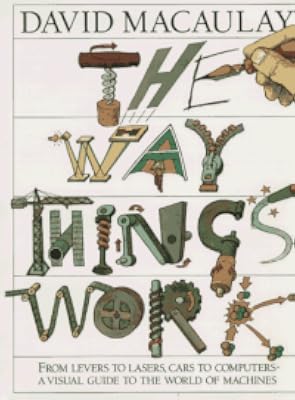
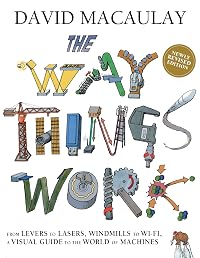
Text and numerous detailed illustrations introduce and explain the scientific principles and workings of hundreds of machines including a lawn sprinkler, pneumatic drill, electric guitar, and a smoke detector.Tags
Recommendations
























Member Reviews
This has always been, and always will be, one of my all-time favourite books. It’s definitely the children’s book I hold most dear.
I was the kind of child that takes everything apart to figure out how it works. Family mythology has it that my grandfather taught me how an internal combustion engine worked during a series of breakfasts while I was three or four, and there’s a drawing I made when I was no older than five that depicts a four-stroke internal combustion engine complete with pistons, crankshaft, valves, spark-plugs, exhaust manifold and cams.
This book’s visual style was right up my street. I remember my mother refusing to buy it for me but successively convincing my dad while on a day-trip to the London Science show more Museum. My copy still has his dedication inside the front cover and the receipt tucked in at the back.
I referred back to it authoritatively for years. Back in the days when internet access was not a given and some information was hard to come by, I actually used the illustration of a half adder to build a full binary adder out of discrete logic gates.
I cannot recommend it enough. show less
I was the kind of child that takes everything apart to figure out how it works. Family mythology has it that my grandfather taught me how an internal combustion engine worked during a series of breakfasts while I was three or four, and there’s a drawing I made when I was no older than five that depicts a four-stroke internal combustion engine complete with pistons, crankshaft, valves, spark-plugs, exhaust manifold and cams.
This book’s visual style was right up my street. I remember my mother refusing to buy it for me but successively convincing my dad while on a day-trip to the London Science show more Museum. My copy still has his dedication inside the front cover and the receipt tucked in at the back.
I referred back to it authoritatively for years. Back in the days when internet access was not a given and some information was hard to come by, I actually used the illustration of a half adder to build a full binary adder out of discrete logic gates.
I cannot recommend it enough. show less
"The Way Things Work" is an amazingly well illustrated pice of work. It is a thorough and unbashfully detailed look at modern appliances and machines. I love it because it has amazing picture that make the text seem almost unnecessary. I would love to use this book in my classroom because of how much sheer information it contains. I would say that it is appropriate for grades 4 and up.
The title says it-- this is a cool book about how things (mostly everyday items like seat belts but also more advanced things like nuclear energy) work. Macauley is an excellent illustrator and the woolly mammoth drawings are cute. I thought that some of the more difficult concepts were glossed over a little, which may be appropriate in a book aimed at kids. In general, I liked it.
Well-drawn descriptions of how the things we use without thinking are made. From elevators to nuclear fusion to thermostats to pulleys to paper making to printing to telescopes to televisions: the basics are here. An essential reference book. It's time for a sequel.
Over 380 pages of illustrator Macaulay’s superb technical drawings fill this large reference work suitable for children age eight years and upward into adulthood. The Way Things Work pairs rich fine line illustrations and a limited water colour palate of blue, grey, and brown, with sometimes complex descriptions more suitable to an older child’s reading comprehension. The Way Things Work covers topics such as pulleys, rotaries wheels, flying, floating, photography, electricity, magnetism, sensors and detectors, etc. Macaulay uses a signature illustrated character—a woolly mammoth—in each of his entries to add comic relief and a visual narrative thread through each of the entries in this massive book. Although some technologies show more covered by Macaulay have advanced since the publication of The Way Things Work (1988), Macaulay’s entries under for example the “Electricity and Automation” section of the book discuss fundamental technological principles that so far remain constant and relevant. show less
I'm keeping it on hand just in case I'm ever trapped in a post apocalyptic sci fi movie and need to reconstruct modern technology from scratch. Until then, I'll just enjoy Macaulay's ability to work his drawings of wooly mammoths into every conceivable illustration.
Fantastic diagrams and other art detailing how things work, and are put together, and explanations you didn't know you needed to know. I love learning how things work, and this book has some great insights.
Members
- Recently Added By
Lists

Favorite Childhood Books
1,646 works; 518 members

Geek Dad Read to Your Kids Additions List
66 works; 4 members

CCE 1000 Good Books List
1,033 works; 12 members

Blue Pyramid 1,276 Best Books of All Time
1,248 works; 32 members

Children's Books About Science and Math
461 works; 12 members
Favorite Picture Books
479 works; 160 members

Favorite Picture and Board Books
480 works; 1 member

Youth: Science, Miscellaneous
34 works; 1 member

Research/Inquiry - questions and wondering
43 works; 3 members
Author Information

74+ Works 30,360 Members
David Macaulay was born on December 2, 1946 in Lancashire, England, but moved to Bloomfield, New Jersey when he was 11. He received a bachelor's degree in architecture from the Rhode Island School of Design (RISD). Before becoming an author and illustrator, he worked as an interior designer, a junior high school teacher, and instructor of interior show more design at RISD from 1969 to 1973. His first book, Cathedral: The Story of Its Construction, was published in 1973. His other books include City, Castle, Pyramid, Mill, Underground, Mosque, The Way Things Work, Rome Antics, Shortcut,and How Machines Work. He has received numerous awards including a Caldecott Honor Medal in 1991 for Black and White and the Washington Children's Book Guild Award for a Body of Non-Fiction Work in 1977. He won the Royal Society young people¿s book prize for the best science books for children for his book How Machines Work. (Bowker Author Biography) show less
Awards and Honors
Awards
Distinctions
Series

Common Knowledge
- Original title
- The Way Things Work Now
- Original publication date
- 1988
- People/Characters
- The Mammoth [The Way Things Work]
- Dedication
- ...Finally, my thanks go to my wife, Ruth, who has alternately encouraged and tolerated this project and all its demands. To her, with love, this book is dedicated.
- First words
- Introduction: To any machine, work is a matter of principle, because everything a machine does is in accordance with a set of principles or scientific laws.
- Last words
- (Click to show. Warning: May contain spoilers.)These will eventually step out into the world only with major advances in computers.
- Original language
- English UK
Classifications
Statistics
- Members
- 3,271
- Popularity
- 5,215
- Reviews
- 27
- Rating
- (4.18)
- Languages
- 12 — Czech, Dutch, English, Finnish, French, German, Hungarian, Italian, Polish, Portuguese, Spanish, Swedish
- Media
- Paper
- ISBNs
- 46
- UPCs
- 4
- ASINs
- 8