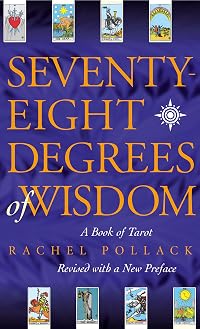
Seventy-Eight Degrees of Wisdom
by Rachel Pollack
On This Page
Description
When it was first published nearly 40-years-ago, Seventy-Eight Degrees of Wisdom was an instant classic and inspired generations of tarot students. Often referred to as the "bible of tarot books" it has now helped to launch the "tarot renaissance" we're seeing today. Drawing on mythology and esoteric traditions and delving deeply into the symbolism and ideas of each card, the book offers a modern psychological interpretation of the tarot archetypes rather than a system of esoteric symbolism. show more This book provides: - A concise history of tarot - An introduction to common tarot spreads - A clear and endlessly useful reference for both beginning and advanced tarot students. show lessTags
Recommendations





Member Reviews
Considered one of the foundational texts for the modern tarot reader, Pollack is visionary in her work and her passion for the mysterious art of Tarot and reading the cards is contagious. She has an amazing way of writing the cards to life, appreciating them for their complexity, never over-explaining and acting more as a wise and inspired tour guide than anything else.
When I first started pursuing my interest in tarot, I made sure to ask around for book recommendations. Seventy-Eight Degrees of Wisdom was probably the most often to be mentioned. Even though I almost immediately found a copy for myself, it wasn't until several years later that I finally got around to reading the book. It really is a shame that I took so long because it definitely would have been worth reading sooner; there's a reason it was so frequently recommended--it's a fantastic resource.
Seventy-Eight Degrees of Wisdom was originally published in two separate volumes. The first volume consisted of Part One (Major Arcana) while the second volume contained both Part Two and Part Three (Minor Arcana and Readings, respectively). The show more single volume edition, compiled and revised in 1997, also includes a new preface, a bibliography and an index. Pollack primarily uses the Rider-Waite deck imagery--among the most popular and prevalent in tarot decks--as the basis for the text and includes an abundance of black and white, photographic card reproductions. Unfortunately, although very useful to have, some illustrations end up strangely placed; the page layout and design sometimes leaves quite a bit to be desired. While not necessary, I would recommend having a tarot deck on hand to read along with in order to minimize page flipping and just to get a feel of working with the cards.
In Part One and Part Two, Pollack examines the symbolism and meanings behind each card. The major arcana receive the most in-depth treatment, and I found the section to be very enlightening and enjoyable to read. The minor arcana are subject to a more uneven treatment--some cards have extensive entries while others are fairly brief. Additionally, they aren't cross-referenced very well. If you want all the information about a particular card, make sure to check the entries for the others of the same value in other suits and take a glance at the index because otherwise you might miss something without even knowing it. One thing that Pollack emphasizes throughout the book is the relationships and common characteristics between the individual cards instead of simply focusing on each in a vacuum.
Pollack extensively covers three different spreads in Part Three: Readings. First is the Celtic Cross--probably one of the most commonly used and popular spreads. The second, Work Cycle, was actually created and designed by Pollack. I really liked the thoughts and explanations behind this spread and will definitely try it out at some point. Finally, Pollack presents a very complicated spread based on Kabbalah and the Tree of Life that uses the entire deck in a single reading. Detailed sample readings are provided for each of these spreads. In addition, Pollack explores the reasons, methods, and uses of tarot readings, including meditation.
It's wonderful to have both of the original volumes of Seventy-Eight Degrees of Wisdom under one cover. Unfortunately, the formatting issues and prevalent typos really detract from the package as a whole. I don't know if these problems were also found in the original publications or if they somehow snuck in during the process of compilation, but it can be rather distracting. Looking past it's presentation, the content itself is marvelous. Pollack's writing is very accessible, but what I particularly appreciate is that intuitiveness is encouraged while still providing a strong basis to start with for those of us who are sorely lacking in that particular skill area. Seventy-Eight Degrees of Wisdom definitely has earned its place as the "tarot bible" for a variety of reasons. It was one of the first books of its kind in terms of comprehensiveness and the exploration of card and deck variants. Pollack seems to have created a tarot tradition and interpretation a little different from anything that came before. While much is drawn from personal experience, established schools also had a significant influence in its creation. Pollack's tradition is one that I like--it has a sense of truth and wisdom for me--and is commonly accepted. Newcomers to tarot will find Seventy-Eight Degrees of Wisdom to be a good introduction while more experienced devotees will still find plenty to hold their interest. I know I found it to be very useful and will be keeping the book close by; I'm sure I'll be revisiting it frequently in the future.
Experiments in Reading show less
Seventy-Eight Degrees of Wisdom was originally published in two separate volumes. The first volume consisted of Part One (Major Arcana) while the second volume contained both Part Two and Part Three (Minor Arcana and Readings, respectively). The show more single volume edition, compiled and revised in 1997, also includes a new preface, a bibliography and an index. Pollack primarily uses the Rider-Waite deck imagery--among the most popular and prevalent in tarot decks--as the basis for the text and includes an abundance of black and white, photographic card reproductions. Unfortunately, although very useful to have, some illustrations end up strangely placed; the page layout and design sometimes leaves quite a bit to be desired. While not necessary, I would recommend having a tarot deck on hand to read along with in order to minimize page flipping and just to get a feel of working with the cards.
In Part One and Part Two, Pollack examines the symbolism and meanings behind each card. The major arcana receive the most in-depth treatment, and I found the section to be very enlightening and enjoyable to read. The minor arcana are subject to a more uneven treatment--some cards have extensive entries while others are fairly brief. Additionally, they aren't cross-referenced very well. If you want all the information about a particular card, make sure to check the entries for the others of the same value in other suits and take a glance at the index because otherwise you might miss something without even knowing it. One thing that Pollack emphasizes throughout the book is the relationships and common characteristics between the individual cards instead of simply focusing on each in a vacuum.
Pollack extensively covers three different spreads in Part Three: Readings. First is the Celtic Cross--probably one of the most commonly used and popular spreads. The second, Work Cycle, was actually created and designed by Pollack. I really liked the thoughts and explanations behind this spread and will definitely try it out at some point. Finally, Pollack presents a very complicated spread based on Kabbalah and the Tree of Life that uses the entire deck in a single reading. Detailed sample readings are provided for each of these spreads. In addition, Pollack explores the reasons, methods, and uses of tarot readings, including meditation.
It's wonderful to have both of the original volumes of Seventy-Eight Degrees of Wisdom under one cover. Unfortunately, the formatting issues and prevalent typos really detract from the package as a whole. I don't know if these problems were also found in the original publications or if they somehow snuck in during the process of compilation, but it can be rather distracting. Looking past it's presentation, the content itself is marvelous. Pollack's writing is very accessible, but what I particularly appreciate is that intuitiveness is encouraged while still providing a strong basis to start with for those of us who are sorely lacking in that particular skill area. Seventy-Eight Degrees of Wisdom definitely has earned its place as the "tarot bible" for a variety of reasons. It was one of the first books of its kind in terms of comprehensiveness and the exploration of card and deck variants. Pollack seems to have created a tarot tradition and interpretation a little different from anything that came before. While much is drawn from personal experience, established schools also had a significant influence in its creation. Pollack's tradition is one that I like--it has a sense of truth and wisdom for me--and is commonly accepted. Newcomers to tarot will find Seventy-Eight Degrees of Wisdom to be a good introduction while more experienced devotees will still find plenty to hold their interest. I know I found it to be very useful and will be keeping the book close by; I'm sure I'll be revisiting it frequently in the future.
Experiments in Reading show less
My tarot bible! Even after years of use, I can come back to it and discover fresh insights. Arguably Pollack's greatest gift to the tarot community (and she's bestowed many).
A really good primer on the basics of tarot and how to use/do readings. I didn't love the parts that tried to combined science with the so-called metaphysical world. That being said, if you are reading this book, you know what you are getting into.
Total newbie tarot here, but I liked how Rachel uses a real life example for her Celtic Cross reading.
I found her descriptions of each card exciting to read initially, but when it came to the Minor Arcana, the symbolism was quite lacking. Hence the 3 stars for the rating.
I found her descriptions of each card exciting to read initially, but when it came to the Minor Arcana, the symbolism was quite lacking. Hence the 3 stars for the rating.
This is one of my favorite Tarot references. Not only do you get a meaning for all the cards, but Ms. Pollack poses questions, and gives you little bits and pieces to start thinking, and create an internal discussion. If you're buying more then 1 Tarot book this must be on your list.
I cannot think of a better resource, either for beginners or those knowledegable with the vast topic of Tarot. This volume is a must have for any serious Tarot library. It is the first resource I bought on the topic and one of the keepers. It is a great work and highly recommended.
Members
- Recently Added By
Lists

Tarot Books
4 works; 1 member

el
1,139 works; 1 member
Author Information

126+ Works 4,528 Members
Rachel Pollack is considered one of the world's foremost authorities on the modern interpretation of the Tarot. She is a member of the American Tarot Association, the International Tarot Society, and the Tarot Guild of Australia and has taught at the famed Omega Institute for the past fifteen years. She is an award-winning fiction writer and has show more also written twelve books on the Tarot. She lives in New York. show less
Common Knowledge
- Canonical title
- Seventy-Eight Degrees of Wisdom
- Original publication date
- 1980
- Canonical DDC/MDS
- 133.32424
Classifications
- Genres
- Nonfiction, Religion & Spirituality, General Nonfiction
- DDC/MDS
- 133.32424 — Philosophy & psychology Parapsychology & occultism Specific topics in parapsychology and occultism Divinatory arts Fortune-telling by crystals and stones; dowsing; fortune-telling by cards, tea leaves and coffee grounds, oracles and sibyls Fortune-telling by cards, tea leaves and coffee grounds, oracles and sibyls Fortune-telling by cards (Cartomancy) Fortune-telling by tarot
- LCC
- BF1879 .T2 .P65 — Philosophy, Psychology and Religion Psychology Occult sciences Fortune-telling
- BISAC
Statistics
- Members
- 1,024
- Popularity
- 25,476
- Reviews
- 12
- Rating
- (4.30)
- Languages
- 5 — Danish, Dutch, English, German, Portuguese
- Media
- Paper, Audiobook, Ebook
- ISBNs
- 16
- ASINs
- 6