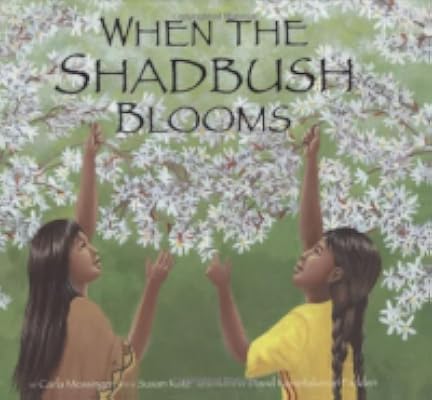
When the Shadbush Blooms
by Carla Messinger, Susan Katz
On This Page
Description
A young Lenni Lenape Indian child describes her family's life through the seasons. Includes facts about the Lenni Lenape Indians.Tags
Recommendations









Member Reviews
Two young Lenape Indian girls - one contemporary and one historical - together narrate this gentle tale of changing seasons, family activities, and the ties that bind the generations. Each month, or moon, is given its Lenape name, and the English translation, beginning and ending with Mechoammowi Gischuch, or "When the Shadfish Return Moon."
I originally discovered When the Shadbush Blooms through Debbie Reese's American Indians in Children's Literature blog, where great emphasis is always placed on the importance of teaching young readers that Native Americans are contemporary people. This wonderful picture book, beautifully illustrated by David Kanietakeron Fadden, manages to do just that, while still paying homage to the past...
I originally discovered When the Shadbush Blooms through Debbie Reese's American Indians in Children's Literature blog, where great emphasis is always placed on the importance of teaching young readers that Native Americans are contemporary people. This wonderful picture book, beautifully illustrated by David Kanietakeron Fadden, manages to do just that, while still paying homage to the past...
Shadbush got its name because it blooms when the shad fish are running up river to spawn. This story, about the Lenni Lenape Native people of both the past and the present, focuses on structuring life around nature and the seasons, such as the time to fish for shad. Each double-page spread shows the lives of both Traditional Sister and Contemporary Sister, comparing and contrasting their experiences and family relationships at the same time and place in the cycle of seasons. Depending on the time of year, they fish, plant, harvest, play ball games, prepare for winter, play in the snow, and collect maple syrup.
The left side of each page spread features the ancestors of those on the right side. On the left, the captions are written in show more Lenape words; English words are on the right. (Parent/Teacher pages in the back provide a glossary and pronunciation guide, as well as additional information about the Lenni Lenape culture.)
Evaluation: This story shows just how much contemporary Lenape families have in common with their ancestors, in spite of all of our technological advances. It is also clear that Lenape families are not so different than non-Native families. In addition, to me it suggests how much an emulation of the Lenape relationship with nature might enrich the lives of all of us, as we seek to redefine our relationship with a changing planet.
The principal author, Carla Messinger, is a descendant of the Lenape (Delaware) Indians (Turtle Clan), and is the Director of Native American Heritage Programs. The book, warmly illustrated by Wolf Clan Mohawk David Kanietakeron Fadden, has won a number of awards.
Note: This informative website will give you more information on the Lenape way of life. There is also a page with links to kids activities.
Product Details
Reading level: Ages 3 and up
Hardcover: 32 pages
Language: English
ISBN-10: 1582461929
ISBN-13: 978-1582461922 show less
The left side of each page spread features the ancestors of those on the right side. On the left, the captions are written in show more Lenape words; English words are on the right. (Parent/Teacher pages in the back provide a glossary and pronunciation guide, as well as additional information about the Lenni Lenape culture.)
Evaluation: This story shows just how much contemporary Lenape families have in common with their ancestors, in spite of all of our technological advances. It is also clear that Lenape families are not so different than non-Native families. In addition, to me it suggests how much an emulation of the Lenape relationship with nature might enrich the lives of all of us, as we seek to redefine our relationship with a changing planet.
The principal author, Carla Messinger, is a descendant of the Lenape (Delaware) Indians (Turtle Clan), and is the Director of Native American Heritage Programs. The book, warmly illustrated by Wolf Clan Mohawk David Kanietakeron Fadden, has won a number of awards.
Note: This informative website will give you more information on the Lenape way of life. There is also a page with links to kids activities.
Product Details
Reading level: Ages 3 and up
Hardcover: 32 pages
Language: English
ISBN-10: 1582461929
ISBN-13: 978-1582461922 show less
When the Shadbush Blooms is a wonderful story about life and culture through the seasons of the Lenni Lenape people, then and now. The illustrations will be particularly interesting to students, as they see, on the left-hand side, images of Native Americans in the 1600s, and on the right, the same setting with modern day Native Americans. I think that is a very important lesson for young students, who tend to get stuck in their thinking about Native Americans, and can't imagine those people in t-shirts today. The story has themes of tradition, respect for and connections with nature, and family values. It is a wonderful book for young students.
This is a book that fast became one of my favorite picture books celebrating native americans. I will definitely read this each year with multiple grades. I love the parallel stories between today's characters and their ancestors. I love the inclusion of the Lenape language on the ancestor page and the english translation on the current day page. It really ties the family from past to present. I will recommend this to my fourth grade teachers that do a heritage unit and use it as a read aloud in my library (especially during National Native American Heritage Month).
This book would be great for 2-3rd graders, the text is fairly short, but the text splits from history to modern day which maybe harder for younger readers to understand. This story shows two Native girls as they show their culture, it shows the modern version as well as the historical version of their lives, and their traditions, and daily lives. In a classroom this would be great to show the history of Native American culture, students learn a lot about Native history so having some background about the culture would be beneficial.
When the Shadbush Blooms is a wonderful story about life and culture through the seasons of the Lenni Lenape people, then and now. The illustrations will be particularly interesting to students, as they see, on the left-hand side, images of Native Americans in the 1600s, and on the right, the same setting with modern day Native Americans. I think that is a very important lesson for young students, who tend to get stuck in their thinking about Native Americans, and can't imagine those people in t-shirts today. The story has themes of tradition, respect for and connections with nature, and family values. It is a wonderful book for young students.
The book is well known for its exquisite plot, which compares the past to the present. The illustrations are very detailed and brightly colored, drawing the reader in to pay attention to the specific differences between each time period. The intricate illustrations add to the quality of the book by allowing the reader to be able to understand what the main characters are doing in each separate scene while also noticing how the changes in centuries have influenced the lifestyle of both families. The characters are far from flat and are very relatable since the present-day family lives a life similar to the students who would be reading the book itself. The characters demonstrate a representation of how the Native American ancestors may show more have done things differently, but present day society and present day Native Americans still do the same tasks, just in different ways. The illustrations and diction throughout the text allow the reader to fully grasp this concept.
This book is appropriate to use in a second-grade classroom because of how relatable it is to this specific age group of students. The students would be able to relate to the present-day children in the text while also comparing how their grandparents lived differently than the students, just like the grandparents of the children in the book. This book is also appropriate to use in a second-grade classroom since students at this age are learning about what it means to compare and contrast someone, something, or even time periods. The text provides a simple follow- along pattern for the students of this particular age group. I would read this book one time as a group text so that students are familiar with the plot and understand what happens throughout the story. Then, I would utilize this story as a group read aloud where the students and teacher practice choral reading. This allows students to improve their vocabulary and also assists them in their comprehension skills since they hear other students and the instructor speaking each word with them. show less
This book is appropriate to use in a second-grade classroom because of how relatable it is to this specific age group of students. The students would be able to relate to the present-day children in the text while also comparing how their grandparents lived differently than the students, just like the grandparents of the children in the book. This book is also appropriate to use in a second-grade classroom since students at this age are learning about what it means to compare and contrast someone, something, or even time periods. The text provides a simple follow- along pattern for the students of this particular age group. I would read this book one time as a group text so that students are familiar with the plot and understand what happens throughout the story. Then, I would utilize this story as a group read aloud where the students and teacher practice choral reading. This allows students to improve their vocabulary and also assists them in their comprehension skills since they hear other students and the instructor speaking each word with them. show less
Members
- Recently Added By
Published Reviews
ThingScore 100
K-Gr 5–”When the leaves fly like red and yellow wings, and nuts tumble from the trees, Dad makes the house snug and warm before cold weather.” Lenni Lenape people are at the heart of this story narrated by a young girl. One side shows a family before contact with Europeans, while the facing page presents a contemporary family engaged in the same activity. This format and warm acrylic show more illustrations beautifully challenge the false notion that Indians vanished. show less
added by private library
Lists

Top 100 books by Indigenous Masters
134 works; 7 members

Native Picture Books by Native Authors
47 works; 1 member
Author Information
1 Work 146 Members
19 Works 561 Members
All Editions
Awards and Honors
Awards
Classifications
Statistics
- Members
- 146
- Popularity
- 224,864
- Reviews
- 22
- Rating
- (4.07)
- Languages
- English
- Media
- Paper, Ebook
- ISBNs
- 4
- ASINs
- 1