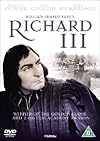
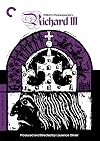
Richard III {1955 film}
by Laurence Olivier (Director; Actor [Richard III]), William Shakespeare (Original play)
On This Page
Description
Begins by recapitulating the final scene of Henry IV, Part III with Edward IV being crowned king. In the background of the celebration, Richard jealously views the proceedings. Soon afterwards, Edward IV is murdered, drowned in a vat of wine. Richard becomes king and, after proceeding with a succession of intrigues and duplicities, he finds his kingdom in dire peril, set upon by Henry Tudor and mustering a final defense for his realm at the Battle of Bosworth. An immortal tale of lust, show more murder, treachery and the ruthless pursuit of power. show lessTags
Recommendations














Member Reviews
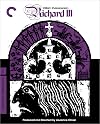
"Waldstein" provides a brilliant review, touching on many moments in the film which chill one to the bone. No other version brings the Shakespearian arch manipulator Richard, Duke of Gloucester to such vivid life. Olivier obviously takes much of the credit for that, but the Richard III Society may beg to differ as to the accuracy of the portrayal given here. The opening scene, with the medieval chandelier that looks just like a crown looming into view, together with Walton's fine music sets everything up for what is to follow, almost as though it was all fated to happen as it did, and not in any other way.
Em matéria de vilania shakespeariana, nada suplanta o intrigante ladrão de coroas Richard III. Uma peça soberbamente dramática, na qual, por variações de ritmo entre os Atos, pelo rigor exigido na atuação por parte do elenco e por uma maravilhosa habilidade de elencar personagens secundários, em todos os momentos a poesia de Shakespeare, (quando impecavelmente recitada) aumenta, ininterrupta, a atmosfera dramática. As cenas de batalha, no clima, só rivalizam com a pompa das de Henrique V. Os solilóquios são íntimos , descarados no auto-deleite com a sua propria eloquência, e deliciosamente perversos. Não há nada aqui que exija a mise-en-scene sombria de Hamlet ou os conceitos teatrais destemidos de The Tempest.
Aug 15, 2025English (UK)
Ratings
Members
- Recently Added By
Author Information


William Shakespeare, 1564 - 1616 Although there are many myths and mysteries surrounding William Shakespeare, a great deal is actually known about his life. He was born in Stratford-Upon-Avon, son of John Shakespeare, a prosperous merchant and local politician and Mary Arden, who had the wealth to send their oldest son to Stratford Grammar School. show more At 18, Shakespeare married Anne Hathaway, the 27-year-old daughter of a local farmer, and they had their first daughter six months later. He probably developed an interest in theatre by watching plays performed by traveling players in Stratford while still in his youth. Some time before 1592, he left his family to take up residence in London, where he began acting and writing plays and poetry. By 1594 Shakespeare had become a member and part owner of an acting company called The Lord Chamberlain's Men, where he soon became the company's principal playwright. His plays enjoyed great popularity and high critical acclaim in the newly built Globe Theatre. It was through his popularity that the troupe gained the attention of the new king, James I, who appointed them the King's Players in 1603. Before retiring to Stratford in 1613, after the Globe burned down, he wrote more than three dozen plays (that we are sure of) and more than 150 sonnets. He was celebrated by Ben Jonson, one of the leading playwrights of the day, as a writer who would be "not for an age, but for all time," a prediction that has proved to be true. Today, Shakespeare towers over all other English writers and has few rivals in any language. His genius and creativity continue to astound scholars, and his plays continue to delight audiences. Many have served as the basis for operas, ballets, musical compositions, and films. While Jonson and other writers labored over their plays, Shakespeare seems to have had the ability to turn out work of exceptionally high caliber at an amazing speed. At the height of his career, he wrote an average of two plays a year as well as dozens of poems, songs, and possibly even verses for tombstones and heraldic shields, all while he continued to act in the plays performed by the Lord Chamberlain's Men. This staggering output is even more impressive when one considers its variety. Except for the English history plays, he never wrote the same kind of play twice. He seems to have had a good deal of fun in trying his hand at every kind of play. Shakespeare wrote 154 sonnets, all published on 1609, most of which were dedicated to his patron Henry Wriothsley, The Earl of Southhampton. He also wrote 13 comedies, 13 histories, 6 tragedies, and 4 tragecomedies. He died at Stratford-upon-Avon April 23, 1616, and was buried two days later on the grounds of Holy Trinity Church in Stratford. His cause of death was unknown, but it is surmised that he knew he was dying. (Bowker Author Biography) show less
All Editions
Series
Belongs to Publisher Series
Criterion Laserdiscs (190)
The Criterion Collection (213)
Work Relationships
Is contained in
Is an adaptation of
Has as a supplement
Common Knowledge
- Canonical title
- Richard III {1955 film}
- Original publication date
- 1955-12-13
- People/Characters
- Richard III, King of England
Classifications
Statistics
- Members
- 81
- Popularity
- 391,500
- Reviews
- 2
- Rating
- (4.31)
- Languages
- English, French, Polish
- ISBNs
- 15
- UPCs
- 7
- ASINs
- 16