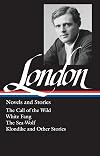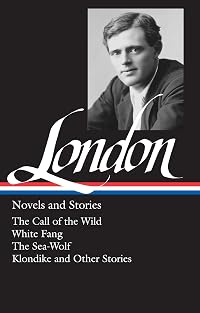
Novels and Stories: Call of the Wild / White Fang / The Sea-Wolf / Klondike and Other Stories
by Jack London
On This Page
Description
A collection of London's stories about dogs.Tags
Recommendations







Member Reviews
Many consider The Sea-Wolf by Jack London to be among the best sea stories ever written. I found it a moving and epic tale. Not only did it achieve great popular and literary success, but it also was effectively realized in several cinematic versions (most recently as a TV mini-series). The story ranks in the great tradition of one of London's literary influences, Herman Melville, while I saw similarities to another story of a life changed by sea voyage, captured by Rudyard Kipling in Captains Courageous.
Drawing upon his experiences seal hunting in the North Pacific, London created a story with a lot of realism. He put himself and his contradictory nature into the two opposing characters, the captain Wolf Larsen, a ruthless and rugged show more individualist, the superman, and Humphrey van Weyden, a weak, but highly cultivated and virtuous gentleman. It is in the clash of these two forces that London gives vent to his innermost struggles: idealism versus materialism, conscience versus instinct, desire versus soul. Humphrey joins Larsen's crew when a ferry he is on sinks. Later in the story he and the captain are joined by a young woman, Maude Brewster who, like Humphrey, is well-educated and literate. During one of their discussions Brewster and Larsen take opposite positions on the importance of desire versus soul. The argument is concluded when Humphrey says:
The man's soul is his desires. . . There lies the temptation. It is the wind that fans the desire until it leaps up to mastery. That's temptation. It may not fan sufficiently to make the desire overmastering , but in so far as fans at all, that far is it temptation. And, as you say, it may tempt for good as well as for evil. (pp. 674-75)
But the main philosophy demonstrated in the novel is a form of Social Darwinism. It is this that is the philosophy espoused by Wolf Larsen as justification for his tyrannical domination of others. Larsen's library is noted to contain works by Darwin, Malthus and Spencer - all seminal theorists of the concept. Darwin himself rejected the concepts of Social Darwinism even though his biological theories were generally used to support and inform the sociological concept that social inequality is the inexorable result of meritocratic division of available resources. Larsen summarizes the concepts of Social Darwinism in his extended analogy of a yeasty ferment of existence.
The novel's drama proceeds to a resolution of this elemental conflict through van Weyden's struggle toward fulfillment and mastery of life's forces and Larsen's ultimate deterioration. Ironically, the majority of the critics and the public misunderstood the work, thinking it a glorification of the superhuman and individualism, and London later wrote, ". . . I attacked Nietzsche and his super-man idea ... no one discovered that it was an attack upon the super-man philosophy. " In the death of Wolf Larsen and the survival of Van Weyden and Maude Brewster we see the confirmation of London's claim. show less
Drawing upon his experiences seal hunting in the North Pacific, London created a story with a lot of realism. He put himself and his contradictory nature into the two opposing characters, the captain Wolf Larsen, a ruthless and rugged show more individualist, the superman, and Humphrey van Weyden, a weak, but highly cultivated and virtuous gentleman. It is in the clash of these two forces that London gives vent to his innermost struggles: idealism versus materialism, conscience versus instinct, desire versus soul. Humphrey joins Larsen's crew when a ferry he is on sinks. Later in the story he and the captain are joined by a young woman, Maude Brewster who, like Humphrey, is well-educated and literate. During one of their discussions Brewster and Larsen take opposite positions on the importance of desire versus soul. The argument is concluded when Humphrey says:
The man's soul is his desires. . . There lies the temptation. It is the wind that fans the desire until it leaps up to mastery. That's temptation. It may not fan sufficiently to make the desire overmastering , but in so far as fans at all, that far is it temptation. And, as you say, it may tempt for good as well as for evil. (pp. 674-75)
But the main philosophy demonstrated in the novel is a form of Social Darwinism. It is this that is the philosophy espoused by Wolf Larsen as justification for his tyrannical domination of others. Larsen's library is noted to contain works by Darwin, Malthus and Spencer - all seminal theorists of the concept. Darwin himself rejected the concepts of Social Darwinism even though his biological theories were generally used to support and inform the sociological concept that social inequality is the inexorable result of meritocratic division of available resources. Larsen summarizes the concepts of Social Darwinism in his extended analogy of a yeasty ferment of existence.
The novel's drama proceeds to a resolution of this elemental conflict through van Weyden's struggle toward fulfillment and mastery of life's forces and Larsen's ultimate deterioration. Ironically, the majority of the critics and the public misunderstood the work, thinking it a glorification of the superhuman and individualism, and London later wrote, ". . . I attacked Nietzsche and his super-man idea ... no one discovered that it was an attack upon the super-man philosophy. " In the death of Wolf Larsen and the survival of Van Weyden and Maude Brewster we see the confirmation of London's claim. show less
4**** to The Call of the Wild
2½** to White Fang — too sentimentally soapy an ending
4****to selected "Klondike stories"
2** to The Sea-Wolf — cartoonish characters and a plot that relies on too many coincidences
4**** to the other selected stories
Overall, I'll give this 3½***, perhaps a bit generously, but it's being the Library of America edition boosts the score, and this edition does have some fairly decent end-noting.
Note that my higher ratings tend to be for London's stories, and this is probably the strength of The Call of the Wild, that it's novella-length. London doesn't have the strength of characterization or of extended plot that's necessary for full-length novels. He's much better at shorter pieces.
2½** to White Fang — too sentimentally soapy an ending
4****to selected "Klondike stories"
2** to The Sea-Wolf — cartoonish characters and a plot that relies on too many coincidences
4**** to the other selected stories
Overall, I'll give this 3½***, perhaps a bit generously, but it's being the Library of America edition boosts the score, and this edition does have some fairly decent end-noting.
Note that my higher ratings tend to be for London's stories, and this is probably the strength of The Call of the Wild, that it's novella-length. London doesn't have the strength of characterization or of extended plot that's necessary for full-length novels. He's much better at shorter pieces.
Le très très grand Jack London...
"The call of the wild", "White fang", "The sea-wolf", "Short stories"
Ratings
Members
- Recently Added By
Lists

American Lit for Eng 11 Research Project
368 works; 6 members
Author Information

1,809+ Works 82,060 Members
One of the pioneers of 20th century American literature, Jack London specialized in tales of adventure inspired by his own experiences. London was born in San Francisco in 1876. At 14, he quit school and became an "oyster pirate," robbing oyster beds to sell his booty to the bars and restaurants in Oakland. Later, he turned on his pirate show more associates and joined the local Fish Patrol, resulting in some hair-raising waterfront battles. Other youthful activities included sailing on a seal-hunting ship, traveling the United States as a railroad tramp, a jail term for vagrancy and a hazardous winter in the Klondike during the 1897 gold rush. Those experiences converted him to socialism, as he educated himself through prolific reading and began to write fiction. After a struggling apprenticeship, London hit literary paydirt by combining memories of his adventures with Darwinian and Spencerian evolutionary theory, the Nietzchean concept of the "superman" and a Kipling-influenced narrative style. "The Son of the Wolf"(1900) was his first popular success, followed by 'The Call of the Wild" (1903), "The Sea-Wolf" (1904) and "White Fang" (1906). He also wrote nonfiction, including reportage of the Russo-Japanese War and Mexican revolution, as well as "The Cruise of the Snark" (1911), an account of an eventful South Pacific sea voyage with his wife, Charmian, and a rather motley crew. London's body broke down prematurely from his rugged lifestyle and hard drinking, and he died of uremic poisoning - possibly helped along by a morphine overdose - at his California ranch in 1916. Though his massive output is uneven, his best works - particularly "The Call of the Wild" and "White Fang" - have endured because of their rich subject matter and vigorous prose. (Bowker Author Biography) show less
All Editions
Series
Belongs to Publisher Series
Library of America (006)
Work Relationships
Contains
Common Knowledge
- Canonical title
- Novels and Stories: Call of the Wild / White Fang / The Sea-Wolf / Klondike and Other Stories
- Alternate titles
- LONDON: Novels & Stories
- Original publication date
- 1982-11-1
- Publisher's editor
- Pizer, Donald
- Disambiguation notice
- This is an omnibus unique to the Library of America; therefore, all CK facts apply to this publication only.
Classifications
Statistics
- Members
- 793
- Popularity
- 35,235
- Reviews
- 5
- Rating
- (4.26)
- Languages
- Chinese, English
- Media
- Paper
- ISBNs
- 5