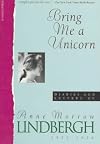
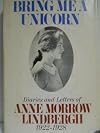
Bring Me a Unicorn: Diaries and Letters of Anne Morrow Lindbergh, 1922-1928
by Anne Morrow Lindbergh
Diaries and Letters of Anne Morrow Lindbergh (1, 1922-1928)
On This Page
Description
Diaries and letters of Anne Morrow Lindbergh, 1922- 1928.Tags
Recommendations







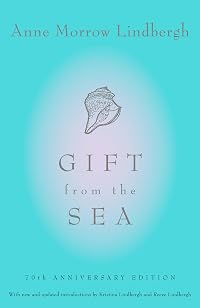
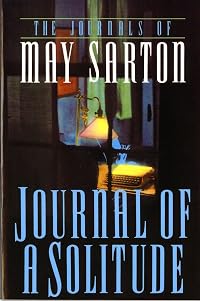


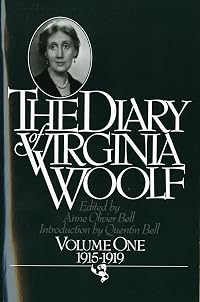


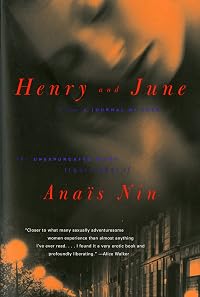











Member Reviews
[b:Bring Me a Unicorn: Diaries and Letters of Anne Morrow Lindbergh, 1922-1928|307079|Bring Me a Unicorn Diaries and Letters of Anne Morrow Lindbergh, 1922-1928|Anne Morrow Lindbergh|https://images.gr-assets.com/books/1173592189s/307079.jpg|298051] is a compilation of letters and diary entries written by Anne Morrow Lindbergh between 1921 and 1928, which encompasses the meeting of her future husband, Charles Lindbergh. She is a remarkably observant and eloquent writer, even in personal correspondence and musing meant only for herself at the time they were written. She has been a fascinating individual for me over the years--such a beautiful woman, so elegant and poised, and such a courageous soul in the way she handled the tragedy to show more come, which was all too personal and yet all too public. This book predates that time, and reveals how little prepared she must have been to have such a fate befall her.
She seemed to recognize how fragile life could be, however, writing in 1927:
A day at Helen’s: a big, summery, chintzy house, empty and still and cool. And Helen playing Brahms and Cesar Franck. A still, perfect moment, framed neither by time nor by space but high apart, above these. Still, caught--the drop of water from the eaves, swelling, about to fall, but now whole, crystalline, perfect. These moments are so rare, so few, for anyone--those moments of perfection.
What a lovely diary entry this is! I probably would have written “had a nice with Helen.” I’m glad she had more imagination than I.
Her first encounter with Lindbergh is so special an entry, since it is not a speculation of what she thought, but her exact thoughts put to paper:
Colonel Lindbergh was there--a very nice boy, very nice, but we hardly took it in, or at least were a little annoyed--all this public-hero stuff breaking into our family party. What did I expect? A regular newspaper hero, the baseball-player type--a nice man, perhaps, but not at all “intellectual” and not of my world at all, so I wouldn’t be interested. I certainly was not going to worship “Lindy” (that odious name, anyway).
Ha! Not the most auspicious of first impressions.
Quite a bit of her pennings are about various encounters with him, the development of their friendship, and her worries that Lindbergh might be interested in her older sister, Elizabeth, or just being nice to her because he felt a duty toward her father, who was an Ambassador to Mexico. Some of her thoughts are so sweet, and so reminiscent of first loves we might all have had, that I could not but smile.
The feeling of exultant joy that there is anyone like that in the world. I shall never see him again, and he did not notice me, or would ever, but there is such a person alive, there is such a life, and I am here on this earth, in this age, to know it!
Of course, he did notice her and they embarked on what might have been a fairytale, but then life never is a fairytale, is it?
I was particularly struck by a portion of her diary and letters that dealt with the suicide death of a close friend at college.
If only I had talked to her after vacation--if only I had gone up to her room--if I could have just caught her in that gust of despair that must have come over her suddenly.
I wondered if this dealing with the loss, the guilt, the “what ifs” that accompany any premature death, might not have helped her when her own terrible tragedy came. She expresses so much of compassion and faith and composure, and yet she asks all those questions that each of us would and do.
Is there anything beautiful, is there anything good, anything lovely in this world, if such things can happen?
And as if an omen to her, the foreshadowing of things to come:
A nightmare of reporters, papers, reports, clues, detectives, questioning.
I could not help wishing I could see her mother’s replies to these heartfelt, questing letters, in which she is reaching out for both comfort and to make some sense of things. What did her mother say? And, how might that have helped her forge the inner strength she was to need so sorely later in life?
I very much enjoyed reading about this remarkable woman. I often think the women behind the famous men are more intriguing than the men themselves. I fell in love with Anne Morrow Lindbergh when I read, A Gift From the Sea, and this collection of her letters reinforced that feeling that she was someone quite special. I shall continue to pry into her life. I have a biography sitting on my physical bookshelf and I understand that there are two other volumes of her letters and diaries.
On an aside note, I cannot help lamenting that we have lost the art of letter writing. I details the thoughts and feelings of a person so much more than any of our more modern technology does. Who writes passages in an email. Where will the blogs be in one hundred years? And, how genuine are they anyway, when they are written for mass consumption. These letters are so personal and heartfelt--meant only for the eyes of the friend or relative to whom they are written; the diary so unassuming and honest, an attempt to record feelings and sort out the soul. I am happy that they have survived for all of us to see, but I am equally happy that they were never meant to be seen at all. show less
She seemed to recognize how fragile life could be, however, writing in 1927:
A day at Helen’s: a big, summery, chintzy house, empty and still and cool. And Helen playing Brahms and Cesar Franck. A still, perfect moment, framed neither by time nor by space but high apart, above these. Still, caught--the drop of water from the eaves, swelling, about to fall, but now whole, crystalline, perfect. These moments are so rare, so few, for anyone--those moments of perfection.
What a lovely diary entry this is! I probably would have written “had a nice with Helen.” I’m glad she had more imagination than I.
Her first encounter with Lindbergh is so special an entry, since it is not a speculation of what she thought, but her exact thoughts put to paper:
Colonel Lindbergh was there--a very nice boy, very nice, but we hardly took it in, or at least were a little annoyed--all this public-hero stuff breaking into our family party. What did I expect? A regular newspaper hero, the baseball-player type--a nice man, perhaps, but not at all “intellectual” and not of my world at all, so I wouldn’t be interested. I certainly was not going to worship “Lindy” (that odious name, anyway).
Ha! Not the most auspicious of first impressions.
Quite a bit of her pennings are about various encounters with him, the development of their friendship, and her worries that Lindbergh might be interested in her older sister, Elizabeth, or just being nice to her because he felt a duty toward her father, who was an Ambassador to Mexico. Some of her thoughts are so sweet, and so reminiscent of first loves we might all have had, that I could not but smile.
The feeling of exultant joy that there is anyone like that in the world. I shall never see him again, and he did not notice me, or would ever, but there is such a person alive, there is such a life, and I am here on this earth, in this age, to know it!
Of course, he did notice her and they embarked on what might have been a fairytale, but then life never is a fairytale, is it?
I was particularly struck by a portion of her diary and letters that dealt with the suicide death of a close friend at college.
If only I had talked to her after vacation--if only I had gone up to her room--if I could have just caught her in that gust of despair that must have come over her suddenly.
I wondered if this dealing with the loss, the guilt, the “what ifs” that accompany any premature death, might not have helped her when her own terrible tragedy came. She expresses so much of compassion and faith and composure, and yet she asks all those questions that each of us would and do.
Is there anything beautiful, is there anything good, anything lovely in this world, if such things can happen?
And as if an omen to her, the foreshadowing of things to come:
A nightmare of reporters, papers, reports, clues, detectives, questioning.
I could not help wishing I could see her mother’s replies to these heartfelt, questing letters, in which she is reaching out for both comfort and to make some sense of things. What did her mother say? And, how might that have helped her forge the inner strength she was to need so sorely later in life?
I very much enjoyed reading about this remarkable woman. I often think the women behind the famous men are more intriguing than the men themselves. I fell in love with Anne Morrow Lindbergh when I read, A Gift From the Sea, and this collection of her letters reinforced that feeling that she was someone quite special. I shall continue to pry into her life. I have a biography sitting on my physical bookshelf and I understand that there are two other volumes of her letters and diaries.
On an aside note, I cannot help lamenting that we have lost the art of letter writing. I details the thoughts and feelings of a person so much more than any of our more modern technology does. Who writes passages in an email. Where will the blogs be in one hundred years? And, how genuine are they anyway, when they are written for mass consumption. These letters are so personal and heartfelt--meant only for the eyes of the friend or relative to whom they are written; the diary so unassuming and honest, an attempt to record feelings and sort out the soul. I am happy that they have survived for all of us to see, but I am equally happy that they were never meant to be seen at all. show less
Bring Me a Unicorn is the first in a series of autobiographies by Anne Morrow Lindbergh. It covers her life from 1922 to 1928. I have to say Anne's writing is delightful. I admire how brutally honest she is with herself. Her letters home are typical of any college kid, "sorry this is so rushed...I have been frightfully busy!" She is also typical in her growing interest in Colonel Lindbergh. She feels she is not in his league but mentions him more and more in her diary entries. You could see her attraction grow until she finally admits that she loves him. The photographs are great. They represent (visually) what was happening in Anne's world at that present time.
Mostly really fine. Quite poetic, etc. Young sheltered educated girl falls for Lindbergh, a man of action ! Sometime a little long-winded. I love her writing. I'm going to read most of her memoirs now (several volumes to go)! Sad to think of the tragedy to come in the next one.
Anne Morrow Lindbergh describes her close-knit family as bookish, intellectual and introspective. Her greatest delight is to be left alone with a book in hand. Miss Morrow's letters are full of literary allusions and vivid descriptions of her surroundings and the people who frequent it. A great many of her letters have been saved and with her journals present the history of her life from 1922-1928. It was during this time period that she attended and graduated from Smith College, lived in Mexico City with her parents and met Charles Lindbergh while on his victory tour to Mexico. A fascinating portrayal of a young, inexperienced, uncertain girl falling in love with the hero of the times whose background, education, interests and show more confident demeanor were in marked contrast to hers. An intimate unfolding of the truism that opposites attract. show less
Covering the years from 1922 to her engagement to Charles Lindbergh in 1928, this collection of excerpts from her diary and letters gives us a picture of a young woman growing up in the powerful and privileged upper classes of American society. Her life after college appears to be a series of dinners, receptions and parties all to relieve boredom. Names are dropped such as Vanderbilt, Lamont, Morgan on many pages. Her father was the ambassador to Mexico thus we are exposed to the privileged life she led there.
A good snap shot of life at the top of American society in the 1920's as well as a limited view of Lindbergh, the aviator from a more personal perspective.
A good snap shot of life at the top of American society in the 1920's as well as a limited view of Lindbergh, the aviator from a more personal perspective.
It's too bad people don't write hand-written letters or keep diaries anymore. Whatever will be left of us in years to come?
Anne Morrow Lindbergh's letters and diaries presented in this book offer a fascinating look into her world: Anne, intellectual, dreamy, somewhat romantic but bookish, and "Lindy", out-going, popular, already a national hero. Throughout her writings, their lives, so different, begin to intertwine...
My edition came with pictures of Anne and her family...a wonderful book!
Anne Morrow Lindbergh's letters and diaries presented in this book offer a fascinating look into her world: Anne, intellectual, dreamy, somewhat romantic but bookish, and "Lindy", out-going, popular, already a national hero. Throughout her writings, their lives, so different, begin to intertwine...
My edition came with pictures of Anne and her family...a wonderful book!
Very interesting , the history of the time viewed from her perspective,
an inside look at her family life from 1922-1928 and her development as a writer.
an inside look at her family life from 1922-1928 and her development as a writer.
Members
- Recently Added By
Author Information

41+ Works 8,488 Members
Anne Morrow Linbergh, 1906-2001 Anne Morrow Lindbergh was born Anne Spencer Morrow on June 22, 1906 in Englewood New Jersey. Her father was a multimillionaire banker with the firm J.P.Morgan and Co., who would later become a senator for New Jersey. Her mother was an educator and poet who held the position of acting president of Smith College from show more 1939-1940. Anne Morrow attended Miss Chapin's School in Manhattan and graduated Smith College in 1928. She is best known for penning over two dozen books of prose and poetry, including five diaries of her tumultuous life. Lindbergh married the famous Charles Lindbergh in 1929 and was introduced to the real world through his fame. Her childhood had been a sheltered one, yet she thrived in this new lifestyle. In 1930, she became the first woman to receive a glider pilot's license in the United States. That same year she accompanied her husband as copilot and navigator, when he broke the transatlantic speed record. In 1939 she earned the prestigious Hubbard Gold Medal of the National Geographic Society, becoming the first woman ever to do so. Ironically, Anne Lindbergh is best known not for her literary prowess, but for the kidnapping and death of her first born son, Charles Jr.. Known as the Crime of the Century, the Lindberghs gained an enormous amount of public recognition in the wake of the brutal murder. Lindbergh would never be the same for the incident. In 1935, Lindbergh published her first book, which also became her first best seller. While sometimes criticized by the literary world, Lindbergh remained popular with the public, females in particular, until her death. Perhaps her most famous book, "Gift from the Sea", a philosophical meditation on women's lives, was an inspiration to those same women. Because of her sympathy to the plight of the every day woman, and their returned sympathy for her own tragedy, Lindbergh was voted one of the 10 most admired women of 1975 by readers of Good Housekeeping. Her later works, which included the somewhat questionable "The Wave of the Future" was placed under greater criticisms, yet survived as another example of her involvement in world events, as they touch home. Anne Morrow Lindbergh died at the age of 94 at her home in Passumpsic, Vermont. (Bowker Author Biography) show less
Awards and Honors
Distinctions
Series

Belongs to Publisher Series
Serie Piper (1293)
Work Relationships
Common Knowledge
- Original title
- Bring Me a Unicorn: Diaries and Letters of Anne Morrow Lindbergh, 1922–1928
- Original publication date
- 1971
- Original language*
- Englisch
*Some information comes from Common Knowledge in other languages. Click "Edit" for more information.
Classifications
- Genre
- Biography & Memoir
- DDC/MDS
- 818.5 — Literature & rhetoric American literature in English American miscellaneous writings in English 20th Century
- LCC
- TL540 .L49 .A26 — Technology Motor vehicles. Aeronautics. Astronautics Motor vehicles. Aeronautics. Astronautics Aeronautics. Aeronautical engineering
- BISAC
Statistics
- Members
- 607
- Popularity
- 48,089
- Reviews
- 11
- Rating
- (4.07)
- Languages
- English, German
- Media
- Paper
- ISBNs
- 10
- ASINs
- 26