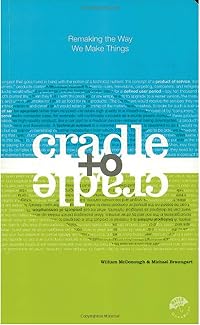
Cradle to Cradle: Remaking the Way We Make Things
by William McDonough, Michael Braungart
On This Page
Description
"Reduce, reuse, recycle," urge environmentalists; in other words, do more with less in order to minimize damage. As William McDonough and Michael Braungart argue in their provocative, visionary book, however, this approach perpetuates a one-way, "cradle to grave" manufacturing model that dates to the Industrial Revolution and casts off as much as 90 percent of the materials it uses as waste, much of it toxic. Why not challenge the notion that human industry must inevitably damage the natural show more world? they ask. In fact, why not take nature itself as our model? A tree produces thousands of blossoms in order to create another tree, yet we do not consider its abundance wasteful but safe, beautiful, and highly effective; hence, "waste equals food" is the first principle the book sets forth. Products might be designed so that, after their useful life, they provide nourishment for something new-either as "biological nutrients" that safely re-enter the environment or as "technical nutrients" that circulate within closed-loop industrial cycles without being "downcycled" into low-grade uses (as most "recyclables" now are). Elaborating their principles from experience redesigning everything from carpeting to corporate campuses, the authors make an exciting and viable case for change. show lessTags
Recommendations







Member Recommendations

Member Reviews
Have just finished reading Cradle to Cradle by William McDonough and Michael Braungart. As a reluctant environmentalist, I was very impressed. Living as I do in a small flat, I find that recycling regimes assume you have a garden for lots of separate bins, or a large amount of indoor space to store all your detritus until it gets to the recycling point. In some locales, you are even expected to buy a car to drive to the recycling bins - crazy! Every time you visit someone who has a different recycling regime you have to get used to throwing something out you usually recycle, and saving something, you would have thrown out in another local authority.
For years I have been moaning that everything is the wrong way around: 'Why do they make show more this so difficult? Why can't they just design things that are easy to recycle, or that can be re-used - this cannot be efficient!' After reading Cradle to Cradle I don't feel so much like a voice in the wilderness. I was impressed with the idea of products being designed with recycling in mind, either as biological or technological 'nutrients', although I wonder how this would work when some products are kept for years? It may be decades before some of these products are ready to be recycled and the system tested.
A lot of the book chronicles the exploits of the authors in their careers as architect and chemist, and by the end I had a mental image of them whizzing about the world solving the world's environmental woes, like environmental Supermen. It would be reassuring to learn that they weren't the only design practitioners trying to save the planet, but perhaps that's another book?
I also wonder what we as a society will leave behind if we really get to grips with recycling? The days of rummaging through waste tips to find antique jam jars and ginger bottles will be a thing of the past, and some artifacts may be lost to history in the urge to re-, down- and up-cycle?
An excellent book. Do the green thing and request it from your local library! show less
For years I have been moaning that everything is the wrong way around: 'Why do they make show more this so difficult? Why can't they just design things that are easy to recycle, or that can be re-used - this cannot be efficient!' After reading Cradle to Cradle I don't feel so much like a voice in the wilderness. I was impressed with the idea of products being designed with recycling in mind, either as biological or technological 'nutrients', although I wonder how this would work when some products are kept for years? It may be decades before some of these products are ready to be recycled and the system tested.
A lot of the book chronicles the exploits of the authors in their careers as architect and chemist, and by the end I had a mental image of them whizzing about the world solving the world's environmental woes, like environmental Supermen. It would be reassuring to learn that they weren't the only design practitioners trying to save the planet, but perhaps that's another book?
I also wonder what we as a society will leave behind if we really get to grips with recycling? The days of rummaging through waste tips to find antique jam jars and ginger bottles will be a thing of the past, and some artifacts may be lost to history in the urge to re-, down- and up-cycle?
An excellent book. Do the green thing and request it from your local library! show less
Instead of trying to reduce our negative effects on the world (being "eco-efficient") what you will find in this book is how to maximize our positive effects (how to be "eco-effective"). It involves truly taking responsibility for the things we create by considering from the start what happens to our products at their end; switching from a "cradle-to-grave" approach to a "cradle-to-cradle" approach where products are made of biological nutrients (material that can be thrown away safely, even beneficially) or technical nutrients (material that can be safely recovered and re-used by industry).
What's great is that the book itself serves as an example of what it describes: it's not made of paper. Instead it's made of a high grade plastic show more that can be re-used by the manufacturer indefinitely or, if you'd rather keep it, can be safely placed on your shelf for many years without much wear. The ink can be stripped from the pages by the manufacturer and re-used to print other such books. This kind of construction makes the book extremely durable and waterproof while also providing for the possibility of upcycling.
It's not perfect, however. The kind of systems required for manufacturers to implement their cradle-to-cradle approach will take time to develop, since they will essentially need to completely overhaul the ingredients that go into making their products. They even admit they couldn't yet completely eliminate all harmful materials from the book's construction. However, I believe that any shift we could make towards cradle-to-cradle design would be beneficial; at least it gets us thinking about how the things we make could be safer.
In any case, the world of abundance the writers describe in the book is inspiring. I hope one day we'll have, as they invite us to imagine, "buildings like trees; cities like forests." show less
What's great is that the book itself serves as an example of what it describes: it's not made of paper. Instead it's made of a high grade plastic show more that can be re-used by the manufacturer indefinitely or, if you'd rather keep it, can be safely placed on your shelf for many years without much wear. The ink can be stripped from the pages by the manufacturer and re-used to print other such books. This kind of construction makes the book extremely durable and waterproof while also providing for the possibility of upcycling.
It's not perfect, however. The kind of systems required for manufacturers to implement their cradle-to-cradle approach will take time to develop, since they will essentially need to completely overhaul the ingredients that go into making their products. They even admit they couldn't yet completely eliminate all harmful materials from the book's construction. However, I believe that any shift we could make towards cradle-to-cradle design would be beneficial; at least it gets us thinking about how the things we make could be safer.
In any case, the world of abundance the writers describe in the book is inspiring. I hope one day we'll have, as they invite us to imagine, "buildings like trees; cities like forests." show less
Offers an uncompromising, ethical, idealistic, visionary, impractical, narrow-minded, utterly unworkable proposal for solving the problems of waste and scarcity. Turns out, we've simply got to rebuild everything in the world in such a way that it produces no waste. Nature does it, why can't we? Well, for one thing, nature regulates itself by letting the population die out until there's a resource equilibrium, and I don't know if I want to let a couple billion poor people die.
Good intentions, but the book struck me as fatally out of touch.
Good intentions, but the book struck me as fatally out of touch.
The premise is great, but even when the author mentions the destruction of an ecosystem (such as the Exxon Valdez oil spill) there is no mention of the indigenous people whose lives, livelihoods, communities, and way of life were also destroyed.
The author also claims that pollution and other aspects of non-sustainable manufacturing are not because of immoral corporate decisions, but just "outdated design". Yikes.
The author also claims that pollution and other aspects of non-sustainable manufacturing are not because of immoral corporate decisions, but just "outdated design". Yikes.
For those to are ecologically minded, a key part of creating any new product is to produce a life cycle assessment (LCA), which is also known as a cradle-to-grave analysis, working from manufacture (‘cradle’) to use and disposal (‘grave’). The LCA investigates all of the environmental impacts of that product and attempts to minimise that damage.One of the key premises of McDonough and Brangart’s Cradle to Cradle is that minimising damage just isn’t good enough. Instead, the authors propose that we change our entire design processes so that reuse and nourishment are built right into the process. Instead of minimising waste, we create value.Cradle to Cradle goes beyond the notion of having recycling as the final step in a show more process flow, and instead builds on the idea that waste need not exist at all. We can design our lives and products around the notion of nourishment – from the way we live to how we design and produce goods. The natural world provides the template for what the authors suggest, from the regenerative world of the insect, to the cherry tree, to the use of natural nutrients such as solar and wind power. They suggest that the key to working within, rather than against, nature is to respect biodiversity, respect the elegance and abundance of what is around us, and begin our design process with the notion of there is no such thing as waste.The writing style itself is clear, simple, and suitable for all ages and knowledge levels. Different readers will take different things from the book. It is addressed to those that do design for a living, and for those who are professionals in industry, this book will serve as a manual for development.But all of us are engaged in creation and consumption in one way or another (the machine I’m using to type this on, or the reams of paper my kids draw on to take two general examples) and the choices we make on how we will conduct those activities, and seeing ourselves as all being part of the great cradle to cradle cycle is an important step forward. The book spends some time discussing the whole notion of dangerous design principles, including the way in which “downcycling” only defers the problem as products become more and more unstable (and environmental problematic) as they are recycled. Although I’ve yet to see plastic books become a trend, the book itself is an example of how a product can be manufactured in a way that will be infinitely valuable. It’s made out of synthetic paper which doesn’t use wood pulp or any dangerous inks or substances, and is both waterproof and pleasurable to read, with nice thick pages and clear ink. The book goes into quite a lot of detail about what it would mean to design products that weren’t less bad, but rather 100% good. The authors look at architecture and how we can design buildings that take into account the diversity of their settings, and the natural needs of their inhabitants. The book concludes with “Five Steps to Eco-Effectiveness”, a neat summary of how to put the philosophical principles discussed in the book into practice. Some of these, such as “Step 2: Follow informed personal preferences” may seem a little unusual, advocating that we use our aesthetic sense, our observations and our own sense of pleasure (yes, pleasure) to guide our design decisions. While others, such as “Step 4: Reinvent” may seem almost too broad for the average reader. However, the book is full of so many specific examples, primarily from industry, that it’s easy to picture what they are advocating working in practice. After all, the book itself is not only beautifully and safely designed to fit the “cradle-to-cradle” philosophy, it is also written in a way that is easily read, linguistically elegant and appealing, and sound in its advice. As a writer, I can see the sense in taking on this wholistic approach to environmentalism, ditching the hysteria and the mass of finger-pointing practices which look green but which don’t actually make much of a difference, and taking on this approach in a whole body sense. It’s powerful stuff and the impact is starting to happen, perhaps a little too slowly, but, as the authors say, “it’s going to take forever…that’s the point.” show less
I guess this is as good of an environmental design book as you can get if you are working within the model of capitalism. I dislike the authors' disregard for government regulation, because ideas are great but money and laws are what make companies change. Putting a green roof on an automobile manufacturer is certainly better than no green roof, but without questioning the consumer system that creates millions of cars each year, the environment isn't seeing much of a net benefit.
Technotopia can be great, but it needs guidelines. The book is made out of plastic with inorganic fillers. Great, but nowhere in the book are these ingredients fully disclosed. My problem with many consumer products is that there's no need for ingredients to be show more disclosed, so they aren't. And without motivation for people to recycle or turn-in their newly designed products appropriately, we're just going to be landfilling them. I would have liked to have read some more dramatic ideas than "put a green roof on it." But hey, if this book gets enough people's gears turning I guess it's not too bad. show less
Technotopia can be great, but it needs guidelines. The book is made out of plastic with inorganic fillers. Great, but nowhere in the book are these ingredients fully disclosed. My problem with many consumer products is that there's no need for ingredients to be show more disclosed, so they aren't. And without motivation for people to recycle or turn-in their newly designed products appropriately, we're just going to be landfilling them. I would have liked to have read some more dramatic ideas than "put a green roof on it." But hey, if this book gets enough people's gears turning I guess it's not too bad. show less
3.25 stars
The authors are an architect and a chemist who work together to make/create more environmentally-friendly/sustainable items. They actually start off by saying that what we mostly do now is not good enough; that is, there are still issues with trying to be not “as bad” vs. all-out bad. They want to make things “good” (for human health, for the environment, and even for company’s/industry’s bottom lines, economically. They say it can be done (and they have examples of things they’ve done working with various companies to do those things).
It’s probably something we need to hear, but it’s new, and so for some things, I had a hard time wrapping my head around the ideas: eco-effective vs eco-efficient, upcycling vs show more downcycling, biological nutrients and technical nutrients, and more. I think I figured out downcycling -- when we currently recycle, this is what happens. This means that the items we recycle are being reused/remade, but they are of lower quality. Because they are of lower quality, more potential toxins/chemicals need to be added to “shore things up”, so to speak. I’m probably not explaining that well.
They did have some good examples and I think they are probably correct in what they are suggesting, but it was hard for me to figure all of it out. Maybe there needs to be more written on this, as the more I read, I’ll likely clue in a bit better. But what’s unfortunate (and I hadn’t realized) is that this book was published 20 years ago, in 2002. Without having heard much more about these concepts, I’m concerned that they haven’t really taken root, still. show less
The authors are an architect and a chemist who work together to make/create more environmentally-friendly/sustainable items. They actually start off by saying that what we mostly do now is not good enough; that is, there are still issues with trying to be not “as bad” vs. all-out bad. They want to make things “good” (for human health, for the environment, and even for company’s/industry’s bottom lines, economically. They say it can be done (and they have examples of things they’ve done working with various companies to do those things).
It’s probably something we need to hear, but it’s new, and so for some things, I had a hard time wrapping my head around the ideas: eco-effective vs eco-efficient, upcycling vs show more downcycling, biological nutrients and technical nutrients, and more. I think I figured out downcycling -- when we currently recycle, this is what happens. This means that the items we recycle are being reused/remade, but they are of lower quality. Because they are of lower quality, more potential toxins/chemicals need to be added to “shore things up”, so to speak. I’m probably not explaining that well.
They did have some good examples and I think they are probably correct in what they are suggesting, but it was hard for me to figure all of it out. Maybe there needs to be more written on this, as the more I read, I’ll likely clue in a bit better. But what’s unfortunate (and I hadn’t realized) is that this book was published 20 years ago, in 2002. Without having heard much more about these concepts, I’m concerned that they haven’t really taken root, still. show less
Members
- Recently Added By
Lists

Best Architecture Books
87 works; 13 members

Bret Victor's Five-Star List
46 works; 5 members

Macmillan Publishers
129 works; 3 members

TED 2013 Summer Reading List
190 works; 13 members

The Joe Rogan Experience Library
254 works; 3 members

The Great Courses: Earth at the Crossroads
48 works; 1 member

The Venus Project Recommended Books - Contemporary sources
53 works; 2 members
Author Information

50+ Works 2,350 Members

4 Works 2,257 Members
Common Knowledge
- Original title
- Cradle to Cradle: Remaking the Way We Make Things
- Original publication date
- 2002
- Epigraph
- 'The world will not evolve past its current state of crisis by using the same thinking that created the situation.'
Albert Einstein
'Glance at the sun.
See the moon and the stars.
Gaze at the beauty of earth's greenings.
Now, think.'
Hildegard von Bingen
'What you people call your natural resources our people call our relatives.'
Oren Lyons, faith keeper of the Onondanga - Dedication
- To our families, and to all of the children of all species for all time
- First words
- In the twenty-some years since I came up with the phrase "cradle to cradle", it has become as complicated as a musical score.
- Quotations
- We did not design the materials of this book. After years of analyzing and testing polymers to replace paper, we were delighted when designer Janine James happened to mention our search to Charlie Melcher of Melcher Media. ... (show all)Melcher was working with a paer adapted from a polymer blend that had been used to label detergent bottles, so that the labels could be recycled along with the bottles instead of being burned off...When Michael tested it, he found that it off-gassed similarly to a conventional book. But it could be recycled, and more to the point, it has the potential to be upcycled: dissolved and remade as polymer of high quality and usefulness.
- Last words
- (Click to show. Warning: May contain spoilers.)But then, that's the point.
Classifications
- Genres
- Science & Nature, Art & Design, Nonfiction, General Nonfiction, Economics, Business
- DDC/MDS
- 745.2 — Arts & recreation Drawing & decorative arts Decorations & Handicrafts / Calligraphy Industrial
- LCC
- TD794.5 .M395 — Technology Environmental technology. Sanitary engineering Environmental technology. Sanitary engineering Municipal refuse. Solid wastes
- BISAC
Statistics
- Members
- 2,095
- Popularity
- 9,908
- Reviews
- 33
- Rating
- (4.01)
- Languages
- 11 — Chinese, Danish, Dutch, English, French, German, Hungarian, Italian, Japanese, Portuguese, Spanish
- Media
- Paper, Audiobook, Ebook
- ISBNs
- 30
- ASINs
- 6