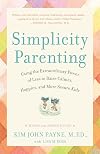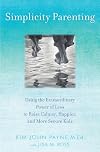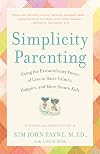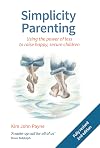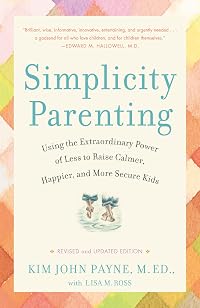
Simplicity Parenting: Using the Extraordinary Power of Less to Raise Calmer, Happier, and More Secure Kids
by Kim John Payne
On This Page
Description
Family & Relationships. Nonfiction. Today's busier, faster society is waging an undeclared war on childhood. With too much stuff, too many choices, and too little time, children can become anxious, have trouble with friends and school, or even be diagnosed with behavioral problems. Now internationally renowned family consultant Kim John Payne helps parents reclaim for their children the space and freedom that all kids need for their attention to deepen and their individuality to flourish. show more Simplicity Parenting offers inspiration, ideas, and a blueprint for change:* Streamline your home environment. Reduce the amount of toys, books, and clutter-as well as the lights, sounds, and general sensory overload.* Establish rhythms and rituals. Discover ways to ease daily tensions, create battle-free mealtimes and bedtimes, and tell if your child is overwhelmed. * Schedule a break in the schedule. Establish intervals of calm and connection in your child's daily torrent of constant doing.* Scale back on media and parental involvement. Manage your children's "screen time" to limit the endless deluge of information and stimulation.A manifesto for protecting the grace of childhood, Simplicity Parenting is an eloquent guide to bringing new rhythms to bear on the lifelong art of raising children. show lessTags
Recommendations




Member Reviews
I loved this book for both the practical suggestions (backed by both formal research and informal observation) and for its tone.
Since I began reading this book, I've made some concrete changes in our home environment, including reducing the number of toys and books my children have easy access to (I put many into a "library" in our basement until I can work up the courage to donate/sell/throw away), reducing the number of scheduled activities I have for my children, and implementing some basic daily routines, most notably the "flute-practice-after-breakfast" routine.
There have been some small but noticeable changes in the way my children go about their days in the weeks since I've made these changes. We've had fewer arguments about show more flute practice, and my daughter (age 6.5) has been practicing more regularly and with more joy. She's even begun initiating flute practice on her own without my even prompting her!
My children, especially my 2yo son, are playing imaginatively with everyday objects more than they were before, making an empty toy bin into a car for the stuffed toys and things like that.
And my daughter has lightened up about the order in which we use the colored plastic cups and flatware. She used to scream at me and my husband if we forgot and gave her a blue cup before the green cup. The order was green, light blue, dark blue, yellow, orange, pink, pink, and woe betide the parent who tried to go out of order. There were no discussions about the cups, and we made no changes directly related to the cups, she just stopped getting angry with us about them. Which has been quite a relief.
Of course, my son has also decided that the toy room is much too neat, so he goes in and up-ends three or four toy bins at a time into the middle of the room. That's not so cool, but at least it doesn't take long to pick everything up.
I was already in the habit of simplifying our home, but this book really helped give me the confidence to cut deeper, and to remove toys and books without my children's input about which we kept and which we got rid of. The books were a real change for me, though. I knew the kids (and I) were somewhat overwhelmed by the number of books on their shelves, but I felt like I just couldn't get rid of any of them. Books are unequivocally good, right? But once I halved the number of books, they've been much more engaged with the ones they have left. And they don't even seem to notice that any are missing.
One area that I'm going to try to work on a little bit more is verbal clutter. From the book:
"In our era of spin and counterspin, when words are parsed and split, where news stands beside opinion and embraces blogs, meaning is often drowned out. Just as it's hard to cherish a toy lost in the middle of a mountain of play things, when we say less, our words mean more."
Although I fear that if I really take that to heart, I might blog a lot less.
The tone of the book was the real refreshing piece, though. Payne clearly delights in childhood and the whimsy of children. His anecdotes and suggestions are peppered with images of children interacting with each other and with adults and the funny and adorable things they do and say. I felt a sense of peace and well-being reading such a sunny view of childhood. Not that Payne isn't realistic about the struggles of parenting and children's sometimes not-so-desirable actions, he just doesn't focus on them. He treats children as human beings to be loved and guided rather than creatures to be trained and manipulated, and "misbehavior" as a sign that something in the child's environment might do with some changing.
Payne talks about how one of the biggest differences between parenting now and parenting a generation ago is how much data about our children we have available and how many "experts" we have to consult to make sure we're doing this really big job right. But in this, too, he offers reassurance.
"For all of the measures we now have at our fingertips, by and large children defy them by being both more 'normal' and more extraordinary than any scientific measure, or means of quantifying them."
This rings true to me, and it promotes the freedom we as parents have to love our kids and to let go of worrying that we're not giving them an "ideal" childhood, whatever that might be.
The only thing that I thought was a little lacking was that Payne is very much focused on two-working-parent homes. As a stay-at-home mom who homeschools, I would have kind of liked a little bit of information directed towards me or that at least reflected my demographic. However, I know I'm in a pretty tiny minority, so I don't hold it against the author for not including me and my friends. His suggestions are significant and applicable even to those of us who do not see our specific situations in his case studies. show less
Since I began reading this book, I've made some concrete changes in our home environment, including reducing the number of toys and books my children have easy access to (I put many into a "library" in our basement until I can work up the courage to donate/sell/throw away), reducing the number of scheduled activities I have for my children, and implementing some basic daily routines, most notably the "flute-practice-after-breakfast" routine.
There have been some small but noticeable changes in the way my children go about their days in the weeks since I've made these changes. We've had fewer arguments about show more flute practice, and my daughter (age 6.5) has been practicing more regularly and with more joy. She's even begun initiating flute practice on her own without my even prompting her!
My children, especially my 2yo son, are playing imaginatively with everyday objects more than they were before, making an empty toy bin into a car for the stuffed toys and things like that.
And my daughter has lightened up about the order in which we use the colored plastic cups and flatware. She used to scream at me and my husband if we forgot and gave her a blue cup before the green cup. The order was green, light blue, dark blue, yellow, orange, pink, pink, and woe betide the parent who tried to go out of order. There were no discussions about the cups, and we made no changes directly related to the cups, she just stopped getting angry with us about them. Which has been quite a relief.
Of course, my son has also decided that the toy room is much too neat, so he goes in and up-ends three or four toy bins at a time into the middle of the room. That's not so cool, but at least it doesn't take long to pick everything up.
I was already in the habit of simplifying our home, but this book really helped give me the confidence to cut deeper, and to remove toys and books without my children's input about which we kept and which we got rid of. The books were a real change for me, though. I knew the kids (and I) were somewhat overwhelmed by the number of books on their shelves, but I felt like I just couldn't get rid of any of them. Books are unequivocally good, right? But once I halved the number of books, they've been much more engaged with the ones they have left. And they don't even seem to notice that any are missing.
One area that I'm going to try to work on a little bit more is verbal clutter. From the book:
"In our era of spin and counterspin, when words are parsed and split, where news stands beside opinion and embraces blogs, meaning is often drowned out. Just as it's hard to cherish a toy lost in the middle of a mountain of play things, when we say less, our words mean more."
Although I fear that if I really take that to heart, I might blog a lot less.
The tone of the book was the real refreshing piece, though. Payne clearly delights in childhood and the whimsy of children. His anecdotes and suggestions are peppered with images of children interacting with each other and with adults and the funny and adorable things they do and say. I felt a sense of peace and well-being reading such a sunny view of childhood. Not that Payne isn't realistic about the struggles of parenting and children's sometimes not-so-desirable actions, he just doesn't focus on them. He treats children as human beings to be loved and guided rather than creatures to be trained and manipulated, and "misbehavior" as a sign that something in the child's environment might do with some changing.
Payne talks about how one of the biggest differences between parenting now and parenting a generation ago is how much data about our children we have available and how many "experts" we have to consult to make sure we're doing this really big job right. But in this, too, he offers reassurance.
"For all of the measures we now have at our fingertips, by and large children defy them by being both more 'normal' and more extraordinary than any scientific measure, or means of quantifying them."
This rings true to me, and it promotes the freedom we as parents have to love our kids and to let go of worrying that we're not giving them an "ideal" childhood, whatever that might be.
The only thing that I thought was a little lacking was that Payne is very much focused on two-working-parent homes. As a stay-at-home mom who homeschools, I would have kind of liked a little bit of information directed towards me or that at least reflected my demographic. However, I know I'm in a pretty tiny minority, so I don't hold it against the author for not including me and my friends. His suggestions are significant and applicable even to those of us who do not see our specific situations in his case studies. show less
Not only was this book excessively smart, reasonable, thoughtful, and thought-provoking, it was well-written. Some of the fresh vocabulary and constructs it offered for thinking about the author's ideas were lovely, stunning. No other way to put it. These aren't even the best examples, but a couple I remember: "By seeing only syndromes, tendencies, and labels, we risk not seeing our children's intrinsic intent, their deep biographical gesture in the world." or "I sometimes think of simplification as a powerful anti-inflammatory for a family."
Lovely reminder to be a Slow Mother - I was trying to enrich my daughter's day by jam packing it full of crafts, activities, cooking, trips, dancing etc and I know see that by filling it full of high notes every day they all start to look the same - instead I will not stop trying to contantly keep her entertained and rather allow her to be bored and find her own 'ordinary' and just schedule one or two fun-filled out of the ordinary activities for each day so that they are actually memorable. If every moment is 'rainbows' soon rainbows become dull.
I found the minimalist way of life last year and I can attest that the fewer toys they have the more they play. And the ones she plays with the most are things like cups, fabric etc - things show more that can be turned into anything, along with some small dolls/figurines. show less
I found the minimalist way of life last year and I can attest that the fewer toys they have the more they play. And the ones she plays with the most are things like cups, fabric etc - things show more that can be turned into anything, along with some small dolls/figurines. show less
I have been burning through books about parenting and child development lately and most of them have been of little or no help. So little help that I don't even record them as read because they were just a waste of my time. But this book was a breath of fresh air. Now of course the authors opinions are very much in line with mine but he has the experience of a counseling career to support keeping things simple. Anecdotal examples and real tips and tricks that back up the way I always intended things to be in my home. No screens, routines, a calmer schedule, less clutter. Things we have done lost some of our consistency with for various reasons. But I am inspired to go back to the basics and have the affirmation I needed that I am moving show more in the right direction! show less
An interesting book that really speaks to how (I think) I will want to parent when we have kids. Focusing on simplicity: less stuff, less toys, less planned activities, less busyness and stress. I truly believe that kids being allowed to be "bored" is very valuable, and leads to creativity and a healthier mental state, and this book really backed me up on that.
I'm not sure I agree with everything in the book such as: not talking to your kid as you would an adult, avoiding politics and global issues, and talking to them less in general (to encourage them to listen when you speak, and make your speaking more impactful), removing the TV entirely, etc. Not that I disagree with these things, I just haven't really made up my mind on them.
I show more also didn't really like how the entire book seemed to be written for parents who already have kids they can't manage, rather than parents who's kids are fine and just want to learn new concepts, or prospective parents trying to ready themselves, or just adults who are often adjacent to kids (uncles, teachers, etc). show less
I'm not sure I agree with everything in the book such as: not talking to your kid as you would an adult, avoiding politics and global issues, and talking to them less in general (to encourage them to listen when you speak, and make your speaking more impactful), removing the TV entirely, etc. Not that I disagree with these things, I just haven't really made up my mind on them.
I show more also didn't really like how the entire book seemed to be written for parents who already have kids they can't manage, rather than parents who's kids are fine and just want to learn new concepts, or prospective parents trying to ready themselves, or just adults who are often adjacent to kids (uncles, teachers, etc). show less
The author, a former Waldorf teacher, manages to convey the best elements of Waldorf as it applies to family life without getting into anything I disagree with. I skimmed some chapters, but feel that it was reasonably concise nonetheless. It's a good piece of encouragement for anyone wanting to simplify their family life by decluttering, inserting breathing room into over-packed schedules, and creating low-key grounding points in the family's routine. I especially liked the way the author explained how simple, non-fussy, and un-ritualistic these moments of re-connecting could be -- less about lighting biodynamic candles and more about simply being present for your kids in a reliable, mostly predictable way.
Brilliant. I just bought a copy after finishing it and plan on reading it over 2021 with Bre (my wife) to apply his advice. His approach to parenting included much more culture critique and practical suggestions than I expected, and I loved it. Nuggets of wisdom throughout.
Hopefully I'll write a thorough review after finishing it a second time.
Hopefully I'll write a thorough review after finishing it a second time.
Members
- Recently Added By
Lists

Rainbow Gardens: Parent Collection
19 works; 1 member

Books Read in 2015
3,299 works; 129 members

Read in 2015
26 works; 1 member
Author Information
24 Works 1,007 Members
Kim John Payne M.Ed, is a leading teacher, parent educator and family counsellor. He and his team have trained over 1,00,0 Simplicity Parenting counsellors, coaches and group leaders around the world. His books have been translated into over 40 languages. A father of two, Kim lives in Massachusetts with his children and wife Katharine who show more illustrated this book. show less
Classifications
- Genres
- Nonfiction, Health & Wellness, General Nonfiction
- DDC/MDS
- 649.1 — Applied science & technology Home economics & family management Child rearing; home care of people with illnesses and disabilities by family and friends Parenting
- LCC
- HQ755.8 .P3993 — Social sciences The family. Marriage, Women and Sexuality The Family. Marriage. Women The family. Marriage. Home Parents. Parenthood
- BISAC
Statistics
- Members
- 756
- Popularity
- 37,096
- Reviews
- 16
- Rating
- (4.16)
- Languages
- English, German
- Media
- Paper, Audiobook, Ebook
- ISBNs
- 11
- ASINs
- 2