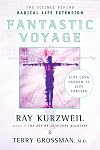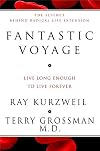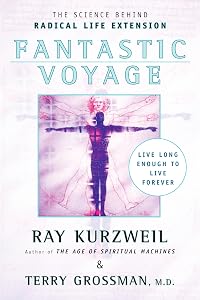
Fantastic Voyage: Live Long Enough to Live Forever
by Ray Kurzweil, Terry Grossman
On This Page
Description
From the author of How to Create a Mind comes a book about the science behind radical life extension. Startling discoveries in the areas of genomics, biotechnology, and nanotechnology occur practically every day. The rewards of this research, some of it as spectacular as science fiction, are practically in our grasp. Fantastic Voyage shows us how we can use these new technologies to live longer than previously imaginable. The authors take the reader on a journey to undreamed-of vitality show more with a comprehensive investigation into the cutting-edge science regarding diet, supplementation, genetics, detoxification, and the hormones involved with aging and youth. By following their program, which includes such simple recommendations as eating a balanced, low-glycemic-index diet, and taking powerful anti-aging nutritional supplements, anyone will be able to add years of healthy, active life. show lessTags
Recommendations













Member Reviews
An important book that helped make radical life extension a pop theme for many years after. The hypothesis so far has not quite worked except for extremely wealthy people and complicated treatments that seem to offer an edge.
What is really important and a shift that society still has to make is to emphasise mantaining good health, avoiding disease as being more important than repairing what goes wrong. This emerges automatically from healthy life extension movements.
What is really important and a shift that society still has to make is to emphasise mantaining good health, avoiding disease as being more important than repairing what goes wrong. This emerges automatically from healthy life extension movements.
img src="http://1.bp.blogspot.com/_3wqjVl3r5N4/TFJZXT4jl2I/AAAAAAAAAAM/Jsc1ta6T0pE/s320/6688f920.gif" width="320" height="56" alt="T"/>
High-tech problems
Has your computer ever gotten a glitch or a virus, causing it to freeze up, run extremely slow, or get the "blue screen of death"? Most people have experienced something like this at one time or another, but apparently Ray Kurzweil never has. His faith in technology is so complete, so blinded by love, that he actually dreams of a day when we can remove all our natural red blood cells from circulation, and replace them with "more efficient" nanotechnology robots, which will not only deliver oxygen, but perform other helpful functions as well.
I don't doubt that medical science will show more continue to amaze us all with new developments, including in vivo nano-bots one day, but Kurzweil's vision looks more reckless than appealing. Maybe Kurzweil should consider the following scenerio:
There's nothing wrong with dreaming big- in fact, that seems to be what Kurzweil is paid for, but his dreams appear to be untempered by caution or skepticism. Should I really be excited about replacing all my organs with proprietary technology? And how much is all this going to cost? And who's going to pay for it?
This isn't for you
The prospect of living forever is exciting, but don't rush out and get a 3500 year mortgage on your house just yet. It should be obvious that not everybody will be able to afford Kurzweil's life-extension program. So where are these developments heading? A two-tiered society composed of wealthy semi-immortals, and short-lived poor? Even if life-extending technologies were distributed justly, what would happen to society if people suddenly started to live for 2500 years? (Kurzweil throws that number out there, but later says that life may be able to be extended indefinitely) And it wouldn't be just any people living 2500 years, it would specifically be the super-rich. Imagine how much more difficult it would have been to abolish slavery in the U.S. if a large fraction of the wealthiest Americans were 2500-year-olds who had owned slaves back in the days of ancient Greece and the Roman Empire.
This isn't for you
One doesn't need to contemplate the implications of this book for long to realize it would be truly terrifying if Kurzweil's vision comes to pass. Time is the biggest commodity you need to get rich. Extended life would make the super-rich richer (and the poor poorer). What's worse: simple arithmetic demonstrates what a population problem we'd have if a lot of people started living 2500 years or more. The result would force a lot of hard questions on the public about limits on childbearing, euthenasia, maybe mandatory life limits, etc. The debate would be driven by super-wealthy in a position to influence both the media and public policy makers. It seems likely that they would conclude that the super-rich immortal are entitled to their demigodhood, and the rest of us should somehow suck it up, either by having fewer kids, and/or by accepting lower and lower lifespans. The magazine "H+" (which stands for "Humanity +", a reference to the enhanced humans Kurzweil wishes to create) hints at two possible approaches to this problem: 1) replace real sex with cybersex; or 2) bioengineering ways to make the sex act neurologically displeasurable to the general population. Gee, where have I heard that before? So, to enable our political and financial Elite to obtain immortality, we all have to become celibate? I guess progress has its price.
This isn't for you
Kurzweil is smart to steer clear of the social questions in this book, and to stick to the scientific aspects of his "fantastic voyage". If you look to outside sources, you can learn that he is well aware of the social issues, and has no problem with the two-tiered society I've described. You can check out an interview in which he imagines the "unenhanced" will be as bacteria to biogenetic/nanotech modified superhumans.
This isn't for you
I am certainly onboard with reducing human sufferring, and giving people longer, more productive lives. Fantastic Voyage, however, is not about that at all. It is the basis for an envisioned social system which would be inequitable by intention. In fact, by necessity, it is about giving some people (i.e. most of us) shorter, less fulfilled lives (if you consider children in your life to be a blessing, if you enjoy real sex with real partners, or if you do not wish to reengineer the orgasm into an unpleasant experience). From a biologic standpoint, Kurzweil's ambitions possess a hubris on the level of Icarus. Unless we plan on agressively colonizing space in the next few decades, I do not see how his vision can end in anything but extreme injustice.
Edit: More about all this from Manny show less
High-tech problems
Has your computer ever gotten a glitch or a virus, causing it to freeze up, run extremely slow, or get the "blue screen of death"? Most people have experienced something like this at one time or another, but apparently Ray Kurzweil never has. His faith in technology is so complete, so blinded by love, that he actually dreams of a day when we can remove all our natural red blood cells from circulation, and replace them with "more efficient" nanotechnology robots, which will not only deliver oxygen, but perform other helpful functions as well.
I don't doubt that medical science will show more continue to amaze us all with new developments, including in vivo nano-bots one day, but Kurzweil's vision looks more reckless than appealing. Maybe Kurzweil should consider the following scenerio:
====================================
TS:Welcome to Bio-nano-dyne Tech Support... (in a thick Indian accent) my name is Kevin, how can I help you?
Kurzweil: Uh...yeah...my name is Ray Kurzweil... I just replaced all my natural red blood cells with your OxygenMaster 3000 (TM) cells, and I don't feel so good. I'm sweating in buckets, my piss is green, and I have double.. make that triple.. vision.
TS: Oh, I think I can help you, Sir... Let me ask you: do you have a Jarvik 6 heart?
Kurzweil: Yeah, but it's never been a problem before.
TS: Oh yes... we've discovered a slight glitch in the OxygenMaster 3000 (TM) series when used with the Jarvik 6 heart, but don't worry, we've corrected it! You'll just have to install a patch. Have you been to our website?
Kurzweil: Oh God, can you please call me an ambulance?!?
TS: After you install the patch, you'll have to reboot the system. Do you have a friend with you, and a set of defibrillator paddles?...
=====================================
There's nothing wrong with dreaming big- in fact, that seems to be what Kurzweil is paid for, but his dreams appear to be untempered by caution or skepticism. Should I really be excited about replacing all my organs with proprietary technology? And how much is all this going to cost? And who's going to pay for it?
This isn't for you
The prospect of living forever is exciting, but don't rush out and get a 3500 year mortgage on your house just yet. It should be obvious that not everybody will be able to afford Kurzweil's life-extension program. So where are these developments heading? A two-tiered society composed of wealthy semi-immortals, and short-lived poor? Even if life-extending technologies were distributed justly, what would happen to society if people suddenly started to live for 2500 years? (Kurzweil throws that number out there, but later says that life may be able to be extended indefinitely) And it wouldn't be just any people living 2500 years, it would specifically be the super-rich. Imagine how much more difficult it would have been to abolish slavery in the U.S. if a large fraction of the wealthiest Americans were 2500-year-olds who had owned slaves back in the days of ancient Greece and the Roman Empire.
This isn't for you
One doesn't need to contemplate the implications of this book for long to realize it would be truly terrifying if Kurzweil's vision comes to pass. Time is the biggest commodity you need to get rich. Extended life would make the super-rich richer (and the poor poorer). What's worse: simple arithmetic demonstrates what a population problem we'd have if a lot of people started living 2500 years or more. The result would force a lot of hard questions on the public about limits on childbearing, euthenasia, maybe mandatory life limits, etc. The debate would be driven by super-wealthy in a position to influence both the media and public policy makers. It seems likely that they would conclude that the super-rich immortal are entitled to their demigodhood, and the rest of us should somehow suck it up, either by having fewer kids, and/or by accepting lower and lower lifespans. The magazine "H+" (which stands for "Humanity +", a reference to the enhanced humans Kurzweil wishes to create) hints at two possible approaches to this problem: 1) replace real sex with cybersex; or 2) bioengineering ways to make the sex act neurologically displeasurable to the general population. Gee, where have I heard that before? So, to enable our political and financial Elite to obtain immortality, we all have to become celibate? I guess progress has its price.
This isn't for you
Kurzweil is smart to steer clear of the social questions in this book, and to stick to the scientific aspects of his "fantastic voyage". If you look to outside sources, you can learn that he is well aware of the social issues, and has no problem with the two-tiered society I've described. You can check out an interview in which he imagines the "unenhanced" will be as bacteria to biogenetic/nanotech modified superhumans.
This isn't for you
I am certainly onboard with reducing human sufferring, and giving people longer, more productive lives. Fantastic Voyage, however, is not about that at all. It is the basis for an envisioned social system which would be inequitable by intention. In fact, by necessity, it is about giving some people (i.e. most of us) shorter, less fulfilled lives (if you consider children in your life to be a blessing, if you enjoy real sex with real partners, or if you do not wish to reengineer the orgasm into an unpleasant experience). From a biologic standpoint, Kurzweil's ambitions possess a hubris on the level of Icarus. Unless we plan on agressively colonizing space in the next few decades, I do not see how his vision can end in anything but extreme injustice.
Edit: More about all this from Manny show less
The authors believe that nanotechnology will make open-ended life extension possible a few decades hence. As a bridge to that, people will need to avail themselves of big biotechnology advances that should exist by around 2020. And as a bridge to *that*, people at the present time need to pay a lot of attention to their nutrition and other things that affect their aging rate. Most of the book is about this first bridge. (It would all be consistent with my long-held suspicion that the Age of Immortality is scheduled to begin just after my expiry.) Kurzweil is well known as one of the strongest proponents of strong AI. He is 56 but intends to live indefinitely. His personal health regime includes -- can you believe it? -- 250 supplement show more pills a day and weekly clinic visits for therapies and injections. www.fantastic-voyage.net show less
I'm interested, but man, this book was stuffy.
Explores the development of science in the field of biotechnology with in depth research in to latest medical trends, and nutritional information. Both a predictive op-ed as well as a reference manual.
Overly speculative.
Members
- Recently Added By
Author Information

18+ Works 7,032 Members
Ray Kurzweil was born on February 12, 1948. He was the principal developer of the first CCD flat-bed scanner, the first omni-font optical character recognition, the first print-to-speech reading machine for the blind, the first text-to-speech synthesizer, the first music synthesizer capable of recreating the grand piano and other orchestral show more instruments, and the first commercially marketed large-vocabulary speech recognition. He has received numerous awards including the MIT-Lemelson Prize and the National Medal of Technology. In 2002, he was inducted into the National Inventor's Hall of Fame. He has written several books including The Age of Spiritual Machines, The Age of Intelligent Machines, The Singularity Is Near, and How to Create a Mind: The Secret of Human Thought Revealed. (Bowker Author Biography) show less
3 Works 743 Members
Work Relationships
Reference guide/companion to
Classifications
- Genres
- Nonfiction, Science & Nature, Health & Wellness, General Nonfiction, Technology
- DDC/MDS
- 610 — Applied science & technology Medicine & health Medicine and health
- LCC
- RA776.75 .K875 — Medicine Public aspects of medicine Public aspects of medicine Public health. Hygiene. Preventive medicine Personal health and hygiene
- BISAC
Statistics
- Members
- 509
- Popularity
- 59,393
- Reviews
- 7
- Rating
- (3.54)
- Languages
- Czech, English, French, Portuguese
- Media
- Paper, Ebook
- ISBNs
- 7
- ASINs
- 4