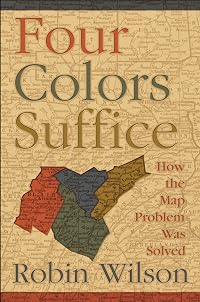
Four Colors Suffice: How the Map Problem Was Solved
by Robin Wilson
On This Page
Description
On October 23, 1852, Professor Augustus De Morgan wrote a letter to a colleague, unaware that he was launching one of the most famous mathematical conundrums in history--one that would confound thousands of puzzlers for more than a century. This is the amazing story of how the "map problem" was solved. The problem posed in the letter came from a former student: What is the least possible number of colors needed to fill in any map (real or invented) so that neighboring counties are always show more colored differently? This deceptively simple question was of minimal interest to cartographers, who saw little need to limit how many colors they used. But the problem set off a frenzy among professional mathematicians and amateur problem solvers, among them Lewis Carroll, an astronomer, a botanist, an obsessive golfer, the Bishop of London, a man who set his watch only once a year, a California traffic cop, and a bridegroom who spent his honeymoon coloring maps. In their pursuit of the solution, mathematicians painted maps on doughnuts and horseshoes and played with patterned soccer balls and the great rhombicuboctahedron. It would be more than one hundred years (and countless colored maps) later before the result was finally established. Even then, difficult questions remained, and the intricate solution--which involved no fewer than 1,200 hours of computer time--was greeted with as much dismay as enthusiasm. Providing a clear and elegant explanation of the problem and the proof, Robin Wilson tells how a seemingly innocuous question baffled great minds and stimulated exciting mathematics with far-flung applications. This is the entertaining story of those who failed to prove, and those who ultimately did prove, that four colors do indeed suffice to color any map. This new edition features many color illustrations. It also includes a new foreword by Ian Stewart on the importance of the map problem and how it was solved. show lessTags
Recommendations







Member Recommendations
by anonymous user
Member Reviews
Interesting, and well-presented. It's more about math and less about maps than I'd thought, but those are both interests of mine so it worked. The history of a math problem - not just "can every map be colored with no more than four colors so that no two countries that share a border have the same color" - but can that be _proved_. Chapter after chapter, he'd mention that it had been proved that the theory was true for any map with no more than...20, 50, 150 countries. But is it true for _all_ maps? The question kept getting more abstract - from maps, to geometric shapes, to graphs of connected points. There were a lot of proofs that were eventually shown not to be proofs - holes in their logic. The final answer (the question was first show more posed in the mid-1800s; the answer came in 1976) required a computer to work the proof, and was greeted with a good deal of skepticism thereby. Was it really a proof if a human hadn't done all the steps? I found that part particularly interesting. It's a question I'd heard of vaguely, and I'm glad I read this; I now understand the question, at least, though the details of the math began to escape me near the end. Definitely worth reading. show less
This is a relatively brief (228 pages with lots of illustrations) and coherent history of the 4-color map problem. A map is what you think it is, a surface with boundaries between regions. Other rules: the map may be on a sphere but it may not be on a torus (donut) or other 3D form with a hole, each region is independent (so not a map of the world in which some countries are split into parts that must be the same color), and the boundary is defined as more than a single point (n regions that meet in the center of a pie do not require n colors to be distinct). The problem made its appearance in 1852, when a student asked a professor, who asked a friend... and remained unsolved until 1976. It rose to notoriety because it's a simple show more question that was difficult to answer, and it was worth tackling because effort on any one problem can yield results that apply to other problems. One strategy was to prove the impossibility of a "minimal criminal": a minimal counterexample with a configuration of regions such that (a) the configuration _cannot_ be colored with 4 colors, but (b) any sub-configuration (the same configuration with one or more regions removed) _can_ be colored with 4 colors. A configuration might be a square (a region surrounded by four others), or a cluster of three pentagons (three regions each surrounded by five others), etc. Various mathematicians over decades contributed proofs regarding specific configurations of increasing complexity, and different methods of determining their properties. The strategy that eventually led to a proof was to find an "unavoidable set" (a set of regions one or more of which _must_ be in any map) of "reducible configurations" (configurations that may not be in a minimal criminal). The proof, by Kenneth Appel and Wolfgang Haken, consisted of nearly 2000 such configurations verified by a computer program, and was disturbing for its inelegance and non-transparency, to the extent that one math department deemed Appel and Haken a bad influence and barred them from meeting students. The proof has since been streamlined, but not fundamentally changed. The book is nicely presented in chronological order, with concepts succinctly explained and helpfully illustrated, especially in the earlier stages when things were still relatively straightforward. It becomes less clear in the later stages, but this is not the fault of the author, as the details are far too numerous for this sort of publication.
(read 27 Jun 2011) show less
(read 27 Jun 2011) show less
I don't know why this book has so many low ratings; they're entirely undeserved. Wilson makes clear the important conceptual issues without going into too much minute detail, and does it in a way that's thoroughly entertaining to read. The book strikes a good balance between humorous anecdotes and serious mathematics. If you don't have any interest in math, you obviously shouldn't bother with this book. On the other hand, if you're looking for a textbook, this isn't it--and it's not supposed to be.
I first came across the four colour problem a few years back when I was planning to make a map of the countries I've read from. Although there are some exceptions (although nit on the world map), I found it very interesting when I discovered it and of course started basing my reading map on it. I was surprised to find my library had a book about it and decided to pick it up. This is an interesting book about the theorem that looks at some of its key players. Although some parts are more maths heavy with more of a focus on formulas (especially the chapter on Euler) I think it's pretty accessible overall and you can understand the history without understanding all the formulas. There are plenty of diagrams to explain what is being described.
Excellent: On the surface the four colour theorem may seem like a dull story for a book like this. But Robin Wilson does a great job of making this a fascinating story. I was hooked from the start. It doesn't get too technical but nevertheless you do get an idea, though perhaps not a complete understanding, of how and why the proof worked. A great read for any 'popular science' fan. If you enjoy Simon Singh, Ian Stewart and the like, you'll like this too.
The title Four Colors Suffice refers to a simple mathematics problem that was first discussed in the 1850's. Namely, how many colors does it take to color a map so that no two bordering countries have the same color? The answer appeared to be 4 colors, but proving that took 150 years and required the use of computers. This book traces the history of the problem from the first publications to the proof of it in 1976, plus a discussion of the validity of a computer proof.
The writing overall was fine -- not brilliant, not poor, but somewhere in the middle. For some of the mathematics, the discussion was a bit unclear and hard to follow. (Yes, the methods used by various attempted proofs are difficult topics, but even having a decent show more mathematical background, I had to reread several pages to understand what he was trying to say.) The diagrams were terrific! The history was well researched with notes and a bibliography.
On the down side, the book lacked somewhat. As mentioned above, some areas were obtuse. Also some topics, such as why this is an important problem and not just a "let's see if we can prove it" type of problem, were alluded to but never really discussed. Wilson stated several places that the math used to solve this problem led to other important results, such as...well, he never says. Also, the final section as to whether or not the proof is valid felt like it was added later, without much enthusiasm. Proof by exhaustive computer search is a very interesting question -- is it really a proof? I understand that a thorough discussion would involve a lot of discussion of computer programming, but this book (as evidenced by the level of math when discussing the historic proofs) is aimed for a mathematical literate audience that could understand the basics of the computer issues.
Overall, the history part of the book was fine, but the "we have a proof" section was lacking. I will probably read it again at sometime, but not terribly soon. show less
The writing overall was fine -- not brilliant, not poor, but somewhere in the middle. For some of the mathematics, the discussion was a bit unclear and hard to follow. (Yes, the methods used by various attempted proofs are difficult topics, but even having a decent show more mathematical background, I had to reread several pages to understand what he was trying to say.) The diagrams were terrific! The history was well researched with notes and a bibliography.
On the down side, the book lacked somewhat. As mentioned above, some areas were obtuse. Also some topics, such as why this is an important problem and not just a "let's see if we can prove it" type of problem, were alluded to but never really discussed. Wilson stated several places that the math used to solve this problem led to other important results, such as...well, he never says. Also, the final section as to whether or not the proof is valid felt like it was added later, without much enthusiasm. Proof by exhaustive computer search is a very interesting question -- is it really a proof? I understand that a thorough discussion would involve a lot of discussion of computer programming, but this book (as evidenced by the level of math when discussing the historic proofs) is aimed for a mathematical literate audience that could understand the basics of the computer issues.
Overall, the history part of the book was fine, but the "we have a proof" section was lacking. I will probably read it again at sometime, but not terribly soon. show less
3756. Four Colors Suffice: How the Map Problem Was Solved, by Robin Wilson (read June 9 2003) This book tells us that four colors are all that are necessary so that each country will not on a map touch another country of the same color. It delves into impossibly complex mathematics which I could never hope to understand, so I just read it as history of the question, first posed in 1852 and the subject of controversy and inquiry for over a century since. The proof that four colors suffice involves huge amounts of computer time. So, I know four colors suffice--which a month ago I did not know! Big deal.
Members
- Recently Added By
Author Information

11+ Works 906 Members
Series
Belongs to Publisher Series
Common Knowledge
- Original publication date
- 2002
- Dedication
- In memory of John Fauvel, who encouraged me to write this book.
- First words
- It is rare for a mathematical problem to catch the attention of the general public. (Preface)
Before we embark upon our historical journey, there are a number of basic questions to be answered. (Chapter 1) - Last words
- (Click to show. Warning: May contain spoilers.)With these thoughts of the future in our minds, we leave our last poetic musings to Bill Tuttle:
The Four Colour Theorem is the tip of the iceberg,
the end of the wedge
and the first cuckoo of Spring.
Classifications
Statistics
- Members
- 325
- Popularity
- 98,325
- Reviews
- 9
- Rating
- (3.42)
- Languages
- English
- Media
- Paper, Ebook
- ISBNs
- 6