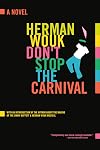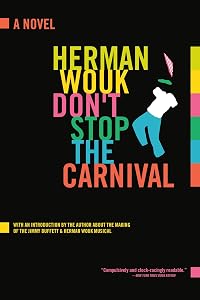
Don't Stop the Carnival
by Herman Wouk
On This Page
Description
The basis for the Herman Wouk-Jimmy Buffett musical: A middle-aged New Yorker buys a Caribbean hotel and learns that paradise has its drawbacks. Broadway press agent Norman Paperman is pushing fifty with one heart attack already under his belt. So, he decides to chuck the stressful Manhattan life and bring his wife and teenage daughter to a lush green island. With the help of a wheeler-dealer friend, he winds up buying a small hotel. How hard could running one be? Pretty hard, actually, when show more you throw in an earthquake, plumbing problems, rampaging ants, and a few more unexpected developments at the Gull Reef Club. Before long, Norman's spirit is as drained as his bank account, his marriage is on the brink, and he's desperately searching for a way out of this beautiful "Don't Stop the Carnival" is a clever comic departure for the award-winning, #1 New York Times-bestselling author of such classics as "Marjorie Morningstar", "The Winds of War", and "The Caine Mutiny"and eventually served as the basis for the celebrated Jimmy Buffett album and stage musical. show lessTags
Recommendations





















Member Reviews
If you are ever remotely tempted by the idea of running a hotel in the Caribbean, read this book first!
Norman Paperman, a New York executive, decided to run a hotel in fictional Amerigo, said to be Grenada. He had heart problems and believed the more relaxed lifestyle would be just the ticket. Idyllic, yes, but before he could pick up his first Planter's Punch he ran into problems. The financing arrangement came as a shock and too late to do anything about it, the barman/accountant ran off with the departing owner, water storage was primitive, water supply even worse, and the renovation was ... well, you know what trouble a reno can be at the best of times.
This book was funny, the characters were well-developed - coming from the show more author of The Caine Mutiny this was to be expected. There were occasional dated attitudes, typical in 1965 when the book was written, but all in all an enjoyable read. It was inspired by the personal experience of Wouk and his wife who ran a hotel in the Caribbean. Like the Wouks, Norman and Henny Paperman survived the adventure. show less
Norman Paperman, a New York executive, decided to run a hotel in fictional Amerigo, said to be Grenada. He had heart problems and believed the more relaxed lifestyle would be just the ticket. Idyllic, yes, but before he could pick up his first Planter's Punch he ran into problems. The financing arrangement came as a shock and too late to do anything about it, the barman/accountant ran off with the departing owner, water storage was primitive, water supply even worse, and the renovation was ... well, you know what trouble a reno can be at the best of times.
This book was funny, the characters were well-developed - coming from the show more author of The Caine Mutiny this was to be expected. There were occasional dated attitudes, typical in 1965 when the book was written, but all in all an enjoyable read. It was inspired by the personal experience of Wouk and his wife who ran a hotel in the Caribbean. Like the Wouks, Norman and Henny Paperman survived the adventure. show less
http://andalittlewine.blogspot.com/2013/01/dont-stop-carnival-by-herman-wouk.htm....
I struggled to finish Herman Wouk's Don't Stop the Carnival, not because it was hard to read, but because it was too familiar. In fact, a couple years ago it went into the Did Not Finish pile, and only recently was re-exposed to the light of day.
Listen: I grew with a father who was an incorrigible Jimmy Buffett fan. So, yes, of course I knew Buffett's musical adaptation of Don't Stop the Carnival long before I knew that it was based on a book. And the adaptation is faithful; Wouk even worked with Buffett to produce the musical.
Listen: while it may have been a scathing, and daring, critique of American business culture, involvement in the Caribbean, and show more race relations in 1965- fifty years will take the edge off most anything.
Norman Paperman is a workaholic, a philanderer and emotionally vacuous. And when he can't have his life the way he's always imagined it, he packs up his toys and goes home. I suppose I should feel either pity or satisfaction that he gets his come-uppance, but I've seen it coming- and I think I would have seen it coming even if I hadn't known the Buffett version. I'm indifferent to his struggles.
I think of Graham Greene's The Heart of the Matter, about a British soldier in colonial Africa torn between his love for his wife and his feelings for a native girl. Published nearly twenty years before Don't Stop the Carnival, Greene's novel has maintained its urgency because it is built around a central character who is tragically flawed, and whose desires are as sincere as they are irreconcilable.
Much of Don't Stop the Carnival is satirical: the shiftless natives, the Byzantine labor laws, the island's incestuous internal politics. But the institutions being satirized are so long gone, I need to do serious research to see much more than the joke.
Is it about the moral vacillations of white people who say they want social change, but please not too much and don't let it disrupt my life... ? Is it about the arrogance of a business man to think he can be successful at any endeavor... ?
I've heard these jokes before, and I've heard better ones, too. show less
I struggled to finish Herman Wouk's Don't Stop the Carnival, not because it was hard to read, but because it was too familiar. In fact, a couple years ago it went into the Did Not Finish pile, and only recently was re-exposed to the light of day.
Listen: I grew with a father who was an incorrigible Jimmy Buffett fan. So, yes, of course I knew Buffett's musical adaptation of Don't Stop the Carnival long before I knew that it was based on a book. And the adaptation is faithful; Wouk even worked with Buffett to produce the musical.
Listen: while it may have been a scathing, and daring, critique of American business culture, involvement in the Caribbean, and show more race relations in 1965- fifty years will take the edge off most anything.
Norman Paperman is a workaholic, a philanderer and emotionally vacuous. And when he can't have his life the way he's always imagined it, he packs up his toys and goes home. I suppose I should feel either pity or satisfaction that he gets his come-uppance, but I've seen it coming- and I think I would have seen it coming even if I hadn't known the Buffett version. I'm indifferent to his struggles.
I think of Graham Greene's The Heart of the Matter, about a British soldier in colonial Africa torn between his love for his wife and his feelings for a native girl. Published nearly twenty years before Don't Stop the Carnival, Greene's novel has maintained its urgency because it is built around a central character who is tragically flawed, and whose desires are as sincere as they are irreconcilable.
Much of Don't Stop the Carnival is satirical: the shiftless natives, the Byzantine labor laws, the island's incestuous internal politics. But the institutions being satirized are so long gone, I need to do serious research to see much more than the joke.
Is it about the moral vacillations of white people who say they want social change, but please not too much and don't let it disrupt my life... ? Is it about the arrogance of a business man to think he can be successful at any endeavor... ?
I've heard these jokes before, and I've heard better ones, too. show less
Don't stop the carnival by Wouk_ Herman
Like this book because it's about a Carribean island where a lot of people visit for various reasons and they find want they were looking for.
One man, has had a heart attack and is recuperating but he knows business and helps others out by expanding their places to allocate more space for more beds, etc and it brings in a lot more money.
Like the descriptions of the area and the culture.
Money is in land deals and they are abundant-using others money to get the land, what a concept and it's working-for some.
Job and workers always need more money and there are diasters every day with help and land.
I received this book from National Library Service for my BARD (Braille Audio Reading Device).
Like this book because it's about a Carribean island where a lot of people visit for various reasons and they find want they were looking for.
One man, has had a heart attack and is recuperating but he knows business and helps others out by expanding their places to allocate more space for more beds, etc and it brings in a lot more money.
Like the descriptions of the area and the culture.
Money is in land deals and they are abundant-using others money to get the land, what a concept and it's working-for some.
Job and workers always need more money and there are diasters every day with help and land.
I received this book from National Library Service for my BARD (Braille Audio Reading Device).
I’m going to finish this, but more out of grim determination than anything else. There are so many isms that seem to come so naturally to the period. I donÂt know why they shock me so. It isnÂt as if I never read older works. I think one of the things I find most distressing is his casual assumption that itÂs perfectly okay for men to have affairs, but not women. He divides his characters along strict moral and gender lines, and it never occurs to him to do differently. There are good women and bad women and sluts everywhere. When someone like Siddons writes about the period it is with the understanding that good girls would like to be doing it, Âno, that isnÂt it. Siddons doesnÂt assume that some girls are good and show more some are bad. She has characters who play by the rules and others who donÂt but she takes the time to explain why and how. A character may be shocked if another one has sex, but Siddons isnÂt shocked. Someone may call someone else a slut, but Siddons doesnÂt. Wauk on the other hand keeps letting his male characters sleep with girls and discard them like used Kleenex, and neither the characters, nor Wauk think thatÂs wrong. He agrees with the stereotypes, and heÂs lazy about it, and that I do not approve of.
I finally finished it. It was a chore, I didnÂt really want to. When I was done I wished I hadnÂt made myself do it. Do you know how he ends the thing? IÂm infuriated. Night of the big party Hyppolite the murderous one comes for Atlas, and after a week or so of heavy drinking and no food, Janet/Iris dresses up and comes to the party. Nothing happens. Hyppolite frightens Esmé and she goes into labor, but manages to have her baby in the hospital and all. Janet/Iris falls down and scratches up her face and her dog is slashed by Hyppolite. ThatÂs all. Essentially everything goes off without a hitch. And then the next day a policeman comes to get the facts on Hyppolite and ends up shooting Hassim and killing him. No good reason, just a stupid thing. And then Janet/Iris borrows NormanÂs car to go pick up her dog at the vet, and she has an accident and dies. SheÂs not drunk or anything. A cab driver stops in the middle of the road to talk to a girl, and she comes up and runs into him, and goes flying out the windshield. Stupid. Far all the concern about her drinking herself to death, she dies in a perfectly normal car accident. For all the fear of the murderous Hyppolite, he doesnÂt harm anyone. There are two other big expectations: that Norman will go broke and that his wife will leave him if he has another affair. Norman pulls out of the island hotel business at least even, maybe ahead a little, and when Henny realizes that he slept with Janet/Iris (after sheÂs dead) not only does she not leave him, she ends up comforting him.
The worst thing about it all is that Wauk hasnÂt set up these expectations in order to fulfill them in an unexpected way, nor has he set it all up to make a joke of how the things we worry about never come true. ItÂs as if heÂd worked on this novel, painstakingly crafted it, and someone else came along and wrote the last chapter using the same characters. The characterizations are so poor that I canÂt figure out who Norman all of a sudden decides to leave. ItÂs crazy. One of the most frustrating books IÂve ever read. show less
I finally finished it. It was a chore, I didnÂt really want to. When I was done I wished I hadnÂt made myself do it. Do you know how he ends the thing? IÂm infuriated. Night of the big party Hyppolite the murderous one comes for Atlas, and after a week or so of heavy drinking and no food, Janet/Iris dresses up and comes to the party. Nothing happens. Hyppolite frightens Esmé and she goes into labor, but manages to have her baby in the hospital and all. Janet/Iris falls down and scratches up her face and her dog is slashed by Hyppolite. ThatÂs all. Essentially everything goes off without a hitch. And then the next day a policeman comes to get the facts on Hyppolite and ends up shooting Hassim and killing him. No good reason, just a stupid thing. And then Janet/Iris borrows NormanÂs car to go pick up her dog at the vet, and she has an accident and dies. SheÂs not drunk or anything. A cab driver stops in the middle of the road to talk to a girl, and she comes up and runs into him, and goes flying out the windshield. Stupid. Far all the concern about her drinking herself to death, she dies in a perfectly normal car accident. For all the fear of the murderous Hyppolite, he doesnÂt harm anyone. There are two other big expectations: that Norman will go broke and that his wife will leave him if he has another affair. Norman pulls out of the island hotel business at least even, maybe ahead a little, and when Henny realizes that he slept with Janet/Iris (after sheÂs dead) not only does she not leave him, she ends up comforting him.
The worst thing about it all is that Wauk hasnÂt set up these expectations in order to fulfill them in an unexpected way, nor has he set it all up to make a joke of how the things we worry about never come true. ItÂs as if heÂd worked on this novel, painstakingly crafted it, and someone else came along and wrote the last chapter using the same characters. The characterizations are so poor that I canÂt figure out who Norman all of a sudden decides to leave. ItÂs crazy. One of the most frustrating books IÂve ever read. show less
Mmm, not so good, actually. It feels as if Wouk didn't quite know whether he wanted to write a 'real' novel with characters that develop, or rather some satirical entertainment filled with caricatures.
The never ending row of misfortunes that occur while Paperman (what's in a name) tries to set up a hotel in the Caribbean doesn't strike me as funny after the umpteenth catastrophe. Catastrophes that become a habit do not really move or shock the reader anymore.
The lackadaisical and innocent but cunning natives, the boorish American businessman Atlas, Paperman's daughter Hazel and her boyfriend, the maniacal bartender Church, they are clearly conceived with satire in mind. They act only as prototypes would, not as human beings. Therefore show more they do not blend at all with the attempts to incorporate a 'real' character, the tragic Iris, whose sorry development into an alcoholic is much too obvious and foreseeable. Paperman himself is neither fish nor fowl, part caricature, part psychological character.
When finally Paperman seems to succeed, his hotel becoming the hit of the island, he throws in the towel for no understandable reason. Frustrating...
The language is fine, though, some of the conversations are exhilarating and the text is readable throughout. show less
The never ending row of misfortunes that occur while Paperman (what's in a name) tries to set up a hotel in the Caribbean doesn't strike me as funny after the umpteenth catastrophe. Catastrophes that become a habit do not really move or shock the reader anymore.
The lackadaisical and innocent but cunning natives, the boorish American businessman Atlas, Paperman's daughter Hazel and her boyfriend, the maniacal bartender Church, they are clearly conceived with satire in mind. They act only as prototypes would, not as human beings. Therefore show more they do not blend at all with the attempts to incorporate a 'real' character, the tragic Iris, whose sorry development into an alcoholic is much too obvious and foreseeable. Paperman himself is neither fish nor fowl, part caricature, part psychological character.
When finally Paperman seems to succeed, his hotel becoming the hit of the island, he throws in the towel for no understandable reason. Frustrating...
The language is fine, though, some of the conversations are exhilarating and the text is readable throughout. show less
What a great read. I was in the Caribbean 4 years ago for an extended stay, visited 6 English speaking islands, and 45 years later this is still "spot on". There are also some very good insights into New York and one eerie sentence:
"Instead of bomb shelters we construct giagantic frail glass buildings all over Manhattanat Ground Zero, a thousand feet high open to the sky, like a woman undressing before an open window and provoking him to rape her."
"Instead of bomb shelters we construct giagantic frail glass buildings all over Manhattanat Ground Zero, a thousand feet high open to the sky, like a woman undressing before an open window and provoking him to rape her."
Not too long ago, I finished reading Mr. Blandings Builds His Dream House and I was thoroughly disappointed. From the hype (various movies and many reprints), I expected more. I had no expectations going into Don’t Stop the Carnival. And yet, when I started the book, I began having the same fears and disappointments and “disbelief in characters” (a new phrase I just made up) I felt with Blandings – the problem being that I felt no sympathy for these schlubs who bought into investments without any common sense.
Maybe it was worsened because I had just read Blandings, but it took me a while to get past that hint of distaste in the back of my mind. But I’m glad I got past it.
Wouk (much more famous for his war novels – in show more particular, The Caine Mutiny) tells the story of a New York promoter Norman Paperman who, swept up in the beauty of the Caribbean island of Amerigo, buys a hotel he will run. It does not go well to start with including a misunderstanding of how much money he and his partner are actually responsible for, a misunderstanding of the laws and politics of the little island, and a misunderstanding of who really does the work. The book is half disaster and half success in adversity.
This beginning is the part I had trouble getting through, watching a clueless man being crushed by circumstance. But Wouk does bring humor to the proceedings – a subtle humor that makes the people more real. And Wouk makes the characters more believable than you first expect - to the point where, when they do stupid things, we really feel sorry for them. And these characterizations and transformations of the people make the transition from disaster to success (no quick fixes, no deus ex machinas) that much more believable.
By the mid-way part of the book, I found myself turned from my earlier revulsion to interest in what was going to happen. In other words, Wouk has made a book about real people (probably because this is an experience he lived for seven years) and real situations (no matter how absurd they may seem) that becomes a pleasure to read. show less
Maybe it was worsened because I had just read Blandings, but it took me a while to get past that hint of distaste in the back of my mind. But I’m glad I got past it.
Wouk (much more famous for his war novels – in show more particular, The Caine Mutiny) tells the story of a New York promoter Norman Paperman who, swept up in the beauty of the Caribbean island of Amerigo, buys a hotel he will run. It does not go well to start with including a misunderstanding of how much money he and his partner are actually responsible for, a misunderstanding of the laws and politics of the little island, and a misunderstanding of who really does the work. The book is half disaster and half success in adversity.
This beginning is the part I had trouble getting through, watching a clueless man being crushed by circumstance. But Wouk does bring humor to the proceedings – a subtle humor that makes the people more real. And Wouk makes the characters more believable than you first expect - to the point where, when they do stupid things, we really feel sorry for them. And these characterizations and transformations of the people make the transition from disaster to success (no quick fixes, no deus ex machinas) that much more believable.
By the mid-way part of the book, I found myself turned from my earlier revulsion to interest in what was going to happen. In other words, Wouk has made a book about real people (probably because this is an experience he lived for seven years) and real situations (no matter how absurd they may seem) that becomes a pleasure to read. show less
Members
- Recently Added By
Lists

discontinued
24 works; 4 members

Publisher's Weekly Bestsellers - Part II - 1940 - 1979
355 works; 6 members
Author Information

84+ Works 19,284 Members
Herman Wouk was born in the Bronx, New York on May 27, 1915. He received a bachelor's degree in comparative literature and philosophy from Columbia University. In 1936, he became a staff writer for the radio comedian Fred Allen. He enlisted in the Navy immediately after Pearl Harbor and was posted as a radio officer in the South Pacific. His debut show more novel, Aurora Dawn, was published in 1947. His other novels included The City Boy, Marjorie Morningstar, Youngblood Hawke, Don't Stop the Carnival, The Winds of War, War and Remembrance, The Hope, The Gift, A Hole in Texas, and The Lawgiver. He received the Pulitzer Prize for fiction in 1952 for The Caine Mutiny. He received the first Library of Congress Lifetime Achievement Award for the Writing of Fiction in 2008. His nonfiction books included This Is My God, The Language God Talks, and Sailor and Fiddler: Reflections of a 100-Year-Old Author. Several of his books were adapted into movies including The Caine Mutiny and Marjorie Morningstar. He adapted the courtroom sections of The Caine Mutiny into the Broadway play The Caine Mutiny Court-Martial. His other Broadway shows included The Traitor and Nature's Way. He died on May 17, 2019 at the age of 103. (Bowker Author Biography) show less
Awards and Honors
Distinctions
Series
Belongs to Publisher Series
Work Relationships
Has the adaptation
Has as a student's study guide
Common Knowledge
- Canonical title
- Don't Stop the Carnival
- Original title
- Don't Stop the Carnival
- Original publication date
- 1965
- People/Characters
- Norman Paperman; Iris Tramm; Henny Paperman; Hazel Paperman; Lester Atlas
- Important places
- Amerigo (fictional island nation | based on Grenada)
- Important events
- Carnival
- First words
- Kinja was the name of the island when it was British.
- Last words
- (Click to show. Warning: May contain spoilers.)"We can just go home."
Classifications
Statistics
- Members
- 783
- Popularity
- 35,865
- Reviews
- 23
- Rating
- (3.72)
- Languages
- English, German, Hungarian, Swedish
- Media
- Paper, Audiobook, Ebook
- ISBNs
- 24
- ASINs
- 19