On This Page
Description
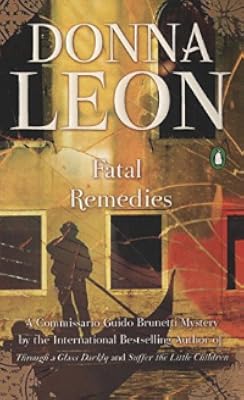
In Fatal Remedies, Brunetti's career is under threat when his professional and personal lives unexpectedly intersect. In the chill of the Venetian dawn, a sudden act of vandalism shatters the quiet of the deserted city, and Brunetti is shocked to find that the culprit waiting to be apprehended at the scene is a member of his own family. Meanwhile, he is also under pressure from his superiors to solve a daring robbery with connections to a suspicious accidental death. Could the two crimes be show more connected? And will Brunetti be able to prove his family's innocence before it's too late? show lessTags
Recommendations





















Member Reviews
Fatal Remedies
Donna Leon
8th in the Commisario Brunetti series, set in Venice, Italy.
An early morning phone call from the Questura summons Brunetti to complete the arrest, for vandalism, of--Paola, his wife. She’s thrown a rock through the window of a travel agency, protesting its knowing complicity in sex tourism to third world countries, where children are prostituted to pederasts. While in sympathy with her rage, Paola has broken the law and put Brunetti in a lose-lose situation; not only is he in a massive argument with Paula, he is put on administrative leave by Vice-Questore Patta because he refuses to either deceive his wife or make deals for her, insisting the she and she alone has to decide whether and how to settle. The whole show more thing becomes a media circus, a nightmare for the family.
Then the owner of the travel agency is murdered, and Patta conveniently forgets that he has suspended Brunetti, giving him the case.
This is one of the best in the series. Leon has taken yet another social issue--sex tourism in third world countries--and has woven an incredible discussion of the different views of the morality of action by means of the very real argument between Brunetti and Paola. There is absolutely nothing forced or preachy or phony about it, and it works like a charm, not only to illuminate the issue but to give incredible depth and intensity to the story. The plot itself is one of her best; there is an unusual amount of action in it, since Leon prefers to write character-driven, real-life stories in a small Italian city that is relatively crime-free. But the action is there, and it’s a page-turner. The denouement is very well done, and is a surprise, a satisfying one.
By this time, if you’re a fan of Leon’s books, you know what to expect in terms of her solid recurring characters, the authenticity of the ambience of Venice, and the way she weaves her plots.
One of the strongest in the series--highly recommended. show less
Donna Leon
8th in the Commisario Brunetti series, set in Venice, Italy.
An early morning phone call from the Questura summons Brunetti to complete the arrest, for vandalism, of--Paola, his wife. She’s thrown a rock through the window of a travel agency, protesting its knowing complicity in sex tourism to third world countries, where children are prostituted to pederasts. While in sympathy with her rage, Paola has broken the law and put Brunetti in a lose-lose situation; not only is he in a massive argument with Paula, he is put on administrative leave by Vice-Questore Patta because he refuses to either deceive his wife or make deals for her, insisting the she and she alone has to decide whether and how to settle. The whole show more thing becomes a media circus, a nightmare for the family.
Then the owner of the travel agency is murdered, and Patta conveniently forgets that he has suspended Brunetti, giving him the case.
This is one of the best in the series. Leon has taken yet another social issue--sex tourism in third world countries--and has woven an incredible discussion of the different views of the morality of action by means of the very real argument between Brunetti and Paola. There is absolutely nothing forced or preachy or phony about it, and it works like a charm, not only to illuminate the issue but to give incredible depth and intensity to the story. The plot itself is one of her best; there is an unusual amount of action in it, since Leon prefers to write character-driven, real-life stories in a small Italian city that is relatively crime-free. But the action is there, and it’s a page-turner. The denouement is very well done, and is a surprise, a satisfying one.
By this time, if you’re a fan of Leon’s books, you know what to expect in terms of her solid recurring characters, the authenticity of the ambience of Venice, and the way she weaves her plots.
One of the strongest in the series--highly recommended. show less
I am tempted to think of this book as a particularly personal statement by the author. As a woman writing about a man, pretending to represent the mind of a very clever man, she calls on some issues important to her as a woman, even using Paola to make the point that a man can never really understand a woman's feelings about sex trafficking.
That segues into a very cleverly plotted murder, with even more cleverness in Brunetti's solving of the murder.
The book ends with a reflection on the ongoing conflict between good and evil. The most personal of her books I have read so far and also a very good story.
That segues into a very cleverly plotted murder, with even more cleverness in Brunetti's solving of the murder.
The book ends with a reflection on the ongoing conflict between good and evil. The most personal of her books I have read so far and also a very good story.
First read after my month on the Lido, commuting by vaporetto to the Biblioteca Marciana to research my books on Giordano Bruno. His first Inquisition Trial was right next to Basilica San Marco, in the little San Teodoro, still closed to all but locals, clerics. I think San Teodoro can be entered from Rio Canonico (also called Rio di Palazzo) behind the Palazzo Ducale—see entrance on the cover of my book, Worlds of Giordano Bruno. [A Facebook page, too.]
Another year we stayed for a week at Campo Santi Apostoli, near where we heard the author lived south of Campo Santa Maria Nova. At any rate, we had great daily experience of the vaporetto routes, and of course the grand Ponte Rialto, built in marble in the 1590’s.
Commissario show more Brunetti lives near Campo San Polo, not too far from playwright Goldoni’s house at the San Toma vaporetto stop. He usually walks from home, across the Rialto bridge, and various routes to arrive at headquarters, the Questura on Rio dei Grechi. Brunetti and I share very few things, but taste in wine— Pinot Grigio—and in books—on “administrative leave” he goes home and reads all of Gibbon’s Decline and Fall.
Unlike many of her novels, where Brunetti solves a crime that the Italian state bureaucracy somehow inhibits prosecuting, here Commissario actually has evidence that will hold up. No spoiler, but the evidence after an inspiration, at home when he almost runs out. Leon does not allow her novels translated into Italian, where they might be seen as an attack on Italian government and its high taxation—which justifies almost envy crime. Here a crime had implicated his wife who protested against a travel agency selling sex-tours to S Asia. She brought a rock from Maine (where I spent my youth summers on 40 acres) to use in her night attack on the agency owned by the rich chemist later found murdered.
Though she herself is American with a British accent (say, “maths” for US “math”), the heart of Donna Leon’s mysteries is very Italian: la casa, la famiglia. House and family. Here, Brunetti’s daughter Chiara (11?) asks “Are you and Mom going to have an argument?
“Why do you say that?
“You always call Mamma ‘your mother’ when you’re going to have an argument with her.”
“Yes, I suppose I do.” (47*).
Chiara had earlier satirized her older brother Raffi, who tells his dad, “I hope you don’t mind I used your razor.” Chiara, “To do what? There’s certainly nothing growing on that face of yours that needs a razor” (31).
As in many of my favorite books*, the US comes in for glancing satire, as in his computer whizz Signorina Elettra, also secretary to his semi-competent boss. Brunetti asks her, “‘Accessed’?”
“It’s computer speak, sir.”
“To access?” he asked. “It’s a verb now.”
“Yes, sir, I believe it is.”
“But it didn’t used to be,” Brunetti said, remembering when it had been a noun.
“I think Americans are allowed to do that to their words, sir”(37).
Wonderful, amusing writing. Many fully drawn characters like the semi-competent boss, Patta, who occasionally impresses the Commissario by bureaucratically positioning crimes out of their jurisdiction. Then there’s Pattta’s kissass Lieut. Scarpa, as well as Brunetti’s faithful officer Vianello and others. While Brunetti has his own office, on a higher floor reached by stairs, officers like Vianello share one large room.
As for suspects, besides his wife Paola—why his boss sends him on “administrative leave,” though he needs him back to solve the crime—there’s a passel of ‘em, including mafiosi, pizzaioli, business successes and failures. And there’s serious business fraud selling deadly potion to UN charities for poor countries.
* Pagination from Penguin, first edition, 1999. show less
Another year we stayed for a week at Campo Santi Apostoli, near where we heard the author lived south of Campo Santa Maria Nova. At any rate, we had great daily experience of the vaporetto routes, and of course the grand Ponte Rialto, built in marble in the 1590’s.
Commissario show more Brunetti lives near Campo San Polo, not too far from playwright Goldoni’s house at the San Toma vaporetto stop. He usually walks from home, across the Rialto bridge, and various routes to arrive at headquarters, the Questura on Rio dei Grechi. Brunetti and I share very few things, but taste in wine— Pinot Grigio—and in books—on “administrative leave” he goes home and reads all of Gibbon’s Decline and Fall.
Unlike many of her novels, where Brunetti solves a crime that the Italian state bureaucracy somehow inhibits prosecuting, here Commissario actually has evidence that will hold up. No spoiler, but the evidence after an inspiration, at home when he almost runs out. Leon does not allow her novels translated into Italian, where they might be seen as an attack on Italian government and its high taxation—which justifies almost envy crime. Here a crime had implicated his wife who protested against a travel agency selling sex-tours to S Asia. She brought a rock from Maine (where I spent my youth summers on 40 acres) to use in her night attack on the agency owned by the rich chemist later found murdered.
Though she herself is American with a British accent (say, “maths” for US “math”), the heart of Donna Leon’s mysteries is very Italian: la casa, la famiglia. House and family. Here, Brunetti’s daughter Chiara (11?) asks “Are you and Mom going to have an argument?
“Why do you say that?
“You always call Mamma ‘your mother’ when you’re going to have an argument with her.”
“Yes, I suppose I do.” (47*).
Chiara had earlier satirized her older brother Raffi, who tells his dad, “I hope you don’t mind I used your razor.” Chiara, “To do what? There’s certainly nothing growing on that face of yours that needs a razor” (31).
As in many of my favorite books*, the US comes in for glancing satire, as in his computer whizz Signorina Elettra, also secretary to his semi-competent boss. Brunetti asks her, “‘Accessed’?”
“It’s computer speak, sir.”
“To access?” he asked. “It’s a verb now.”
“Yes, sir, I believe it is.”
“But it didn’t used to be,” Brunetti said, remembering when it had been a noun.
“I think Americans are allowed to do that to their words, sir”(37).
Wonderful, amusing writing. Many fully drawn characters like the semi-competent boss, Patta, who occasionally impresses the Commissario by bureaucratically positioning crimes out of their jurisdiction. Then there’s Pattta’s kissass Lieut. Scarpa, as well as Brunetti’s faithful officer Vianello and others. While Brunetti has his own office, on a higher floor reached by stairs, officers like Vianello share one large room.
As for suspects, besides his wife Paola—why his boss sends him on “administrative leave,” though he needs him back to solve the crime—there’s a passel of ‘em, including mafiosi, pizzaioli, business successes and failures. And there’s serious business fraud selling deadly potion to UN charities for poor countries.
* Pagination from Penguin, first edition, 1999. show less
As always, Venice is a strong but silent character in a Commissario Brunetti story. And as is her usual custom with this series, Donna Leon highlights a difficult social or social justice issue -- more than one, in fact -- and there's a murder which is not what it seems.
I question the necessity of spoiler hiding, because the event occurs in the first chapter, but anyway...
The thing that made it really difficult for me to suspend disbelief and enjoy the book was the thoughtless crime of Brunette's wife Paola. I can believe, even applaud, that a respected university professor would break the law to pursue a worthy goal. The method she used, however, I question. Breaking a travel agency's plate glass window is violent (and dangerous to show more herself!), but worse, doesn't actually send a message. I would recommend making up a stencil or two saying something like CHILD RAPISTS WELCOME HERE or PEDOPHILE TOURS ARRANGED and spray painting the message all over the window. That would effectively deter business, I would think. There must be other ways; I'm no expert in anarchy and civil disobedience. But breaking a 4-million-lire window is not optimal.
I considered closing the book, returning it to the library, and getting on with the next in the series. But I kept reading for another chapter and then another, and things began to happen. Eventually I ended up appreciating the book. But I still think that Paola had the wrong approach. show less
I question the necessity of spoiler hiding, because the event occurs in the first chapter, but anyway...
I considered closing the book, returning it to the library, and getting on with the next in the series. But I kept reading for another chapter and then another, and things began to happen. Eventually I ended up appreciating the book. But I still think that Paola had the wrong approach. show less
Brunetti finds his own wife in police custody after she admits to having committed an act of civil disobedience in protest of a travel agency that operates sex tours to Asian countries. It isn't long before someone involved with that travel agency is found dead. Brunetti must work through all possibilities to find the person responsible. There's plenty of action to keep the reader engaged. The uncertainties created by his wife's acts add elements of tension. A solid installment in the series.
Commissario Brunetti is not prepared for the phone call that leads to his discovery that his beloved Paola has taken to crime. Her desire to put a stop to the sex tourism industry led her to throw a stone through the window of a local travel agency that arranged for these tours. Before the building’s owner could decide whether he wanted to press charges, he was murdered. Did Paola’s actions motivate the murder, or was there another reason that someone might have wanted to kill Dottor Mitri?
The series seemed to hit its stride again with this book. The investigation of the crime was more satisfactory than that in the previous book in the series. Paola’s vandalism and the motive behind it provided a means to explore the relationship show more between Guido and Paola. The investigation took an unexpected turn, and the murder was wrapped up more satisfactorily than is typical for the series. The series shows no sign yet of growing stale. show less
The series seemed to hit its stride again with this book. The investigation of the crime was more satisfactory than that in the previous book in the series. Paola’s vandalism and the motive behind it provided a means to explore the relationship show more between Guido and Paola. The investigation took an unexpected turn, and the murder was wrapped up more satisfactorily than is typical for the series. The series shows no sign yet of growing stale. show less
It all starts with Paola Brunetti throwing a rock at a shop window and shattering it in the middle of the night. She has her own reasons but vandalism is never an answer - even when your husband is a police commissario and your father is a Count. When the man who owns the window is killed, seemingly because of her actions and accusations, things change even for Paola - her plan was never to cause real harm - she was just trying to highlight the problem of sex-tourism (thus the shop window of the agency being broken). So Guido Brunetti and Count Falier use their separate powers and influences to try to find out what really happened - and to shied and protect Paola. By the end of the novel the rift between the spouses is closed and show more Brunetti finds the truth about the dead man but the novel makes one think seriously about choices and consequences. show less
Members
- Recently Added By
Published Reviews
ThingScore 25
Donna Leon kokettiert mit politischer Unkorrektheit, ist jedoch schlichtweg erzreaktionär. In einer Welt des Sittenzerfalls erscheint die Familienzellwand bei ihr als einziger Schutzwall gegen all den brodelnden Unflat. Im Schoße seiner Lieben kann der Patriarch noch in aller Ruhe auf dem Sofa liegen, in den knorrigen römischen Moralisten schmökern, während ihm die Frau das Essen auf den show more immer sanfter atmenden Brustkorb stellt...
Richtig kämpferisch wird Donna Leon nur bei Konsensthemen. Doch daß Kinderprostitution des Teufels ist, wird wohl vom Kreisvorsitzenden der PDS Chemnitz bis hin zum päpstlichen Gesandten in Laos niemand zu bestreiten wagen...
Ebenso herkömmlich wie Donna Leons Weltsicht ist ihre Erzählkunst. "In Sachen Signora Brunetti" ist ein hieb- und stichfest heruntergeschriebener italienischer Krimistiefel. In Donna Leons Prosawerkstatt muß ein leicht vergilbter Meisterbrief der venezianischen Erzählhandwerkskammer hängen. show less
Richtig kämpferisch wird Donna Leon nur bei Konsensthemen. Doch daß Kinderprostitution des Teufels ist, wird wohl vom Kreisvorsitzenden der PDS Chemnitz bis hin zum päpstlichen Gesandten in Laos niemand zu bestreiten wagen...
Ebenso herkömmlich wie Donna Leons Weltsicht ist ihre Erzählkunst. "In Sachen Signora Brunetti" ist ein hieb- und stichfest heruntergeschriebener italienischer Krimistiefel. In Donna Leons Prosawerkstatt muß ein leicht vergilbter Meisterbrief der venezianischen Erzählhandwerkskammer hängen. show less
added by Indy133
Lists

Donna Leon
23 works; 5 members

Stories set in Venice The City Of Canals
14 works; 2 members

Books Read in 2019
4,052 works; 110 members

Books Read in 2023
5,638 works; 147 members
Author Information

61+ Works 46,101 Members
Donna Leon was born on September 29, 1942 in Montclair, New Jersey. She taught English literature in England, Switzerland, Iran, China, Italy and Saudi Arabia. She is the author of a Commissario Guido Brunetti Mystery series. Friends in High Places, a novel from the series, won the Crime Writers Association Macallan Silver Dagger for Fiction in show more 2000. German Television has produced 16 Commissario Brunetti mysteries for broadcast. She was a crime reviewer for the Sunday Times. She has written the libretto for a comic opera and has set up her own opera company, Il Complesso Barocco. Her titles Jewels of Pardise, The Golden Egg, By Its Cover, Falling in Love and The Waters of Eternal Youth made The New York Times Bestseller List. (Bowker Author Biography) show less
Some Editions
Series

Belongs to Publisher Series
detebe (23311)
Work Relationships
Common Knowledge
- Canonical title
- Fatal Remedies
- Original title
- Fatal Remedies
- Original publication date
- 1999
- People/Characters
- Commissario Guido Brunetti; Paola Brunetti; Mitri; Vice-Questore Patta; Signorina Elettra
- Important places
- Venice, Veneto, Italy
- Related movies*
- In Sachen Signora Brunetti (2001)
- Epigraph
- Di questo tradimento
Chi mai sarà l'autor?
Of this treachery,
Who could be the author?
--La Clemenza di Tito Mozart - Dedication
- For William Edwards
- First words
- The woman walked quietly into the empty campo.
- Quotations*
- Di questo tradimento
Chi mai sarà l'autor?
Wie kan de auteur zijn
Van dit verraad?
La Clemenza di Tito
Mozart - Last words
- (Click to show. Warning: May contain spoilers.)'The wanting's enough, I think.'
- Original language
- English
*Some information comes from Common Knowledge in other languages. Click "Edit" for more information.
Classifications
Statistics
- Members
- 1,675
- Popularity
- 13,382
- Reviews
- 45
- Rating
- (3.65)
- Languages
- 15 — Dutch, English, Estonian, Finnish, French, German, Hungarian, Polish, Russian, Croatian, Slovenian, Spanish, Swedish, Turkish, Portuguese (Portugal)
- Media
- Paper, Audiobook, Ebook
- ISBNs
- 64
- ASINs
- 20