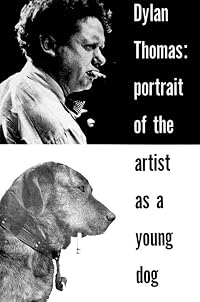
Portrait of the Artist as a Young Dog
by Dylan Thomas
On This Page
Description
First the young schoolboy, gloriously immersed in make-believe in a shabby farmyard; then the budding poet with his thrilling friendships and dreams of fortune. Finally, the neophyte reporter roaming suburban Swansea for momentous material. In ten wonderfully evocative short stories, Dylan Thomas conveys the exuberance and enthusiasm of youth as he fictionalises events from his childhood. Adolescent sexuality and male friendship are two of the themes that pervade this collection, along with show more the more familiar topics of love, death and religion. show lessTags
Recommendations
















Member Reviews
Ez egy olyasfajta könyv, amit nagyon el tud rontani, ha épp rossz passzban kezdünk bele. Masszív költői képekkel dolgozik, amikhez szükségeltetik egyfajta optimális hangulat, és elég rövid ahhoz, hogy ha az első oldalakon nem találjuk meg az ívét, akkor ez a későbbiekben is így maradjon. Szerencsére én jó időpontban kaptam elő, minek következtében: tetszett. Dylan Thomas legnagyobb bravúrja, hogy a lírai eszközöket képes kombinálni a helyenként naturalista-realista ábrázolásmóddal, így színekből és szeretetből egy nagyon élményszerű Wales-képet épít fel. Mindemellett Thomas novellái úgy ábrázolják az átmenetet a gyermekkorból a férfikorba, hogy a gyermek által érzékelt idegen, show more helyenként ellenséges, helyenként pedig varázslatos világ az elbeszélések során egyre inkább kinyílik (bezárul?), és átalakul valami új minőséggé: a felnőttkorrá. Nagyon szép folyamatábrázolás egy igazán érzékeny írótól, aki hála Istennek megfelelő fordítót is kapott a kiteljesedéshez: Gergely Ágnest. Akinek külön köszönöm.
U.i.: Ungvári Tamás utószavában még kiemeli a kontrasztot e könyv „tündérvilága” és az dekadens urbanizált irodalom között – amit ő (többek között) igen szárnyalóan „intellektuális önfertőzésként” aposztrofál. Ami nagyon izgalmasan hangzik, kedvet is csinált nekem az efféle művekhez. Kár, hogy konkrét címekkel nem szolgált, most pedig tépelődhetek, pontosan kikre utalt ezzel. Joyce-ra mondjuk, akinek korai művei egészen biztosan erős hatással voltak erre a szövegre? Vagy csak akart mondani valamit, ami jól hangzik? show less
U.i.: Ungvári Tamás utószavában még kiemeli a kontrasztot e könyv „tündérvilága” és az dekadens urbanizált irodalom között – amit ő (többek között) igen szárnyalóan „intellektuális önfertőzésként” aposztrofál. Ami nagyon izgalmasan hangzik, kedvet is csinált nekem az efféle művekhez. Kár, hogy konkrét címekkel nem szolgált, most pedig tépelődhetek, pontosan kikre utalt ezzel. Joyce-ra mondjuk, akinek korai művei egészen biztosan erős hatással voltak erre a szövegre? Vagy csak akart mondani valamit, ami jól hangzik? show less
Dylan Thomas never fails at reclaiming his literary streets, although I found his portrait kind of painted in water colours when it should have been oil based - I guess he was merely whittling away at memories and on this level it worked. Don't get me wrong, I think the man is a enigma of brazen thought, only this particular work sort of tied me over rather then carried me away.
The poet Thomas shares with us nuggets of his youth, adolescence, and early adulthood in these charming stories, many of which are poetically written, with lyrically descriptive sentences of scenes, of emotions, of backgrounds. Some brought upon a giggle. Though not all spoke to me, most did.
Peaches – At the youngest age of his stories, two rambunctious boys enjoy some play time until they were interrupted by a preaching uncle. I was touched by the difference in wealth between Dylan and his playmate Jack which Dylan acknowledged and even exaggerated but also seemed oblivious at the same time. Ah, the age of innocence…
Patricia, Edith, and Arnold – Loved the strength of sisterhood against the player, Arnold.
The Fight – The show more budding 14 year old poet shares his early poems with us. His speech has flourishes, as though speaking in a play.
Extraordinary Little Cough – A take on bullying and the Little Cough’s (aka George) reaction to it.
Just Like Little Dogs – The youths, just like dogs in heat; this story had some of my favorite passages.
Where Tawe Flows – Dylan collaborates with three other writers to author a novel. The conversation alone amongst the writers was illustrative, without even considering the contents of their writings.
Who Do You Wish Was with Us – This was my most effecting story. Ray’s sad family history and the trauma that imprinted his then young soul was simply moving.
Some Quotes:
On a boy’s ‘love’ – I chuckled (from ‘Extraordinary Little Cough’):
“Although I knew I loved her, I didn’t like anything she said or did.”
On walking at night (one of several good passages from ‘Just Like Little Dogs’):
“…I liked to walk through the wet town after midnight, when the streets were deserted and the window lights out, alone and alive on the glistening tram-lines in dead and empty High Street under the moon, gigantically sad in the damp streets by ghostly Ebenezer Chapel. And I never felt more a part of the remote and overpressing world, or more full of love and arrogance and pity and humility, not for myself alone, but for the living earth I suffered on and for the unfeeling systems in the upper air, Mars and Venus and Brazell and Skully, men in China and St. Thomas, scorning girls and ready girls, soldiers and bullies and policemen and sharp, suspicious buyers of second-hand books, bad, ragged women who’d pretend against the museum wall for a cup of tea, and perfect, unapproachable women out of the fashion magazines, seven feet high, sailing slowly in their flat, glazed creations through steel and glass and velvet...“
On courtship – another chuckle (from ‘Where Tawe Flows’):
“Daphne was the name of the grass-widow in Manselton for whom Mr. Roberts had lost both his reputation and his position in the brewery. He had been in the habit of delivering bottles to her house, free of charge, and he had bought her a cocktail cabinet and given her a hundred pounds and his mother’s rings. In return, she held large parties and never invited him.”
On grapes of wrath – I laughed (from ‘Where Tawe Flows’):
“Mrs. Evans heard the last remark as she came into the room. She was a thin woman with bitter lines, tired hands, the ruins of fine brown eyes, and a superior nose. An unshockable woman, she had once listened to Mr. Roberts’s description of his haemorrhoids for over an hour on a New Year’s Eve and had allowed him, without protest, to call them the grapes of wrath.”
On the common man (from ‘Where Tawe Flows’):
“…I must disagree there. The life of that mythical common denominator, the man-in-the-street, is dull as ditch-water, Mr. Roberts. Capitalist society has made him a mere bundle of repressions and useless habits under that symbol of middle-class divinity, the bowler… The ceaseless toil for bread and butter, the ogres of unemployment, the pettifogging gods of gentility, the hollow lies of the marriage bed. Marriage,…, ‘legal monogamous prostitution.’”
On memory (from ‘Who Do You Wish Was with Us’):
“I had seen him only two days ago in the snooker-room, but his dimpled face was fading, even as I though of him, into the colours of our walk, the ash-white of the road, the common heathers, the green and blue of fields and fragmentary sea, and the memory of his silly voice was lost in the sounds of birds and unreasonably moving leaves in the lack of wind.” show less
Peaches – At the youngest age of his stories, two rambunctious boys enjoy some play time until they were interrupted by a preaching uncle. I was touched by the difference in wealth between Dylan and his playmate Jack which Dylan acknowledged and even exaggerated but also seemed oblivious at the same time. Ah, the age of innocence…
Patricia, Edith, and Arnold – Loved the strength of sisterhood against the player, Arnold.
The Fight – The show more budding 14 year old poet shares his early poems with us. His speech has flourishes, as though speaking in a play.
Extraordinary Little Cough – A take on bullying and the Little Cough’s (aka George) reaction to it.
Just Like Little Dogs – The youths, just like dogs in heat; this story had some of my favorite passages.
Where Tawe Flows – Dylan collaborates with three other writers to author a novel. The conversation alone amongst the writers was illustrative, without even considering the contents of their writings.
Who Do You Wish Was with Us – This was my most effecting story. Ray’s sad family history and the trauma that imprinted his then young soul was simply moving.
Some Quotes:
On a boy’s ‘love’ – I chuckled (from ‘Extraordinary Little Cough’):
“Although I knew I loved her, I didn’t like anything she said or did.”
On walking at night (one of several good passages from ‘Just Like Little Dogs’):
“…I liked to walk through the wet town after midnight, when the streets were deserted and the window lights out, alone and alive on the glistening tram-lines in dead and empty High Street under the moon, gigantically sad in the damp streets by ghostly Ebenezer Chapel. And I never felt more a part of the remote and overpressing world, or more full of love and arrogance and pity and humility, not for myself alone, but for the living earth I suffered on and for the unfeeling systems in the upper air, Mars and Venus and Brazell and Skully, men in China and St. Thomas, scorning girls and ready girls, soldiers and bullies and policemen and sharp, suspicious buyers of second-hand books, bad, ragged women who’d pretend against the museum wall for a cup of tea, and perfect, unapproachable women out of the fashion magazines, seven feet high, sailing slowly in their flat, glazed creations through steel and glass and velvet...“
On courtship – another chuckle (from ‘Where Tawe Flows’):
“Daphne was the name of the grass-widow in Manselton for whom Mr. Roberts had lost both his reputation and his position in the brewery. He had been in the habit of delivering bottles to her house, free of charge, and he had bought her a cocktail cabinet and given her a hundred pounds and his mother’s rings. In return, she held large parties and never invited him.”
On grapes of wrath – I laughed (from ‘Where Tawe Flows’):
“Mrs. Evans heard the last remark as she came into the room. She was a thin woman with bitter lines, tired hands, the ruins of fine brown eyes, and a superior nose. An unshockable woman, she had once listened to Mr. Roberts’s description of his haemorrhoids for over an hour on a New Year’s Eve and had allowed him, without protest, to call them the grapes of wrath.”
On the common man (from ‘Where Tawe Flows’):
“…I must disagree there. The life of that mythical common denominator, the man-in-the-street, is dull as ditch-water, Mr. Roberts. Capitalist society has made him a mere bundle of repressions and useless habits under that symbol of middle-class divinity, the bowler… The ceaseless toil for bread and butter, the ogres of unemployment, the pettifogging gods of gentility, the hollow lies of the marriage bed. Marriage,…, ‘legal monogamous prostitution.’”
On memory (from ‘Who Do You Wish Was with Us’):
“I had seen him only two days ago in the snooker-room, but his dimpled face was fading, even as I though of him, into the colours of our walk, the ash-white of the road, the common heathers, the green and blue of fields and fragmentary sea, and the memory of his silly voice was lost in the sounds of birds and unreasonably moving leaves in the lack of wind.” show less
The ten short glimpses into Dylan Thomas’s youth in Wales are a joy to read. I particularly liked “The Peaches”, “Extraordinary Little Cough”, “Just Like Little Dogs”, and “Where Tawe Flows”, but Thomas’s writing is lyrical and poignant throughout.
Quotes:
On walking at night, feeling both solitude and a oneness with the world at the same time:
“I liked to walk through the wet town after midnight, when the streets were deserted and the window lights out, alone and alive on the glistening tram-lines in dead and empty High Street under the moon, gigantically sad in the damp streets by ghostly Ebenezer Chapel. And I never felt more a part of the remote and overpressing world, or more full of love and arrogance and pity show more and humility, not for myself alone, but for the living earth I suffered on and for the unfeeling systems in the upper air, Mars and Venus and Brazell and Skully, men in China and St. Thomas, scorning girls and ready girls, soldiers and bullies and policemen and sharp, suspicious buyers of second-hand books, bad, ragged women who’d pretend against the museum wall for a cup of tea, and perfect, unapproachable women out of the fashion magazines, seven feet high, sailing slowly in their flat, glazed creations through steel and glass and velvet. “
Also this one, another night scene:
“A train raced over us, and the arch shook. Over the shore, behind the vanishing train, smoke clouds flew together, rags of wings and hollow bodies of great birds black as tunnels, and broke up lazily; cinders fell through a sieve in the air, and the sparks were put out by the wet dark before they reached the sand. The night before, little quick scarecrows had bent and picked at the track-line and a solitary dignified scavenger wandered three miles by the edge with a crumpled coal sack and a park-keeper’s steel-tipped stick. Now they were tucked up in sacks, asleep in a siding, their heads in bins, their beards in straw, in coal-trucks thinking of fires, or lying beyond pickings on Jack Stiff’s slab near the pub in the Fishguard Alley, where the methylated-spirit drinkers danced into the policemen’s arms and women like lumps of clothes in a pool waited, in doorways and holes in the soaking wall, for vampires or firemen. Night was properly on us now. The wind changed. Thin rain began. The sands themselves went out. We stood in the scooped, windy room of the arch, listening to the noises from the muffled town, a good train shunting, a siren in the docks, the hoarse trams in the streets far behind, one bark of a dog, unplaceable sounds, iron being beaten, the distant creaking of wood, doors slamming where there were no houses, an engine coughing like a sheep on a hill.”
On childhood memories one isn’t proud of:
“I let Edgar Reynolds be whipped because I had taken his homework; I stole from my mother’s bag; I stole from Gwyneth’s bag; I stole twelve books in three visits from the library, and threw them away in the park; I drank a cup of my water to see what it would taste like; I beat a dog with a stick so that it would roll over and lick my hand afterwards; I looked with Dan Jones through the keyhole while his maid had a bath; I cut my knee with a penknife, and put the blood on my handkerchief and said it had come out of my ears so that I could pretend I was ill and frighten my mother; I pulled my trousers down and showed Jack Williams; I saw Billy Jones beat a pigeon to death with a fire-shovel, and laughed and got sick; Cedric Williams and I broke into Mrs. Samuels’s house and poured ink over her bedclothes.”
On approaching girls:
“I could have swept the ground with my cap, kissed my hand gaily, called them senoritas, and made them smile without tolerance. Or I could have stayed at a distance, and this would have been better still, my hair blown in the wind, though there was no wind at all that evening, wrapped in mystery and staring at the sun, too aloof to speak to girls; but I knew that all the time my ears would have been burning, my stomach would have been as hollow and as full of voices as a shell. ‘Speak to them quickly, before they go away!’ a voice would have said insistently over the dramatic silence, as I stood like Valentino on the edge of the bright, invisible bull-ring of the sands. ‘Isn’t it lovely here!’ I said.”
On ‘love’ as a boy:
“Although I knew I loved her, I didn’t like anything she said or did.”
On memories:
“We wanted to run down to the beach, Dan and Sidney and George and I, to be alone together, to walk and shout by the sea in the country, throw stones at the waves, remember adventures and make more to remember.”
And this one, on memories that take us back to youth and which will be with us until we die:
“I watched the queue outside the Empire and studied the posters of Nuit-de-Paris, and thought of the long legs and startling faces of the chorus-girls I had seen walking arm in arm, earlier that week, up and down the streets in the winter sunshine, their mouths, I remembered remarking and treasuring for the first page of The Merciless Ladies that was never begun, like crimson scars, their hair raven-black or silver; their scent and paint reminded me of the hot and chocolate-covered East, their eyes were pools. Lola de Kenway, Babs Courcey, Ramona Day would be with me all my life. Until I died, of a wasting, painless disease, and spoke my prepared last words, they would always walk with me, recalling to my dead youth in the vanished High Street, nights when the shop windows were blazing, and singing came out of the pubs, and sirens from the Hafod sat in the steaming chip shops with their handbags on their knees and their earrings rattling.”
Lastly this one drew a smile:
“Mrs. Evans heard the last remark as she came into the room. She was a thin woman with bitter lines, tired hands, the ruins of fine brown eyes, and a superior nose. An unshockable woman, she had once listened to Mr. Roberts’s description of his haemorrhoids for over an hour on a New Year’s Eve and had allowed him, without protest, to call them the grapes of wrath.” show less
Quotes:
On walking at night, feeling both solitude and a oneness with the world at the same time:
“I liked to walk through the wet town after midnight, when the streets were deserted and the window lights out, alone and alive on the glistening tram-lines in dead and empty High Street under the moon, gigantically sad in the damp streets by ghostly Ebenezer Chapel. And I never felt more a part of the remote and overpressing world, or more full of love and arrogance and pity show more and humility, not for myself alone, but for the living earth I suffered on and for the unfeeling systems in the upper air, Mars and Venus and Brazell and Skully, men in China and St. Thomas, scorning girls and ready girls, soldiers and bullies and policemen and sharp, suspicious buyers of second-hand books, bad, ragged women who’d pretend against the museum wall for a cup of tea, and perfect, unapproachable women out of the fashion magazines, seven feet high, sailing slowly in their flat, glazed creations through steel and glass and velvet. “
Also this one, another night scene:
“A train raced over us, and the arch shook. Over the shore, behind the vanishing train, smoke clouds flew together, rags of wings and hollow bodies of great birds black as tunnels, and broke up lazily; cinders fell through a sieve in the air, and the sparks were put out by the wet dark before they reached the sand. The night before, little quick scarecrows had bent and picked at the track-line and a solitary dignified scavenger wandered three miles by the edge with a crumpled coal sack and a park-keeper’s steel-tipped stick. Now they were tucked up in sacks, asleep in a siding, their heads in bins, their beards in straw, in coal-trucks thinking of fires, or lying beyond pickings on Jack Stiff’s slab near the pub in the Fishguard Alley, where the methylated-spirit drinkers danced into the policemen’s arms and women like lumps of clothes in a pool waited, in doorways and holes in the soaking wall, for vampires or firemen. Night was properly on us now. The wind changed. Thin rain began. The sands themselves went out. We stood in the scooped, windy room of the arch, listening to the noises from the muffled town, a good train shunting, a siren in the docks, the hoarse trams in the streets far behind, one bark of a dog, unplaceable sounds, iron being beaten, the distant creaking of wood, doors slamming where there were no houses, an engine coughing like a sheep on a hill.”
On childhood memories one isn’t proud of:
“I let Edgar Reynolds be whipped because I had taken his homework; I stole from my mother’s bag; I stole from Gwyneth’s bag; I stole twelve books in three visits from the library, and threw them away in the park; I drank a cup of my water to see what it would taste like; I beat a dog with a stick so that it would roll over and lick my hand afterwards; I looked with Dan Jones through the keyhole while his maid had a bath; I cut my knee with a penknife, and put the blood on my handkerchief and said it had come out of my ears so that I could pretend I was ill and frighten my mother; I pulled my trousers down and showed Jack Williams; I saw Billy Jones beat a pigeon to death with a fire-shovel, and laughed and got sick; Cedric Williams and I broke into Mrs. Samuels’s house and poured ink over her bedclothes.”
On approaching girls:
“I could have swept the ground with my cap, kissed my hand gaily, called them senoritas, and made them smile without tolerance. Or I could have stayed at a distance, and this would have been better still, my hair blown in the wind, though there was no wind at all that evening, wrapped in mystery and staring at the sun, too aloof to speak to girls; but I knew that all the time my ears would have been burning, my stomach would have been as hollow and as full of voices as a shell. ‘Speak to them quickly, before they go away!’ a voice would have said insistently over the dramatic silence, as I stood like Valentino on the edge of the bright, invisible bull-ring of the sands. ‘Isn’t it lovely here!’ I said.”
On ‘love’ as a boy:
“Although I knew I loved her, I didn’t like anything she said or did.”
On memories:
“We wanted to run down to the beach, Dan and Sidney and George and I, to be alone together, to walk and shout by the sea in the country, throw stones at the waves, remember adventures and make more to remember.”
And this one, on memories that take us back to youth and which will be with us until we die:
“I watched the queue outside the Empire and studied the posters of Nuit-de-Paris, and thought of the long legs and startling faces of the chorus-girls I had seen walking arm in arm, earlier that week, up and down the streets in the winter sunshine, their mouths, I remembered remarking and treasuring for the first page of The Merciless Ladies that was never begun, like crimson scars, their hair raven-black or silver; their scent and paint reminded me of the hot and chocolate-covered East, their eyes were pools. Lola de Kenway, Babs Courcey, Ramona Day would be with me all my life. Until I died, of a wasting, painless disease, and spoke my prepared last words, they would always walk with me, recalling to my dead youth in the vanished High Street, nights when the shop windows were blazing, and singing came out of the pubs, and sirens from the Hafod sat in the steaming chip shops with their handbags on their knees and their earrings rattling.”
Lastly this one drew a smile:
“Mrs. Evans heard the last remark as she came into the room. She was a thin woman with bitter lines, tired hands, the ruins of fine brown eyes, and a superior nose. An unshockable woman, she had once listened to Mr. Roberts’s description of his haemorrhoids for over an hour on a New Year’s Eve and had allowed him, without protest, to call them the grapes of wrath.” show less
There's a great deal of interesting characters to these stories and though they don't really knock you over the head, they tend to stick with you for awhile in all their small subtleties. What I really enjoyed about this book is, and excuse me for being very Holden Caufield-y but none of the characters are fake or phony even the guy who convinces two women he loves them both. There's a sense of innocence to these Welsh human beings even when their intentions are not so good and there's also a huge range of people to discover from the preacher man to the grandfather losing his wits to the burgeoning poet who gets a chance to share his words with others. You can't help but feel a love and affection for them.
In a small way, it bears a show more crucial similarity to James Joyce's Dubliners in that all of these characters could in fact exist and be based on townspeople...yet, the polar opposite nature lies in the fact that none of these people seem to be filled with such depraved crooked malice. show less
In a small way, it bears a show more crucial similarity to James Joyce's Dubliners in that all of these characters could in fact exist and be based on townspeople...yet, the polar opposite nature lies in the fact that none of these people seem to be filled with such depraved crooked malice. show less
With a title nodding at James Joyce, Thomas' first prose collection (after several volumes of poetry) was published in 1940. Also autobiographical, these ten somewhat bittersweet stories cover different periods in the author's childhood, later youth and early adulthood. These stories are tenderly written, though they have more than a fair share of humour and are definitely written with a twinkle in the eye. They give an interesting insight to the lower-middle class childhood and coming of age Thomas had in 1920s & '30s south Wales. Here is a little flavour of the stories:
The Peaches -
Young Dylan is staying with Aunt Annie, Uncle Jim and older cousin Gwilym at their farm. The dusty and snug summer country routine is broken when show more arrangements are made for the apparently posh Mrs Williams' son Jack to come and play.
"'Is Mrs Williams very rich?' asked Gwilym.
I told him she had three motor cars and two houses, which was a lie. 'She's the richest woman in Wales, and once she was a mayoress,' I said. 'Are we going to have tea in the best room?'
Annie nodded. 'And a large tin of peaches' she said.
'That old tin's been in the cupboard since Chistmas,' said Gwilym, 'mother's been keeping it for a day like this.' 'They're lovely peaches,' Annie said. She went upstairs to dress like Sunday."
A Visit to Grandpa's -
"It was the first time I had stayed in grandpa's house. The floorboards had squeaked like mice as I climbed into bed, and the mice between the walls had creaked like wood as though another visitor was walking on them."
Dylan's eccentric (and probably senile) Grandpa proceed's to behave very strangely - in a way that alerts a well-drilled corps of villagers to prompt action: 'Dai Thomas has been to Llanstephan, and he's got his waistcoat on' is the uncoded cry that goes up shop by shop...
Patricia, Edith, and Arnold -
A winter scene this time as young Dylan is witness to the family help's despair. The reality dawns on her best friend (the next door girl) and her that their beau-in-common has been a cad. Tears and snowball sodden letters.
The Fight -
Two boys have a fight and end up the best of friends. Dylan visits Dan at his house later that day and they decide to start a magazine called 'The Thunderer'. Dylan reads some of his poetry at the family dinner table.
Extraordinary Little Cough -
"One afternoon, in a particularly bright and glowing August, some years before I knew I was happy, George Hooping, whom we called Little Cough, Sidney Evans, Dan Davies, and I sat on the roof of a lorry travelling to the end of the Peninsular."
So begins an entertaining tale of adventure and girls as the boys go on holiday in the Gower.
Just Like Little Dogs -
An off-season seaside town. Three men shelter from the rain under a railway arch one windy and dark evening.
"Families sat down to supper in rows of short houses, the wireless sets were on, the daughters' young men sat in the front rooms. In neighbouring houses they read the news off the table cloth, and the potatoes from dinner were fried up. Cards were played in the front rooms of houses on the hills. In the houses on tops of the hills families were entertaining friends, and the blinds of the front rooms were not quite drawn. I heard the sea in a cold bit of the cheery night.
One of the strangers said suddenly, in a high, clear voice: 'What are we all doing then?'
'Standing under a bloody arch' said the other one."
Where Tawe Flows -
"Mr Humphries, Mr Roberts, and young Mr Thomas knocked on the front door of Mr Emlyn Evans's small villa 'Lavengro', punctually at nine o'clock in the evening."
The four men proceed to sit and discuss their collaborative attempts at writing together "a novel of provinicial life" chapter by chapter and week by week each Friday at nine o'clock sharp.
Who Do You Wish Was With Us? -
Dylan and his friend Ray embark on a walking trip - once again it's the beautiful Gower Peninsular, so close to Thomas' Swansea.
Old Garbo -
Now Cub reporter at the Tawe News, just before Christmas, Dylan is reviewing a performance called 'The Crucifixion' on his Saturday afternoon off. A masterful character study follows where we see the young writer observing the comings and goings in various local drinking holes.
One Warm Saturday -
Possibly the strongest piece in this collection, it's well suited closing out the collection as it's atmosphere and imagery really linger long after the reading. In a seaside-set story, a young man falls heavily for a girl he sees briefly sitting on a bench reading a book. By chance they meet again later in a nearby pub. An ensuing 'party' sees the frustrated love-struck couple accompanied by a bevvy of other drinkers, chaperones and assorted hangers-on. In an unexpectedly Kafka-esque denouement they somehow manage to lose each other.
Overall, this was an interesting collection I'm glad to have read. I didn't like all of it, but there was enough here to make me want to read more of Thomas' short stories. I particularly liked 'The Peaches', 'A Visit to Grandpa's', 'Just Like Little Dogs', and 'One Warm Saturday' show less
The Peaches -
Young Dylan is staying with Aunt Annie, Uncle Jim and older cousin Gwilym at their farm. The dusty and snug summer country routine is broken when show more arrangements are made for the apparently posh Mrs Williams' son Jack to come and play.
"'Is Mrs Williams very rich?' asked Gwilym.
I told him she had three motor cars and two houses, which was a lie. 'She's the richest woman in Wales, and once she was a mayoress,' I said. 'Are we going to have tea in the best room?'
Annie nodded. 'And a large tin of peaches' she said.
'That old tin's been in the cupboard since Chistmas,' said Gwilym, 'mother's been keeping it for a day like this.' 'They're lovely peaches,' Annie said. She went upstairs to dress like Sunday."
A Visit to Grandpa's -
"It was the first time I had stayed in grandpa's house. The floorboards had squeaked like mice as I climbed into bed, and the mice between the walls had creaked like wood as though another visitor was walking on them."
Dylan's eccentric (and probably senile) Grandpa proceed's to behave very strangely - in a way that alerts a well-drilled corps of villagers to prompt action: 'Dai Thomas has been to Llanstephan, and he's got his waistcoat on' is the uncoded cry that goes up shop by shop...
Patricia, Edith, and Arnold -
A winter scene this time as young Dylan is witness to the family help's despair. The reality dawns on her best friend (the next door girl) and her that their beau-in-common has been a cad. Tears and snowball sodden letters.
The Fight -
Two boys have a fight and end up the best of friends. Dylan visits Dan at his house later that day and they decide to start a magazine called 'The Thunderer'. Dylan reads some of his poetry at the family dinner table.
Extraordinary Little Cough -
"One afternoon, in a particularly bright and glowing August, some years before I knew I was happy, George Hooping, whom we called Little Cough, Sidney Evans, Dan Davies, and I sat on the roof of a lorry travelling to the end of the Peninsular."
So begins an entertaining tale of adventure and girls as the boys go on holiday in the Gower.
Just Like Little Dogs -
An off-season seaside town. Three men shelter from the rain under a railway arch one windy and dark evening.
"Families sat down to supper in rows of short houses, the wireless sets were on, the daughters' young men sat in the front rooms. In neighbouring houses they read the news off the table cloth, and the potatoes from dinner were fried up. Cards were played in the front rooms of houses on the hills. In the houses on tops of the hills families were entertaining friends, and the blinds of the front rooms were not quite drawn. I heard the sea in a cold bit of the cheery night.
One of the strangers said suddenly, in a high, clear voice: 'What are we all doing then?'
'Standing under a bloody arch' said the other one."
Where Tawe Flows -
"Mr Humphries, Mr Roberts, and young Mr Thomas knocked on the front door of Mr Emlyn Evans's small villa 'Lavengro', punctually at nine o'clock in the evening."
The four men proceed to sit and discuss their collaborative attempts at writing together "a novel of provinicial life" chapter by chapter and week by week each Friday at nine o'clock sharp.
Who Do You Wish Was With Us? -
Dylan and his friend Ray embark on a walking trip - once again it's the beautiful Gower Peninsular, so close to Thomas' Swansea.
Old Garbo -
Now Cub reporter at the Tawe News, just before Christmas, Dylan is reviewing a performance called 'The Crucifixion' on his Saturday afternoon off. A masterful character study follows where we see the young writer observing the comings and goings in various local drinking holes.
One Warm Saturday -
Possibly the strongest piece in this collection, it's well suited closing out the collection as it's atmosphere and imagery really linger long after the reading. In a seaside-set story, a young man falls heavily for a girl he sees briefly sitting on a bench reading a book. By chance they meet again later in a nearby pub. An ensuing 'party' sees the frustrated love-struck couple accompanied by a bevvy of other drinkers, chaperones and assorted hangers-on. In an unexpectedly Kafka-esque denouement they somehow manage to lose each other.
Overall, this was an interesting collection I'm glad to have read. I didn't like all of it, but there was enough here to make me want to read more of Thomas' short stories. I particularly liked 'The Peaches', 'A Visit to Grandpa's', 'Just Like Little Dogs', and 'One Warm Saturday' show less
...Dream-like autobiographical vignette of the author as a pup... Is it just me, or do you also start to fade in interest as soon as someone tells you, "I had a dream last night..." Maybe I was just not in the mood for this quick, ephemeral read. If you are a fan of Under Milk Wood, there is apparently some background material to that here. Or, at least that is what I glean from the marginalia of a previous owner.
Members
- Recently Added By
Lists

Best Autobiographies and Memoirs
370 works; 67 members
Amanda's Guaranteed Books
110 works; 5 members

short stories / novella
23 works; 1 member

recommended
8 works; 1 member

Animals in the Title
498 works; 11 members
Author Information

275+ Works 15,846 Members
The most important Welsh poet of the twentieth century, Thomas was born in Swansea, about which he remembered unkindly "the smug darkness of a provincial town." He attended Swansea Grammar School but received his real education in the extensive library of his father, a disappointed schoolteacher with higher ambitions. Refusing university study in show more favor of immediately becoming a professional writer, Thomas worked first in Swansea and then in London at a variety of literary jobs, which included journalism and, eventually, filmscripts and radio plays. In 1936 he began the satisfying but stormy marriage to the bohemian writer and dancer Caitlin MacNamara that would endure for the rest of his career. His life fell into a pattern of oscillation between work and dissipation in London and recovery and relaxation in a rural retreat, usually in Wales. Thomas worked in a documentary film unit during the war. Besides his poetry, he wrote plays and fiction. In the early 1950s, he gave three celebrated poetry-reading tours of the United States, during which his outrageous behavior vied with his superb reading ability for public attention. Aggravated by chronic alcoholism, his health collapsed during the last tour, and he died in a New York City hospital. In his poetry, Thomas embraced an exuberant romanticism in the encounter between self and world and a joyous riot in the lushness of language. His work falls into three periods---an early "womb-tomb" phase during which he produced a notebook, which he later mined for further poems, a middle one troubled by marriage and war, and a final acceptance of the human condition. The exuberant rhetoric of his work belies an equally strong devotion to artistry, what he once called "my craft or sullen art." His great "Fern Hill," for example, builds its imagery of the rejoicing innocence of childhood on a strict and demanding syllabic count. A recollection of boyhood holidays on the farm of his aunt and uncle, that poem places its emotion within an Edenic framework typical of Thomas's work. The impressive sonnet sequence "Altarwise by Owl-Light" (1936) combines the internal quest of romanticism with a more elaborate religious outlook in tracing the birth and spiritual autobiography of a poet. Almost at the end of his career he produced the moving elegy "Do Not Go Gentle into That Good Night" (1952), written during the final illness of his father. Despite his periods of doubt and dissipation, Thomas celebrated the fullness of life. As he wrote in a note to his Collected Poems (1952), "These poems, with all their crudities, doubts, and confusion, are written for the love of Man and in praise of God, and I'd be a damn fool if they weren't." (Bowker Author Biography) show less
Some Editions
Series
Belongs to Publisher Series
Guild books (250)
Aldine paperback (no. 34)
Work Relationships
Is a reply to
Common Knowledge
- Canonical title
- Portrait of the Artist as a Young Dog
- Original title
- Portrait of the Artist as a Young Dog
- Original publication date
- 1940
- People/Characters
- Dylan Thomas
- First words
- The grass-green cart, with 'J. Jones, Gorse-hill' painted shakily on it, stopped in the cobblestone passage between 'The Hare's Foot' and 'The Pure Drop'.
- Original language
- English
Classifications
Statistics
- Members
- 1,151
- Popularity
- 21,959
- Reviews
- 19
- Rating
- (3.87)
- Languages
- 15 — Catalan, Dutch, English, Finnish, French, German, Hungarian, Italian, Portuguese, Romanian, Russian, Croatian, Spanish, Swedish, Turkish
- Media
- Paper, Audiobook, Ebook
- ISBNs
- 44
- ASINs
- 31