On This Page
Description
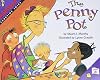
The face painting booth at the school fair provides plenty of opportunities to count combinations of coins adding up to fifty.Tags
Recommendations




Member Reviews
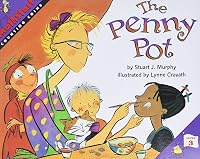
At the school fair, Jessie comes across art teacher Fran’s face-painting booth and desperately wants her face painted. But each face painting costs 50 cents, and Jessie’s already spent some of her money getting an ice cream cone, leaving her with only 39 cents. Helpfully, Fran designates a leave-a-penny-take-a-penny pot. Jessie sits down as other children come in to get their faces painted and patiently waits for enough pennies to build up to the 11 cents she needs.
Designed as part of a series of books to teach mathematics, The Penny Pot also functions to teach children some basic economic concepts regarding money. Children will learn about the different types of coins available in American currency and how much money each show more represents. They will also learn that goods and services cost money and how sometimes they may have to choose between different wants because of limited means. But they’ll also learn that sometimes a little contribution each from a few people can add up to a big benefit for one person.
The Penny Pot ends with suggestions for activities to expand upon the mathematics concepts presented in the book. As many of these involve activities determining the monetary value of coins or pretend play scenarios of “buying” common items, these also serve to further economic concepts.
The face-painting plot of The Penny Pot and its vivid accompanying illustrations buoy the book up from being purely didactic, so reading this book will be both educational and enjoyable for children.
I reviewed this book for EconKids. show less
Designed as part of a series of books to teach mathematics, The Penny Pot also functions to teach children some basic economic concepts regarding money. Children will learn about the different types of coins available in American currency and how much money each show more represents. They will also learn that goods and services cost money and how sometimes they may have to choose between different wants because of limited means. But they’ll also learn that sometimes a little contribution each from a few people can add up to a big benefit for one person.
The Penny Pot ends with suggestions for activities to expand upon the mathematics concepts presented in the book. As many of these involve activities determining the monetary value of coins or pretend play scenarios of “buying” common items, these also serve to further economic concepts.
The face-painting plot of The Penny Pot and its vivid accompanying illustrations buoy the book up from being purely didactic, so reading this book will be both educational and enjoyable for children.
I reviewed this book for EconKids. show less
Follow along and count coins with Jessie and her friends as they are transformed into a clown, a monster, and more at the face painting booth. With a naughty cat underfoot and festive illustrations by Lynne Cravath, this coin counting story is sure to be a favorite.
This is a great math book that all young readers should read. Jessie is at the school fair where all the students are getting their face painted. She wants to get her's painted, but she doesn't have enough money. When other students get their face painted, they put their change in what they call the "penny pot". This would help Jessie get enough money to get her face painted. This is a cute book that not only introduces pennies, but it also introduces other coins as well. Also, the illustrations are adorable!
Various students count their coins to pay 50 cents for face painting which Fran, the art teacher was in charge of, at the school fair. Jess had only .39 cents. Extra pennies are put in the penny pot for other students to use if needed. Does Jess get her face painted?
When introduced to this book, I automatically thought of my daughter who is having the hardest time with her counting coins skills. I borrowed the book, then read it with her. I pulled out some 'real money' so that we can keep along with the story. She loved it!!! I can see the wheels turning a little faster after this little experience.
In the classroom, I would also do the same as I had done with my daughter, except use plastic coins. I would give them word problems to show more solve with money. ALso I would set up a market within the classroom, I would give the children fake money to redeem upon good behavior or improved grades. An incentive as well as a lesson. show less
When introduced to this book, I automatically thought of my daughter who is having the hardest time with her counting coins skills. I borrowed the book, then read it with her. I pulled out some 'real money' so that we can keep along with the story. She loved it!!! I can see the wheels turning a little faster after this little experience.
In the classroom, I would also do the same as I had done with my daughter, except use plastic coins. I would give them word problems to show more solve with money. ALso I would set up a market within the classroom, I would give the children fake money to redeem upon good behavior or improved grades. An incentive as well as a lesson. show less
Summary: Jessie's schoold was having a school fair. She wanted to get her face painted, but it cost $0.50. Since she had just bought ice cream, she only had $0.39. Fran, the art teacher, who was doing the face painting had suggested to Jessie that she wait while other kids had their faces painted because some students put their extra change into the penny pot. So she waited. Finally, she counted all the money in the penny pot along with her money and she had more than enough money to get her face painted.
Personal Reaction: Like that it was a good story that incorporated counting money. On almost every page there were different assortments of change that was counted.
Classroom Extensions: Use it when teaching students how to count money. show more Have students count the money on the pages while reading it. show less
Personal Reaction: Like that it was a good story that incorporated counting money. On almost every page there were different assortments of change that was counted.
Classroom Extensions: Use it when teaching students how to count money. show more Have students count the money on the pages while reading it. show less
This is an engaging book ideal for math lessons. Students can relate to Jenny as she is trying to get enough pennies T
o have her face painted. It is a colorful book that all students would enjoy as a read aloud or read to self.
o have her face painted. It is a colorful book that all students would enjoy as a read aloud or read to self.
Summary: Jessie is a little girl who wants her face painted at the school fair. It cost 50 cents, but she didn't quite have enough money. Her art teacher, Fran, told her if she would wait, people who had extra pennies left over would put them in a pot and she could use them when there was enough. As Jessie waits, other kids get their faces painted and contribute to the penny pot. In the end, Jessie has enough money to get her face painted, with 1 penny left over to put in the penny pot.
Personal Reaction: I like that this book shows children how to count coins throughout the story. It makes me think of my daughter, who is at the age where she is starting to buy her own things with her own money.
Classroom Extension: I could have the show more classroom 1) practice counting coins at a pretend store or 2) instead of actual face painting, we could draw on paper plates and wear them as masks. show less
Personal Reaction: I like that this book shows children how to count coins throughout the story. It makes me think of my daughter, who is at the age where she is starting to buy her own things with her own money.
Classroom Extension: I could have the show more classroom 1) practice counting coins at a pretend store or 2) instead of actual face painting, we could draw on paper plates and wear them as masks. show less
Members
- Recently Added By
Lists

75 Books for Literacy Block: Fall 2016
75 works; 2 members
Author Information

84 Works 25,593 Members
All Editions
Awards and Honors
Series

Common Knowledge
- Canonical title
- The Penny Pot
Classifications
Statistics
- Members
- 649
- Popularity
- 44,583
- Reviews
- 32
- Rating
- (4.09)
- Languages
- English
- Media
- Paper
- ISBNs
- 9
- ASINs
- 1