
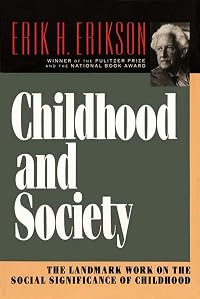
Childhood and Society
by Erik H. Erikson
On This Page
Description
"The original and vastly influential ideas of Erik H. Erikson underlie much of our understanding of human development. His insights into the interdependence of the individual's growth and historical change, his now-famous concepts of identity, growth, and the life cycle, have changed the way we perceive ourselves and society. Widely read and cited, his works have won numerous awards including the Pulitzer Prize and the National Book Award. Combining the insights of clinical psychoanalysis show more with a new approach to cultural anthropology, Childhood and Society deals with the relationships between childhood training and cultural accomplishment, analyzing the infantile and the mature, the modern and the archaic elements in human motivation. It was hailed upon its first publication as "a rare and living combination of European and American thought in the human sciences" (Margaret Mead, The American Scholar). Translated into numerous foreign languages, it has gone on to become a classic in the study of the social significance of childhood."--Back cover. Combining the insights of clinical psychoanalysis with a (then) new approach to cultural anthropology, this book is considered a landmark work on the social significance of childhood. The author examines the relationships between childhood training and cultural accomplishment, analyzing the infantile and the mature, the modern and the archaic elements in human motivation. show lessTags
Recommendations

































Member Reviews
If you're only familiar with the condensed version of Erikson described in undergraduate psychology and child development classes (the stages of psychosocial development, with their neat pairings of opposed forces) then actually reading his defining book may be a surprise. In this mixed bag of personal case studies, theoretical wanderings, and psychological biography, he approaches Freudian theory as if it were a large stalled vehicle, takes it apart to reveal some unusual components, and then reassembles the parts into something that looks a lot like the original but sometimes goes sideways instead of forward. I get the feeling that consistency was not his main interest, and I'm glad, since watching such an inquisitive mind move in so show more many directions at once is better than any number of little charts. show less
An interesting anthropological approach, riddled with dated views on sex, gender and roles, particularly in the first half.
Containing accounts of the author's field work among Sioux and Yurok Indians, and an examination of the American, German and Russian characters, this is an interpretation of human life on psychological lines. Using case histories as springboards for theoretical discussion of the formative years of childhood, Professor Erikson identifies human life as a delicate balance between bodily, mental and social influences. The main chapters are devoted to anxiety in young children, apathy in American Indians, confusion in veterans of war, and arrogance in young Nazis.
my edition is from 1950 - given me by Dr Stewart in early 2000s; card from Strybing as bookmark - more later when I locate reading notes ...
meanwhile shelved it Bay 3 Shelf 6 until I have time to clean it up
meanwhile shelved it Bay 3 Shelf 6 until I have time to clean it up
Childhood and society
Autor: Erik H Erikson
Editorial: St Albans : Triad, 1977.
Edition/Format: Libro : Inglés (eng) : Revised ed
Autor: Erik H Erikson
Editorial: St Albans : Triad, 1977.
Edition/Format: Libro : Inglés (eng) : Revised ed
Members
- Recently Added By
Author Information

33+ Works 4,254 Members
Erik H. Erikson, a German-born American psychologist and psychoanalyst, developed theories about the sequence of human development that have had an impact on clinical psychoanalysis, ethics, history, literature, child care, and the emerging interdisciplinary study of the life course. Erikson was an art student, but after undergoing psychoanalysis show more by Anna Freud in Vienna in 1927, he turned to the field of psychology. According to Erikson's life-cycle theory, first published in Childhood and Society (1950), there are eight developmental stages, which are biologically determined but environmentally shaped: infancy, early childhood, play age, school age, adolescence, young adulthood, mature adulthood, and old age. Each of these stages is associated with a particular crisis that the individual must successfully resolve in order to proceed normally to the next stage-for example, identity versus confusion in adolescence. The concept of the identity crisis is now firmly embedded in psychiatric theory. Erikson also studied the relationship between a person's life and the times in which he or she lives; and his historical-biographical studies of Luther and Gandhi are outstanding products of this inquiry. Erikson taught at Harvard University for 30 years (Bowker Author Biography) show less
Some Editions
Series
Belongs to Publisher Series
Aula-boeken (181)
Work Relationships
Common Knowledge
- Original publication date
- 1950
- Original language
- English
- Canonical DDC/MDS
- 301.431
Classifications
- Genres
- Sociology, Nonfiction, General Nonfiction
- DDC/MDS
- 301.431 — Society, government, & culture Social sciences, sociology & anthropology Sociology and anthropology Formerly: Social structure Life stages Childhood and child development
- LCC
- HQ781 .E75 — Social sciences The family. Marriage, Women and Sexuality The Family. Marriage. Women The family. Marriage. Home Children. Child development
- BISAC
Statistics
- Members
- 1,091
- Popularity
- 23,382
- Reviews
- 6
- Rating
- (3.60)
- Languages
- 14 — Czech, Dutch, English, Finnish, French, German, Greek, Hungarian, Italian, Norwegian (Bokmål), Portuguese, Romanian, Spanish, Swedish
- Media
- Paper, Ebook
- ISBNs
- 34
- ASINs
- 19