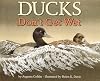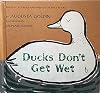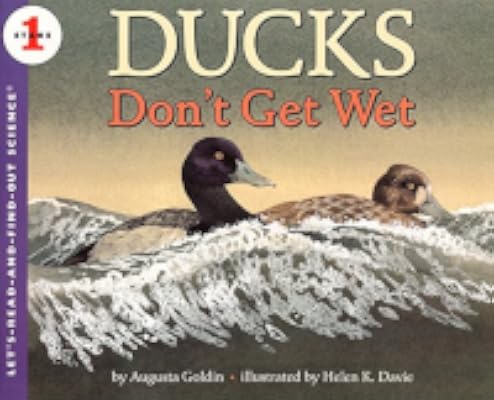
Ducks Don't Get Wet
by Augusta Goldin
On This Page
Description
Describes the behavior of different kinds of ducks and, in particular, discusses how all ducks use preening to keep their feathers dry.Tags
Recommendations















Member Reviews
Genre: Informational
Age Appropriateness: Primary and Intermediate
Media: Watercolors
Review:
All types of ducks don't get wet, but why? This books does an excellent job of describing in a child-friendly manner how and why the ducks don't get wet when they are always swimming in the water. Also, this book portrays the life of a duck smoothly, including the reason for their migration, and wonderful illustrations to assist presentation of information. There is also an experiment included in the back of the book that allows the experimenter to see how something can be waterproof.
Age Appropriateness: Primary and Intermediate
Media: Watercolors
Review:
All types of ducks don't get wet, but why? This books does an excellent job of describing in a child-friendly manner how and why the ducks don't get wet when they are always swimming in the water. Also, this book portrays the life of a duck smoothly, including the reason for their migration, and wonderful illustrations to assist presentation of information. There is also an experiment included in the back of the book that allows the experimenter to see how something can be waterproof.
This book gives students a lot of information about ducks such as where they live, how they act, what they eat, etc. I like this book because there is not a lot of text, but still good information for students to learn from. Sometimes informational texts can be wordy and that will push a student to not want to read it. This book has a really good balance of words and pictures. This would definitely be a kinder or 1st grade level book. The students could even do some sort of project afterwards that had to do with ducks, that would be fun. This book talks about different types of ducks so maybe students could choose their favorite from the story, give information about that duck and draw/color a picture.
This is a great book that explains how and why ducks don't get wet, even if they are completely under water! It has nice pictures to go along with the text to explain how ducks' bodies produce an oil to cover their feathers. This book also explores different species of ducks and how they migrate to find food during the winter. It also provides short experiments that you could do at home or in the classroom.
What do different kinds of ducks eat? Why do ducks fly south for the winter? Are ducks very good swimmers? And, when they do swim, why don't ducks get wet?
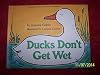
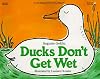
The curious child will learn plenty about ducks from Ducks Don't Get Wet, a Let's-Read-and-Find-Out Science Book by Augusta Goldin, illustrated by Leonard Kessler.
Like What Makes Day and Night, Ducks Don't Get Wet is interesting and informative, and the illustrations, though sometimes a little odd, go well with the text. Also like What Makes Day and Night, Ducks Don't Get Wet includes some experiments children can do at home to help them understand why ducks, as the book says, don't get wet.
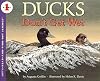
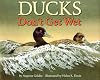
There's a newer edition than mine with illustrations by Helen K. Davie. It looks to have much show more more realistic illustrations, compared to Kessler's version, but it seems a shame to miss the strangeness of Kessler's illustrations. Either version should be good, though.
Ducks Don't Get Wet is another wonderful book in the Let's-Read-and-Find-Out Science Books series, and a great choice for children. It's educational and fun--you can't go wrong!
This review also appears on Barba Non DB. show less
The curious child will learn plenty about ducks from Ducks Don't Get Wet, a Let's-Read-and-Find-Out Science Book by Augusta Goldin, illustrated by Leonard Kessler.
Like What Makes Day and Night, Ducks Don't Get Wet is interesting and informative, and the illustrations, though sometimes a little odd, go well with the text. Also like What Makes Day and Night, Ducks Don't Get Wet includes some experiments children can do at home to help them understand why ducks, as the book says, don't get wet.
There's a newer edition than mine with illustrations by Helen K. Davie. It looks to have much show more more realistic illustrations, compared to Kessler's version, but it seems a shame to miss the strangeness of Kessler's illustrations. Either version should be good, though.
Ducks Don't Get Wet is another wonderful book in the Let's-Read-and-Find-Out Science Books series, and a great choice for children. It's educational and fun--you can't go wrong!
This review also appears on Barba Non DB. show less
This picture book describes how ducks' feathers have an oil on them that repels water which is why they are able to go into the water without getting wet. This informational book is fun to read and has many interesting facts.
Andy and I were able to read this book together and marvel at the mysteries of ducks. He enjoyed it as much as I did and we were able to talk about how oil repells water and how amazing it is that ducks are able to use it. We talked over the questions, "what would happen if ducks did get wet? would they be able to fly?", "What would ducks eat if they couldn't go under water?" and "do any other birds have this same property?"
As a teacher I would incorporate this book with a science lesson on buoyancy where I would show more read this book and then the students would experiement with water and oil and see what happens. They would also look up the word buoyancy and use it to describe what happens when water and oil are mixed. show less
Andy and I were able to read this book together and marvel at the mysteries of ducks. He enjoyed it as much as I did and we were able to talk about how oil repells water and how amazing it is that ducks are able to use it. We talked over the questions, "what would happen if ducks did get wet? would they be able to fly?", "What would ducks eat if they couldn't go under water?" and "do any other birds have this same property?"
As a teacher I would incorporate this book with a science lesson on buoyancy where I would show more read this book and then the students would experiement with water and oil and see what happens. They would also look up the word buoyancy and use it to describe what happens when water and oil are mixed. show less
Genre: Informational
Summary: This book explains why ducks can be in the water but don't get wet. It also discusses the different types of ducks and how and what they eat. the last main focus is explaining where and why ducks migrate south during the winter.
Review: This is a good informational book because it gives a lot of facts, gives reasoning for many facts (such as why ducks don't get wet,) provides accurate illustrations, and is written in clear non-scientific language easy for young readers and listeners to understand.
Summary: This book explains why ducks can be in the water but don't get wet. It also discusses the different types of ducks and how and what they eat. the last main focus is explaining where and why ducks migrate south during the winter.
Review: This is a good informational book because it gives a lot of facts, gives reasoning for many facts (such as why ducks don't get wet,) provides accurate illustrations, and is written in clear non-scientific language easy for young readers and listeners to understand.
Have you ever wondered how ducks spend the whole day in the water and never get wet? Did you know that they can dive 100 feet deep, and still come up dry? We meet ten different kinds of ducks in this book and discover what they eat, how they find food and how they fly.
Members
- Recently Added By
Lists

Children's Books About Science and Math
461 works; 12 members
Author Information
15 Works 1,751 Members
Some Editions
Awards and Honors
Awards
Series
Belongs to Publisher Series
Let's-Read-and-Find-Out Science (Level 1)
Common Knowledge
- Canonical title
- Ducks Don't Get Wet
- Original publication date
- 1965
Classifications
- Genre
- Nonfiction
- DDC/MDS
- 598.4 — Natural sciences & mathematics Animals Birds Waterbirds
- LCC
- QL696 .A52 .G64 — Science Zoology Zoology Chordates. Vertebrates Birds
- BISAC
Statistics
- Members
- 981
- Popularity
- 26,939
- Reviews
- 13
- Rating
- (3.72)
- Languages
- English
- Media
- Paper
- ISBNs
- 17
- UPCs
- 1
- ASINs
- 12