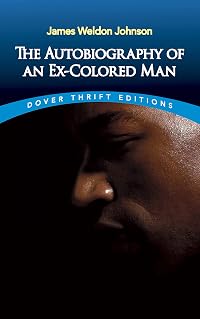
The Autobiography of an Ex-Colored Man
by James Weldon Johnson
On This Page
Description
James Weldon Johnson's The Autobiography of an Ex-Colored Man is the fictional account of the life of a young American man in the late nineteenth and early twentieth century. With his bi-racial heritage, the Ex-Colored Man is faced with the choice of embracing his black culture and its ragtime music, or passing as a white man and living a mediocre middle-class existence. While not actually an autobiography, Johnson based the book on his own life and the lives of people he knew..
Tags
Recommendations





Member Reviews
The slimness of this novel belies the breadth and depth of its exploration of the racial and social divide in post-Reconstruction America.
We are whisked through the protagonist's relatively fortunate life, where his "Italian" complexion allows him access to white privilege while his upbringing allows him to also maintain an access to Black culture and community. Through this back-and-forth across the two cultures, he presents his experiences life as a Black-but-passing-for-white man in and outside of America.
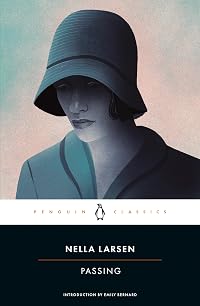
The title forever hangs at the back of the reader's mind through the protagonist's various travels. At what point will he seek the "easy" way out? There are some essay-ish moments which the novel is clearly built around on to build show more up to the inevitable titular moment. But instead of being clunky or out-of-place I found them remarkable in how the author does not shy away from presenting opposing arguments as well as exposing the hypocrisy of both sides. Overall it feels like the academic brother of the more psychological and emotionally-charged Passing by Nella Larsen. show less
We are whisked through the protagonist's relatively fortunate life, where his "Italian" complexion allows him access to white privilege while his upbringing allows him to also maintain an access to Black culture and community. Through this back-and-forth across the two cultures, he presents his experiences life as a Black-but-passing-for-white man in and outside of America.
The title forever hangs at the back of the reader's mind through the protagonist's various travels. At what point will he seek the "easy" way out? There are some essay-ish moments which the novel is clearly built around on to build show more up to the inevitable titular moment. But instead of being clunky or out-of-place I found them remarkable in how the author does not shy away from presenting opposing arguments as well as exposing the hypocrisy of both sides. Overall it feels like the academic brother of the more psychological and emotionally-charged Passing by Nella Larsen. show less
Readers never learn the original name of the supposed author of this fictional autobiography nor the name which he concocts once he decides what his future is to be. A Negro Everyman then. Our protagonist is the progeny of the handsome scion of a wealthy Connecticut family and the scion’s mother’s high-yellow seamstress, or as he calls it “the child of this unsanctioned love.” The boy favors his White ancestry and is brought up with every luxury, except the open acknowledgement of his father, who only occasionally visits but pays for fine clothing, piano and voice lessons and more. In other words, this young man has every privilege that can be conferred on a Negro at the end of the 19th century in the North.
But at a time of show more segregation and racism, bad enough in the North and horrific in the South, can that be enough? The title’s use of “Ex-Coloured Man” reveals what readers expect from the beginning. That working for what was then called the Negro race and being openly Black came at a very high cost. Still in print more than a century after author and NAACP leader James Weldon Johnson released anonymously in 1912, sadly, so much of what Johnson wrote still applies. (He was a diplomat to Venezuela and then Nicaragua under the Teddy Roosevelt administration, and he feared that what would be considered a radical work would harm his career.) As Johnson wrote:
But at a time of show more segregation and racism, bad enough in the North and horrific in the South, can that be enough? The title’s use of “Ex-Coloured Man” reveals what readers expect from the beginning. That working for what was then called the Negro race and being openly Black came at a very high cost. Still in print more than a century after author and NAACP leader James Weldon Johnson released anonymously in 1912, sadly, so much of what Johnson wrote still applies. (He was a diplomat to Venezuela and then Nicaragua under the Teddy Roosevelt administration, and he feared that what would be considered a radical work would harm his career.) As Johnson wrote:
And this is the dwarfing, warping, distorting influence which operates upon each and every colored man in the United States. He is forced to take his outlook on all things, not from the viewpoint of a citizen, or a man, or even a human being, but from the viewpoint of a colored man.show less
As we can see with the Trump Administration’s attempt to obliterate mentions of women and people of color off government websites, including heroes off the Pentagon’s webpages, things in the process of reverting back to Johnson’s day. That’s why this is so highly, highly, highly recommended.
Trivia: Johnson is the author of the words to the Negro National Anthem, “Lift Ev’ry Voice and Sing,” while his brother wrote the music.
What an extraordinary novel! It's difficult to believe such a short work can contain so much. First there is the story itself, which includes among other things a detailed and colorful explanation of the Cakewalk, the story of the rise of Ragtime, the beauty of the music of the Fisk Jubilee Singers, a rigorous defense of Gospel singing as culturally significant, an explanation of the inner workings of a cigar factory, a celebration of Uncle Remus stories before they were sullied by Walt Disney, and scenes describing gambling, fetishization of blacks by whites, and what it's like to travel overnight in the laundry closet of a Pullman car...amazing. Interlaced throughout the liveliness of the tale are ruminations about race that feel show more contemporary. By making his protagonist able to 'pass' for white Johnson creates a character who can move into and out of black or white culture at will. Johnson thus gives the character the perception and insight of an outsider, someone who observes and records without feeling compelled to judge. The ending is wrenching, when the protagonist realizes he has sacrificed his dreams and his ambitions and his talents, by choosing the safety and prosperity of living as a white man: "I have chosen the lesser part, that I have sold my birthright for a mess of pottage." show less
A fine book, more notable for it's place as a pioneering work in African American literature than any literary qualities. It interests me as an inversion of the more common narrative in which a black protagonists opts for a life of public excellence in service to the race, rather than a life of more quiet personal fulfillment. In this way, it reminds me of books like the Damnation of Theron Ware or Main Street, and the "confession" of a black man who chooses to pass for white gives the novel an easily accessible layer of social critique.
I will say that James Weldon Johnson really accomplished what he hoped for in this novel. I really felt like I was reading an actual autobiography. A very interesting story. The lack of contractions made the language feel awkward at times. A good reader, but the writing a bit stilted. I think that made it feel more like the real story of a man's life, a man who wasn't a writer. Bill Andrew Quinn has a wonderful melodious voice, a pleasure to listen to.
I'm pretty sure the only other time I read this novel was back in high school as required reading. Even as its impression on me this time has been enhanced by increased experience and whatnot, this book still struck me in the past as "one of the saddest books I've ever read."
Not because it's depressing at every turn, which it isn't. There are a few interesting friendships, and various parts of the narrative shine with historical Black culture, including the cakewalks and especially the celebration of ragtime.
But the hard parts were more profound to me this time, in a way, including the profundity of pain. I also took more time to think about the characters' different views, including the protagonist's.
This novel is a call to think. To show more pause, to listen, and to think. And the call is still relevant now, as it was back when the book was published (anonymously, the first time) over a century ago.
This time after I finished it, I cried. Yet, one of the saddest books I've ever read also gives me hope in regard to progress, and it makes me that much more grateful and determined to be who I am.
Because I can. show less
Not because it's depressing at every turn, which it isn't. There are a few interesting friendships, and various parts of the narrative shine with historical Black culture, including the cakewalks and especially the celebration of ragtime.
But the hard parts were more profound to me this time, in a way, including the profundity of pain. I also took more time to think about the characters' different views, including the protagonist's.
This novel is a call to think. To show more pause, to listen, and to think. And the call is still relevant now, as it was back when the book was published (anonymously, the first time) over a century ago.
This time after I finished it, I cried. Yet, one of the saddest books I've ever read also gives me hope in regard to progress, and it makes me that much more grateful and determined to be who I am.
Because I can. show less
At the end of this book I was absolutely gut punched- my biggest fear in life is having regrets of not doing enough, of making the wrong life changing choice, of choosing what feels comfortable and safe simply because I have the privilege too and then at the end of my life, I'd regret not following my heart by being a stronger advocate for myself and my communities. people forgive but time doesn't.
Members
- Recently Added By
Lists

Books Read in 2014
2,343 works; 89 members

Best African and African diaspora books
111 works; 4 members

Charleston Syllabus (waitingtoderail)
143 works; 2 members

Lithub: 50 Great Classic Novels Under 200 pages
50 works; 10 members

AP Lit
363 works; 6 members
Author Information

39+ Works 4,346 Members
Born in Jacksonville Fla. in 1871, James Weldon Johnson was one of the leaders of the Harlem Renaissance of the 1920s. His career was varied and included periods as a teacher, lawyer, songwriter (with his brother J. Rosamond Johnson), and diplomat (as United States Consul to Puerto Cabello, Venezuela, from 1906 to 1909). Among his most famous show more writings are Autobiography of an Ex-Coloured Man, published anonymously in 1912, and God's Trombones: Seven Negro Sermons in Verse (1927), the winner of the Harmon Gold Award. He was also editor of several anthologies of African-American poetry and spirituals, and in 1933 his autobiography, Along This Way, was published. He served as Secretary to the NAACP from 1916 to 1930 and was a professor of literature at Fisk University in Nashville from 1930 until his death in 1938. (Bowker Author Biography) show less
Some Editions
Awards and Honors
Notable Lists
Series
Belongs to Publisher Series
Work Relationships
Is contained in
Is abridged in
Has as a reference guide/companion
Has as a commentary on the text
Has as a student's study guide
Common Knowledge
- Canonical title
- The Autobiography of an Ex-Colored Man
- Alternate titles
- The Autobiography of an Ex-Coloured Man
- Original publication date
- 1912
- First words
- I know that in writing the following pages I am divulging the great secret of my life, the secret which for some years I have guarded far more carefully than any of my earthly possessions; and it is a curious study to me to ... (show all)analyze the motives which prompt me to do it.
- Last words
- (Click to show. Warning: May contain spoilers.)My love for my children makes me glad that I am what I am and keeps me from desiring to be otherwise; and yet, when I sometimes open a little box in which I still keep my fast-yellowing manuscripts, the only tangible remnants of a vanished dream, a dead ambition, a sacrificed talent, I cannot repress the thought that, after all, I have chosen the lesser part, that I have sold my birthright for a mess of pottage.
- Original language
- English
- Disambiguation notice
- Please do not combine this with the "Norton Critical Editions" version - that edition has its own work entry
Classifications
Statistics
- Members
- 1,687
- Popularity
- 13,209
- Reviews
- 29
- Rating
- (3.77)
- Languages
- English, French, Portuguese, Spanish
- Media
- Paper, Audiobook, Ebook
- ISBNs
- 114
- UPCs
- 2
- ASINs
- 29