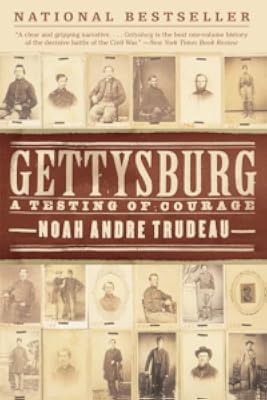
Gettysburg: A Testing of Courage
by Noah Andre Trudeau
On This Page
Description
This text presents an account of the July 1, 1863, Civil War battle, covering heightening campaign tensions, commander decisions, and the struggles faced by thousands of soldiers. Balancing his own narrative style with revealing firsthand accounts, including excerpts from the diaries and letters of the men on both sides of the battlefield, the author recounts the heightening tension of the campaign, the life-or-death decisions made by its commanders, and the struggle endured by thousands of show more its bravest soldiers. Not forgotten are the stories of the noncombatants, the thousands of civilians whose placid lives were swept into the ferocious cauldron. show lessTags
Recommendations





Member Reviews
Yet another military book. I have a preference for obscure wars and obscure battles, so I’ve generally resisted detailed studies of Gettysburg, but this one was part of a “Buy Two, Get One Free” deal at Barnes & Noble, so I couldn’t resist. I’m glad I didn’t; Noah Andre Trudeau’s Gettysburg is very good indeed. Back cover blurbs compare Trudeau to Catton and Foote as a civil war history, and I have to concur. Trudeau’s style combines memoirs of individual soldiers and civilians from both sides with detailed but easy-to-follow descriptions of the battle.
I assume most here know about Gettysburg – for the benefit of our non-USA friends, here’s a rough summary.
Robert E. Lee and the Confederate Army of Northern Virginia show more defeat the Army of the Potomac at Chancellorsville, leaving Union General Joe Hooker to pull back and refit. Lee is pressured by Richmond to send some of his army west to help out at the siege of Vicksburg, but demurs and decides to invade the North instead. The ANV steals a march on Hooker and heads into Pennsylvania. Hooker eventually follows, but like many Union generals feels he is outnumbered and demands reinforcements. Hooker is relieved and replaced by George Meade. In the mean time, Lee’s army is wandering around central Pennsylvania scooping up supplies and generally making mischief; unfortunately for him his cavalry under J.E.B. Stuart has managed to get itself on the wrong side of the Army of the Potomac and is unavailable to perform reconnaissance. Even though neither side wants a general engagement, a Union cavalry screen under General John Buford encounters a Confederate force under Henry Heth on July 1, 1863. Both sides throw in reinforcements – the Union First Corps arrives and things are temporarily going the Union’s way when another confederate force under Richard Ewell arrives on the north. After fierce fighting, the Federals break and retreat to positions on Cemetary Hill and Seminary Ridge. First day to the Army of Northern Virginia.
On July 2nd Lee tries to outflank the Union left with Longstreet’s corps. The Federals are generally in a fairly strong position, except they have neglected to put troops on Little Round Top, a commanding hill on their extreme left; and eccentric General Daniel Sickles either fails to understand Meade’s orders or ignores them and positions his Third Corps in front of Seminary Ridge instead of on top of it. This is where many of the famous places on the battlefield are – The Peach Orchard, Devil’s Den, The Wheatfield, and, of course, Little Round Top, where the 20th Maine under Joshua Chamberlain holds off the 15th Alabama under Warren Oates until out of ammunition, then breaks the exhausted Confederates with a bayonet charge (Trudeau points out that this wasn’t quite as dramatic as depicted in the movie, but he’s still full of praise for Chamberlain). In the meantime, Sickles is pushed out of his position and back to Seminary Ridge, losing a leg in the process. (Well, he didn’t actually lose it; it just wasn't attached to him any more. It ended up in an army medical museum, where Sickles would frequently visit it after war.) Second day slightly in favor of the Army of Northern Virginia.
Having attacked the Union right and left, on July 3rd Lee goes after the Union center, a decision forever controversial. Pickett’s Division goes after the Union Second Corps in the infamous Pickett’s Charge. Unfortunately for them, Union artillery commander Henry Hunt has anticipated this move and positioned all his reserve artillery in this sector. Further, Hunt orders units to stop firing and conserve their ammunition, to make the Confederates think their own preparatory counterbattery fire has been successful. Pickett’s Division goes down to bloody ruin in the face of massed Union artillery and musket fire; a little copse of trees (still there) at the crest of Seminary Ridge is the “high water mark” of the Confederacy. Although Lee is able to retreat the battered Army of Northern Virginia back to friendly soil, he’s never able to take the offensive again. Day Three, battle, and war to the Union.
Up to now, my understanding of the battle was strongly influenced by the movie Gettysburg and my own visits to the site, which mostly focused on the more accessible sites of the second and third days of fighting. I hadn’t realized that the first days fighting was that extensive, or the degree of action at Cemetery and Culp’s Hills on the Union right, or the location of the cavalry battle between Stuart and Custer on the third day. The actions of the Eleventh Corps on the Union right were especially interesting; this unit had a strong contingent of immigrants. If you asked somebody “In what war did officers Leopold Von Gilsa, Detleo von Einsiedal, Gotthilf Bourry, Alexander Schimmelfennig, Georg von Amsberg, Adolphus Dobke, Adolph von Hartung, Alexander von Mitzel, Gustav Schleiter, August Otto, Emil Koenig, and Wlodzimierz Kryzanowski lead units of regiment size or greater?” they probably wouldn’t guess the American Civil War. I wonder if there’s some chauvinism acting there, with Union and Confederate historians both reluctant to admit the participation of non-anglosaxons?
There are extensive maps, both of strategic and tactical situations; the maps for Hooker and Mead’s pursuit of Lee show the position of each Union corps at the start and end of each day. The one salient drawback to the maps is Trudeau uses black rectangles to indicate Confederate units and dark gray rectangles to indicate Union ones; in this edition they are practically indistinguishable. I wonder if the hardcover version had them in different colors, or perhaps on coated paper? Fortunately, units also have the commanding officer’s name alongside, so as long as you are reasonably familiar with Civil War generals things usually make sense, although it may take some perusal of the organization tables for both armies in the appendix to figure out the complicated fighting on the second day. Although I very seldom write in books, I’m tempted to go over all the maps with a highlighter to distinguish the units.
Highly recommended; Trudeau isn’t quite as readable a historian as Bruce Catton or quite the narrator as Shelby Foote, but he comes close enough in both areas. I’m hyped for another visit to Gettysburg with this book in hand. show less
I assume most here know about Gettysburg – for the benefit of our non-USA friends, here’s a rough summary.
Robert E. Lee and the Confederate Army of Northern Virginia show more defeat the Army of the Potomac at Chancellorsville, leaving Union General Joe Hooker to pull back and refit. Lee is pressured by Richmond to send some of his army west to help out at the siege of Vicksburg, but demurs and decides to invade the North instead. The ANV steals a march on Hooker and heads into Pennsylvania. Hooker eventually follows, but like many Union generals feels he is outnumbered and demands reinforcements. Hooker is relieved and replaced by George Meade. In the mean time, Lee’s army is wandering around central Pennsylvania scooping up supplies and generally making mischief; unfortunately for him his cavalry under J.E.B. Stuart has managed to get itself on the wrong side of the Army of the Potomac and is unavailable to perform reconnaissance. Even though neither side wants a general engagement, a Union cavalry screen under General John Buford encounters a Confederate force under Henry Heth on July 1, 1863. Both sides throw in reinforcements – the Union First Corps arrives and things are temporarily going the Union’s way when another confederate force under Richard Ewell arrives on the north. After fierce fighting, the Federals break and retreat to positions on Cemetary Hill and Seminary Ridge. First day to the Army of Northern Virginia.
On July 2nd Lee tries to outflank the Union left with Longstreet’s corps. The Federals are generally in a fairly strong position, except they have neglected to put troops on Little Round Top, a commanding hill on their extreme left; and eccentric General Daniel Sickles either fails to understand Meade’s orders or ignores them and positions his Third Corps in front of Seminary Ridge instead of on top of it. This is where many of the famous places on the battlefield are – The Peach Orchard, Devil’s Den, The Wheatfield, and, of course, Little Round Top, where the 20th Maine under Joshua Chamberlain holds off the 15th Alabama under Warren Oates until out of ammunition, then breaks the exhausted Confederates with a bayonet charge (Trudeau points out that this wasn’t quite as dramatic as depicted in the movie, but he’s still full of praise for Chamberlain). In the meantime, Sickles is pushed out of his position and back to Seminary Ridge, losing a leg in the process. (Well, he didn’t actually lose it; it just wasn't attached to him any more. It ended up in an army medical museum, where Sickles would frequently visit it after war.) Second day slightly in favor of the Army of Northern Virginia.
Having attacked the Union right and left, on July 3rd Lee goes after the Union center, a decision forever controversial. Pickett’s Division goes after the Union Second Corps in the infamous Pickett’s Charge. Unfortunately for them, Union artillery commander Henry Hunt has anticipated this move and positioned all his reserve artillery in this sector. Further, Hunt orders units to stop firing and conserve their ammunition, to make the Confederates think their own preparatory counterbattery fire has been successful. Pickett’s Division goes down to bloody ruin in the face of massed Union artillery and musket fire; a little copse of trees (still there) at the crest of Seminary Ridge is the “high water mark” of the Confederacy. Although Lee is able to retreat the battered Army of Northern Virginia back to friendly soil, he’s never able to take the offensive again. Day Three, battle, and war to the Union.
Up to now, my understanding of the battle was strongly influenced by the movie Gettysburg and my own visits to the site, which mostly focused on the more accessible sites of the second and third days of fighting. I hadn’t realized that the first days fighting was that extensive, or the degree of action at Cemetery and Culp’s Hills on the Union right, or the location of the cavalry battle between Stuart and Custer on the third day. The actions of the Eleventh Corps on the Union right were especially interesting; this unit had a strong contingent of immigrants. If you asked somebody “In what war did officers Leopold Von Gilsa, Detleo von Einsiedal, Gotthilf Bourry, Alexander Schimmelfennig, Georg von Amsberg, Adolphus Dobke, Adolph von Hartung, Alexander von Mitzel, Gustav Schleiter, August Otto, Emil Koenig, and Wlodzimierz Kryzanowski lead units of regiment size or greater?” they probably wouldn’t guess the American Civil War. I wonder if there’s some chauvinism acting there, with Union and Confederate historians both reluctant to admit the participation of non-anglosaxons?
There are extensive maps, both of strategic and tactical situations; the maps for Hooker and Mead’s pursuit of Lee show the position of each Union corps at the start and end of each day. The one salient drawback to the maps is Trudeau uses black rectangles to indicate Confederate units and dark gray rectangles to indicate Union ones; in this edition they are practically indistinguishable. I wonder if the hardcover version had them in different colors, or perhaps on coated paper? Fortunately, units also have the commanding officer’s name alongside, so as long as you are reasonably familiar with Civil War generals things usually make sense, although it may take some perusal of the organization tables for both armies in the appendix to figure out the complicated fighting on the second day. Although I very seldom write in books, I’m tempted to go over all the maps with a highlighter to distinguish the units.
Highly recommended; Trudeau isn’t quite as readable a historian as Bruce Catton or quite the narrator as Shelby Foote, but he comes close enough in both areas. I’m hyped for another visit to Gettysburg with this book in hand. show less
It's hard for any writer to keep a book that's this in-depth and this detailed from becoming tedious. A lot of the narrative has to do with troop movements and other such details, so at times one's eyes may begin to glaze over, especially during the chapters that take place before the battle. Nevertheless, this is a fascinating read overall. Trudeau gives us quite a bit of good information about the motivations, both military and political, of the major players in the battle, especially Generals Meade and Lee. In addition, Trudeau dips liberally into letters and diaries to give almost every section of the book a personal dimension.
The descriptions of the battle itself are outstanding, both from a historical and from a narrative point of show more view. Although this is certainly not the first book about the Civil War I've read, I feel like I gained a whole new insight into the nature and horros of combat during this tragic conflict, and also the intriguing, and often baffling, way decisions got made all along the line.
I may not be doing this book justice here, but I do recommend it highly for anyone interested in an extremely detailed account of this bloody and pivotal battle. show less
The descriptions of the battle itself are outstanding, both from a historical and from a narrative point of show more view. Although this is certainly not the first book about the Civil War I've read, I feel like I gained a whole new insight into the nature and horros of combat during this tragic conflict, and also the intriguing, and often baffling, way decisions got made all along the line.
I may not be doing this book justice here, but I do recommend it highly for anyone interested in an extremely detailed account of this bloody and pivotal battle. show less
Noah Trudeau's Gettysburg: A Testng of Courage, is a very readable account of the Battle of Gettysburg. Prior to reading it I was given mixed reviews of very good to outstanding, and I believe that is a oustanding history that lends to the historiography of this battle, by the detail and narrative style of the author.
I have read many books on the battle and it stands outside of Coddington's among the best single volume histories on Gettysburg that I have read. I rate this a 4.5 star read and have no problems recommending it to others.
I have read many books on the battle and it stands outside of Coddington's among the best single volume histories on Gettysburg that I have read. I rate this a 4.5 star read and have no problems recommending it to others.
An engrossing history of a battle that many have felt has been studied to the point of exhaustion. Trudeau is especially a master of making first hand accounts of the battle come to life, as if their authors were sitting in front of the reader. The biggest drawback to the history is the author’s long and extensive descriptions of troop movement, which become too complicated to follow without a map of which there are too few of. Overall though, I enjoyed the book which gave me a better appreciation of the sacrifice witnessed over those three days. I would recommend it to a select group of people.
This is a meticulously researched, in-depth study of the battle and the men who fought it. Trudeau draws not only on official documents and the activities of the general staffs, but also on the letters and diaries of common soldiers and citizens. Yes, the maps are small and hard to read, and there is a great deal of detail about troop movements. But larger maps would have made for a much bigger book, and it is impossible to discuss a battle intelligently without knowing who was where, when, and why. Trudeau's writing, in any event, makes it all come alive in a way that few other civil war historians can.
Excellent account of the 3 days of fighting at Gettysburg. Trudeau includes personal stories and official accounts of the battle which serve to make it both interesting and poignant. His writing style seems to work in concert with the rapid pace in which the events at Gettysburg unfolded. The only drawback to this book is that some of his maps are remarkably complex and difficult to read. In addition there are instances when the typeset on these maps and subsequent keys or legends is so small that it actually requires a magnifying glass --at least for anyone who already uses bifocals to read!
This is really the first book about a CW battle that I've read. It detailed nearly every skirmish of the battle, but it never seemed dry. If I had read more books on the battles, I could perhaps give a better 'comparison' review. If you want to know everything there is about this battle, this book would certainly cover it.
Members
- Recently Added By
Author Information

13+ Works 2,085 Members
Common Knowledge
- Original publication date
- 2002
- People/Characters
- Robert E. Lee; George Gordon Meade; Edward Porter Alexander; Nathaniel Allen; Adelbert Ames; John W. Ames (show all 82); George von Amsberg; George Thomas Anderson ('Tige'); Richard Heron Anderson (as Richard H. Anderson); James J. Archer; Lewis A. Armistead; George Arrowsmith; Nellie Aughinbaugh; Isaac E. Avery; Romeyn B. Ayres; Elijah W. Bacon; Edwin H. Balson; William Barksdale; Arabella Barlow; Francis Channing Barlow (as Francis C. Barlow); James Barnes; Agnes Barr; Henry Baxter; Harriet Bayly; William H. Bailey; P. G. T. Beauregard; Robert K. Beecham; Robert Bell; George G. Benedict; John W. Benett (sic); Henry L. Benning; Hiram Berdan; Henry Robinson Berkeley; A. D. Betts; John L. Beveridge; Chapman Biddle; John Bigelow; Henry H. Bingham; David B. Birney; George D. Bisbee; John L. Black; Eugene Blackford; William W. Blackford; John A. Blair; George D. Bowen; L. G. Bradwell; John L. Brady; Henry C. Brainard; George Breck; William R. Brewster; Robert A. Bright; George Broadbent; Sarah Broadhead (as Sarah 'Sallie' R. Brodhead); John M. Brockenbrough; John R. Brooke; James M. Brooks; G. Campbell Brown; J. Thompson Brown; Philip Brown; William Brown; Morris Brown, Jr.; Daniel W. Buck; Lynde W. Buckingham; Abram Buckles; John K. Bucklyn; Fannie Buehler; John Buford; Michael J. Bulger; Sidney Burbank; Henry K. Burgwyn, Jr.; George K. Burling; John Burner; John L. Burns; Daniel Butterfield; Homer Byington; G. W Bynum; Henry C. Cabell; John C. Caldwell; John H. Calef; Norman H. Camp; Hugh Carey; Casper R. Carlisle
- Important places
- USA; Adams County, Pennsylvania, USA; Gettysburg, Pennsylvania, USA; Pennsylvania, USA; Alabama, USA (troops from); Aldie, Virginia, USA (show all 21); Aquia Landing, Virginia, USA; Arkansas, USA (troops from); Ashby's Gap, Virginia, USA; Baltimore, Maryland, USA; Baltimore Pike, Gettysburg, Pennsylvania, USA; Baltimore Street, Gettysburg, Pennsylvania, USA; Barlow's Knoll, Gettysburg, Pennsylvania, USA; Benner's Hill, Gettysburg, Pennsylvania, USA; Biesecker's Woods, Gettysburg, Pennsylvania, USA; Big Round Top, Gettysburg, Pennsylvania, USA; Black Horse Tavern, Gettysburg, Pennsylvania, USA; Blocher's Knoll, Gettysburg, Pennsylvania, USA; Brandy Station, Virginia, USA; Brickyard Lane, Gettysburg, Pennsylvania, USA; Brinkerhoff's Ridge, Gettysburg, Pennsylvania, USA
- Important events
- American Civil War (1861 | 1865); Gettysburg Campaign (1863); Battle of Gettysburg (1863-07-01 | 1863-07-03)
- Epigraph
- When I was younger I could remember anything, whether it happened or not. But as I grew older, it got so I only remembered the latter. -Mark Twain
- First words
- The dawn light came up behind Richmond's imposing statehouse, spreading inexorably across the eight marble columns fronting the building.
- Last words
- (Click to show. Warning: May contain spoilers.)With these words, Abraham Lincoln transformed the three days of combat at Gettysburg, comprising one of the greatest battles of the Civil War, into a defining moment in American history.
Classifications
- Genres
- History, Nonfiction, General Nonfiction
- DDC/MDS
- 973.7349 — History & geography History of North America United States Civil War Era (1857-1865) Abraham Lincoln (1861-1865) Campaign of 1863 Battle of Gettysburg, Pa. (1-3 July)
- LCC
- E475.53 .T78 — History of the United States United States Civil War period, 1861-1865 The Civil War, 1861-1865
- BISAC
Statistics
- Members
- 570
- Popularity
- 52,114
- Reviews
- 8
- Rating
- (4.18)
- Languages
- English
- Media
- Paper, Audiobook, Ebook
- ISBNs
- 4
- ASINs
- 5