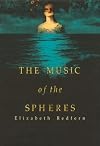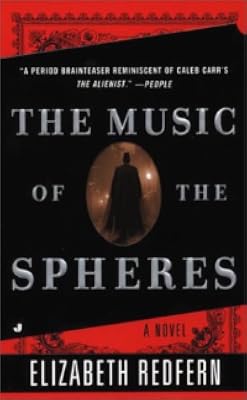
The Music of the Spheres
by Elizabeth Redfern
On This Page
Description
In the London of 1795, intrigue and death walk the dark streets. England is at war with its neighbor and nemesis, France, and espionage is rampant. It is the job of Jonathan Absey at the Home Office to catch these spies, but his mind is elsewhere, his dreams haunted by the still unsolved murder of his fifteen-year-old daughter on these same streets. Desperately pursuing both investigations, he stumbles across a strange society of astronomers called the Company of Titius who are on a furious show more search of their own: to discover a long-lost star in the wide black sky. As he digs into their arcane world, their quest begins to merge with his own, and Absey finds himself discovering more than he had ever imagined -- not only about spies and murderers but also about celestial numbers and the making of codes; about passions as unnatural as they are obsessive; and about the bonds of family...and the lengths we will go to preserve them. With "The Music of the Spheres," Elizabeth Redfern emerges asan evocative and elegant writer of startling power, her gifts for characterization, atmosphere, narrative, and rich moral drama marking her as a show lessTags
Recommendations









































Member Reviews
Set in 1795 London against the backdrop of the disastrous English-backed Royalist invasion of Revolutionary France, Elizabeth Redfern's first novel, The Music of the Spheres (2001) is a dark, rich tale of international espionage, astronomical observation, and diabolical murder. All three of those themes combine to create a very creepy literary thriller, best not read immediately before bedtime (which was, naturally, when I read most of it).
None of Redfern's characters are very likable (in fact they are to a person rather the opposite), but that only adds to the murkiness of the book. The author has, though, captured the essence of her time period and setting very well, and she's written a book which is sure to hold its reader's show more attention (even if it's only to find out what horrible thing happens next). The ending may be apparent somewhat in advance (it was for me), but even having guessed what was coming I had no idea how Redfern was going to get us there.
If you enjoyed The Alienist, or Instance of the Fingerpost, or The Interpretation of Murder, I'd recommend this one as well.
http://philobiblos.blogspot.com/2007/12/book-review-music-of-spheres.html show less
None of Redfern's characters are very likable (in fact they are to a person rather the opposite), but that only adds to the murkiness of the book. The author has, though, captured the essence of her time period and setting very well, and she's written a book which is sure to hold its reader's show more attention (even if it's only to find out what horrible thing happens next). The ending may be apparent somewhat in advance (it was for me), but even having guessed what was coming I had no idea how Redfern was going to get us there.
If you enjoyed The Alienist, or Instance of the Fingerpost, or The Interpretation of Murder, I'd recommend this one as well.
http://philobiblos.blogspot.com/2007/12/book-review-music-of-spheres.html show less
The mystery kept me interested and engaged. The author has a nice style and knows how to interweave characters and historical events.
I found the sexual threads unnecessary and distracting. Why must so many of the characters be deviants? Why and how does Augustine wield so much power over so many? Nothing in the story leads me to a reasonable understanding of this.
This novel is ok. What makes me sad is that I think it is just steps away from being good. I doubt I would select another of her books. Time is an investment and this did not have enough of a payoff in my view.
I found the sexual threads unnecessary and distracting. Why must so many of the characters be deviants? Why and how does Augustine wield so much power over so many? Nothing in the story leads me to a reasonable understanding of this.
This novel is ok. What makes me sad is that I think it is just steps away from being good. I doubt I would select another of her books. Time is an investment and this did not have enough of a payoff in my view.
Fairly well done murder mystery set in London in 1795. Its most profound flaw is the choice to use an omnipotent narrative voice, which simply does not work in a mystery: if the narrator knows all, why is certain information being withheld from the reader? And the connection with the protagonist is lost when the reader is not looking at the clues from his point of view.
A jack-the-ripper-flavored story, set in 18th-century London - but with
enough original elements to make it a more than worthwhile read.
Jonathan Absey is a government clerk whose career has not been going very
well since he went out on a limb to get his estranged brother a pardon for
homosexual acts - and it's gone from bad to worse as he becomes obsessed
with finding the killer of his daughter. Since the girl, also estranged,
was a prostitute at the time, he's officially discouraged from pursuing
the case... but when more and more women of his daughter's description
keep turning up dead, it's hard for him to concentrate on his offical
assignment: scouring the mails for signs of French espionage.
But both murders and spies seem to lead to a show more group of odd and enigmatic
astronomers, obsessed with finding a new planet that they call Selene.
Cover-ups, betrayals, madness, perversion and violence will ensue before
all is revealed in this dark and gripping mystery. show less
enough original elements to make it a more than worthwhile read.
Jonathan Absey is a government clerk whose career has not been going very
well since he went out on a limb to get his estranged brother a pardon for
homosexual acts - and it's gone from bad to worse as he becomes obsessed
with finding the killer of his daughter. Since the girl, also estranged,
was a prostitute at the time, he's officially discouraged from pursuing
the case... but when more and more women of his daughter's description
keep turning up dead, it's hard for him to concentrate on his offical
assignment: scouring the mails for signs of French espionage.
But both murders and spies seem to lead to a show more group of odd and enigmatic
astronomers, obsessed with finding a new planet that they call Selene.
Cover-ups, betrayals, madness, perversion and violence will ensue before
all is revealed in this dark and gripping mystery. show less
This felt strangely familiar, or perhaps inevitable would be a better description. There are the down-trodden though spirited prostitutes of 18th–19th century London. There are the men who are persecuted for preferring boys. There are the spheres within spheres of clandestine work by and against the government – this time surrounding the aftermath of the Revolution in France. (Napoleon is waiting in the wings.) A character's death which seemed probable was inevitable; the main character, Jonathan Absey, has a dogged determination to discover his daughter's murderer which combines with a growing disregard for his own safety, professionally and physically, which has predictable results. (The man has some of the most truly, show more consistently terrible luck of anyone in the world, his or ours.)
I enjoyed parts of this book very much. The entire astronomical angle was fascinating – that strange cross between poetry and dreams and hard science, and the elusive planet they believed had to exist between Mars and Jupiter – the formulae were only slightly tortured, and while it might be something very like the "Kennedy had a secretary named Lincoln and Lincoln had a secretary named Kennedy, etc." string of correlations, it's still a fascinating thing. Despite some of the well-worn tropes that went into him, Jonathan's half-brother Alexander had some real originality to him, and I enjoyed him and his past and his circumscribed world. Poor man – his luck isn't much better than his brother's. There were some good ideas for the espionage aspect. The setting was not done poorly; it was very vivid in places. The unfortunate thing was that it just felt like so many of the gaslit mysteries I've read. And the shocking revelation of who the killer was … wasn't that shocking. Not as shocking as some of what happened to minor characters, at least. I had hoped that there was a sequel, perhaps, in which Alexander and Jonathan search for a person who goes missing near the end of the book – but I guess the little part of me that became invested in the book and its world will just have to go on worrying about him.
Honestly, I think it was largely the sheer unrelenting bad fortune Absey experienced that made this less than a favorite. Blow after blow after blow … in a way it's reminiscent of Harry Dresden taking beating after beating and still plowing forward. But Harry has much more of a sense of humor, and so do the Dresden Files. And that makes all the difference.
http://www.universetoday.com/14869/was-there-a-planet-between-mars-and-jupiter/ show less
I enjoyed parts of this book very much. The entire astronomical angle was fascinating – that strange cross between poetry and dreams and hard science, and the elusive planet they believed had to exist between Mars and Jupiter – the formulae were only slightly tortured, and while it might be something very like the "Kennedy had a secretary named Lincoln and Lincoln had a secretary named Kennedy, etc." string of correlations, it's still a fascinating thing. Despite some of the well-worn tropes that went into him, Jonathan's half-brother Alexander had some real originality to him, and I enjoyed him and his past and his circumscribed world. Poor man – his luck isn't much better than his brother's. There were some good ideas for the espionage aspect. The setting was not done poorly; it was very vivid in places. The unfortunate thing was that it just felt like so many of the gaslit mysteries I've read. And the shocking revelation of who the killer was … wasn't that shocking. Not as shocking as some of what happened to minor characters, at least. I had hoped that there was a sequel, perhaps, in which Alexander and Jonathan search for a person who goes missing near the end of the book – but I guess the little part of me that became invested in the book and its world will just have to go on worrying about him.
Honestly, I think it was largely the sheer unrelenting bad fortune Absey experienced that made this less than a favorite. Blow after blow after blow … in a way it's reminiscent of Harry Dresden taking beating after beating and still plowing forward. But Harry has much more of a sense of humor, and so do the Dresden Files. And that makes all the difference.
http://www.universetoday.com/14869/was-there-a-planet-between-mars-and-jupiter/ show less
I enjoyed this story of espionage, serial killers and astronomy in the late 18th century, a lot more than I thought I would. There was a lot of historical detail, particularily about the advances in astronomy during that time and the period was brilliantly brought to life.
This is really "can't put it down" mystery filled with interesting characters, just enough history, (maybe a bit much astronomy -- but necessary) and lots of twists and turns. I hope Redfern is working on another one. Overall good reading!
Members
- Recently Added By
Lists

BingoDOG - Scientists in Fiction
111 works; 17 members
Author Information

3 Works 942 Members
Series
Belongs to Publisher Series
BLT (92140)
Common Knowledge
- Canonical title*
- Der Fluch der Sterne
- Original title
- The music of the spheres
- Original publication date
- 2001-07-09
- People/Characters
- Jonathan Absey; Auguste de Montpellier; Guy de Montpellier; William Carline; Pierre Raultier; Alexander Frederick Wilmot
- Epigraph
- It matters little whether the disasters which have arisen are to be ascribed to the weaknesses of Generals, the intrigues of camps or the jealousies of Cabinets: the fact is that they exist, and that we must anew commence ... (show all)the salvation of Europe.
William Pitt, 1795 - Dedication
- With thanks to my agent David Grossman and my editor Oliver Johnson
- First words
- Algol is the name of the winking demon star, Medusa of the skies, fair but deadly to look on, even for one who is already dying.
- Last words
- (Click to show. Warning: May contain spoilers.)With a kind of calm joy, Alexander lifted his bright, blind face to the sky, and talked to his brother about the stars.
- Blurbers
- Grimes, Martha
- Original language*
- Englisch
*Some information comes from Common Knowledge in other languages. Click "Edit" for more information.
Classifications
Statistics
- Members
- 750
- Popularity
- 37,536
- Reviews
- 17
- Rating
- (3.24)
- Languages
- 6 — Dutch, English, French, German, Norwegian (Bokmål), Spanish
- Media
- Paper, Audiobook, Ebook
- ISBNs
- 25
- ASINs
- 10