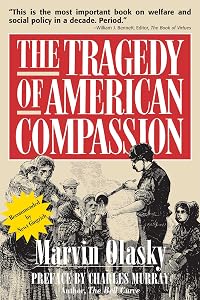
The Tragedy of American Compassion
by Marvin Olasky
On This Page
Description
Can a man be content with a piece of bread and some change tossed his way from a passerby? Today's modern welfare state expects he can. Those who control the money in our society think that giving a dollar at the train station and then appropriating a billion dollars for federal housing can cure the ails of the homeless and the poor. But the crisis of the modern welfare state is more than a crisis of government. Private charities that dispense aid indiscriminately while ignoring the moral show more and spiritual needs of the poor are also to blame. Like animals in the zoo at feeding time, the needy are given a plate of food but rarely receive the love and time that only a person can give. Poverty fighters 100 years ago were more compassionate--in the literal meaning of "suffering with"--than many of us are now. They opened their own homes to deserted women and children. They offered employment to nomadic men who had abandoned hope and human contact. Most significantly, they made moral demands on recipients of aid. They saw family, work, freedom, and faith as central to our being, not as life-style options. No one was allowed to eat and run. Some kind of honest labor was required of those who needed food or a place to sleep in return. Woodyards next to homeless shelters were as common in the 1890s as liquor stores are in the 1990s. When an able bodied woman sought relief, she was given a seat in the "sewing room" and asked to work on garments given to the helpless poor. To begin where poverty fighters a century ago began, Marvin Olasky emphasizes seven ideas that recent welfare practice has put aside: affiliation, bonding, categorization, discernment, employment, freedom, and most importantly, belief in God. In the end, not much will be accomplished without a spiritual revival that transforms the everyday advice we give and receive, and the way we lead our lives. It's time we realized that there is only so much that public policy can do. That only a richness of spirit can battle a poverty of soul. The century-old question--does any given scheme of help... make great demands on men to give themselves to their brethren?--is still the right one to ask. Most of our 20th-century schemes have failed. It's time to learn from the warm hearts and hard heads of the 19th-century. show lessTags
Recommendations








































Member Reviews
I cannot recall where I came across a reference to this book -- but I am very, very glad I did.
Although this comprehensive and remarkably illuminating history of American charity and social service is now over 20 years old, it could not be more apposite, as fresh record highs for the number of people depending on government largesse seem to be set weekly in Obama's America.
Marvin Olasky surveys the provisions for the poor and needy from colonial America through the 1980s. He traces the devolution of these efforts from personal, hands-on, discriminating (in the positive sense) religious charity to the entitlement state of the 1960s and beyond. This is a history rarely told, as the many advocates of the welfare state would prefer you show more believe that before Uncle Sam started collecting from the productive to redistribute to the 'poor', the latter simply starved in the gutters.
Nothing of the sort is true. Conversely, the 19th century in particular saw a web of charitable organizations upholding the common good, with largely volunteer workers applying the 'seven marks of compassion' -- affiliation, bonding, categorization, discernment, employment, freedom and God -- in distributing charity to the truly needy, while providing chances for work for those who were able. The goal was the transformation of lives, not establishing entitlements that sap initiative and ultimately undermine the humanity of those who come to expect and depend on them. Olasky shows how this true compassion was far more generous than the 'stingy' entitlement state: the former intimately involved the giver and those who received; the latter absolves the taxpayer from any other personal costs, and enslaves and demeans those on the dole.
This book should be required reading in every sociology and social work program in the USA. show less
Although this comprehensive and remarkably illuminating history of American charity and social service is now over 20 years old, it could not be more apposite, as fresh record highs for the number of people depending on government largesse seem to be set weekly in Obama's America.
Marvin Olasky surveys the provisions for the poor and needy from colonial America through the 1980s. He traces the devolution of these efforts from personal, hands-on, discriminating (in the positive sense) religious charity to the entitlement state of the 1960s and beyond. This is a history rarely told, as the many advocates of the welfare state would prefer you show more believe that before Uncle Sam started collecting from the productive to redistribute to the 'poor', the latter simply starved in the gutters.
Nothing of the sort is true. Conversely, the 19th century in particular saw a web of charitable organizations upholding the common good, with largely volunteer workers applying the 'seven marks of compassion' -- affiliation, bonding, categorization, discernment, employment, freedom and God -- in distributing charity to the truly needy, while providing chances for work for those who were able. The goal was the transformation of lives, not establishing entitlements that sap initiative and ultimately undermine the humanity of those who come to expect and depend on them. Olasky shows how this true compassion was far more generous than the 'stingy' entitlement state: the former intimately involved the giver and those who received; the latter absolves the taxpayer from any other personal costs, and enslaves and demeans those on the dole.
This book should be required reading in every sociology and social work program in the USA. show less
More than anything else, this book refutes the frequent argument that government has to look after the indigent because private charity won't or doesn't know how. Olasky takes us through the full history of charity in this country, showing the ideas that shaped it at each step in it's devolution. Starting with the categorization of workhouses and almshouses, the frequency of woodyards and sewing rooms let charitable providers differentiate the truly needy from the truly lazy. He also points out that this only worked because the charities could be personal because they worked at a local level. Through most of the first century, the underlying principal was only to help those who would help themselves or at least not hurt themselves. show more Olasky shows how each extension of the leniency subtly took us step-by-step down the path that the early charity workers predicted.
Too much leniency in charity was considered one of the causes of pauperism and Cotton Mather admonished people that "you may not abuse your charity by misapplying it". Nonetheless, the trend moved toward "easy charity" (my term) and then came the cry for centralization, which only government had the power to implement. During the New Deal, some worked hard in the only jobs they could get with the WPA, CCC, et al, while others fit the WPA joke "How is a WPA worker like King Solomon?" ("He takes his pick and goes to bed.") But the final blow came during the Great Society, where asking too many questions of welfare recipients was found to be in violation of their constitutional rights and social workers became a special interest group of their own (driving out volunteers, implicitly and explicitly), and, for a variety of reasons, Black leaders and welfare advocates worked hard to maintain and take the shame out of the system. There were two other surges along the way that contributed to our current state. The utopian ideas of Horace Greeley in the mid-1800's advocated that everyone had a right to the earth's resources. The extreme deliverance of his ideas were seen for what the were and failed. The trend re-emerged with the Universalists in the late 1800's. At that time, there was complaining that the idealistic charity advocates wanted to "save the world" but couldn't see individuals in the process. The wave of Social Darwinism also came and went. The anecdote of Grace Capetillo is sobering. A welfare recipient, she worked hard to save more than the limits allowed and was hauled to court about it -- having $3,000 when $1,000 was the limit. Previous to this book, I believed that the fundamental problem was that our system takes away the concept of pride from the supposed beneficiaries. Now I believe it is that we have removed all reason from the entire system, both for the beneficiaries and for society as a whole. show less
Too much leniency in charity was considered one of the causes of pauperism and Cotton Mather admonished people that "you may not abuse your charity by misapplying it". Nonetheless, the trend moved toward "easy charity" (my term) and then came the cry for centralization, which only government had the power to implement. During the New Deal, some worked hard in the only jobs they could get with the WPA, CCC, et al, while others fit the WPA joke "How is a WPA worker like King Solomon?" ("He takes his pick and goes to bed.") But the final blow came during the Great Society, where asking too many questions of welfare recipients was found to be in violation of their constitutional rights and social workers became a special interest group of their own (driving out volunteers, implicitly and explicitly), and, for a variety of reasons, Black leaders and welfare advocates worked hard to maintain and take the shame out of the system. There were two other surges along the way that contributed to our current state. The utopian ideas of Horace Greeley in the mid-1800's advocated that everyone had a right to the earth's resources. The extreme deliverance of his ideas were seen for what the were and failed. The trend re-emerged with the Universalists in the late 1800's. At that time, there was complaining that the idealistic charity advocates wanted to "save the world" but couldn't see individuals in the process. The wave of Social Darwinism also came and went. The anecdote of Grace Capetillo is sobering. A welfare recipient, she worked hard to save more than the limits allowed and was hauled to court about it -- having $3,000 when $1,000 was the limit. Previous to this book, I believed that the fundamental problem was that our system takes away the concept of pride from the supposed beneficiaries. Now I believe it is that we have removed all reason from the entire system, both for the beneficiaries and for society as a whole. show less
An excellent review of the true causes of poverty and the two approaches to solving poverty. Olasky has done his homework, citing the public view on poverty and how it was solved as far back as the 1700's and how the public attitude has evolved, resulting in the increase in poverty, not the reduction of the very same. His highlight of the debates between Horace Greeley and Henry Raymond present a clear picture of the choice we face today, in dealing with "pauperism and poverty" as he puts it.
Ratings
Members
- Recently Added By
Author Information

56+ Works 2,875 Members
Marvin Olasky is editor in chief of World, dean of the World Journalism Institute, and the author of twenty-two books. Previously a reporter for Yale Daily News and The Boston Globe, he also taught journalism for twenty-five years at The University of Texas at Austin.
Awards and Honors
Classifications
- Genres
- Nonfiction, General Nonfiction, Religion & Spirituality, History, Politics and Government
- DDC/MDS
- 361.973 — Society, government, & culture Social problems and social services Social problems and services Biography; History by Place North America United States
- LCC
- HV91 .O52 — Social sciences Social pathology. Social and public welfare. Criminology Social pathology. Social and public welfare. By region or country
- BISAC
Statistics
- Members
- 406
- Popularity
- 76,317
- Reviews
- 3
- Rating
- (3.53)
- Languages
- English
- Media
- Paper, Ebook
- ISBNs
- 7
- ASINs
- 1