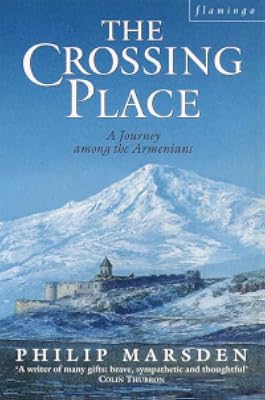
The Crossing Place: A Journey Among the Armenians
by Philip Marsden
On This Page
Description
A revised and updated edition of Philip Marsden's classic travel book, published to coincide with the centenary of the Armenian massacres. After centuries of prominence as a world power, Armenia has withstood every attempt during the 20th century to destroy it. With a name redolent both of dim antiquity and of a modern world and its tensions, the Armenians founded a civilization and underwent a diaspora that brought many of the great ideas of the East to Western Europe. The Crossing Place is show more Philip Marsden's gripping account of his remarkable journey through the Middle East, Eastern Europe and the Caucasus in a quest to discover the secret of one of the world's most extraordinary peoples. Caught between opposing empires, between warring religions and ideologies - at the crossing place of history - the Armenians have somehow survived against the odds. This is their story - told by one of the finest travel writers at work today. show lessTags
Recommendations
















Member Reviews
A wonderful travel book, now thirty years old. Philip Marsden is to be admired for his toughness, skilled observation and his enthusiasm for Armenia and its dispersed people. Much has changed in the thirty years since this edition. His visits coincide with traumatic events in Lebanon and the disintegration of U.S.S.R. Marsden has taken the time to learn Armenian; and this helps transport him from being treated suspiciously (usually as a Russian) to becoming the recipient of overwhelming generosity. (On one occasion, his taxi-driver refused the fare and offered him money).
Marsden attributes Armenian persistence to the impact of persecution and the ethnic cleansing from which they have endured for centuries. The author refers to the show more remarkable Armenian Christian Church; it's ground-breaking architecture (now so often in ruins) and the care with which its manuscripts are honoured.
Note of interest for Australian and NZ readers:- the persecution, expulsion and slaughter of Armenians from Eastern Turkey began on 24 April 1915 with the rounding up of 600 Armenian leaders in Constantinople, along with another 5,000 from the city's Armenian quarter. Few of these were ever seen again. This date was the eve of the futile assault by British and Anzac forces at Gallipoli, and is still observed as a national day of commemoration. I have not read of any speculation on the coincidence of these two shattering events. It gives cause to imagine that Turkey had reached a point where a total offensive was its response to threats, perceived and actual. show less
Marsden attributes Armenian persistence to the impact of persecution and the ethnic cleansing from which they have endured for centuries. The author refers to the show more remarkable Armenian Christian Church; it's ground-breaking architecture (now so often in ruins) and the care with which its manuscripts are honoured.
Note of interest for Australian and NZ readers:- the persecution, expulsion and slaughter of Armenians from Eastern Turkey began on 24 April 1915 with the rounding up of 600 Armenian leaders in Constantinople, along with another 5,000 from the city's Armenian quarter. Few of these were ever seen again. This date was the eve of the futile assault by British and Anzac forces at Gallipoli, and is still observed as a national day of commemoration. I have not read of any speculation on the coincidence of these two shattering events. It gives cause to imagine that Turkey had reached a point where a total offensive was its response to threats, perceived and actual. show less
This 1993 work opens with the author happening on a human bone while in E Turkey. "Armenians!" explains a local shepherd, harking back to the 1915 genocide as, in an early episode of 'ethnic cleansing', the Turks turned on the Armenian population.
Marsden goes on to investigate the dispersed Armenians. Taking in various countries of the Levant, lands of Eastern Europe...and finally Armenia itself, he tries to get to the heart of this resilient and never-assimilated people.
One sees huge similarities with the plight of the Jewish people- years of pogroms and hostility, for no very apparent reason; finding success as merchants and businessmen; a strong identification with their culture...
It wasn't quite as fascinating as I'd hoped- Armenia show more is on my list of Places I Must Visit (we also have a relative who married an Armenian immigrant to UK). Nonetheless provides a starting point for some understanding of the Armenian diaspora. show less
Marsden goes on to investigate the dispersed Armenians. Taking in various countries of the Levant, lands of Eastern Europe...and finally Armenia itself, he tries to get to the heart of this resilient and never-assimilated people.
One sees huge similarities with the plight of the Jewish people- years of pogroms and hostility, for no very apparent reason; finding success as merchants and businessmen; a strong identification with their culture...
It wasn't quite as fascinating as I'd hoped- Armenia show more is on my list of Places I Must Visit (we also have a relative who married an Armenian immigrant to UK). Nonetheless provides a starting point for some understanding of the Armenian diaspora. show less
Published in 1993, the book relates a journey in Middle Orient, Eastern Europe and then in collapsing USSR in the last months of its existence — that is 1991.
It begins with a travel in Turkey to find very few remembrances of the Armenian presence — then Syria, Jerusalem and Venice. But this first journey is just a first taste of the places to go, of the people to meet, of the sentiment to feel.
Then the author goes from Cyprus to Lebanon still in war, and then to Syria still peaceful to find the last remains of the Armenian genocide of 1915. This part, with all the testimonies of old survivors, is very sad and difficult to read.
The second part, from Turkey to Bulgaria, Romania and Moldova is lighter: Armenian people in theses three show more countries are vividly described, and the atmosphere in these times of revolutions, with the communists reluctantly disappearing, is partly confuse and partly joyous.
The last part, in what was still USSR (april 1991), is for me the most impressive: we forget for a time the Armenians (until the author eventually reachs Armenia and the Karabagh war with Azerbaijan) and we follow a clandestine traveler in his attempts to find a bus, a train, a boat…
The book is both very well written, sensitive and erudite, and very personal: a quest for Armenia and for self-knowledge. show less
It begins with a travel in Turkey to find very few remembrances of the Armenian presence — then Syria, Jerusalem and Venice. But this first journey is just a first taste of the places to go, of the people to meet, of the sentiment to feel.
Then the author goes from Cyprus to Lebanon still in war, and then to Syria still peaceful to find the last remains of the Armenian genocide of 1915. This part, with all the testimonies of old survivors, is very sad and difficult to read.
The second part, from Turkey to Bulgaria, Romania and Moldova is lighter: Armenian people in theses three show more countries are vividly described, and the atmosphere in these times of revolutions, with the communists reluctantly disappearing, is partly confuse and partly joyous.
The last part, in what was still USSR (april 1991), is for me the most impressive: we forget for a time the Armenians (until the author eventually reachs Armenia and the Karabagh war with Azerbaijan) and we follow a clandestine traveler in his attempts to find a bus, a train, a boat…
The book is both very well written, sensitive and erudite, and very personal: a quest for Armenia and for self-knowledge. show less
“The Crossing Place: A Journey Among the Armenians” (1993) by Philip Marsden is more difficult to define. I think it is a nice travelogue, describing Marsden’s circumvent journey through the Middle East, Turkey, then Eastern Europe, eventually ending up in Armenia, in the early 1990s. He manages largely because of his Armenian network, who help him along the way – until he actually gets to Armenia, where he is treated more suspect, every foreigner a potential Russian spy. The other element of the book, trying to identify what it means to be Armenian, is less convincing. He falls to often back to the 1915 genocide, for which there are better alternatives, if you want to learn about this. The book is perhaps too much of an attempt show more to eulogise a people who have suffered in history, no doubt, and who have been remarkably resilient, no doubt, but who may have been at times part of a conflict, too, not just the victim – something Marsden may realise at the very end of the book, only. show less
This is a wonderful book. As a result of reading it I know so much more about Armenia and the Armenia people especially in the diaspora within the Middle East.
One revelation for me was finding out about the Matenadaran Library in Yerevan which holds thousands of mediaeval MSS.
The author doesn't shy away from describing the nastier aspects of his travels towards Armenia, but at the same time he writes lyrically about the natural aspects of the countries he visits as well as the gardens which the Armenian people create wherever they find themselves ending up.
I read it in the e-book version and found it easy to read on my phone.
One revelation for me was finding out about the Matenadaran Library in Yerevan which holds thousands of mediaeval MSS.
The author doesn't shy away from describing the nastier aspects of his travels towards Armenia, but at the same time he writes lyrically about the natural aspects of the countries he visits as well as the gardens which the Armenian people create wherever they find themselves ending up.
I read it in the e-book version and found it easy to read on my phone.
A complex, multi country odyssey to uncover the history of the Armenians - a much persecuted people. The hardship and danger incurred is clear, but results in a fascinating history.
I was expecting this exploration of the Armenians to be fascinating but somehow it wasn't, it was reduced to the merely interesting. Marsden's style, for me, didn't really open up the Armenian people, the Armenian diaspora or modern Armenia itself. He was convinced there is something different about the Armenians but, if he ever found out what it is, he hasn't quite managed to capture it here. 8 Mar 2016.
Members
- Recently Added By
Lists

Best of Travel Narratives
142 works; 28 members

Best Travel Narrative
32 works; 20 members

Caucasus
122 works; 2 members
Author Information

11+ Works 791 Members
Awards and Honors
Awards
Series
Belongs to Publisher Series
Common Knowledge
- Canonical title
- The Crossing Place: A Journey Among the Armenians
- Original publication date
- 1993
- People/Characters
- Philip Marsden
- Important places
- Jerusalem; Deir ez-Zor, Syria; Aleppo, Syria; Beirut, Lebanon; Bulgaria; Armenia (show all 7); Yerevan, Armenia
- Important events
- Armenian Genocide; Gulf War, 1990-1991
- Epigraph
- The wind is singing, the leaves of the mulberry-tree are shuffling. Eternal song; eternal life; eternal death; eternal sorrow; and eternal joy... VAHAN TOTOVENTS, Scenes from an Armenian Childhood (trans Mischa Kudian)
- First words
- One summer, walking in the hills of eastern Turkey, I came across a short piece of bone.
- Last words
- (Click to show. Warning: May contain spoilers.)It traced a slow, hypnotic path in the breeze and I thought of how every one of the Armenian evenings had contained in them this - these men, this village; and all that inherited fear of lost land.
- Original language
- English
Classifications
- Genres
- Travel, Nonfiction, General Nonfiction
- DDC/MDS
- 909.0491992082 — History & geography History World history History with respect to ethnic and national groups Other Other Indo-Europeans people East Indo-Europeans Armenians, Albanians Armenians
- LCC
- DS165 .M37 — History of Europe, Asia, Africa and Oceania Asia History of Asia Armenia
- BISAC
Statistics
- Members
- 148
- Popularity
- 222,111
- Reviews
- 8
- Rating
- (4.02)
- Languages
- 6 — Armenian, Chinese, Dutch, English, French, Norwegian (Bokmål)
- Media
- Paper, Ebook
- ISBNs
- 9
- ASINs
- 2