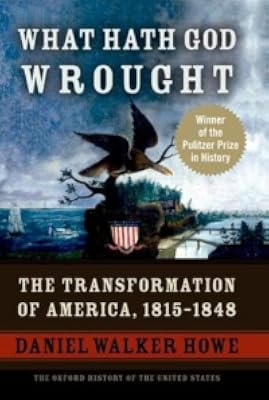
What Hath God Wrought: The Transformation of America, 1815-1848
by Daniel Walker Howe
Oxford History of the United States (5)
On This Page
Description
As part of the Oxford History of the United States series, this volume is a portrait of an era that saw dramatic transformations in American life. The author illuminates the period from the battle of New Orleans to the end of the Mexican-American War, an era when the United States expanded to the Pacific and won control over the richest part of the North American continent. This narrative portrays revolutionary improvements in transportation and communications that accelerated the extension show more of the American empire. Railroads, canals, newspapers, and the telegraph dramatically lowered travel times and spurred the spread of information. These innovations prompted the emergence of mass political parties and stimulated America's economic development from an overwhelmingly rural country to a diversified economy in which commerce and industry took their place alongside agriculture. In his story, the author weaves together political and military events with social, economic, and cultural history. He examines the rise of Andrew Jackson and his Democratic party, but contends that John Quincy Adams and other Whigs, advocates of public education and economic integration, defenders of the rights of Indians, women, and African-Americans, were the true prophets of America's future. He reveals the power of religion to shape many aspects of American life during this period, including slavery and antislavery, women's rights and other reform movements, politics, education, and literature. This story of American expansion culminates in the bitterly controversial but brilliantly executed war waged against Mexico to gain California and Texas for the United States. By 1848 America had been transformed. This book provides a monumental narrative of this formative period in United States history. show lessTags
Recommendations



Member Reviews
This is an outstanding history of the US between 1815 and 1848. Before I started this book, I had thought of this period as a tedious time when too little of interest occurred. As a result of Howe's book, I found this period to be full of exciting and important events. Although the book is 900 pages long (i.e. 300 pages per decade), I found the book to be such an appetizer that I now have a long list of other books I want to read. Howe's coverage is broad with discussions on the political, economic, military and cultural histories of the period as well as good overviews on slavery, native Americans, and Mexican Americans. The book was a pleasure to read.
In WHAT HATH GOD WROUGHT, Daniel Howe has managed to create an animated verbal film depicting a still-new nation writhing in the throes of its growing pains, still undecided as to its political structure, the extent of its religious toleration, its attitude toward currency and banking, or even its desire for a standing army.
As immature boys reacting to growing testosterone levels, various national leaders, supported by a goodly (though never unanimous) part of the country, charged blindly ahead toward their various egocentric goals of driving earlier inhabitants from their lands to make way for the "superior" white, male-dominated culture and to take what lands they wished from inhabitants who could not defend them from avaricious show more greed. Similarly, as with youth who have not yet lived long enough to have learned from life's lessons the meanings of "equality," "freedom," and "humanity," the young nation felt few pangs of guilt over human slavery or the belittling subjugation of women.
Perhaps the most beneficial result of reading about the country as it was only about 180 years ago (not long at all in terms of human civilization) is the realization that the nation that most of us readers were born in was not as we see it today and that our public school history books may not have been adequate to teach us all that we should know about our collective younger self. Howe is very adept at showing us truths about our historical selves, and he is equally adept at using the English language effectively and, at times, entertainingly, to do so. With this book, the author has created a motion picture in words--shall we call it a documentary film in print?--to explain a three-decade period in the "growth spurt" of the United States (which, as one comes to realize, were not all that much united at the time).
Some reviewers criticize Howe's work as drawing unflattering parallels between old presidents such as Andrew Jackson and James Polk and modern heads of state such as George W. Bush. First, let's dispense with this specious criticism by noting that Howe draws no parallels. Nowhere in the entire book is there any comparison with contemporary figures. On the other hand, if unilateral, ill-defined, and inadequately-justified acts characterize presidential administrations that are 180 years apart, the reader is perfectly free to infer whatever comparisons may come to mind. And this does bring up another thought: whether to be reassured that the nation has endured despite the selfish and bullying acts of former presidents and weak congresses, or whether to be dismayed that more than a century-and-a-half of progress has not freed the country from self-serving leaders. Howe's historical recitation may well leave the reader very conscious of this ambiguity as well as with a better understanding of the rocky roads traversed (jerkily and painfully at times) by the nation in the decades preceding the Civil War.
Another thought that Howe has left with me is the high irony of having Andrew Jackson pictured on the $20 bill. Sandwiched in with his racist imperialism is the fact that Jackson steadfastly opposed "soft" money or allowing the Federal government to issue currency of any sort! This militarist, who needlessly picked a battle with British forces near New Orleans in 1815 after peace had been declared (okay, admittedly he wasn't aware that the U.S. and Britain were no longer at war), would find today's system of currency and of national banks and of the FDIC itself abhorrent and would most likely disavow any connection with them. I shall probably never look again at a $20 bill without thinking of Howe's book.
WHAT HATH GOD WROUGHT is a heavy tome of 855 pages not counting the bibliographical essay and index, at least in terms of physical weight. However, it is far from heavy in terms of readability. The little irony of Andrew Jackson and the $20 bill is but a small sample of the fascinating "factoids" that the reader gleans from this book. Is it a totally objective picture of the nation during the first half of the 19th century? No indeed. How utterly boring that would be! Besides, what artist even pretends at total objectivity? I believe that most artists will tell us that the true artistry of their creations lies in their interpretation of the subject matter. In this instance, Howe applies the artistry of his expertise as a professional writer and historian to bring what, in other hands, might have been dreary facts to vibrant life and to help the 21st century reader see, understand and appreciate the 19th century picture he is viewing. When I was a student, I generally found history a boring subject. Not so now with books such as this one, and I heartily recommend WHAT HATH GOD WROUGHT as a fascinating and instructive read for anyone who cares at all about how this nation came to be as it is today and who just might care to help it avoid some of the pitfalls that befell it in its youth. show less
As immature boys reacting to growing testosterone levels, various national leaders, supported by a goodly (though never unanimous) part of the country, charged blindly ahead toward their various egocentric goals of driving earlier inhabitants from their lands to make way for the "superior" white, male-dominated culture and to take what lands they wished from inhabitants who could not defend them from avaricious show more greed. Similarly, as with youth who have not yet lived long enough to have learned from life's lessons the meanings of "equality," "freedom," and "humanity," the young nation felt few pangs of guilt over human slavery or the belittling subjugation of women.
Perhaps the most beneficial result of reading about the country as it was only about 180 years ago (not long at all in terms of human civilization) is the realization that the nation that most of us readers were born in was not as we see it today and that our public school history books may not have been adequate to teach us all that we should know about our collective younger self. Howe is very adept at showing us truths about our historical selves, and he is equally adept at using the English language effectively and, at times, entertainingly, to do so. With this book, the author has created a motion picture in words--shall we call it a documentary film in print?--to explain a three-decade period in the "growth spurt" of the United States (which, as one comes to realize, were not all that much united at the time).
Some reviewers criticize Howe's work as drawing unflattering parallels between old presidents such as Andrew Jackson and James Polk and modern heads of state such as George W. Bush. First, let's dispense with this specious criticism by noting that Howe draws no parallels. Nowhere in the entire book is there any comparison with contemporary figures. On the other hand, if unilateral, ill-defined, and inadequately-justified acts characterize presidential administrations that are 180 years apart, the reader is perfectly free to infer whatever comparisons may come to mind. And this does bring up another thought: whether to be reassured that the nation has endured despite the selfish and bullying acts of former presidents and weak congresses, or whether to be dismayed that more than a century-and-a-half of progress has not freed the country from self-serving leaders. Howe's historical recitation may well leave the reader very conscious of this ambiguity as well as with a better understanding of the rocky roads traversed (jerkily and painfully at times) by the nation in the decades preceding the Civil War.
Another thought that Howe has left with me is the high irony of having Andrew Jackson pictured on the $20 bill. Sandwiched in with his racist imperialism is the fact that Jackson steadfastly opposed "soft" money or allowing the Federal government to issue currency of any sort! This militarist, who needlessly picked a battle with British forces near New Orleans in 1815 after peace had been declared (okay, admittedly he wasn't aware that the U.S. and Britain were no longer at war), would find today's system of currency and of national banks and of the FDIC itself abhorrent and would most likely disavow any connection with them. I shall probably never look again at a $20 bill without thinking of Howe's book.
WHAT HATH GOD WROUGHT is a heavy tome of 855 pages not counting the bibliographical essay and index, at least in terms of physical weight. However, it is far from heavy in terms of readability. The little irony of Andrew Jackson and the $20 bill is but a small sample of the fascinating "factoids" that the reader gleans from this book. Is it a totally objective picture of the nation during the first half of the 19th century? No indeed. How utterly boring that would be! Besides, what artist even pretends at total objectivity? I believe that most artists will tell us that the true artistry of their creations lies in their interpretation of the subject matter. In this instance, Howe applies the artistry of his expertise as a professional writer and historian to bring what, in other hands, might have been dreary facts to vibrant life and to help the 21st century reader see, understand and appreciate the 19th century picture he is viewing. When I was a student, I generally found history a boring subject. Not so now with books such as this one, and I heartily recommend WHAT HATH GOD WROUGHT as a fascinating and instructive read for anyone who cares at all about how this nation came to be as it is today and who just might care to help it avoid some of the pitfalls that befell it in its youth. show less
Thorough & well written history of the period: As other reviewers have mentioned, the book is necessarily heavy on political history, though this book is not the tale of the rise and fall of political parties or politicians. Instead, Howe has chosen to evaluate American society largely through a political lens - in fact, he has chosen six major actors to play leading roles in his story: Andrew Jackson, J.Q. Adams, Henry Clay, James K. Polk, John Calhoun, & Daniel Webster.
Although he focuses largely on the achievements (or, in some cases the failures) of these men, he does not ignore society as a whole, nor does he ignore military endeavors, such as the Mexican War and the participants in that conflict.
All told, this is an excellent show more synthesis of the period. Professor Howe has demonstrated an extraordinary command of the secondary literature of the period, while incorporating many works of recent scholarship (especially the last 10 years). I was very impressed as I read the book with Howe's skillful weaving of a narrative loosely coupled by the theme of a communications revolution, which is much different than many other works pertaining to this period, which focus almost exclusively on the economic transformation that took place in this period.
I was equally impressed with Howe's command of the entire nation; unlike many books about this period, he did not sectionalize the book; by not focusing on just the Southern US, or just the Eastern seaboard, he allows the reader to understand the whole picture.
This is a worthy addition to any library of one who is intrigued by US History, even if that reader is not a 19th century specialist. I would even encourage professors to consider assigning this as a basic text (despite the fact that it is a rather lenghty tome at 860 pages) for an upper level survey of Jacksonian America. It is a much appreciated addition to the Oxford History of the United States series. show less
Although he focuses largely on the achievements (or, in some cases the failures) of these men, he does not ignore society as a whole, nor does he ignore military endeavors, such as the Mexican War and the participants in that conflict.
All told, this is an excellent show more synthesis of the period. Professor Howe has demonstrated an extraordinary command of the secondary literature of the period, while incorporating many works of recent scholarship (especially the last 10 years). I was very impressed as I read the book with Howe's skillful weaving of a narrative loosely coupled by the theme of a communications revolution, which is much different than many other works pertaining to this period, which focus almost exclusively on the economic transformation that took place in this period.
I was equally impressed with Howe's command of the entire nation; unlike many books about this period, he did not sectionalize the book; by not focusing on just the Southern US, or just the Eastern seaboard, he allows the reader to understand the whole picture.
This is a worthy addition to any library of one who is intrigued by US History, even if that reader is not a 19th century specialist. I would even encourage professors to consider assigning this as a basic text (despite the fact that it is a rather lenghty tome at 860 pages) for an upper level survey of Jacksonian America. It is a much appreciated addition to the Oxford History of the United States series. show less
A well written, comprehensive history of America between the War of 1812 and just before the Civil War. The book maintains a general chronological narrative, but chapters are organized thematically, alternating between politics, religion, and education/culture/technology. The chapter on literature was quite interesting; apparently, the United States only recognized U.S. copyright laws, so literature from Britain was printed en masse royalty free and almost pushed American authors out of the business entirely. This was cited as one of the reasons so many authors who are famous today (Poe, Melville, etc) died dirt-poor.
What I learned: everything old is new again. All of the outrages committed today, especially under the Bush show more administration, were perfected during this period of American history. If you think the Iraq War is a sham, just read the excuses James K. Polk used to declare war against Mexico and grab two-thirds of its territory. Then, as now, politicians and citizens were alarmed at these excesses in the use of executive power, but just as in today, these concerns didn't prevent anything.
I would have given this book a 4.5 if it was possible. It is definitely deserving of winning the 2008 Pulitzer Prize for history. show less
What I learned: everything old is new again. All of the outrages committed today, especially under the Bush show more administration, were perfected during this period of American history. If you think the Iraq War is a sham, just read the excuses James K. Polk used to declare war against Mexico and grab two-thirds of its territory. Then, as now, politicians and citizens were alarmed at these excesses in the use of executive power, but just as in today, these concerns didn't prevent anything.
I would have given this book a 4.5 if it was possible. It is definitely deserving of winning the 2008 Pulitzer Prize for history. show less
Really excellent overview of the period. Howe's obvious distaste for Andrew Jackson is a welcome corrective to our culture's celebration of the first truly, deeply authoritarian president; an overrated blowhard if there ever was one. Likewise, he rescues John Q. Adams and some other important but easily forgotten figures like Winfield Scott from their relative obscurity.
Howe argues that the revolutions in transportation (canals, railroads) and communication (telegraph especially) did more to transform antebellum America than the market revolutions typically put forward by other historians. I have a lot of sympathy with this view, especially since a burgeoning market economy is traceable in America much earlier than the period covered show more in this book.
The book can repeat itself at times, and Howe places an enormous emphasis on religion, especially on Protestant revivalism. While pointing out that it did a lot in the fight for abolition, Howe is a little too rosy and a little too sympathetic. He yammers on about its importance in the fight for reform movements, but never once mentions any downsides or drawbacks to the overheated religious climate.
I would also be embarrassed to be a professional historian and to have written the following about the US seizure of California:
"In the long run of history, however, in some respects, the seizure of California by the United States did work, as Polk expected, for "the general interests of mankind." For example, it enabled a strong stand [...] against the aggressions of Imperial Japan in the 1940s. God moves in mysterious ways, and He is certainly capable of bringing good out of evil (811)."
Puke. Though Howe spends more time discussing religion than most other historians of the period writing primarily narrative history, the treatments of non-evangelical Protestants, Catholics, and the small but growing free-thought movement are disappointingly breezy by comparison. On a positive note, he spends an appropriate amount of time talking about the growth and development of Mormonism, though he places himself in the odd position of justifying some of its more reprehensible practices, namely polygamy.
All of these are relatively minor squabbles with a masterful work of history. show less
Howe argues that the revolutions in transportation (canals, railroads) and communication (telegraph especially) did more to transform antebellum America than the market revolutions typically put forward by other historians. I have a lot of sympathy with this view, especially since a burgeoning market economy is traceable in America much earlier than the period covered show more in this book.
The book can repeat itself at times, and Howe places an enormous emphasis on religion, especially on Protestant revivalism. While pointing out that it did a lot in the fight for abolition, Howe is a little too rosy and a little too sympathetic. He yammers on about its importance in the fight for reform movements, but never once mentions any downsides or drawbacks to the overheated religious climate.
I would also be embarrassed to be a professional historian and to have written the following about the US seizure of California:
"In the long run of history, however, in some respects, the seizure of California by the United States did work, as Polk expected, for "the general interests of mankind." For example, it enabled a strong stand [...] against the aggressions of Imperial Japan in the 1940s. God moves in mysterious ways, and He is certainly capable of bringing good out of evil (811)."
Puke. Though Howe spends more time discussing religion than most other historians of the period writing primarily narrative history, the treatments of non-evangelical Protestants, Catholics, and the small but growing free-thought movement are disappointingly breezy by comparison. On a positive note, he spends an appropriate amount of time talking about the growth and development of Mormonism, though he places himself in the odd position of justifying some of its more reprehensible practices, namely polygamy.
All of these are relatively minor squabbles with a masterful work of history. show less
A massive but not over-stuffed guide to a short but extremely active period in American history, and one often overlooked. This period saw the transition from the nation founded along the Atlantic to the one which spanned the continent, from a basically agricultural economy to a burgeoning industrial power. This period also saw the development of religious and social movements which are still active today, and also laid the groundwork for much of the current US political system. Howe's approach is, as he says in his conclusion, to tell a story, not to argue a thesis. He does not present an overarching Theory Of American History into which all of the events detailed can be shoehorned. Instead, he presents threads which seem to be related show more (a covert theory of history, but an unavoidable and uncontroversial one) and follows them in an order which is roughly chronological, but only very roughly. One of the advantages of Howe's approach to the material for the amateur historian (like myself) is that he is not afraid to revisit events, to plow over the ground from several angles. This allows the reader unfamiliar with the period (such as myself) to develop a more firm understanding of the overall picture than would be obtained by a more linear path. Quite worth the reading. show less
The real drawback for me of Daniel Walker Howe's early 19th century American history was not the writing, but the narrator. There were times that I wondered if the reader was a computer or a human. So monotone at different points it was almost enough to get me to turn it off. But Howe's writing was good and the topics/tales/history that were told were very interesting. Mix that with the turbulent times and exciting and unbelievable characters Walker Howe had a great canvas with which to work. So good as a book, didn't quite reach that level as a audiobook. Still, I would recommended it, well worth the time.
Members
- Recently Added By
Published Reviews
ThingScore 88
[An] exemplary addition to the Oxford History of the United States.
added by Shortride
One of the chief merits of “What Hath God Wrought” is Howe’s earnest effort, and great success, at chronicling changes of all sorts, from rates of childhood mortality to the gross national product, from the frequency of bathing to the firepower of cannons.
added by Shortride
Lists

Pulitzer Prize for History
16 works; 2 members

Books Read in 2017
4,249 works; 130 members

r/AskHistorians' Recommended Books
1,068 works; 19 members

2024-2025 Ezra Klein Guest Recommendations
213 works; 6 members

To Read
140 works; 1 member

Books in the Bibliography of The Alchemy of Us by Ainissa Ramirez
181 works; 1 member

In Our Time books
4,934 works; 2 members
Author Information

14+ Works 2,199 Members
Some Editions
Awards and Honors
Awards
Series

Belongs to Publisher Series
Common Knowledge
- Canonical title
- What Hath God Wrought: The Transformation of America, 1815-1848
- Original title
- What Hath God Wrought: The Transformation of America, 1815-1848
- Original publication date
- 2007
- People/Characters
- James Knox Polk
- Important places
- USA
- Important events
- Mexican-American War (1846 | 1848)
- Dedication
- To the Memory of John Quincy Adams
- First words
- On the twenty-fourth of May 1844, Professor F.B. Morse, seated amidst a hushed gathering of distinguished national leaders in the chambers of the United States Supreme Court in Washington, tapped out a message on a device of ... (show all)cogs and coiled wires: WHAT HAS GOD WROUGHT
- Last words
- (Click to show. Warning: May contain spoilers.)Like the people of 1848, we look with both awe and uncertainty at what God hath wrought in the United States of America.
- Original language
- English
Classifications
- Genres
- History, Nonfiction, General Nonfiction
- DDC/MDS
- 973.5 — History & geography History of North America United States Jacksonian Era (1809-1837)
- LCC
- E338 .H69 — History of the United States United States Revolution to the Civil War, 1775/1783-1861 By period Early nineteenth century, 1801/1809-1845 General
- BISAC
Statistics
- Members
- 1,938
- Popularity
- 10,986
- Reviews
- 29
- Rating
- (4.30)
- Languages
- English
- Media
- Paper, Audiobook, Ebook
- ISBNs
- 13
- ASINs
- 13