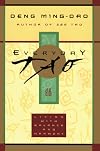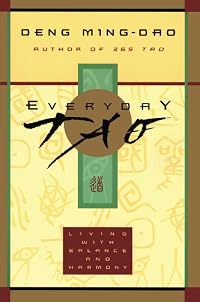
Everyday Tao: Living with Balance and Harmony
by Ming-Dao Deng
On This Page
Description
The Taoist spirit comes to life, made vibrant and contemporary through the Chinese ideograms whose images and stories speak of living in harmony with the Tao. Everyday Tao revives an ancient approach to meditation and reflection by using these stories as sources of insight for spiritual growth. Tao is a person running along a path A companion volume to the bestselling 365 Tao, Everyday Tao offers clear, specific directions on bringing the Taoist spirit into our work, our relationships, and show more other aspects of our everyday lives. Each ideogram provides the starting point for a Taoist lesson. The narrative that follows shows how we can achieve an intimate relationship with nature, others, and our natural selves. show lessTags
Recommendations

Member Reviews
Eastern philosophy is a rather intricate subject that has many different viewpoints. This particular book couples well into that philosophy.
Everyday Tao – Living With Balance & Harmony by Deng Min-Dao is a very insightful book.
Split up into 15 different sections, Everyday Tao covers a variety of ways into which individuals are able to get in tune with the Tao. The 15 sections are: nature, silence, books, strategy, movement, skill, craft, conduct, moderation, devotion, perseverance, teaching, self, simplifying and union.
Using Chinese ideograms, which contain inherent stories therein, the author brings about much meaning showing the reader what each ideogram breaks into and what insights can be had.
The way the book is set up, each show more individual insight covering no more than a page, makes this the type of book that can be read straight through, or on a day-by-day basis. For me, the latter offered much enjoyment and meaning because I was able to digest and discern much of what the book provided and ponder it deeply therein without rushing.
Through and through, the book offers a no-nonsense approach into Taoist insights. As someone who’s relatively new to Eastern Philosophy and am open minded about it, there was much to appreciate, regardless if one is locked within a particular paradigm or not. This volume offers much value, and if you’re seeking more to read on Tao or Eastern Philosophy, do not hesitate – get this book. show less
Everyday Tao – Living With Balance & Harmony by Deng Min-Dao is a very insightful book.
Split up into 15 different sections, Everyday Tao covers a variety of ways into which individuals are able to get in tune with the Tao. The 15 sections are: nature, silence, books, strategy, movement, skill, craft, conduct, moderation, devotion, perseverance, teaching, self, simplifying and union.
Using Chinese ideograms, which contain inherent stories therein, the author brings about much meaning showing the reader what each ideogram breaks into and what insights can be had.
The way the book is set up, each show more individual insight covering no more than a page, makes this the type of book that can be read straight through, or on a day-by-day basis. For me, the latter offered much enjoyment and meaning because I was able to digest and discern much of what the book provided and ponder it deeply therein without rushing.
Through and through, the book offers a no-nonsense approach into Taoist insights. As someone who’s relatively new to Eastern Philosophy and am open minded about it, there was much to appreciate, regardless if one is locked within a particular paradigm or not. This volume offers much value, and if you’re seeking more to read on Tao or Eastern Philosophy, do not hesitate – get this book. show less
Nothing can surpass reading the classical texts to understand Taoism. It's my opinion indeed that many Western books claiming to make such ancient Chinese philosophies accessible or relevant to our modern lifestyles are, far too often and sadly, grossly simplistic. This book (sadly too) falls into that trap. It omits a lot and is far too basic in its goal to catch too broad an audience. However...
However, its originality manages to make it somewhat enlightening. The fact is, the author focuses on some key words ('silence', 'Tao', 'prayer' etc.) by, first, displaying their Chinese ideograms and, then, describing such ideograms in using them as a way to give free rein to some thoughts and stories enabling to better understand their show more meaning and importance -from a Taoist perspective. We thus have the essential Chinese pictograms as basis for explanation, something otherwise impossible with translations using solely the Western alphabet.
All in all, then, here's an interesting take, enlightening somehow. Still, it could have been deeper and, above all, doesn't compensate for reading the classics. show less
However, its originality manages to make it somewhat enlightening. The fact is, the author focuses on some key words ('silence', 'Tao', 'prayer' etc.) by, first, displaying their Chinese ideograms and, then, describing such ideograms in using them as a way to give free rein to some thoughts and stories enabling to better understand their show more meaning and importance -from a Taoist perspective. We thus have the essential Chinese pictograms as basis for explanation, something otherwise impossible with translations using solely the Western alphabet.
All in all, then, here's an interesting take, enlightening somehow. Still, it could have been deeper and, above all, doesn't compensate for reading the classics. show less
This book probably changed my personality more than any other book (for the better). To clarify, Taoism isn't a new-age sort of religion, it's similar in Buddhism and came from around the same time (give or take a few centuries), and this book is one of the easiest ways to understand the teachings and to apply them to daily life. Every page has a new point on it, with an explanation or a story (or a poem in some cases) and its layout makes it very easy to read. One small point against it, though, is that it can be hard to find a particular teaching if you need it. It has a contents page, but often the titles of the pages don't have an easily-understandable link to what they're actually about.
If you're interested in Taoism (it's better show more suited to people new to the philosophy) then I highly, highly recommend this book. show less
If you're interested in Taoism (it's better show more suited to people new to the philosophy) then I highly, highly recommend this book. show less
I keep buying these daily readings books, thinking I will hit one that stays with me. This has some interesting quotes, but nothing earth shattering. You would probably do as well to read Tao Te Ching or the stories of Chuang-tze every day.
Ratings
Members
- Recently Added By
Author Information

28+ Works 1,832 Members
Classifications
- Genres
- Religion & Spirituality, Nonfiction, Philosophy
- DDC/MDS
- 299.51444 — Religion Other religions Shintoism/Taoism/Other Mythologies Of Asian Origin Religions of Chinese Origin Taoism
- LCC
- BL1942.8 .D463 — Philosophy, Psychology and Religion Religions. Mythology. Rationalism Religions. Mythology. Rationalism History and principles of religions Asian. Oriental By region or country China Taoism
- BISAC
Statistics
- Members
- 252
- Popularity
- 128,646
- Reviews
- 4
- Rating
- (3.73)
- Languages
- Dutch, English, Italian
- Media
- Paper, Ebook
- ISBNs
- 6
- ASINs
- 1