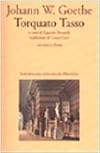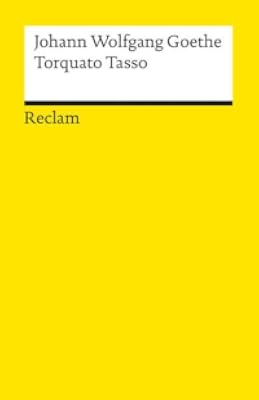
Torquato Tasso
by Johann Wolfgang von Goethe
On This Page
Description
Torquato Tasso is a play by the German dramatist Johann Wolfgang von Goethe about the sixteenth-century Italian poet, Torquato Tasso. The play was first started in Weimar in 1780 but most of it was written during his two years in Italy, between 1786 and 1788. He completed the play in 1790.Tags
Recommendations









Member Reviews
This was a fine play by the master Goethe. He manages to weave poetry, sentence after sentence, into his dramatic words to infuse it with power and meaning. The language is soft and contemplative and allows one to explore the work at length. Overall, quite a good play and very impressive.
4 stars!
4 stars!
1151 Torquato Tasso: A Play, by Johann Wolfgang von Goethe (read 15 Jan 1972) This was published in 1770. It is a "classical" style play. Obviously I prefer Goethe's Sturm and Stress period to his classical. The play reads easily enough, and it is well constructed. But it isn't very exciting, and at least in English has no powerful lines. Tasso in 1577 has finished his poem, Jerusalem Delivered, but is a prima donna and gets mad at Antonio, the Prince, Leonore and the Princess--the only five characters.
Ratings
Members
- Recently Added By
Author Information

Johann Wolfgang von Goethe, 1749-1832 Johann Wolfgang von Goethe was born in Frankfurt am Main. He was greatly influenced by his mother, who encouraged his literary aspirations. After troubles at school, he was taught at home and gained an exceptionally wide education. At the age of 16, Goethe began to study law at Leipzig University from 1765 to show more 1768, and he also studied drawing with Adam Oeser. After a period of illness, he resumed his studies in Strasbourg from 1770 to 1771. Goethe practiced law in Frankfurt for two years and in Wetzlar for a year. He contributed to the Frankfurter Gelehrte Anzeigen from 1772 to 1773, and in 1774 he published his first novel, self-revelatory Die Leiden des Jungen Werthers. In 1775 he was welcomed by Duke Karl August into the small court of Weimar, where he worked in several governmental offices. He was a council member and member of the war commission, director of roads and services, and managed the financial affairs of the court. Goethe was released from day-to-day governmental duties to concentrate on writing, although he was still general supervisor for arts and sciences, and director of the court theatres. In the 1790s Goethe contributed to Friedrich von Schiller´s journal Die Horen, published Wilhelm Meister's Apprenticeship, and continued his writings on the ideals of arts and literature in his own journal, Propyläen. The first part of his masterwork, Faust, appeared in 1808, and the second part in 1832. Goethe had worked for most of his life on this drama, and was based on Christopher Marlowe's Faust. From 1791 to 1817, Goethe was the director of the court theatres. He advised Duke Carl August on mining and Jena University, which for a short time attracted the most prominent figures in German philosophy. He edited Kunst and Altertum and Zur Naturwissenschaft. Goethe died in Weimar on March 22, 1832. He and Duke Schiller are buried together, in a mausoleum in the ducal cemetery. (Bowker Author Biography) show less
Some Editions
Awards and Honors
Series
Belongs to Publisher Series
Work Relationships
Is contained in
Goethes Werke [4] : [Egmont, Iphigenie auf Tauris, Torquato Tasso, Die natürliche Tochter] by Johann Wolfgang von Goethe
Goethes Werke. Unter Mitwirkung mehrerer Fachgelehrter herausgegeben von Prof. Dr. Karl Heinemann. Bd. 6. by Johann Wolfgang von Goethe
Goethes Werke - Band 3 : Götz von Berlichingen; Egmont; Iphigenie auf Tauris; Torquato Tasso; Hermann und Dorothea - (Bong 4 Bde.) by Johann Wolfgang von Goethe
Goethes poetische Werke. Dritter Band. Dramen (Stella - IDie Geschwister - Iphigenie auf Tauris - Götz von Berlichingen - Egmont - Rorquato Tasso - Clavigio) by Johann Wolfgang von Goethe
Common Knowledge
- Canonical title*
- Torquato Tasso
- People/Characters
- Torquato Tasso
- Important places*
- Belriguardo
- Important events*
- Uraufführung 1807-02-16
*Some information comes from Common Knowledge in other languages. Click "Edit" for more information.
Classifications
- Genre
- Fiction and Literature
- DDC/MDS
- 832.6 — Literature & rhetoric German & related literatures German drama 1750–1832 : 18th century; classical period; romantic period
- LCC
- PT2026 .T7 .P3 — Language and Literature German, Dutch and Scandinavian literatures German literature Individual authors or works 1700-ca. 1860/70 Goethe Translations
- BISAC
Statistics
- Members
- 193
- Popularity
- 169,074
- Reviews
- 3
- Rating
- (3.25)
- Languages
- 8 — Danish, Dutch, English, French, German, Greek, Italian, Portuguese
- Media
- Paper, Audiobook, Ebook
- ISBNs
- 26
- ASINs
- 12