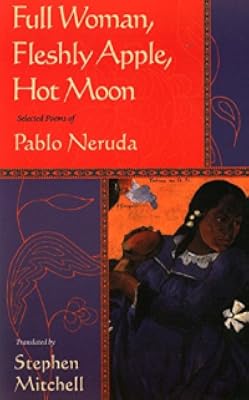
Full Woman, Fleshly Apple, Hot Moon
by Pablo Neruda
On This Page
Description
Full Woman, Fleshly Apple, Hot Moon offers fresh interpretations of the most widely read and loved poet of the 20th century- translated and read by a master of poetic expressiveness. Out of the great profusion of Neruda's poetry, Stephen Mitchell has selected forty-nine poems and brought them to life for a new generation of listeners. These are poems of a happy man, deeply fulfilled in his sexuality, at home in the world, in love with life and its infinite particular forms, and overflowing show more with the joy of language. These large-hearted, generous poems resonant with a humor that is rare in poetry. show lessTags
Recommendations



















Member Reviews
I bought this collection of Pablo Neruda's poetry in 2001 and its taken me until now, ten years later, to finish it. This extremely slow pace should not be mistaken for dislike of the book, however. I had not read Neruda's work before I bought Full Woman, Fleshly Apple, Hot Moon. Traveling Mexico, I was looking for a book in Spanish and English that I could read, enjoy, and practice my Spanish with and I remembered that my Spanish teacher had mentioned this poet's name in class at one point.
I began reading the book by first reading the poem in Spanish, then in English, then in Spanish again, to begin to get a sense of the poetic phrasing and how the language was translated.
As I began reading, however, I fell in love with each new ode show more and the way Neruda was clearly in love with life, the universe, and everything. He wrote odes to socks, to birds, to onions, to anything and everything this world has to offer. All of these ordinary things, which he layered with sensual and resonant language, suddenly had new mystical properties. I could not look at the armored artichoke the same way again as I dropped it into a pot to boil.
One would think I would have powered through the book to read every single poem, but the truth was I could not leave my favorite poems behind. This was a book I always had at hand, on a night stand or in my stack of TBR books. No matter what other books I was reading, I always eventually came back to these poems, returning to them like old lovers. I reread my favorites again and again, while every once in a while progressing forward to the another poem, a new favorite to be added to the list.
Now that I've finally finished the book, beginning to end, I will still be keeping it close. There is so much beautiful language to revisit and rediscover. This is a book that will probably always be by my side. I love it so. show less
I began reading the book by first reading the poem in Spanish, then in English, then in Spanish again, to begin to get a sense of the poetic phrasing and how the language was translated.
As I began reading, however, I fell in love with each new ode show more and the way Neruda was clearly in love with life, the universe, and everything. He wrote odes to socks, to birds, to onions, to anything and everything this world has to offer. All of these ordinary things, which he layered with sensual and resonant language, suddenly had new mystical properties. I could not look at the armored artichoke the same way again as I dropped it into a pot to boil.
One would think I would have powered through the book to read every single poem, but the truth was I could not leave my favorite poems behind. This was a book I always had at hand, on a night stand or in my stack of TBR books. No matter what other books I was reading, I always eventually came back to these poems, returning to them like old lovers. I reread my favorites again and again, while every once in a while progressing forward to the another poem, a new favorite to be added to the list.
Now that I've finally finished the book, beginning to end, I will still be keeping it close. There is so much beautiful language to revisit and rediscover. This is a book that will probably always be by my side. I love it so. show less
A good collection of Pablo Neruda's poetry but a rather unorthodox selection, it has to be said. Translator Stephen Mitchell only chooses poems from when Neruda was in his fifties, i.e. from Elemental Odes onwards. He doesn't attempt to provide a balanced overview of Neruda's work; indeed, in his short foreword, he readily admits to only choosing his personal favourites. I had to leave behind many of Neruda's greatest poems, because they weren't my favourites... As great as some of these poems obviously are, I am not often drawn to reread them." (pg. xiii). Mitchell does identify a common theme in his selections - that of nature, the poetry of "ripeness", and the interconnectivity of all things - which does make the book a cohesive show more collection, but at the same time only provides an insight into one - admittedly, significant - aspect of Neruda's poetry.
The poems themselves are as great as ever. I've read a fair bit of Neruda by now so I was already familiar with a lot of them, and to be honest I've preferred the translations I've read in other compilations like Selected Poems and The Essential Neruda. Mitchell's translated words just didn't seem to dominate the page in the same way those other translations did. Nevertheless, despite my familiarity with Neruda's work I was still blindsided by some really great poems, like 'To the Foot from Its Child'. Most of the selections are Neruda's 'Odes to...', eulogising everyday things like books, tomatoes, timepieces, wine, salt, as well as animals like cats, bees and seagulls. These are eye-opening as Neruda finds new angles to look at things that you wouldn't even notice in your day-to-day life. He finds hidden depths and beauty and nobility in a great number of seemingly mundane things, and expresses those qualities with gorgeous lyricism. Whilst it is not my favourite Neruda collection, Full Woman, Fleshly Apple, Hot Moon is still a worthwhile endeavour." show less
The poems themselves are as great as ever. I've read a fair bit of Neruda by now so I was already familiar with a lot of them, and to be honest I've preferred the translations I've read in other compilations like Selected Poems and The Essential Neruda. Mitchell's translated words just didn't seem to dominate the page in the same way those other translations did. Nevertheless, despite my familiarity with Neruda's work I was still blindsided by some really great poems, like 'To the Foot from Its Child'. Most of the selections are Neruda's 'Odes to...', eulogising everyday things like books, tomatoes, timepieces, wine, salt, as well as animals like cats, bees and seagulls. These are eye-opening as Neruda finds new angles to look at things that you wouldn't even notice in your day-to-day life. He finds hidden depths and beauty and nobility in a great number of seemingly mundane things, and expresses those qualities with gorgeous lyricism. Whilst it is not my favourite Neruda collection, Full Woman, Fleshly Apple, Hot Moon is still a worthwhile endeavour." show less
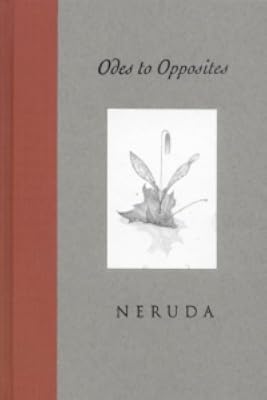
It is one of the best collections I have ever read. I was not familiar with Neruda's odes prior to this reading, and fell completely in love with them - so much so that I just bought a book called Odes to Opposites to keep in my library. I am so grateful that this book came my way just when i needed its inspiration to sit quietly and read about the most mundane of items - salt, watermelon, socks - and to be charmed by them. Here is an excerpt I love from Ode to the Onion:
Star of the poor
fairy godmother
wrapped
in delicate
paper, you rise from the ground
eternal, whole, pure
like an astral seed,
and when the kitchen knife
cuts you, there arises
the only tear
without sorrow.
Star of the poor
fairy godmother
wrapped
in delicate
paper, you rise from the ground
eternal, whole, pure
like an astral seed,
and when the kitchen knife
cuts you, there arises
the only tear
without sorrow.
Stephen Mitchell's translations of Neruda's poetry are remarkable. Full Woman, Fleshly Apple, Hot Moon, selected and translated by Mitchell, is a wonderful introduction to Neruda's incomparable work. If you have wanted to encounter Neruda's work in English, and have been bewildered about just where to start (there are many translations, by many translators, in many collections and anthologies), then I highly recommend this particular selection by this most exacting poet-translator, Mitchell. Here you will find a few sonnets, elegies, odes, and lyrics spanning years of Neruda's work. This bilingual edition will appeal to many readers, and would seem to be an excellent book for budding translators to study the art and craft of translation show more from Spanish to English. And of course, it's Neruda! show less
Ratings
Members
- Recently Added By
Lists

Latin American Literature
50 works; 11 members
Author Information

652+ Works 25,966 Members
Pablo Neruda was born Ricardo Eliecer Neftalí Reyes Basoalto in Ferral, Chile on July 12, 1904. In 1923 he sold all of his possessions to finance the publication of his first book, Crepusculario (Twilight), which he published under the pseudonym Pablo Neruda. Veinte Poemas de Amor y una Cancion Desesperada (Twenty Love Poems and a Song of show more Despair), which was published the following year, made him a celebrity and allowed him to stop his studies to devote himself to poetry. His other works include España en el Corazón, Canto General, Las Uvas y el Viento, and Para Nacer He Nacido. He received numerous awards including the World Peace Prize with Paul Robeson and Pablo Picasso in 1950, the Lenin Peace Prize and the Stalin Peace Prize in 1953, and the Nobel Prize for Literature for his poetry in 1971. He died of leukemia on September 23, 1973. (Bowker Author Biography) show less
Some Editions
Common Knowledge
- Canonical title
- Full Woman, Fleshly Apple, Hot Moon
- Original publication date
- 1998-01-23
Classifications
Statistics
- Members
- 472
- Popularity
- 64,486
- Reviews
- 4
- Rating
- (4.26)
- Languages
- English, Spanish
- Media
- Paper, Audiobook
- ISBNs
- 5
- ASINs
- 2