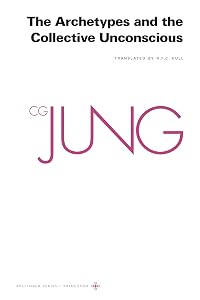
The Archetypes and The Collective Unconscious
by C. G. Jung, Lilly Jung-Merker (Herausgeber)
On This Page
Description
Essays which state the fundamentals of Jung's psychological system: "On the Psychology of the Unconscious" and "The Relations Between the Ego and the Unconscious," with their original versions in an appendix.Tags
Recommendations













Member Reviews
What kind of a book is this? I considered several categories from spiritual to supernatural, but decided that it was a sort of mythology of human archetypes and the psyche. My difficulties with the text came close to my experience reading the Tao of Lao-tse, while in its categorical nature it resembled The Varieties of Religious Experience. My own approach to reading it centered on the literary connections with which I found resonance in the text. These ranged widely from Shakespeare to Stevenson and Hesse with a special emphasis on the importance of Jung for Moby-Dick.
In this work Jung propounds many of his theories regarding the nature of human consciousness, both personal and collective. While portrayed as scientific they seemed to show more lack the evidence normally associated with the scientific method. Jung was great at making his assumptions sound like settled truth, when outside of his coterie there was little that was settled. For example, he compares his discoveries to the discovery of the atom, commenting that "we speak of "atoms" today because we have heard, directly or indirectly, of the atomic theory of Democritus. But where did Democritus, or whoever first spoke of minimal constitutive elements, hear of atoms? This notion had its origin in archetypal ideas, that is , in primordial images which were never reflections of physical events but are spontaneous products of the psychic factor." (p 57) This gives you a flavor of the sort of arguments presented. There are also examples of many of the concepts based on observation of patients. For me, it was these stories that hearkened back to the approach of William James.
http://pics.cdn.librarything.com/pics/s-s.gif
The book is poetic at times and has a wealth of interpretations of psychic events. His examinations of the personal or collective unconscious is fascinating and provides a great introduction to the psychological world of Carl Jung. show less
In this work Jung propounds many of his theories regarding the nature of human consciousness, both personal and collective. While portrayed as scientific they seemed to show more lack the evidence normally associated with the scientific method. Jung was great at making his assumptions sound like settled truth, when outside of his coterie there was little that was settled. For example, he compares his discoveries to the discovery of the atom, commenting that "we speak of "atoms" today because we have heard, directly or indirectly, of the atomic theory of Democritus. But where did Democritus, or whoever first spoke of minimal constitutive elements, hear of atoms? This notion had its origin in archetypal ideas, that is , in primordial images which were never reflections of physical events but are spontaneous products of the psychic factor." (p 57) This gives you a flavor of the sort of arguments presented. There are also examples of many of the concepts based on observation of patients. For me, it was these stories that hearkened back to the approach of William James.
http://pics.cdn.librarything.com/pics/s-s.gif
The book is poetic at times and has a wealth of interpretations of psychic events. His examinations of the personal or collective unconscious is fascinating and provides a great introduction to the psychological world of Carl Jung. show less
Had James George Frazer changed career and become a psychologist, after writing his masterpiece, this is something I imagine he could have written as a sequel. Like the Golden Bough, Archetypes and the Collective Unconscious has a distinctly scientific feel, something often found lacking in the soft (social) sciences and humanities, this sets the work out as something to be taken serious notice of.
Jung sets out to explain the workings of the human mind, why it shows certain patterns, and why these patterns recur; comparable and parallel to Frazer's exposition on how religion and magic evolved across time and the world, what patterns occur, and why. Jung believes, and seeks to show, that the unconscious human mind has evolved to contain show more deeply embedded psychological structures called archetypes, which if understood could not only explain normal and abnormal human psychological behaviour, but the behaviour of mankind across the ages, why we have created myths, rituals and gods, and why they consistently share certain features.
This is one of those books that has to be read to be appreciated, and perhaps has to be read with a knowledge of certain other works to be appreciated to its full extent. From a biological viewpoint the archetypes are not particularly supported in the book, but it is clear to see that they would have evolved in the ancestors of man while the brain on the whole was lacking a capacity for advanced consciousness in order to provide creatures with relatively complicated instincts that would increase their survival value; one illustration I can think of would be the fear of snakes, observable in humans and primates which have never encountered a snake before. This recurrently turns up not only in mythology as the dragon, in religion sometimes representing the devil, but also in many of the contemporary psychological studies present in this book.
Also, taking up quite a lot of this book, are the case studies of patients who Jung has either dealt with or has notes on, in which he finds evidence for his archetypes, using the archetypes to satisfactorily diagnose what is wrong with them.
This book I would recommend to anyone with an interest in the human condition. show less
Jung sets out to explain the workings of the human mind, why it shows certain patterns, and why these patterns recur; comparable and parallel to Frazer's exposition on how religion and magic evolved across time and the world, what patterns occur, and why. Jung believes, and seeks to show, that the unconscious human mind has evolved to contain show more deeply embedded psychological structures called archetypes, which if understood could not only explain normal and abnormal human psychological behaviour, but the behaviour of mankind across the ages, why we have created myths, rituals and gods, and why they consistently share certain features.
This is one of those books that has to be read to be appreciated, and perhaps has to be read with a knowledge of certain other works to be appreciated to its full extent. From a biological viewpoint the archetypes are not particularly supported in the book, but it is clear to see that they would have evolved in the ancestors of man while the brain on the whole was lacking a capacity for advanced consciousness in order to provide creatures with relatively complicated instincts that would increase their survival value; one illustration I can think of would be the fear of snakes, observable in humans and primates which have never encountered a snake before. This recurrently turns up not only in mythology as the dragon, in religion sometimes representing the devil, but also in many of the contemporary psychological studies present in this book.
Also, taking up quite a lot of this book, are the case studies of patients who Jung has either dealt with or has notes on, in which he finds evidence for his archetypes, using the archetypes to satisfactorily diagnose what is wrong with them.
This book I would recommend to anyone with an interest in the human condition. show less
One of the high-water marks of Jung's work, in which he defines archetypes, describes the anima, animus, child, and mother archetypes. Jung also lays the foundation for the structure of his theory of a collective unconscious, which unites us all at a deep level of our unconscious and explains how contemplation of myth and fairytales provide portals to this level of mind, which is laden with treasure and intuitive knowledge. Of the Jungian works I have read, Archetypes and the Collective Unconscious and Symbols of Transformation were works of outstanding merit. The author was one of the seminal thinkers of the 20th century, and subsequent explorers such as James Hillman, Ken Wilber, and others continue his work into the future. In show more Archetypes, Jung also discusses individuation, in which the unconscious is brought into the light and united with the conscious mind in order to integrate the individual and bring about wholeness, and the function of mandala symbolism is explained. It is recommended that one should probably read an introductory book to Jung's thought, before tackling his major works. show less
I like Carl Jung’s work and find him quite intriguing. Unfortunately, I had a hard time staying engaged with this book. There were aspects that were interesting, but it was mostly pretty complex for my taste.
Jung opened up the unseen world for me. Before Joe Campbell came along, Jung taught that ghosts, demons, planets in trine, the Knave of Swords, alchemy, religions, and myth all pointed back to the interior of the human spirit.
Review 1: Princeton University Pr, 1980 Edition; A collection of some of Jung's most important essays on the archetypes and the collective unconscious. The Archetypes and the Collective Unconscious features many of Jung's most important essays describing and elaborating on these two central, related concepts.
The contents are:
Archetypes of the Collective Unconscious (1934)
The Concept of the Collective Unconscious (1936)
Concerning the Archetypes, with Special Reference to the Anima Concept (1936)
Psychological Aspects of the Mother Archetype (1938)
Concerning Rebirth (1939)
The Psychology of the Child Archetype (1940)
The Psychological Aspects of the Kore (1941)
The Phenomenology of the Spirit in Fairytales (1945)
On the Psychology of the show more Trickster-Figure (1954)
Conscious, Unconscious, and Individuation (1939)
A Study in the Process of Individuation (1933)
Review 2: Taylor & Francis, 18 December 2014 edition (ISBNs 9781317534600, 1317534603)
The concept of 'Archteypes' and the hypothesis of 'A Collective Unconscious' are two of Jung's better known and most exciting ideas. In this volume - taken from the Collected Works and appearing in paperback for the first time - Jung describes and elaborates the two concepts.
Three essays establish the theoretical basis which are then followed by essays on specific archetypes. The relation of these to the process of individuation is examined in the last section. The Archetypes and the Collective Unconscious is one of Jung's central works. There are many illustrations in full colour. show less
The contents are:
Archetypes of the Collective Unconscious (1934)
The Concept of the Collective Unconscious (1936)
Concerning the Archetypes, with Special Reference to the Anima Concept (1936)
Psychological Aspects of the Mother Archetype (1938)
Concerning Rebirth (1939)
The Psychology of the Child Archetype (1940)
The Psychological Aspects of the Kore (1941)
The Phenomenology of the Spirit in Fairytales (1945)
On the Psychology of the show more Trickster-Figure (1954)
Conscious, Unconscious, and Individuation (1939)
A Study in the Process of Individuation (1933)
Review 2: Taylor & Francis, 18 December 2014 edition (ISBNs 9781317534600, 1317534603)
The concept of 'Archteypes' and the hypothesis of 'A Collective Unconscious' are two of Jung's better known and most exciting ideas. In this volume - taken from the Collected Works and appearing in paperback for the first time - Jung describes and elaborates the two concepts.
Three essays establish the theoretical basis which are then followed by essays on specific archetypes. The relation of these to the process of individuation is examined in the last section. The Archetypes and the Collective Unconscious is one of Jung's central works. There are many illustrations in full colour. show less
Dense. Good thing I keep a dream journal!
Members
- Recently Added By
Lists

Jordan B. Peterson's Recommended Books
104 works; 5 members

Psicología - Clásicos
165 works; 2 members

My List
302 works; 1 member

Men's healing resources
749 works; 1 member
Author Information

901+ Works 42,813 Members
Carl Gustav Jung was born in Switzerland on July 26, 1875. He originally set out to study archaeology, but switched to medicine and began practicing psychiatry in Basel after receiving his degree from the University of Basel in 1902. He became one of the most famous of modern psychologists and psychiatrists. Jung first met Sigmund Freud in 1907 show more when he became his foremost associate and disciple. The break came with the publication of Jung's Psychology of the Unconscious (1912), which did not follow Freud's theories of the libido and the unconscious. Jung eventually rejected Freud's system of psychoanalysis for his own "analytic psychology." This emphasizes present conflicts rather than those from childhood; it also takes into account the conflict arising from what Jung called the "collective unconscious"---evolutionary and cultural factors determining individual development. Jung invented the association word test and contributed the word complex to psychology, and first described the "introvert" and "extrovert" types. His interest in the human psyche, past and present, led him to study mythology, alchemy, oriental religions and philosophies, and traditional peoples. Later he became interested in parapsychology and the occult. He thought that unidentified flying objects (UFOs) might be a psychological projection of modern people's anxieties. He wrote several books including Studies in Word Association, Flying Saucers: A Modern Myth of Things Seen in the Skies, and Psychology and Alchemy. He died on June 6, 1961 after a short illness. (Bowker Author Biography) show less
Some Editions
Series
Belongs to Publisher Series
Work Relationships
Common Knowledge
- Canonical title
- The Archetypes and The Collective Unconscious
- Original title
- Die Archetypen und das kollektive Unbewußte
- Original publication date
- 1959 (original copyright) (original copyright); 1969 (new material copyright) (new material copyright)
- Original language
- German
Classifications
Statistics
- Members
- 1,543
- Popularity
- 14,908
- Reviews
- 12
- Rating
- (4.15)
- Languages
- 11 — Chinese, Czech, Dutch, English, German, Italian, Polish, Romanian, Serbian, Spanish, Portuguese (Brazil)
- Media
- Paper, Ebook
- ISBNs
- 49
- ASINs
- 20
