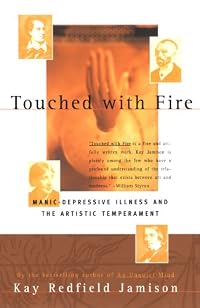
Touched with Fire: Manic-Depressive Illness and the Artistic Temperament
by Kay Redfield Jamison
On This Page
Description
The anguished, volatile intensity we associate with the artistic temperament, often described as "a fine madness," has been thought of as a defining aspect of much artistic genius. Now, Kay Jamison's brilliant work, based on years of studies as a clinical psychologist and prominent researcher in mood disorders, reveals that many artists who were subject to alternatingly exultant and then melancholic moods were, in fact, engaged in a lifelong struggle with manic-depressive illness. Drawing on show more extraordinary recent advances in genetics, neuroscience, and psychopharmacology, Jamison presents the now incontrovertible proof of the biological foundations of this frequently misunderstood disease, and applies what is known about the illness, and its closely related temperaments, to the lives of some of the world's greatest artists - Byron, van Gogh, Shelley, Poe, Melville, Schumann, Coleridge, Virginia Woolf, Burns, and many others. Byron's life, discussed in considerable detail, is used as a particularly fascinating example of the complex interaction among heredity, mood, temperament, and poetic work. Jamison reviews the substantial, rapidly accumulating, and remarkably consistent findings from biographic and scientific studies that demonstrate a markedly increased rate of severe mood disorders and suicide in artists, writers, and composers. She then discusses reasons why this link between mania, depression, and artistic creativity might exist. Manic-depressive illness, a surprisingly common disease, is genetically transmitted. For the first time, the extensive family histories of psychiatric illness and suicide in many writers, artists, and composers are presented. In some instances - for example, Tennyson and Byron - these psychiatric pedigrees are traced back more than 150 years. Jamison discusses the complex ethical and cultural consequences of recent research in genetics, especially as they apply to manic-depressive illness, a disease that almost certainly confers both individual and evolutionary advantage, but often kills and destroys as it does so. Psychiatric treatment of artists remains a fiercely controversial issue. Dr. Jamison discusses both the advantages and problems with current treatments, and advocates a humanistic, flexible, and yet firmly medical approach. However, she strongly cautions against simplistic attempts to cure this most human and tragic of all diseases at the expense of destroying the artistic personality. show lessTags
Recommendations









Member Reviews
'The basic argument of this book is not that all writers and artists are depressed, suicidal, or manic. It is, rather, that a greatly disproportionate number of them are; that the manic-depressive and artistic temperaments are, in many ways, overlapping ones; and, that the two temperaments are causally related to one another.'
'Touched with Fire' is a passionate discussion of what is creativity, and how it can be served by the cognitive processes and moods involved in depression and manic/ hypomanic episodes. I personally love it, not least because I believe Kay Redfield Jamison (renown clinical psychologist and herself a manic-depressive, author of the bestseller 'An Unquiet Mind') has a strong point.
First, focusing on high profiles show more personalities (e.g. whole chapter or vignettes are dedicated to Byron, Van Gogh, Virginia Woolf, Robert Schumann...) I like her holistic approach, away from so many ridicule psychobiographies unfortunately so common with such topic. Indeed, she doesn't focus only on the lives of the artists discussed; she, because bipolar is a genetic illness, support her arguments by looking also at their family backgrounds. Depression, suicide, substance abuse, violence... It's all very telling. Then, because perfectly aware of the scepticism her claim might raise, she dedicates a whole chapter exposing, and then counter-arguing, potential criticisms in sharp and punchy insights, relying on wide researches despite limited data. I, for one, was in any case convinced. She even goes further than that, touching on ethical issues by questioning the impact of treating - if not eliminating -such disease in a last chapter that leaves thoughtful to say the least:
'If manic-depressive illness and its associated temperaments are relatively common in artists, writers, and composers, and if the illness is, at least to some extent, an important part of what makes their work what it is, what are the implications of treating the underlying disease and its temperaments?'
Now, it doesn't mean it's all very strongly convincing. Since depression and mania/ hypomania are cyclic patterns often linked to seasons, she tries and attempts to argue that, some artists had indeed creative periods more prolific than others matching those cyclic patterns. Was she here carried away by her own argumentation, or is there really a connection I personally find too good to be true? I struggled to follow her on that score, and so will leave it here.
Nevertheless, I was strongly convinced by her claim that there clearly is a link between manic-depressive illness and creativity. The turmoil coming with the exhilarating highs and frightening and crushing lows of such 'fine madness' makes, in itself, for such emotional experience that if harnessed by artistic tendencies it no doubt can be the source of uncommon and wonderful art. The high rate of artists having suffered such fate is, alone, a testimony to it! Making science dance with art - understanding a mental illness and the creative process - here's a book which is as enthralling as it is riveting.
A great read. show less
'Touched with Fire' is a passionate discussion of what is creativity, and how it can be served by the cognitive processes and moods involved in depression and manic/ hypomanic episodes. I personally love it, not least because I believe Kay Redfield Jamison (renown clinical psychologist and herself a manic-depressive, author of the bestseller 'An Unquiet Mind') has a strong point.
First, focusing on high profiles show more personalities (e.g. whole chapter or vignettes are dedicated to Byron, Van Gogh, Virginia Woolf, Robert Schumann...) I like her holistic approach, away from so many ridicule psychobiographies unfortunately so common with such topic. Indeed, she doesn't focus only on the lives of the artists discussed; she, because bipolar is a genetic illness, support her arguments by looking also at their family backgrounds. Depression, suicide, substance abuse, violence... It's all very telling. Then, because perfectly aware of the scepticism her claim might raise, she dedicates a whole chapter exposing, and then counter-arguing, potential criticisms in sharp and punchy insights, relying on wide researches despite limited data. I, for one, was in any case convinced. She even goes further than that, touching on ethical issues by questioning the impact of treating - if not eliminating -such disease in a last chapter that leaves thoughtful to say the least:
'If manic-depressive illness and its associated temperaments are relatively common in artists, writers, and composers, and if the illness is, at least to some extent, an important part of what makes their work what it is, what are the implications of treating the underlying disease and its temperaments?'
Now, it doesn't mean it's all very strongly convincing. Since depression and mania/ hypomania are cyclic patterns often linked to seasons, she tries and attempts to argue that, some artists had indeed creative periods more prolific than others matching those cyclic patterns. Was she here carried away by her own argumentation, or is there really a connection I personally find too good to be true? I struggled to follow her on that score, and so will leave it here.
Nevertheless, I was strongly convinced by her claim that there clearly is a link between manic-depressive illness and creativity. The turmoil coming with the exhilarating highs and frightening and crushing lows of such 'fine madness' makes, in itself, for such emotional experience that if harnessed by artistic tendencies it no doubt can be the source of uncommon and wonderful art. The high rate of artists having suffered such fate is, alone, a testimony to it! Making science dance with art - understanding a mental illness and the creative process - here's a book which is as enthralling as it is riveting.
A great read. show less
First of all, there's a lot of discussion about (and occasional colorful descriptions of) suicide in this book, so it isn't light reading at all, and some of the passages quoted from different authors were hard to get through for me.
So this was written in 1993, when we were still on the DSM III, and it's sometimes evident in the more clinical chapters, e.g. positing the idea of what we now commonly refer to as Seasonal Affective Disorder outside of a diagnostic context. Some of the information about the pharmaceuticals involved in treating manic-depressive illnesses shows its age, mostly in terms of the "standard" medications save for lithium. If you're familiar with the physiological side of manic-depressive illnesses, then those show more chapters may drag on slightly, though I still found the research into genetics and inheritance intriguing.
Having said that, the chapters that focused on well-known creative figures with manic-depressive symptoms have made a huge difference in the way that I view my own illness and the methods that I use for managing it. One of the biggest points is how exhaustive Jamison's list of artists, writers, and musicians with manic-depressive symptoms is, and how well-researched their family histories and symptoms are. Some of the more "mainstream" figures studied were familiar to me (Van Gogh, Lord Byron, Samuel Taylor Coleridge), and many others weren't, and I'm grateful that examples of their writing were presented so that I could add quite a few books and collections to my reading list.
Jamison also presents letters and journal entries that aren't as prominent, which I appreciated, and for the first time I found myself researching and saving quotes that were particularly interesting to me. I would definitely recommend this to anyone trying to reconcile their manic-depressive illness with their creative work. show less
So this was written in 1993, when we were still on the DSM III, and it's sometimes evident in the more clinical chapters, e.g. positing the idea of what we now commonly refer to as Seasonal Affective Disorder outside of a diagnostic context. Some of the information about the pharmaceuticals involved in treating manic-depressive illnesses shows its age, mostly in terms of the "standard" medications save for lithium. If you're familiar with the physiological side of manic-depressive illnesses, then those show more chapters may drag on slightly, though I still found the research into genetics and inheritance intriguing.
Having said that, the chapters that focused on well-known creative figures with manic-depressive symptoms have made a huge difference in the way that I view my own illness and the methods that I use for managing it. One of the biggest points is how exhaustive Jamison's list of artists, writers, and musicians with manic-depressive symptoms is, and how well-researched their family histories and symptoms are. Some of the more "mainstream" figures studied were familiar to me (Van Gogh, Lord Byron, Samuel Taylor Coleridge), and many others weren't, and I'm grateful that examples of their writing were presented so that I could add quite a few books and collections to my reading list.
Jamison also presents letters and journal entries that aren't as prominent, which I appreciated, and for the first time I found myself researching and saving quotes that were particularly interesting to me. I would definitely recommend this to anyone trying to reconcile their manic-depressive illness with their creative work. show less
Another brilliant book about bipolar disorder and other mood disorders by Dr. Jamison. She writes about what has come to be known as "the artistic temperament," i.e., unstable, mercurial moods, grand visions, tremendous energy and drive to accomplish goals, inspired creativity, and the plummet into despair and depression that can follow such heightened mood states.
This is a fabulous exploration of the potential link.between creative genius and what others might call madness. It is extremely well-written book intended for the non-scientific audience. Commentators who claimed it was written for scientists obviously have never read any scientific papers, nor much in the way of literature.
This is a must read twice. Maybe three times. It's strength is in the research. Jamison did her homework and the result is a large book of academic weight made readible by her gift of language and respect for audience. I warn against skipping around. Without having her entire thesis in context one can err in the assumption that Jamison proposes that people are made great by insanity. At all costs manic depression must not be romanticized. Does Jamison dance a little too close to that assumption? I have to read it again.
This enthralling study of the relation between manic-depressive illness and the artistic temperament enlarges our understanding of the creative process in new and unexpected ways. Professor Jamison combines psychiatric sense with artistic sensibility in an an original and marvelous book.
Amazon.com
The march of science in explaining human nature continues. In Touched With Fire, Jamison marshals a tremendous amount of evidence for the proposition that most artistic geniuses were (and are) manic depressives. This is a book of interest to scientists, psychologists, and artists struggling with the age-old question of whether psychological suffering is an essential component of artistic creativity. Anyone reading this book closely will be forced to conclude that it is.
The march of science in explaining human nature continues. In Touched With Fire, Jamison marshals a tremendous amount of evidence for the proposition that most artistic geniuses were (and are) manic depressives. This is a book of interest to scientists, psychologists, and artists struggling with the age-old question of whether psychological suffering is an essential component of artistic creativity. Anyone reading this book closely will be forced to conclude that it is.
Members
- Recently Added By
Author Information

17+ Works 8,276 Members
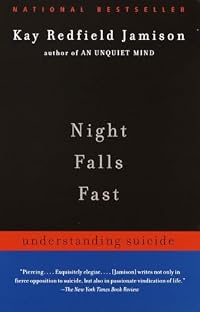
Clinical psychologist Kay Redfield Jamison was born on June 22, 1946. She received a B.A., M.A., and Ph.D. from the University of California, Los Angeles. She is considered one of the foremost experts on bipolar disorder, which she has had since her early adulthood. She is Professor of Psychiatry at the Johns Hopkins University School of Medicine show more and a Honorary Professor of English at the University of St. Andrews in Scotland. She is the author of numerous books including An Unquiet Mind: A Memoir of Moods and Madness; Night Falls Fast: Understanding Suicide; and Touched with Fire: Manic-Depressive Illness and the Artistic Temperament. (Bowker Author Biography) show less
Some Editions
Work Relationships
Has the adaptation
Common Knowledge
- Alternate titles
- Touched with Fire
- Original publication date
- 1993
- People/Characters
- John Berryman; William Blake; Lord Byron (George Gordon, 6th Lord Byron); Samuel Taylor Coleridge; William Cowper; John Keats (show all 14); Robert Lowell; Edgar Allan Poe; John Ruskin; Robert Schumann; Percy Bysshe Shelley; Alfred Lord Tennyson; Vincent van Gogh; Virginia Woolf
- Epigraph
- To those who, by the dint of glass and vapour,
Discover stars, and sail in the wind's eye --
-- Byron
I think continually of those who were truly great.
Who, from the womb, remembered the soul's history
Through corridors of light, where the hours are suns,
Endless and singing. Whose lovely ambition
Was that their ... (show all)lips, still touched with fire,
Should tell of the Spirit, clothed from head to foot in song.
And who hoarded from the Spring branches
The desires falling across their bodies like blossoms.
What is precious, is never to forget
The essential delight of the blood drawn from ageless springs
Breaking through rocks in worlds before our earth.
Never to deny its pleasure in the morning simple light
Nor its grave evening demand for love.
Never to allow gradually the traffic to smother
With noise and fog, the flowering of the spirit.
Near the snow, near the sun, in the highest fields,
See how these names are fêted by the waving grass
And by the streamers of white cloud
And whispers of wind in the listening sky.
The names of those who in their lives fought for life,
Who wore at their hearts the fire's centre.
Born of the sun, they travelled a short while toward the sun
And left the vivid air signed with their honour.
-- Stephen Spender - Dedication
- For
Richard Jed Wyatt, M.D. - First words
- "We of the craft are all crazy," remarked Lord Byron about himself and his fellow poets.
- Last words
- (Click to show. Warning: May contain spoilers.)That they themselves were subject to more than their fair share of these woes deserves our appreciation, understanding, and very careful thought.
- Blurbers
- Marchand, Leslie A.; Storr, Anthony; Watson, James D.; McGann, Jerome; Pardes, Herbert; Martin, Robert Bernard
Classifications
- Genres
- Nonfiction, Biography & Memoir
- DDC/MDS
- 616.89500887 — Applied Science & Technology Medicine & health Diseases, Allergies, Skin Conditions Nervous Disorders: Autism, Anorexia, OCD Mental disorders: bi-polar/schizophrenia Bipolar
- LCC
- RC516 .J36 — Medicine Internal medicine Internal medicine Neurosciences. Biological psychiatry. Neuropsychiatry Psychiatry Psychopathology Psychoses
- BISAC
Statistics
- Members
- 1,369
- Popularity
- 17,285
- Reviews
- 9
- Rating
- (3.98)
- Languages
- 5 — Dutch, English, Italian, Portuguese, Spanish
- Media
- Paper, Ebook
- ISBNs
- 11
- UPCs
- 1
- ASINs
- 4