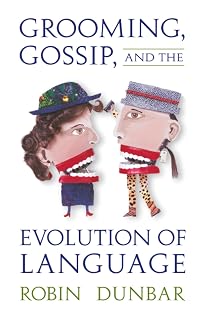
Grooming, Gossip, and the Evolution of Language
by Robin Dunbar
On This Page
Description
Apes and monkeys, humanity's closest kin, differ from other animals in the intensity of their social relationships. All their grooming is not so much about hygiene as it is about cementing bonds, making friends, and influencing fellow primates. But for early humans, grooming as a way to social success posed a problem: given their large social groups of 150 or so, our earliest ancestors would have had to spend almost half their time grooming one another - an impossible burden. What Dunbar show more suggests - and his research, whether in the realm of primatology or in that of gossip, confirms - is that humans developed language to serve the same purpose, but far more efficiently. It seems there is nothing idle about chatter, which holds together a diverse, dynamic group - whether of hunter-gatherers, soldiers, or workmates. Anthropologists have long assumed that language developed in relationships among males during activities such as hunting. Dunbar's original and extremely interesting studies suggest otherwise: that language in fact evolved in response to our need to keep up to date with friends and family. We needed conversation to stay in touch, and we still need it in ways that will not be satisfied by teleconferencing, e-mail, or any other communication technology. As Dunbar shows, the impersonal world of cyberspace will not fulfill our primordial need for face-to-face contact. show lessTags
Recommendations





















Member Reviews
There are so many things wrong about this book it's hard to know where to start... Dunbar is a Professor of evolutionary biology, so presumably he is no fool. But I note that he is also - apparently - famous as a populariser of science. He has succeeded here magnificently - if you assume his audience is about 8 years old. For my part I don't need a five page digression into to operation of the natural opiate system in the human body. Especially when the same simple point is explained by repetition rather than exposition. Perhaps there's not that much to be said about grooming, or more to the point, the author doesn't have much to say about it - at least not much that he considers suitable for 8 year old humans. His section on language show more is equally infantile. It occurs to me that if anything this resembles the pitch for a television series or special. I wouldn't be so annoyed, except that the author commits the cardinal sin for an intellectual (or one who purports to be) and that is quoting obviously spurious and misguided studies. To be told that the rate of homicide between non-related parties living together is 20 times higher than it is for related parties is simply saying (except that the author doesn't understand or doesn't choose to tell the reader) that spouses kill each other at a far higher rate than parents-children or siblings living in the same household. To suggest that this 'proves' that blood ties inhibit blood related individuals from killing each other (as the author claims') is to fail to take account of more issues pertaining to spousal abuse that I could enumerate in anything less than a book - without even touching upon the issue of opportunity and the question of household population profiles which will skew this statistic. As a so-called scientist, the author deserves to be pilloried for demeaning his profession. You can make adjustments in order to popularise science, but this book is unadulterated trash. It has gone in the fire (it's a cold winter here), but I'll keep it in my catalog so that this review can stand. By all means this is a fascinating subject, but read something by someone who understands primates (de Waal for instance), or language (Pinker). The half star indicates the book has a useful calorific value, when ignited. show less
A nice popular science advancing one argument: that language evolved so we could "groom", or rather, socialize, with more individuals than before.
Its discussion on neocortex and group sizes, especially when it comes to humans, is sketchy and almost as capricious as a numerological argument.
Its discussion on neocortex and group sizes, especially when it comes to humans, is sketchy and almost as capricious as a numerological argument.
This book is very interesting when it stays on its main topic: How humans may have developed larger group size than other primates, and how that may have necessitated the development of spoken language.
However, when it strays even slightly from that topic, it becomes very speculative, with so many facts connected in such complicated ways that I am pretty sure there are many other solutions to this puzzle.
However, when it strays even slightly from that topic, it becomes very speculative, with so many facts connected in such complicated ways that I am pretty sure there are many other solutions to this puzzle.
I wanted to enjoy this, but I got to p. 38 and realized that the physical copy I was reading actually Stinks. Yes, like tomcat piss or something similar. Ironically apt, eh?
So, I peeked ahead some, and read a bunch of reviews here, and I realized that the reason I had only gotten that far, despite picking the book up several times, is that too much of it is background, nothing I've not read about before. And the thesis apparently doesn't get articulated until the last chapter.
Moreover, to this interested layperson, the thesis seems to be a common-sense aphorism. Of course language developed, at least in part, to aid in family & tribal communication, and communication developed, at least in part, to aid us to find allies, forge show more alliances, claim our status, and find our role in our group culture.
Maybe I'm still misunderstanding his claim. Maybe I'd be more intrigued if I were familiar with what theses of the early development of language he's making a claim against. But for now, this copy will get aired out thoroughly, and then released via bookcrossing.* And I won't try to find another copy. Thanks to the wonderful GR reviewers who helped me come to this decision by writing such careful reviews!
*to clarify, the book is not dirty or contaminated - the paper itself smells yucky to me... and I'm very sensitive; I'm sure most people wouldn't notice. show less
So, I peeked ahead some, and read a bunch of reviews here, and I realized that the reason I had only gotten that far, despite picking the book up several times, is that too much of it is background, nothing I've not read about before. And the thesis apparently doesn't get articulated until the last chapter.
Moreover, to this interested layperson, the thesis seems to be a common-sense aphorism. Of course language developed, at least in part, to aid in family & tribal communication, and communication developed, at least in part, to aid us to find allies, forge show more alliances, claim our status, and find our role in our group culture.
Maybe I'm still misunderstanding his claim. Maybe I'd be more intrigued if I were familiar with what theses of the early development of language he's making a claim against. But for now, this copy will get aired out thoroughly, and then released via bookcrossing.* And I won't try to find another copy. Thanks to the wonderful GR reviewers who helped me come to this decision by writing such careful reviews!
*to clarify, the book is not dirty or contaminated - the paper itself smells yucky to me... and I'm very sensitive; I'm sure most people wouldn't notice. show less
A thoroughly delightful and compelling book on the origins of language.
According to Dunbar’s theory, language developed to help manage the social relationships within our primate group when it became too big to manage by grooming. It happened at some point of our history when the group approached about 150 members- the biggest group our brain can pay attention to and manage. Within such a big group it wasn’t practical to groom everybody anybody wanted to have good relations with- hence the language developed as a better way of communication. It developed within female circles and served the purpose of keeping friendly connections and exchanging socially relevant information, so in other words, to gossip.
If you are interested in show more the language development theories, it is a very accessible, quick and really interesting read with much more information and interesting theories as you go along.
An interesting fact:
The fact that we can enjoy and discuss books is due to ToM , which is an abbreviation of Theory of Mind- ability to put ourselves into other people’s shoes, and guess their feelings, thoughts and motivation.
Apart from us, and that occurs in us not before we are four years old, only apes are capable of such a feat: chimpanzees for sure, gorillas maybe, but no monkeys, or other animals including elephants and dolphins. Autistic people never develop ToM, either. show less
According to Dunbar’s theory, language developed to help manage the social relationships within our primate group when it became too big to manage by grooming. It happened at some point of our history when the group approached about 150 members- the biggest group our brain can pay attention to and manage. Within such a big group it wasn’t practical to groom everybody anybody wanted to have good relations with- hence the language developed as a better way of communication. It developed within female circles and served the purpose of keeping friendly connections and exchanging socially relevant information, so in other words, to gossip.
If you are interested in show more the language development theories, it is a very accessible, quick and really interesting read with much more information and interesting theories as you go along.
An interesting fact:
The fact that we can enjoy and discuss books is due to ToM , which is an abbreviation of Theory of Mind- ability to put ourselves into other people’s shoes, and guess their feelings, thoughts and motivation.
Apart from us, and that occurs in us not before we are four years old, only apes are capable of such a feat: chimpanzees for sure, gorillas maybe, but no monkeys, or other animals including elephants and dolphins. Autistic people never develop ToM, either. show less
I suspect that you wonder whether I realize how hard it is for you to be sure, that you understand whether I mean to be saying that you can recognize that I can believe you to want me to write a review..
Ratings
Members
- Recently Added By
Lists

Ologies with Alie Ward reading list
42 works; 2 members

Books in the Bibliography of The Dawn of Everything by Graeber & Wengrow
478 works; 2 members
Author Information

41+ Works 1,555 Members
Robin Dunbar is Professor of Evolutionary Psychology at the University of Oxford and an Emeritus Fellow of Magdalen College. He is an elected Fellow of the British Academy and was co-Director of the British Academy's Centenary Research Project. He is known for the social brain hypothesis, the gossip theory of language evolution, and Dunbar's show more Number (the limit on the number of relationships that we can manage). show less
Classifications
- Genres
- Science & Nature, Nonfiction, Anthropology, General Nonfiction
- DDC/MDS
- 573.2 — Natural sciences & mathematics Biology Specific physiological systems in animals, regional histology and physiology in animals Origin of man
- LCC
- GN281.4 .D85 — Geography, Anthropology and Recreation Anthropology Anthropology Physical anthropology. Somatology Human evolution
- BISAC
Statistics
- Members
- 371
- Popularity
- 84,527
- Reviews
- 6
- Rating
- (3.86)
- Languages
- 5 — Dutch, English, German, Italian, Swedish
- Media
- Paper, Ebook
- ISBNs
- 11
- ASINs
- 2