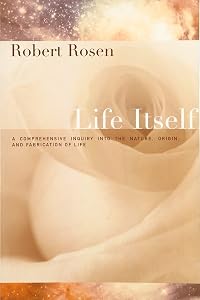
Life Itself: A Comprehensive Inquiry into the Nature, Origin, and Fabrication of Life
by Robert Rosen
On This Page
Description
Why are living things alive? As a theoretical biologist, Robert Rosen saw this as the most fundamental of all questions-and yet it had never been answered satisfactorily by science. The answers to this question would allow humanity to make an enormous leap forward in our understanding of the principles at work in our world. For centuries, it was believed that the only scientific approach to the question "What is life?" must proceed from the Cartesian metaphor (organism as machine). Classical show more approaches in science, which also borrow heavily from Newtonian mechanics, are based on a process called "reductionism." The thinking was that we can better learn about an intricate, complicated system (like an organism) if we take it apart, study the components, and then reconstruct the system-thereby gaining an understanding of the whole. However, Rosen argues that reductionism does not work in biology and ignores the complexity of organisms. Life Itself, a landmark work, represents the scientific and intellectual journey that led Rosen to question reductionism and develop new scientific approaches to understanding the nature of life. Ultimately, Rosen proposes an answer to the original question about the causal basis of life in organisms. He asserts that renouncing the mechanistic and reductionistic paradigm does not mean abandoning science. Instead, Rosen offers an alternate paradigm for science that takes into account the relational impacts of organization in natural systems and is based on organized matter rather than on particulate matter alone. Central to Rosen's work is the idea of a "complex system," defined as any system that cannot be fully understood by reducing it to its parts. In this sense, complexity refers to the causal impact of organization on the system as a whole. Since both the atom and the organism can be seen to fit that description, Rosen asserts that complex organization is a general feature not just of the biosphere on Earth-but of the universe itself. show lessTags
Recommendations








Member Reviews
I found this book to be a very difficult read, but interesting enough that I couldn't immediately reshelve it. I did not understand all the ideas presented, so this review is not meant to judge the validity or novelty of the author’s arguments, only give you some idea of whether or not you would be interested in reading it.
A majority of the text uses mathematical formalism in the form of functions and mappings. If you are not comfortable with the type of math presented in Calculus then I would skip it. The flavor of the book is more like epistemology or the philosophy and fundamentals of science rather than a discussion of life. In fact, I thought the subtitle of this book - "A Comprehensive Inquiry into the nature, origin, and show more fabrication of life" was somewhat misleading since its main thrust is not really a discussion of evolution, the chemical origin of life, or even the biology of life (cellular processes). It is a theoretical work that questions some of the fundamental assumptions of science and more specifically the machine metaphor of life. The author touches on many ideas from Topology, Category Theory, the Theory of Machines, and Relational Biology. This is an advanced text that would probably be used at the graduate level. show less
A majority of the text uses mathematical formalism in the form of functions and mappings. If you are not comfortable with the type of math presented in Calculus then I would skip it. The flavor of the book is more like epistemology or the philosophy and fundamentals of science rather than a discussion of life. In fact, I thought the subtitle of this book - "A Comprehensive Inquiry into the nature, origin, and show more fabrication of life" was somewhat misleading since its main thrust is not really a discussion of evolution, the chemical origin of life, or even the biology of life (cellular processes). It is a theoretical work that questions some of the fundamental assumptions of science and more specifically the machine metaphor of life. The author touches on many ideas from Topology, Category Theory, the Theory of Machines, and Relational Biology. This is an advanced text that would probably be used at the graduate level. show less
Ratings
Members
- Recently Added By
Author Information

15 Works 239 Members
Series
Belongs to Publisher Series
Common Knowledge
- Canonical title
- Life Itself: A Comprehensive Inquiry into the Nature, Origin, and Fabrication of Life
Classifications
Statistics
- Members
- 109
- Popularity
- 298,906
- Reviews
- 1
- Rating
- (3.65)
- Languages
- English
- Media
- Paper
- ISBNs
- 2