On This Page
Description
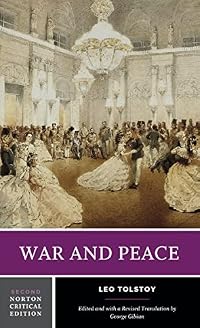
"War and Peace," an epic novel by Leo Tolstoy, unfolds during the Napoleonic era in Russia. The narrative intertwines five aristocratic families amidst the tumult of war and societal change. Amidst political intrigue and military campaigns, Pierre Bezukhov inherits a vast fortune, embarking on a quest for meaning and spiritual fulfillment. Prince Andrei Bolkonsky, disillusioned by the futility of war after severe injury, grapples with love, despair, and the search for purpose. Natasha show more Rostova, a vivacious young woman, experiences passionate love, heartbreak, and personal growth. The novel masterfully juxtaposes individual destinies against the sweeping backdrop of history, exploring themes of free will versus historical determinism, the human capacity for change, and the timeless questions of war's destructive nature and peace's elusive pursuit. show lessTags
Recommendations













Member Reviews
The author repeats himself often throughout this novel, but then, if you were writing a 1500 page novel, you probably would too.
There were three separate components interwoven throughout this book. The first is the story of the people of Russia. The loves and lives of the Rostovs and their acquaintances. I really enjoyed this part, especially when I got into the swing of things the way they were in early 19th century Russia.
The second part was a description of the Napoleon's invasion of Russia and descriptions of the battles. While I didn't particularly enjoy this part (I groaned inwardly every time Napoleon was mentioned), it was interesting at times too, and the rest of the story couldn't have moved along without some description of show more what was happening in the war.
The third part was the part that really made me cringe. This was when Mr. Tolstoy got up on his soapbox and explained at length and repetitively why historians are all wrong and have done a really poor job of figuring out causes and effects throughout history. He started with a few paragraphs of this here and there, but as the novel progressed, his soapbox moments became more frequent and prolonged until the last hundred pages of the book which are almost exclusively devoted to this. It definitely made me glad to finally get to the end of this novel!
I'm glad I made my way through this book mostly because now I can finally say "Yes, I've read War & Peace." If being able to say that isn't on the list of the things that will make you happy, I'd recommend skipping this--I'm sure you can find better ways to spend your time. show less
There were three separate components interwoven throughout this book. The first is the story of the people of Russia. The loves and lives of the Rostovs and their acquaintances. I really enjoyed this part, especially when I got into the swing of things the way they were in early 19th century Russia.
The second part was a description of the Napoleon's invasion of Russia and descriptions of the battles. While I didn't particularly enjoy this part (I groaned inwardly every time Napoleon was mentioned), it was interesting at times too, and the rest of the story couldn't have moved along without some description of show more what was happening in the war.
The third part was the part that really made me cringe. This was when Mr. Tolstoy got up on his soapbox and explained at length and repetitively why historians are all wrong and have done a really poor job of figuring out causes and effects throughout history. He started with a few paragraphs of this here and there, but as the novel progressed, his soapbox moments became more frequent and prolonged until the last hundred pages of the book which are almost exclusively devoted to this. It definitely made me glad to finally get to the end of this novel!
I'm glad I made my way through this book mostly because now I can finally say "Yes, I've read War & Peace." If being able to say that isn't on the list of the things that will make you happy, I'd recommend skipping this--I'm sure you can find better ways to spend your time. show less
Another book that has sat on my Kindle for a few years unread. I admit to struggling at first, more with the style of writing, it takes a while to acclimatise. However, when I did I found my self quite enjoying it.
It certainly provides a rollercoaster of emotions as we follow the Rostov and Bolkonski families and the affect of the Napoleonic invasion of Russia on them and their way of life.
I am not a fan of history, we should learn from it, but never seem to, and certainly not a fan of war, so I found the chapters discussing the history, military strategy and manoeuvres not to my taste and skipped through them.
I almost failed to engage with this book, but I am glad I persisted. Apparently Tolstoy didn't view this as a novel, so I am show more looking forward to reading Anna Karenina, which he did. show less
It certainly provides a rollercoaster of emotions as we follow the Rostov and Bolkonski families and the affect of the Napoleonic invasion of Russia on them and their way of life.
I am not a fan of history, we should learn from it, but never seem to, and certainly not a fan of war, so I found the chapters discussing the history, military strategy and manoeuvres not to my taste and skipped through them.
I almost failed to engage with this book, but I am glad I persisted. Apparently Tolstoy didn't view this as a novel, so I am show more looking forward to reading Anna Karenina, which he did. show less
"O que é Guerra e paz?", questiona Liev Tolstói em um texto que detalha o processo de pesquisa e de criação de sua obra-prima. "Não é um romance, muito menos uma epopeia, menos ainda uma crônica histórica." Ao acompanhar o percurso de cinco famílias aristocráticas russas no período de 1805 a 1820, Tolstói narra a marcha das tropas napoleônicas e seu impacto brutal sobre a vida de centenas de personagens. Em meio a cenas de batalha, bailes da alta sociedade e intrigas veladas, destacam-se as figuras memoráveis dos irmãos Nikolai e Natacha Rostóv, do príncipe Andrei Bolkónski e de Pierre Bezúkhov, filho ilegítimo de um conde, cuja busca espiritual serve como espécie de fio condutor e o torna uma das mais complexas show more personalidades da literatura do século XIX. Ao descrever o cotidiano e os grandes acontecimentos que se sucederam à invasão de Napoleão em 1812, Tolstói retrata uma Rússia magistral, imponente e, sobretudo, profundamente humana. show less
With over 500 characters each given time and place to make a mark within a rolling, panoramic story of truly Historical proportions, where shall I begin? Easy: An unsurpassed MASTERPIECE of its epic genre and Tolstoy one of the genuine immortal great Authors. Everytime I consider the Russian literally penned this immense tome and kept niches for every personality, scene, word and gesture in the mind as he did so just astounds me all over again at his brilliance.
1805 à Moscou, en ces temps de paix fragile, les Bolkonsky, les Rostov et les Bézoukhov constituent les personnages principaux d'une chronique familiale. Une fresque sociale où l'aristocratie, de Moscou à Saint-Pétersbourg, entre grandeur et misérabilisme, se prend au jeu de l'ambition sociale, des mesquineries, des premiers émois. 1812, la guerre éclate et peu à peu les personnages imaginaires évoluent au sein même des événements historiques. Le conte social, dépassant les ressorts de l'intrigue psychologique, prend une dimension d'épopée historique et se change en récit d'une époque. La 'Guerre' selon Tolstoï, c'est celle menée contre Napoléon par l'armée d'Alexandre, c'est la bataille d'Austerlitz, l'invasion de show more la Russie, l'incendie de Moscou, puis la retraite des armées napoléoniennes.
Entre les deux romans de sa fresque, le portrait d'une classe sociale et le récit historique, Tolstoï tend une passerelle, livrant une réflexion philosophique sur le décalage de la volonté humaine aliénée à l'inéluctable marche de l'Histoire ou lorsque le destin façonne les hommes malgré eux. --Lénaïc Gravis et Jocelyn Blériot show less
Първи том на класическия роман на Лев Николаевич Толстой.
„Война и мир” – това е нещо като „Илиадата” на Омир”. Така Лев Толстой сам определя романа си - едно от най-великите произведения в руската и световната литература. Авторът създава цял космос, обрисуван с цялата мощ на епичното повествование, огромното дихание, с което са разгърнати картини от руския и европейския живот, и най-вече дръзкия стремеж show more да се обхване света като цяло, в голямото и малкото, да се открият законите на цялата вселена, да се изследват самите основи на човешкото битие.
Действието на романа се развива в течението на 15 години – от битката на тримата императори (Напалеон, Франц ІІ и Александър І) при Аустерлиц 1805 до 1820 г. В романа са разкрити най-важните страни на обществено-политическия, духовния и семейно-битовия живот на руския народ.
Кулминацията на романа е Бородинското сражение - там побеждава не тактиката и стратегията, а духът на руската армия. show less
„Война и мир” – това е нещо като „Илиадата” на Омир”. Така Лев Толстой сам определя романа си - едно от най-великите произведения в руската и световната литература. Авторът създава цял космос, обрисуван с цялата мощ на епичното повествование, огромното дихание, с което са разгърнати картини от руския и европейския живот, и най-вече дръзкия стремеж show more да се обхване света като цяло, в голямото и малкото, да се открият законите на цялата вселена, да се изследват самите основи на човешкото битие.
Действието на романа се развива в течението на 15 години – от битката на тримата императори (Напалеон, Франц ІІ и Александър І) при Аустерлиц 1805 до 1820 г. В романа са разкрити най-важните страни на обществено-политическия, духовния и семейно-битовия живот на руския народ.
Кулминацията на романа е Бородинското сражение - там побеждава не тактиката и стратегията, а духът на руската армия. show less
Tolstói descreve detalhes físicos com uma vivacidade que torna algumas cenas do livro memoráveis. Ele é, porém, tão didático e repetitivo com sua filosofia da história que aborrece.
Esse livro está na contraditória lista dos livros dos quais eu gostei mas que não pretendo reler.
Esse livro está na contraditória lista dos livros dos quais eu gostei mas que não pretendo reler.
Members
- Recently Added By
Lists

Books Read in 2017
4,249 works; 129 members
Author Information

2,483+ Works 129,187 Members
Count Lev Nikolayevich Tolstoy was born on September 9, 1828 in Russia. He is usually referred to as Leo Tolstoy. He was a Russian author who is regarded as one of the greatest authors of all time. Leo Tolstoy is best known for his novels War and Peace (1869) and Anna Karenina (1877). Tolstoy's fiction includes dozens of short stories and several show more novellas such as The Death of Ivan Ilyich, Family Happiness, and Hadji Murad. He also wrote plays and numerous philosophical essays. Tolstoy had a profound moral crisis and spiritual awakening in the 1870's which he outlined in his work, A Confession. His literal interpretation of the ethical teachings of Jesus, centering on the Sermon on the Mount, caused him to become a fervent Christian anarchist and pacifist. His ideas of nonviolent resistance which he shared in his works The Kingdom of God is Within You, had a profund impact on figures such as Mohandas Gandhi and Martin Luther King, Jr. On September 23, 1862 Tolstoy married Sophia Andreevna Behrs. She was the daughter of a court physician. They had 13 children, eight of whom survived childhood. Their early married life allowed Tolstoy much freedom to compose War and Peace and Anna Karenina with his wife acting as his secretary and proofreader. The Tolstoy family left Russia in the aftermath of the Russian Revolution and the subsequent establishment of the Soviet Union. Leo Tolstoy's relatives and descendants moved to Sweden, Germany, the United Kingdom, France and the United States. Tolstoy died of pneumonia at Astapovo train station, after a day's rail journey south on November 20, 1910 at the age of 82. (Bowker Author Biography) Count Leo Tolstoy was born in 1828 on the family estate of Yasnaya Polyana in the Tula province. He married in 1862 & was the father of 13 children. Tolstoy managed the estate of Yasnaya Polyana & ran its peasant schools, while writing his great novels, "War & Peace" (1869) & "Anna Karenina" (1877). He died in 1910. (Publisher Provided) show less
Some Editions
Awards and Honors
Notable Lists
Series

Belongs to Publisher Series
Work Relationships
Is contained in
I capolavori (Anna Karenina - Guerra e pace - La morte di Ivan Il'ič- Resurrezione - La sonata a Kreutzer e altri racconti) (Italian Edition) by Lev Tolstoj (indirect)
International Collector's Library Classics 19 volumes: Crime & Punishment; Twenty Thousand Leagues Under the Sea; Mysterious Island; Magic Mountain; Around the World in 80 Days; Count of Monte Cristo; Camille; Quo Vadis; Hunchback of Notre Dame; Nana; Scaramouche; Pinocchio; Fernande; War and Peace; The Egyptian; From the Earth to the Moon; Candide; Treasure of Sierra Madre; Siddhartha/Steppenwolf by Jules Verne (indirect)
Common Knowledge
- Canonical title
- War and Peace (1/2) (1/2)
- Original title
- Война и мир
- Original publication date
- 1865-1867: Serialised; 1869: Book
- People/Characters*
- Napoléon Bonaparte
- Important places
- Russia
- Related movies
- War and Peace (1956 | IMDb); Voyna i mir (1967 | IMDb); War and Peace (2007- | IMDb)
- First words
- "Eh bien, mon prince", so Genoa and Lucca are now no more than private estates of the Bonaparte family.
- Last words
- (Click to show. Warning: May contain spoilers.)It seemed to Pierre that this comet spoke in full harmony with all that filled his own softened and uplifted soul, now blossoming into a new life.
- Original language*
- Russisch
- Disambiguation notice
- This is volume 1 in a 2 volume set. If your copy is here but you have a 3 or 4 volumes set, please separate the work and combine with the other volume 1.
*Some information comes from Common Knowledge in other languages. Click "Edit" for more information.
Classifications
- Genres
- General Fiction, Fiction and Literature, Historical Fiction
- DDC/MDS
- 891.78 — Literature & rhetoric Asian Literature East Indo-European and Celtic literatures Russian and East Slavic languages Authors, Russia and Russian miscellany
- LCC
- PG3367 .C38 — Language and Literature Slavic languages and literatures. Baltic languages. Albanian language Slavic. Baltic. Albanian Russian literature Individual authors and works 1800-1870 Tolstoi
- BISAC
Statistics
- Members
- 922
- Popularity
- 28,868
- Reviews
- 16
- Rating
- (4.38)
- Languages
- 21 — Bulgarian, Catalan, Danish, Dutch, English, Estonian, Finnish, French, German, Greek, Italian, Japanese, Norwegian (Nynorsk), Norwegian (Bokmål), Polish, Portuguese, Russian, Slovenian, Spanish, Swedish, Turkish
- Media
- Paper, Audiobook, Ebook
- ISBNs
- 55
- ASINs
- 28