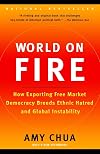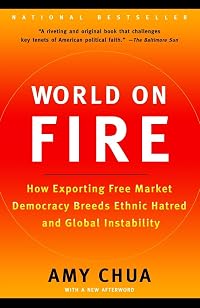
World on Fire: How Exporting Free Market Democracy Breeds Ethnic Hatred and Global Instability
by Amy Chua
On This Page
Description
"Examining the actual impact of economic globalization in every region of the world, from Africa and Asia to Russia and Latin America, Chua exposes an unexpected reality. In every one of these regions, free markets have concentrated disproportionate, often spectacular wealth in the hands of a resented ethnic minority." "Adding democracy to this volatile mix unleashes suppressed ethnic hatreds and brings to power ethno nationalist governments that pursue aggressive policies of confiscation show more and revenge. Chua also shows how individual countries may be viewed as market-dominant minorities at the regional or global level, a fact that may help to explain the Arab-Israeli conflict and the rising tide of anti-American sentiment around the world. America today has become the world's leading market-dominant minority, enjoying wealth and economic power wildly disproportionate to our numbers. This, perhaps more than anything else, accounts for the visceral hatred of Americans that we have seen expressed in recent acts of terrorism." "Chua warns that, far from making the world a better and safer place, democracy and capitalism - at least in the raw, unrestrained form in which they are currently being exported - are intensifying ethnic resentment and global violence, with potentially catastrophic results."--Jacket. show lessTags
Recommendations






Member Reviews
When the Cold War ended in 1989 with the fall of the Berlin Wall, most Western political thinkers assumed that democracy and free markets had triumped, and that the future could only mean exporting these virtues to those 'developing world' countries that lack one or both of them. However as Amy Chua points out in this valuable book, in the real world virtues are not easily exportable (as Iraq is so bloodily proving) and worse still, combining two virtues doesn't always produce another: many times introducing democracy on top of a free market will result in wealth and happiness, but sometimes can lead instead to genocide.
Chua, a professor of international law at Harvard, explains how this happens: a free market may exacerbate rivalries show more between ethnic groups by enriching one group at the expense of others; if those others happen to be the majority, then democracy may offer them the opportunity to take power and exact bloody revenge against their exploiters. Chua didn't need to dig too far for evidence, merely to harvest it from newspaper headlines: massacres of Chinese in Indonesia in 1998; Mugabe's land-grabs in Zimbabwe; the hellish genocides in Rwanda and Bosnia.
This is a courageous book that goes firmly against the grain of both current US neo-conservative and leftist dogmas. Chua, perhaps emboldened by her own Philipino-Chinese descent, tackles matters of ethnic conflict with a robust pragmatism that wholly sidesteps all the pieties of political correctness. She concludes that such conflicts must not only be clearly acknowledged, but as far as possible defused before we can even think about trying to export democracy and free markets. show less
Chua, a professor of international law at Harvard, explains how this happens: a free market may exacerbate rivalries show more between ethnic groups by enriching one group at the expense of others; if those others happen to be the majority, then democracy may offer them the opportunity to take power and exact bloody revenge against their exploiters. Chua didn't need to dig too far for evidence, merely to harvest it from newspaper headlines: massacres of Chinese in Indonesia in 1998; Mugabe's land-grabs in Zimbabwe; the hellish genocides in Rwanda and Bosnia.
This is a courageous book that goes firmly against the grain of both current US neo-conservative and leftist dogmas. Chua, perhaps emboldened by her own Philipino-Chinese descent, tackles matters of ethnic conflict with a robust pragmatism that wholly sidesteps all the pieties of political correctness. She concludes that such conflicts must not only be clearly acknowledged, but as far as possible defused before we can even think about trying to export democracy and free markets. show less
March 18, 2004
I bought this on impulse, from Amazon, after I saw the author's interview with Brian Lamb on a Booknotes rerun.
She was an insightful, generous, thinking human being, who, with vast education and training, has come up with a new and striking theorem about the current state of world politics.
I was so taken with her theory that I bought the book the very next morning, via our very Western computer methodology. Sitting in my living room, in my pajamas on a Sunday morning, I simply looked it up, ordered it, paid by credit card and had it delivered to my porch 3 days later.
Her thesis, market-dominant ethnic minorities and what that means for individiual countries, in particular the US, and her cogent, well-supported show more documentation seem so eminently sensible to me that I wish every world leader and State Dept. employee could read this book.
She says, in essence, that exporting laissez-faire capitalism and one-person/one-vote-democracy to the Third World, with no thought for long-term consequences, is actually causing the very things the US wishes to halt - namely vicious, murderous ethnic conflict and flourishing international terrorism. show less
I bought this on impulse, from Amazon, after I saw the author's interview with Brian Lamb on a Booknotes rerun.
She was an insightful, generous, thinking human being, who, with vast education and training, has come up with a new and striking theorem about the current state of world politics.
I was so taken with her theory that I bought the book the very next morning, via our very Western computer methodology. Sitting in my living room, in my pajamas on a Sunday morning, I simply looked it up, ordered it, paid by credit card and had it delivered to my porch 3 days later.
Her thesis, market-dominant ethnic minorities and what that means for individiual countries, in particular the US, and her cogent, well-supported show more documentation seem so eminently sensible to me that I wish every world leader and State Dept. employee could read this book.
She says, in essence, that exporting laissez-faire capitalism and one-person/one-vote-democracy to the Third World, with no thought for long-term consequences, is actually causing the very things the US wishes to halt - namely vicious, murderous ethnic conflict and flourishing international terrorism. show less
We read this in our college reading club several years ago. It's an excellent book to read along with Niall Ferguson's War of the World: Twentieth Century Conflict and Descent of the West and The Shock Doctrine: The Rise of Disaster Capitalism by Naomi Klein. Chua's basic premise is that ethnic economic disparities that often arise in times of economic progress lead to ethnic strife during economic instability. Market dominant ethnic majorities become much richer even as ethnic majority poor get marginally better off.
As an example, Chua cites the Chinese entrepreneurs in the Philippines who represent 1-2% of the population, yet own a vast majority of the businesses and wealth. She argues that for the United States to export free-market show more capitalism while promoting and exporting democracy is inherently destabilizing because the democratized poor majority will try to retake the wealth from the capitally dominant ethnic minority and this leads to disaster. show less
As an example, Chua cites the Chinese entrepreneurs in the Philippines who represent 1-2% of the population, yet own a vast majority of the businesses and wealth. She argues that for the United States to export free-market show more capitalism while promoting and exporting democracy is inherently destabilizing because the democratized poor majority will try to retake the wealth from the capitally dominant ethnic minority and this leads to disaster. show less
A very interesting thesis about how economically dominant ethnic minorities are often the target of the majority in emerging democracies.
Amy Chua has identified a wedge issue that's been previously under-analysed, if not unnoticed, and has driven in that wedge about as far as it will go. The issue? The fact, that in so many countries, especially developing ones, small ethnic minority groups controls a large proportions of those countries' economies. Her keystone examples are the 'overseas Chinese' in the Philippines, Malaysia, Indonesia and other SE Asian countries, but she ranges around the globe in identifying analagous situations.
This breadth is the strength of the book. Less satisfying are Chua's attempts -- or lack of them -- to explain why this pattern repeats itself over and over.
For an academic, Chua writes clearly, although this book would have benefited from show more more stringent editing. It's repetitive, and the constant academic-style hedging in Chua's prose is irritating, and could easily have been remedied.
Overall, recommended highly. show less
This breadth is the strength of the book. Less satisfying are Chua's attempts -- or lack of them -- to explain why this pattern repeats itself over and over.
For an academic, Chua writes clearly, although this book would have benefited from show more more stringent editing. It's repetitive, and the constant academic-style hedging in Chua's prose is irritating, and could easily have been remedied.
Overall, recommended highly. show less
Interesting study of the impact of globalisation on a world which continues to think in ethnic and cultural terms.
Not in my database.
Members
- Recently Added By
Author Information

7+ Works 3,724 Members
Amy Chua is a professor at Yale Law School and lectures frequently on the effects of gloabalization to government, business, and academic groups around the world. She lives in New Haven, Connecticut. Her title Battle Hymn of the Tiger Mother made The New York Times Best Seller List for 2012. (Publisher Fact Sheets) Amy Chua was born in Champaign, show more Illinois in 1962. She received an A.B. in economics from Harvard College in 1984 and a J.D. from Harvard Law School in 1987, where she was an executive editor of the Harvard Law Review. Before becoming a professor at Duke Law School, she was a corporate law associate at Cleary, Gottlieb, Steen and Hamilton. She is currently the John M. Duff Professor of Law at Yale Law School. Her first book, World on Fire: How Exporting Free Market Democracy Breeds Ethnic Hatred and Global Instability, was selected by The Economist as one of the best books of 2003. Her other works include Day of Empire: How Hyperpowers Rise to Global Dominance-and Why They Fall and Battle Hymn of the Tiger Mother. In 2014 she had a new book on the New York Times bestseller list, The Triple Package: How Three Unlikely Traits Explain the Rise and Fall of Cultural Groups in America. (Bowker Author Biography) show less
Awards and Honors
Distinctions
Common Knowledge
- Original publication date
- 2004
Classifications
Statistics
- Members
- 640
- Popularity
- 45,045
- Reviews
- 8
- Rating
- (3.65)
- Languages
- 5 — English, Finnish, German, Italian, Spanish
- Media
- Paper, Ebook
- ISBNs
- 10
- ASINs
- 5