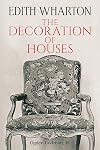
The Decoration of Houses
by Edith Wharton, Ogden Codman, Jr.
On This Page
Description
"This annotated edition of Edith Wharton's decorating guidebook includes a new comprehensive introduction, with relevant biographical information, and reproductions of the book's original illustrations"--Tags
Recommendations

























Member Reviews
How an Edwardian lady with an acid wit saw the houses of her own (wealthy) class and found them in very poor taste. Fun, although I'll never have to decorate a ballroom. Some of the rooms I saw in Europe make more sense now.
Originally written in 1902 by Edith Wharton and Ogden Codman, Jr. two renowned individuals during the gilded age, one an author with a serious interest in house decor and the other a known architect of the time, the book still stands on its own if you have an interest in architecture and house design. For the neophyte, you may find yourself looking up many terms (I most certainly did), but the overall ideas behind house design through the ages are fascinating if you have the interest.
Some takeaways: rooms require balance whether it be through the bric-a-brac, art or actually the architecture itself. For a long hallway with a door on one end, there should be an approximately same size piece of furniture on the other end to balance the show more flow. I discovered that I particularly like Islamic arabesques. show less
Some takeaways: rooms require balance whether it be through the bric-a-brac, art or actually the architecture itself. For a long hallway with a door on one end, there should be an approximately same size piece of furniture on the other end to balance the show more flow. I discovered that I particularly like Islamic arabesques. show less
long out of print classic, lovely pix. Wharton's writing is fun, interesting to see the stylistic differences compared with her novels. Sumptuous package in this new edition, with very good extra notes and other information.
Edith Wharton's The Decoration of Houses is an invaluable reference, one of the classic works on interior decoration, and a testament to the enduring style of one of America's greatest writers. Written in collaboration with celebrated American architect Ogden Codman, Jr., Wharton's first book is a comprehensive look at the history and character of turn-of-the-century interior design, moving from historical traditions to the distinctive styles of contemporary taste. Published in association with the Mount Press, this beautiful hardcover facsimile is carefully reproduced from the first edition published in 1897 and includes all 56 original plates-illustrating furniture, moldings, and interior styles of the 19th-century-and features show more décollage edges as well as a new introduction from renowned scholar Richard Guy Wilson. The Mount is a magnificent estate Edith Wharton designed and built in 1902 as a writer's retreat in the beautiful Berkshire Hills of western Massachusetts. show less
Delightful to look at, but who lives this way except the very rich ?
The seminal book by Wharton and Codman on design - their rules still hold in some respects
Ratings
Members
- Recently Added By
Author Information

378+ Works 63,746 Members
Edith Wharton was a woman of extreme contrasts; brought up to be a leisured aristocrat, she was also dedicated to her career as a writer. She wrote novels of manners about the old New York society from which she came, but her attitude was consistently critical. Her irony and her satiric touches, as well as her insight into human character, show more continue to appeal to readers today. As a child, Wharton found refuge from the demands of her mother's social world in her father's library and in making up stories. Her marriage at age 23 to Edward ("Teddy") Wharton seemed to confirm her place in the conventional role of wealthy society woman, but she became increasingly dissatisfied with the "mundanities" of her marriage and turned to writing, which drew her into an intellectual community and strengthened her sense of self. After publishing two collections of short stories, The Greater Inclination (1899) and Crucial Instances (1901), she wrote her first novel, The Valley of Decision (1902), a long, historical romance set in eighteenth-century Italy. Her next work, the immensely popular The House of Mirth (1905), was a scathing criticism of her own "frivolous" New York society and its capacity to destroy her heroine, the beautiful Lily Bart. As Wharton became more established as a successful writer, Teddy's mental health declined and their marriage deteriorated. In 1907 she left America altogether and settled in Paris, where she wrote some of her most memorable stories of harsh New England rural life---Ethan Frome (1911) and Summer (1917)---as well as The Reef (1912), which is set in France. All describe characters forced to make moral choices in which the rights of individuals are pitted against their responsibilities to others. She also completed her most biting satire, The Custom of the Country (1913), the story of Undine Spragg's climb, marriage by marriage, from a midwestern town to New York to a French chateau. During World War I, Wharton dedicated herself to the war effort and was honored by the French government for her work with Belgian refugees. After the war, the world Wharton had known was gone. Even her Pulitzer Prize-winning novel, The Age of Innocence (1920), a story set in old New York, could not recapture the former time. Although the new age welcomed her---Wharton was both a critical and popular success, honored by Yale University and elected to The National Institute of Arts and Letters---her later novels show her struggling to come to terms with a new era. In The Writing of Fiction (1925), Wharton acknowledged her debt to her friend Henry James, whose writings share with hers the descriptions of fine distinctions within a social class and the individual's burdens of making proper moral decisions. R.W.B. Lewis's biography of Wharton, published in 1975, along with a wealth of new biographical material, inspired an extensive reevaluation of Wharton. Feminist readings and reactions to them have focused renewed attention on her as a woman and as an artist. Although many of her books have recently been reprinted, there is still no complete collected edition of her work. (Bowker Author Biography) show less
1 Work 350 Members
Awards and Honors
Series
Belongs to Publisher Series
Common Knowledge
- Canonical title
- The Decoration of Houses
- Original publication date
- 1897
- People/Characters
- Edith Wharton
- Epigraph
- "Une forme doit être belle en elle-méme et on ne doit jamais compter sur le décor appliqué pour en sauver les imperfections.” Henri Mayeux: 'La composition décorative'.
- First words
- Rooms may be decorated in two ways: by a superficial application of ornament totally independent of structure, or by means of those architectural features which are part of the organism of every house, inside as well as out.
Classifications
- Genres
- Nonfiction, Home & Garden, Art & Design, General Nonfiction
- DDC/MDS
- 747 — Arts & recreation Drawing & decorative arts Interior design / Glassware / Furniture
- LCC
- NK2110 .W5 — Fine Arts 3600-(9990) Other arts and art industries Decorative arts Interior decoration. House decoration General. History, etc.
- BISAC
Statistics
- Members
- 350
- Popularity
- 89,985
- Reviews
- 6
- Rating
- (3.96)
- Languages
- English
- Media
- Paper, Audiobook, Ebook
- ISBNs
- 35
- UPCs
- 1
- ASINs
- 7