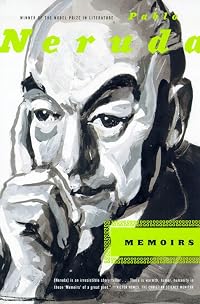
Memoirs
by Pablo Neruda
On This Page
Description
MEMOIRS is as full of Neruda's passionate, volatile and profoundly generous personality as lovers of his poetry would expect. Lorca, Vallejo, Picasso, Gandhi, Mao Tse-tung, Castro and Allende all appear here too, making Neruda's a life story of truly universal reach and significance, as well as the richest account we have of Latin American history, politics, art and literature.Tags
Recommendations









Member Recommendations

by anonymous user
Member Reviews
On the whole, I would recommend this book. I enjoyed this book until about halfway through when it started to get a bit tedious. The style was very poetic and the words he chooses are very rich and full of meaning - but he does get a bit carried away at points making the book longer than strictly necessary. I also really enjoyed the fact that he told his story (often) through the stories of others making the memoir take on varied viewpoints. I did think that at some point, he started to make some very sweeping statements that began to grate on my nerves and this is what made the book tedious. It always infuriates me when people make broad statements about the world when they haven't experienced the whole world.
Finished this a about a week ago. What a beautiful memoir. One of the refreshing aspects of it is that it's not totally linear account of Neruda's life, but more a chain of vignettes that seem to accidentally come in chronological order.
Neruda fue un testigo privilegiado de la historia del siglo xx y un poeta de muchas vidas, que se pasea por la amplitud del mundo, que transita entre la muchedumbre y la intimidad y que explora la naturaleza y el amor. Confieso que he vivido, su proyecto autobiográfico más ambicioso, recoge su rica experiencia vital. Con la potencia verbal que caracteriza sus mejores escritos, en estas memorias Neruda narra los principales episodios de su vida y las circunstancias que rodearon la creación de sus poemas y libros más famosos. De forma no menos brillante, rememora las figuras de algunos amigos: Alberti, Miguel Hernández, Éluard, Aragon y su relación con personajes destacados de la política contemporánea.
Pablo Neruda, pseudônimo de Ricardo Eliécer Neftalí Reyes Basoalto, nasceu a 12 de julho de 1904, em Parral, no Chile.
Ganhador do Prêmio Nobel de Literatura de 1971, sua poesia transpira, na primeira fase, o romantismo extremo de Walt Whitman. Depois vieram a experiência surrealista, influência de André Breton, e uma curta fase hermética.
Marxista e revolucionário, cantou as angústias da Espanha de 1936 e a condição dos povos latino-americanos e seus movimentos libertários. Diplomata desde jovem, foi cônsul na Birmânia (atual Mianmar), no Ceilão (atual Sri Lanka), em Cingapura, no México e na Espanha.
Com o passar dos anos, a participação política de Neruda foi cada vez maior e culminou com sua indicação à show more Presidência da República em 1969 - honra a que renunciou em favor de Salvador Allende. Participou da campanha da Unidade Popular que elegeu Allende no ano seguinte, quando Neruda foi nomeado embaixador do Chile na França.
Em Confesso que vivi, o poeta chileno Pablo Neruda narra desde as memórias de sua longínqua infância até o duro golpe que derrubou Salvador Allende do governo chileno. Através do apaixonante relato dos fatos mais interessantes de sua jornada, Neruda afirma que sua vida foi feita de todas as vidas: as vidas do poeta. Ele confessa: ""Do que deixei escrito nestas páginas se desprenderão sempre ― como nos arvoredos de outono e como no tempo das vinhas ― as folhas amarelas que vão morrer e as uvas que reviverão no vinho sagrado."" Seja na prosa, seja na poesia, a intensidade lírica do poeta contagia e nos arrebata com sua habilidade literária. show less
Ganhador do Prêmio Nobel de Literatura de 1971, sua poesia transpira, na primeira fase, o romantismo extremo de Walt Whitman. Depois vieram a experiência surrealista, influência de André Breton, e uma curta fase hermética.
Marxista e revolucionário, cantou as angústias da Espanha de 1936 e a condição dos povos latino-americanos e seus movimentos libertários. Diplomata desde jovem, foi cônsul na Birmânia (atual Mianmar), no Ceilão (atual Sri Lanka), em Cingapura, no México e na Espanha.
Com o passar dos anos, a participação política de Neruda foi cada vez maior e culminou com sua indicação à show more Presidência da República em 1969 - honra a que renunciou em favor de Salvador Allende. Participou da campanha da Unidade Popular que elegeu Allende no ano seguinte, quando Neruda foi nomeado embaixador do Chile na França.
Em Confesso que vivi, o poeta chileno Pablo Neruda narra desde as memórias de sua longínqua infância até o duro golpe que derrubou Salvador Allende do governo chileno. Através do apaixonante relato dos fatos mais interessantes de sua jornada, Neruda afirma que sua vida foi feita de todas as vidas: as vidas do poeta. Ele confessa: ""Do que deixei escrito nestas páginas se desprenderão sempre ― como nos arvoredos de outono e como no tempo das vinhas ― as folhas amarelas que vão morrer e as uvas que reviverão no vinho sagrado."" Seja na prosa, seja na poesia, a intensidade lírica do poeta contagia e nos arrebata com sua habilidade literária. show less
[from Book Depository]
The classic and deeply moving memoir by Pablo Neruda, the most widely read political poet of our time and winner of the Nobel Prize The south of Chile was a frontier wilderness when Pablo Neruda was born in 1904. In these memoirs he retraces his bohemian student years in Santiago; his sojourns as Chilean consul in Burma, Ceylon, and Java, in Spain during the civil war, and in Mexico; and his service as a Chilean senator. Neruda, a Communist, was driven from his senate seat in 1948, and a warrant was issued for his arrest. After a year in hiding, he escaped on horseback over the Andes and then to Europe; his travels took him to Russia, Eastern Europe, and China before he was finally able to return home in 1952. The show more final section of the memoirs was written after the coup in 1972 that overthrew Neruda's friend Salvador Allende. Many of the century's most important literary and artistic figures were Neruda's friends, and figure in his memoirs--Garcia Lorca, Aragon, Picasso, and Rivera, among them--and also such political leaders as Gandhi, Nehru, Mao, Castro, and Che Guevara. In his uniquely expressive prose, Neruda not only explains his views on poetry and describes the circumstances that inspired many of his poems, but he creates a revealing record of his life as a poet, a patriot, and one of the twentieth century's true men of conscience. show less
The classic and deeply moving memoir by Pablo Neruda, the most widely read political poet of our time and winner of the Nobel Prize The south of Chile was a frontier wilderness when Pablo Neruda was born in 1904. In these memoirs he retraces his bohemian student years in Santiago; his sojourns as Chilean consul in Burma, Ceylon, and Java, in Spain during the civil war, and in Mexico; and his service as a Chilean senator. Neruda, a Communist, was driven from his senate seat in 1948, and a warrant was issued for his arrest. After a year in hiding, he escaped on horseback over the Andes and then to Europe; his travels took him to Russia, Eastern Europe, and China before he was finally able to return home in 1952. The show more final section of the memoirs was written after the coup in 1972 that overthrew Neruda's friend Salvador Allende. Many of the century's most important literary and artistic figures were Neruda's friends, and figure in his memoirs--Garcia Lorca, Aragon, Picasso, and Rivera, among them--and also such political leaders as Gandhi, Nehru, Mao, Castro, and Che Guevara. In his uniquely expressive prose, Neruda not only explains his views on poetry and describes the circumstances that inspired many of his poems, but he creates a revealing record of his life as a poet, a patriot, and one of the twentieth century's true men of conscience. show less
9872060991
Members
- Recently Added By
Lists

501 Must-Read Books
529 works; 72 members

Latin American Literature
50 works; 11 members
Author Information

656+ Works 26,047 Members
Pablo Neruda was born Ricardo Eliecer Neftalí Reyes Basoalto in Ferral, Chile on July 12, 1904. In 1923 he sold all of his possessions to finance the publication of his first book, Crepusculario (Twilight), which he published under the pseudonym Pablo Neruda. Veinte Poemas de Amor y una Cancion Desesperada (Twenty Love Poems and a Song of show more Despair), which was published the following year, made him a celebrity and allowed him to stop his studies to devote himself to poetry. His other works include España en el Corazón, Canto General, Las Uvas y el Viento, and Para Nacer He Nacido. He received numerous awards including the World Peace Prize with Paul Robeson and Pablo Picasso in 1950, the Lenin Peace Prize and the Stalin Peace Prize in 1953, and the Nobel Prize for Literature for his poetry in 1971. He died of leukemia on September 23, 1973. (Bowker Author Biography) show less
Some Editions
Awards and Honors
Series
Belongs to Publisher Series
Work Relationships
Common Knowledge
- Canonical title
- Memoirs
- Original title
- Confieso Que He Vivido
- Alternate titles
- I Confess That I Lived
- Original publication date
- 1974
- People/Characters
- Pablo Neruda
- Important places
- Santiago, Chile
- Quotations*
- Mi pueblo ha sido el más traicionado de este tiempo.
Chile tiene una larga historia civil con pocas revoluciones y muchos gobiernos estables, conservadores y mediocres. Muchos presidentes chicos y sólo dos presidentes grandes: Balmaceda y Allende (...) Balmaceda fue llevado al... (show all) suicidio por resistirse a entregar la riqueza salitrera a las compañías extranjeras. Allende fue asesinado por haber nacionalizado la otra riqueza del subsuelo chileno, el cobre. - Original language
- Spanish
- Canonical DDC/MDS
- 868.9933
*Some information comes from Common Knowledge in other languages. Click "Edit" for more information.
Classifications
- Genre
- Biography & Memoir
- DDC/MDS
- 868.9933 — Literature & rhetoric Spanish Literature Spanish miscellaneous writings Spanish language literature outside of Spain Hispanic South America Chile
- LCC
- PQ8097 .N4 .Z52313 — Language and Literature French, Italian, Spanish and Portuguese literatures Spanish literature Provincial, local, colonial, etc. Spanish America
- BISAC
Statistics
- Members
- 1,602
- Popularity
- 14,252
- Reviews
- 14
- Rating
- (4.11)
- Languages
- 17 — Chinese, Danish, Dutch, English, Finnish, French, German, Hungarian, Italian, Japanese, Norwegian (Bokmål), Polish, Portuguese, Russian, Spanish, Swedish, Turkish
- Media
- Paper, Ebook
- ISBNs
- 96
- ASINs
- 35