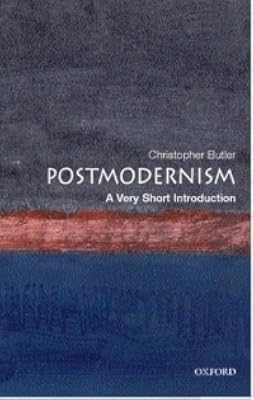
Postmodernism: A Very Short Introduction
by Christopher Butler
On This Page
Description
This introduction unravels the mysteries of the concept of postmodernism, casting a critical light upon the way we live now, from the politicizing of museum culture to the cult of the politically correct.Tags
Recommendations




Member Reviews
Starts out as a critique, and inserts the "introduction" part towards the middle, then goes back to talking about how useless and silly it all is. While attempting to be informative, the author also ends up sounding whiny, not to mention that he spends a lot of time on Foucault (more than half of it enumerating his and Derrida's flaws) without discussing the differences between postmodernism and poststructuralism.
Take this for an example of the author lashing out: "Postmodernists are by and large pessimists, many of them haunted by lost Marxist revolutionary hopes, and the beliefs and the art they inspire are often negative rather than constructive." This statement is presented as irrefutable fact, despite being highly flawed and show more incomplete.
This "very short" introduction could have been shorter without all the complaining, which I think makes this book a hard sell, or maybe an irresponsible and mostly one-sided one, if it is truly meant to be an introduction. show less
Take this for an example of the author lashing out: "Postmodernists are by and large pessimists, many of them haunted by lost Marxist revolutionary hopes, and the beliefs and the art they inspire are often negative rather than constructive." This statement is presented as irrefutable fact, despite being highly flawed and show more incomplete.
This "very short" introduction could have been shorter without all the complaining, which I think makes this book a hard sell, or maybe an irresponsible and mostly one-sided one, if it is truly meant to be an introduction. show less
I like to think I am a fan of post-modern literature, but ask me to explain it, I will have a hard time. Post-modernism is often referred to when talking about art, films, architecture, music and literature but what does it actually mean? I picked up Postmodernism: A Very Short Introduction in the hopes of understand it a little more but I still do not think I can explain it. For me, I view post-modernism, as a reaction to modernism which seemed to reject past thinking in favour of innovations like stream-of-consciousness. Post-modernism still found value in the past techniques and theories and found interesting ways to use them in new and exciting ways. Post-modernism wanted to invoke thought and criticism; within its literature you show more might find something bizarre or weird that you just need to talk about.
I know my view on the topic is very broad and it is far more complex but that is what I love about post-modern literature. I want books that force me to think critically about what I am reading and post-modernism forces you to do just that. In Postmodernism: A Very Short Introduction, Christopher Butler tries to equip us with the basic ideas behind post-modernism to allow us to recognise and understand the theories more easily. This is still a very complex movement but I am starting to understand why I love it. This is a good starting point, if you are actually interested in the critical thinking side of this movement. show less
I know my view on the topic is very broad and it is far more complex but that is what I love about post-modern literature. I want books that force me to think critically about what I am reading and post-modernism forces you to do just that. In Postmodernism: A Very Short Introduction, Christopher Butler tries to equip us with the basic ideas behind post-modernism to allow us to recognise and understand the theories more easily. This is still a very complex movement but I am starting to understand why I love it. This is a good starting point, if you are actually interested in the critical thinking side of this movement. show less
A good introduction. I think I kept my head above water for most of the book. Unfortunately most of the examples of postmodernism in action were from novels and artworks I was not familiar with so I struggled a bit with that chapter.
Postmodernism can be a difficult topic, but this Introduction provides clarity of vision for a subject of muddled origin and meaning. Butler certainly makes value judgments, it is not a NPOV wikipedia article thank goodness; he takes a position in what is ultimately a political movement, but provides multiple POVs. Short but some pages can take a long time to digest, its a "slow read", pithy but never banal.
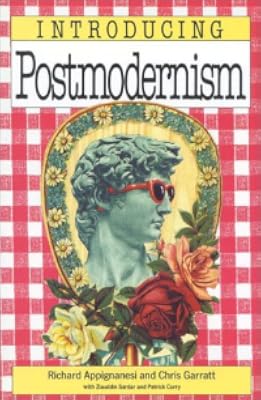
My recent reading of Bram Presser’s The Book of Dirt was a reminder of how much literature has changed in the years since I first began reading adult literature. I can’t think of anything that I read from my parents’ bookshelves that was a blend of fiction and non-fiction, nor can I ever remember then discussing the idea of truth in books being a relative concept. Books were unambiguously fiction or NF, and librarians did not have to struggle with which section of the shelves to put it in. Yet now, after almost a decade of blogging my reading here at ANZ LitLovers, I have become used to, and comfortable with, all kinds of what I now recognise as postmodernist aspects of literature. So although I’ve dabbled in Postmodernism show more before, now seems like a good time to investigate Christopher Butler’s Postmodernism, a Very Short Introduction and also Introducing Postmodernism, a Graphic Guide by Richard Appignanesi and Chris Garratt.
Starting with Christopher Butler’s VSI (because I’ve read his Modernism before and found it illuminating) I see that the chapters are:
The rise of postmodernism
New ways of seeing the world
Politics and identity
The culture of postmodernism
The ‘postmodern condition’.
Chapter 1 begins by talking about the hostile reception to postmodernist art, specifically Carl Andre’s Equivalent VIII (1966). Searching for an image of it, I found a contemporary example of the 1966 reaction – with which I have some sympathy, when it comes to the visual arts. Butler acknowledges this:
To read the rest of my review please visit https://anzlitlovers.com/2017/11/23/postmodernism-a-very-short-introduction-by-c... show less
Starting with Christopher Butler’s VSI (because I’ve read his Modernism before and found it illuminating) I see that the chapters are:
The rise of postmodernism
New ways of seeing the world
Politics and identity
The culture of postmodernism
The ‘postmodern condition’.
Chapter 1 begins by talking about the hostile reception to postmodernist art, specifically Carl Andre’s Equivalent VIII (1966). Searching for an image of it, I found a contemporary example of the 1966 reaction – with which I have some sympathy, when it comes to the visual arts. Butler acknowledges this:
Now enshrined in the Tate Modern, it doesn’t resemble much in the canon of modernist sculpture. It is not formally complex or expressive, or particularly engaging to look at, indeed it can soon be boring. It is easy to repeat. Lacking any features to sustain interest in itself (except perhaps to Pythagorean number mystics) it inspires us to ask questions about its context rather than its content: ‘What is the point of this?’ or ‘Why is this displayed in a museum?’ Some theory about the work has to be brought in to fill the vacuum of interest, and this is also fairly typical. It might inspire the question, ‘Is it really art, or just a pile of bricks pretending to be art?’ But this is not a question that makes much sense in the postmodern era, in which it seems to be generally accepted that it is the institution of the gallery, rather than anything else, which has made it, de facto, a ‘work of art’. The visual arts are just what museum curators show us, from Picasso to sliced -up cows, and it is up to us to keep up with the ideas surrounding these works. (p.1)
To read the rest of my review please visit https://anzlitlovers.com/2017/11/23/postmodernism-a-very-short-introduction-by-c... show less
The most understandable explaination of postmodernism, including a critique of its short comings, that I have encountered. Includes all artistic mediums, including art, literature, architecture, and music.
Good introduction to the topic. I really like these Very Short Introductions.
Members
- Recently Added By
Author Information

9+ Works 1,169 Members
Christopher Butler is Professor of English Language and Literature at the University of Oxford and Student of Christ Church
Series
Belongs to Publisher Series
Common Knowledge
- Canonical title
- Postmodernism: A Very Short Introduction
- Original title
- Postmodernism: A Very Short Introduction
- Alternate titles
- Postmodernism
- Original publication date
- 2002
- First words
- Carl Andre's rectangular pile of bricks, Equivalent VIII (1966), annoyed lots of people when shown at the Tate Gallery, London, in 1976.
- Last words
- (Click to show. Warning: May contain spoilers.)It is this underlying deep dialectic — between reason and scepticism, reality and the image, the political powers of inclusion and exclusion — which is central to postmodernist thought, and it is a dialectic that will continue to engage us for some time to come.
- Original language
- English
- Disambiguation notice
- This is not the same book as Postmodernism by Andrew M. Butler -- please do not recombine them!
Classifications
- Genres
- Nonfiction, Literature Studies and Criticism, Philosophy, Art & Design, General Nonfiction
- DDC/MDS
- 700.4113 — Arts & recreation Arts Arts & Recreation Special topics in the arts Arts displaying specific qualities of style, mood, viewpoint Nontraditional viewpoints
- LCC
- NX456.5 .P66 .B88 — Fine Arts Arts in general Arts in general History of the arts
- BISAC
Statistics
- Members
- 891
- Popularity
- 30,441
- Reviews
- 8
- Rating
- (3.39)
- Languages
- Chinese, Dutch, English
- Media
- Paper, Audiobook, Ebook
- ISBNs
- 11
- ASINs
- 7