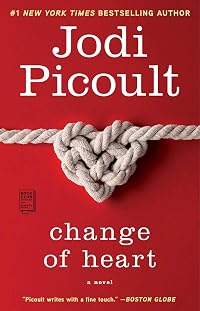
Change of Heart
by Jodi Picoult
On This Page
Description
One moment June Nealon was happily looking forward to years full of laughter and adventure with her family, and the next, she was staring into a future that was as empty as her heart. Now her life is a waiting game. Waiting for time to heal her wounds, waiting for justice. In short, waiting for a miracle to happen. For Shay Bourne, life holds no more surprises. The world has given him nothing, and he has nothing to offer the world. In a heartbeat, though, something happens that changes show more everything for him. Now, he has one last chance for salvation, and it lies with June's eleven-year-old daughter, Claire. But between Shay and Claire stretches an ocean of bitter regrets, past crimes, and the rage of a mother who has lost her child.--From publisher description. show lessTags
Recommendations






























Member Recommendations

Member Reviews
Jodi Picoult has once again tackled a moral dilemma. Up for debate this time is whether the mother of a girl in need of a heart transplant should accept the heart of the man who will be executed for the murder of her husband and older daughter. And if Picoult had stuck to one dilemma, this might have been a better book. Instead, the book is complicated by Green Mile-like questions of whether the condemned man had the power to perform miracles and a Dead Man Walking-like last-hour relationship between the death row inmate and a priest.
In typical Picoult fashion, there is no clear right and wrong in this story. Shay Bourne, the convicted man, does not really contest his conviction, or his sentence. He simply insists that he must be show more allowed to donate his heart afterward, despite the fact that being executed by lethal injection would make this impossible. Enter an ACLU lawyer, with issues of her own, who's determined to get Bourne executed in a way that would allow for his heart to be taken, and, by so doing, turn a spotlight on the inhumanity of the death penalty.
Her argument is that Bourne's religion requires that he be allowed to donate his heart in order for him to find salvation. Here is where the issue of his "miracles" come in. When he supposedly makes wine flow from the taps in the prison, divides a single piece of gum among 7 men, and heals the prisoner in the next cell who is dying of AIDS, word leaks out and people flock to the prison gates, proclaiming the Second Coming. Naturally, there are an equal number on the other side who think he's a fraud or even the devil. Whatever the truth of the matter is, and we're left wondering, Maggie Bloom, the ACLU lawyer, uses these "miracles" and some of Bourne's own words to try to convince the court that he belongs to a religion, even if he's the only member of it, that requires organ donation as necessary to salvation. And here I have to give Picoult credit: what other popular author manages to work the Religious Land Use and Institutionalized Persons Act (RLUIPA) into a novel?!
Although well written as all of Picoult's books are, the multiple threads and questions keep this one from being as good as it ought to have been. Hopefully, in her next book she will go back to presenting us with a with just one moral dilemma, as she has done so well so many times before. show less
In typical Picoult fashion, there is no clear right and wrong in this story. Shay Bourne, the convicted man, does not really contest his conviction, or his sentence. He simply insists that he must be show more allowed to donate his heart afterward, despite the fact that being executed by lethal injection would make this impossible. Enter an ACLU lawyer, with issues of her own, who's determined to get Bourne executed in a way that would allow for his heart to be taken, and, by so doing, turn a spotlight on the inhumanity of the death penalty.
Her argument is that Bourne's religion requires that he be allowed to donate his heart in order for him to find salvation. Here is where the issue of his "miracles" come in. When he supposedly makes wine flow from the taps in the prison, divides a single piece of gum among 7 men, and heals the prisoner in the next cell who is dying of AIDS, word leaks out and people flock to the prison gates, proclaiming the Second Coming. Naturally, there are an equal number on the other side who think he's a fraud or even the devil. Whatever the truth of the matter is, and we're left wondering, Maggie Bloom, the ACLU lawyer, uses these "miracles" and some of Bourne's own words to try to convince the court that he belongs to a religion, even if he's the only member of it, that requires organ donation as necessary to salvation. And here I have to give Picoult credit: what other popular author manages to work the Religious Land Use and Institutionalized Persons Act (RLUIPA) into a novel?!
Although well written as all of Picoult's books are, the multiple threads and questions keep this one from being as good as it ought to have been. Hopefully, in her next book she will go back to presenting us with a with just one moral dilemma, as she has done so well so many times before. show less
La storia sembra un'epopea della sfiga che non ha mai fine: June sopravvive miracolosamente con la figlia di due anni all'incidente automobilistico che le porta via il marito, grande amore della sua vita. Qualche anno dopo, sposa Kurt, agente di polizia intervenuto sul luogo della disgrazia che nel tempo è sempre rimasto in contatto, per diventare poi amico e infine marito. Incinta di sette mesi della secondogenita, June trova il marito e la figlia maggiore uccisi dal falegname che stava sistemando la stanza del nascituro.
Non finisce qui: alla piccola Claire, alle elementari, viene diagnosticato un problema cardiaco, curabile solo con un trapianto.
La storia viene narrata dai suoi stessi protagonisti: June sullo sfondo dà voce al show more proprio dolore. Lucius, vicino di cella dell'omicida Shay, condannato a morte per il duplice omicidio. Michael, sacerdote che si prende la responsabilità di seguire il condannato nei suoi ultimi mesi di vita. Maggie, giovane avvocato, che decide di assistere Shay affinché venga ucciso in modo tale che possa donare il proprio cuore - cosa impossibile se la sentenza venisse eseguita tramite iniezione letale.
Per chi conosce già la Picoult, è facile immaginare che nulla è ciò che sembra: la verità si intuisce un po' alla volta, e finché non viene detta a chiare lettere si preferirebbe convincersi di aver interpretato male. Invece il dolore non ha mai fine, anche se le ultime pagine lasciano intravedere una speranza.
Storia toccante e profonda, che tiene incollati fino all'ultima riga. show less
Non finisce qui: alla piccola Claire, alle elementari, viene diagnosticato un problema cardiaco, curabile solo con un trapianto.
La storia viene narrata dai suoi stessi protagonisti: June sullo sfondo dà voce al show more proprio dolore. Lucius, vicino di cella dell'omicida Shay, condannato a morte per il duplice omicidio. Michael, sacerdote che si prende la responsabilità di seguire il condannato nei suoi ultimi mesi di vita. Maggie, giovane avvocato, che decide di assistere Shay affinché venga ucciso in modo tale che possa donare il proprio cuore - cosa impossibile se la sentenza venisse eseguita tramite iniezione letale.
Per chi conosce già la Picoult, è facile immaginare che nulla è ciò che sembra: la verità si intuisce un po' alla volta, e finché non viene detta a chiare lettere si preferirebbe convincersi di aver interpretato male. Invece il dolore non ha mai fine, anche se le ultime pagine lasciano intravedere una speranza.
Storia toccante e profonda, che tiene incollati fino all'ultima riga. show less
This read was quite a ride. I LOVED it, but at the end decided I "really liked" it. I cried, I yelled, I had to put the book down and think, rehash, debate, predict and argue with my poor mother who had read the book first but was unable to respond fully due to the fact that I hadn't finished it yet. The multiple meanings of "Change of Heart" (both literal and figurative) was impressive and enjoyable to decipher...I do so enjoy her writing.
I learned about the Gnostics for the first time, which is something I take away from this book, and I spent many an hour contemplating what Shay may truly represent. But of course, I was blown away by the ending (as I usually am with Piccoult novels) but with this surprise ending, I really didn't show more know what was true---but wasn't this the point? I guess I didn't enjoy the not knowing at end, but like I said, I do see the point of that. I have more questions than answers.... Bravo, Piccoult.
I feel that I really need a discussion group for this one. show less
I learned about the Gnostics for the first time, which is something I take away from this book, and I spent many an hour contemplating what Shay may truly represent. But of course, I was blown away by the ending (as I usually am with Piccoult novels) but with this surprise ending, I really didn't show more know what was true---but wasn't this the point? I guess I didn't enjoy the not knowing at end, but like I said, I do see the point of that. I have more questions than answers.... Bravo, Piccoult.
I feel that I really need a discussion group for this one. show less
This is the fourth Jodi Picoult novel I've read and they all follow pretty much the same formula : A vunerable child/teenager. Loving parents/parent. Concerned professionals i.e. cops, doctors, lawyer,and or teachers. And a kind stranger.
And while Jodi uses a basic formula, her novels are anything but simple or predictable. The other novels I've read have covered stem cell research, teenage date rape, and school shootings.
What makes me such a fan of Jodi's novels is that rather than use an omnipotent narrator, her stories are told from the point of view of the various characters. There's always two sides to any given story, and by using this method of story telling, the reader receives compelling and personal arguments from both sides show more of an issue. Most people would never think of taking the side of an accused rapist, a school shooter, or a cop killer, but Jodi's characters are so fairly drawn, that's exactly what happens.
Change of Heart involves many current and important issues. It's core issue is the validity of religion in modern day society. Another theme is the use of capital punishment. And in that vein, the rights of prison inmates are also thoroughly discussed.
Some of the main characters includes Maggie an atheist lawyer who begins to find God. Mike a priest who begins to question his faith. And June who goes through quite a number of Changes of Heart.
Because Shay, a man on trial for his life, is a keeper of many secrets, and as these secrets are slowly revealed, June and the other characters, are taken on many emmmotional roller coaster rides. As a consequence, we the reader get taken along on that same ride. What more could a reader ask for ?
Oh yeah, we can ask a novelist to make as laugh. And boy did I laugh, while reading the passage where a prison inmate named his pet robin, get this, Batman the Robin !
Funny, informative, and emmotional. Just a few of the reason why I love Jodi Piccoult. show less
And while Jodi uses a basic formula, her novels are anything but simple or predictable. The other novels I've read have covered stem cell research, teenage date rape, and school shootings.
What makes me such a fan of Jodi's novels is that rather than use an omnipotent narrator, her stories are told from the point of view of the various characters. There's always two sides to any given story, and by using this method of story telling, the reader receives compelling and personal arguments from both sides show more of an issue. Most people would never think of taking the side of an accused rapist, a school shooter, or a cop killer, but Jodi's characters are so fairly drawn, that's exactly what happens.
Change of Heart involves many current and important issues. It's core issue is the validity of religion in modern day society. Another theme is the use of capital punishment. And in that vein, the rights of prison inmates are also thoroughly discussed.
Some of the main characters includes Maggie an atheist lawyer who begins to find God. Mike a priest who begins to question his faith. And June who goes through quite a number of Changes of Heart.
Because Shay, a man on trial for his life, is a keeper of many secrets, and as these secrets are slowly revealed, June and the other characters, are taken on many emmmotional roller coaster rides. As a consequence, we the reader get taken along on that same ride. What more could a reader ask for ?
Oh yeah, we can ask a novelist to make as laugh. And boy did I laugh, while reading the passage where a prison inmate named his pet robin, get this, Batman the Robin !
Funny, informative, and emmotional. Just a few of the reason why I love Jodi Piccoult. show less
The opening words of the book are, "In the beginning, I believed in second chances." That sets the ominous tone for the rest of the book. Will she believe in second chances in the end? This book centers around religion and explores issues related to forgiveness and social issues surrounding capitol punishment. As is usual for Picoult, she has contrived a plot filled with moral and social dilemmas of an extreme nature. Then she has populated the story with an interesting cast of characters and proceeds to pull on every imaginable emotional string. The cast of characters includes a broad spectrum of religious beliefs, and it seems that they're all having a crisis of faith, including the atheist!
Picoult is a master at articulating strong show more personal emotions by writing first person narratives from multiple characters. It is a format that gives rise to interior monologues filled with thought provoking aphorisms. They're the sort of thing that can cause the reader to stop and ponder, and then when the book is finished, ponder again. The following quote is an example of one such aphorism:
"... in order to forgive, you have to remember how you were hurt in the first place. And that in order to forget, you had to accept your role in what had happened."
The above quotation means one thing when mentioned early in the book. It means something different by the end of the book.
The story has many references to the non-canonical Gospel of Thomas, and seems to suggest that gospel contains the foundation for current new age religion. The book sort of follows in the spirit of the "Da Vinci Code" by suggesting that the Roman Catholic Church suppressed the true Christian religion by banning the non-orthodox writings. In general the book is sufficiently balanced for most people to enjoy the story without being too offended by its treatment of religion. However, some may object to the story's portrayal of an individual in the story who shows signs of possibly being the second incarnation of Jesus. But it does raise the question, if Jesus did return as a simple human, would we be able to recognize him (or her)? show less
Picoult is a master at articulating strong show more personal emotions by writing first person narratives from multiple characters. It is a format that gives rise to interior monologues filled with thought provoking aphorisms. They're the sort of thing that can cause the reader to stop and ponder, and then when the book is finished, ponder again. The following quote is an example of one such aphorism:
"... in order to forgive, you have to remember how you were hurt in the first place. And that in order to forget, you had to accept your role in what had happened."
The above quotation means one thing when mentioned early in the book. It means something different by the end of the book.
The story has many references to the non-canonical Gospel of Thomas, and seems to suggest that gospel contains the foundation for current new age religion. The book sort of follows in the spirit of the "Da Vinci Code" by suggesting that the Roman Catholic Church suppressed the true Christian religion by banning the non-orthodox writings. In general the book is sufficiently balanced for most people to enjoy the story without being too offended by its treatment of religion. However, some may object to the story's portrayal of an individual in the story who shows signs of possibly being the second incarnation of Jesus. But it does raise the question, if Jesus did return as a simple human, would we be able to recognize him (or her)? show less
Jodi Picoult never runs away from difficult subjects and this time my own confusion reached new depth. My grandmother was Catholic. We never talked about religion but I wish we had. After her divorce, she never returned to the Church. But she went on a search for a religion instead. When she passed. I inherited a small library of religious texts including the Koran and A Book of the Lost Books of the Bible. That book concentrated on the books that were left out of the Old Testament.
I was surprised to learn there were more books called the Gnostic Gospels that not accepted for the New Testament. Quotes from them in this book left me even more confused than ever!
The main characters were Shay Bourne, June, Michael, Lucius and Maggie. The show more story is narrated through all of them except Shay Bourne, the accu sed murderer of June's second husband and her daughter. I identified most with Maggie, the ACLU attorney who was terrified of her weight and loved to read and argue. June had lost her daughter and second husband but found herself pregnant with her second daughter. Her second daughter desparately needed a heart transplant. Michael, the priest was tormented by a secret. Lucius was one of the miracles that Shay Bourne was credited by his fellow inmates.
But it was Maggie who I loved. For me, this book was difficult when it delved deep into the Gnostic Gospels but I had Maggie who cared a lot about people, had a poor self image but she made me comfortable in this book. show less
I was surprised to learn there were more books called the Gnostic Gospels that not accepted for the New Testament. Quotes from them in this book left me even more confused than ever!
The main characters were Shay Bourne, June, Michael, Lucius and Maggie. The show more story is narrated through all of them except Shay Bourne, the accu sed murderer of June's second husband and her daughter. I identified most with Maggie, the ACLU attorney who was terrified of her weight and loved to read and argue. June had lost her daughter and second husband but found herself pregnant with her second daughter. Her second daughter desparately needed a heart transplant. Michael, the priest was tormented by a secret. Lucius was one of the miracles that Shay Bourne was credited by his fellow inmates.
But it was Maggie who I loved. For me, this book was difficult when it delved deep into the Gnostic Gospels but I had Maggie who cared a lot about people, had a poor self image but she made me comfortable in this book. show less
Shay is hired as a handyman around June’s house. When she comes home one day to find her young daughter and her husband murdered, Shay is charged, found guilty, and is the first person to be put on death row in the state in decades. In prison, it is noticed that he seems to be able to “do” things, magical sorts of things. He would also like to make amends the only way he can think of and donate his heart to June’s other daughter, who is in need of a transplant. Lawyer Maggie comes in to try to help grant Shay his wish, while priest Michael (who has a secret of his own in regards to Shay), comes in to counsel Shay.
There is a lot going on in this book, primarily religion and the death penalty. The story is told from four different show more points of view: June, Michael, Maggie and another prisoner, Lucius. I’m not religious myself, but did find some of the religion “debates” interesting; these mostly focused on the Gnostic Gospels, which I’d heard of, but didn’t know anything about. The “magic” portions reminded me a bit of “The Green Mile”, and in fact, one of the prisoners at one point nicknamed Shay “Green Mile”, which I did think was kind of a fun way to address that (not that it needed to be addressed, but…). At the same time, these events made the book less realistic for me. I still quite enjoyed it, though. show less
There is a lot going on in this book, primarily religion and the death penalty. The story is told from four different show more points of view: June, Michael, Maggie and another prisoner, Lucius. I’m not religious myself, but did find some of the religion “debates” interesting; these mostly focused on the Gnostic Gospels, which I’d heard of, but didn’t know anything about. The “magic” portions reminded me a bit of “The Green Mile”, and in fact, one of the prisoners at one point nicknamed Shay “Green Mile”, which I did think was kind of a fun way to address that (not that it needed to be addressed, but…). At the same time, these events made the book less realistic for me. I still quite enjoyed it, though. show less
Members
- Recently Added By
Lists

Books That Made Me Cry
199 works; 105 members

Books Read in 2009
464 works; 11 members

Books About Murder
313 works; 7 members

Books Tagged Abuse
152 works; 4 members

Books With Body Parts in the Title
153 works; 9 members
Author Information

116+ Works 146,686 Members
Jodi Picoult was born in Nesconset, New York on May 19, 1966. She received a degree in creative writing from Princeton University in 1987 and a master's degree in education from Harvard University. She published two short stories in Seventeen magazine while still in college. Immediately after graduation, she landed a variety of jobs, ranging from show more editing textbooks to teaching eighth-grade English. Her first book, Songs of the Humpback Whale, was published in 1992. Her other works include Picture Perfect, Mercy, The Pact, Salem Falls, The Tenth Circle, Nineteen Minutes, Change of Heart, Handle with Care, House Rules, Sing You Home, Lone Wolf, Leaving Time, and Small Great Things. My Sister's Keeper was made into a movie starring Cameron Diaz. She received the New England Bookseller Award for fiction in 2003. She also wrote five issues of the Wonder Woman comic book series for DC Comics. She writes young adult novels with her daughter Samantha van Leer including Between the Lines and Off the Page. (Bowker Author Biography) show less
Some Editions
Awards and Honors
Work Relationships
Common Knowledge
- Canonical title
- Change of Heart
- Original title
- Change of Heart
- Original publication date
- 2008
- People/Characters
- Shay Bourne; June Nealon; Claire Nealon; Maggie Bloom; Father Michael; Dr. Wu (show all 16); Lucius DuFrense; Dr. Christian Gallagher; Ian Fletcher; Reverend Justus; Rabbi Bloom; Warden Coyne; Elizabeth Nealon; Kurt Nealon; Mariah Fletcher; Faith White
- Important places
- New Hampshire, USA
- Epigraph
- Alice laughed. "There's no use trying," she said. "One can't believe impossible things."
"I dare say you haven't had as much practice," said the Queen. "When I was your age I did it for half an hour a day. Why sometimes I'... (show all)ve believed as many as six impossible things before breakfast."
- Lewis Carroll, Through the Looking-Glass - Dedication
- With love, and too much admiration to fit on these pages
To my grandfather, Hal Friend, who has always been brave enough to question what we believe...
And to my grandmother, Bess Friend, who has never stopped belie... (show all)ving in me. - First words
- In the beginning, I believed in second chances.
- Last words
- (Click to show. Warning: May contain spoilers.)His heart starts beating again, beneath my own two hands.
Classifications
Statistics
- Members
- 5,466
- Popularity
- 2,454
- Reviews
- 165
- Rating
- (3.76)
- Languages
- 7 — Chinese, Dutch, English, German, Hungarian, Italian, Swedish
- Media
- Paper, Audiobook, Ebook
- ISBNs
- 62
- ASINs
- 15