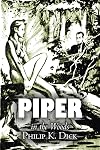
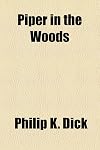
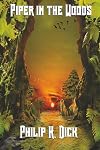
Piper in the Woods
by Philip K. Dick
On This Page
Description
Under extreme duress, the human mind can come up with an array of impossibly complex coping mechanisms. Is that what's behind the strange epidemic that army physician Henry Harris has noticed overtaking soldiers who have returned from the distant celestial body known as Asteroid Y-3? Harris makes a trip to the asteroid to figure things out—and seems to fall prey to the 'delusion' himself. Fans of Philip K. Dick's unique brand of suspenseful science fiction will love this twisted tale..
Tags
Recommendations




Member Reviews
This is oh-so-nearly got the full five stars but the end is too predictable and the simple theme of humans discovering the joys of getting out of the human rat race required something unpredictable to make it more than a bit of pre-hippy didacticism.
However, it is a very fine science fiction story, one of Dick's earliest from 1953. It is witty, compassionate and even, at one point, gently erotic. The image of twenty spaceniks sitting motionless thinking they are plants by a river bank is one to treasure.
The cleverness of the tale lies in Dick making his rat-race rather likeable - ambitious young people, cared for and not bullied, doing good work to protect the people of earth from potential viral and bacterial dangers in space. They show more have no just cause for opting out except their own choice.
The story starts with a young corporal insisting that he is a plant, not like a plant but a plant, despite remaining biologically human. It turns out that he is a victim of subtle suggestion emanating from the woods of an idyllic asteroid (this is 1950s science!).
The story of how this is discovered and what it may mean is an excuse for a bit of rebellion from the author about corporate conformism and ambition, not entirely convincing perhaps but a nice and early corrective to the standard post-war scifi view of what humans were for.
I referred to it as (mildly) didactic and so it is in its core message - basically, there is another way of living than the one we are told to live - but the didacticism is so nicely masked with wry charm that we only notice it when we think about it. A rather lovely little story in its way. show less
However, it is a very fine science fiction story, one of Dick's earliest from 1953. It is witty, compassionate and even, at one point, gently erotic. The image of twenty spaceniks sitting motionless thinking they are plants by a river bank is one to treasure.
The cleverness of the tale lies in Dick making his rat-race rather likeable - ambitious young people, cared for and not bullied, doing good work to protect the people of earth from potential viral and bacterial dangers in space. They show more have no just cause for opting out except their own choice.
The story starts with a young corporal insisting that he is a plant, not like a plant but a plant, despite remaining biologically human. It turns out that he is a victim of subtle suggestion emanating from the woods of an idyllic asteroid (this is 1950s science!).
The story of how this is discovered and what it may mean is an excuse for a bit of rebellion from the author about corporate conformism and ambition, not entirely convincing perhaps but a nice and early corrective to the standard post-war scifi view of what humans were for.
I referred to it as (mildly) didactic and so it is in its core message - basically, there is another way of living than the one we are told to live - but the didacticism is so nicely masked with wry charm that we only notice it when we think about it. A rather lovely little story in its way. show less
A ridiculous idea with some stunningly hilarious moments, but ultimately the story manages to succeed in conveying the allure of such a life. Told as only Dick could tell it, "Piper" surprised me with the depth of pathos it showed. Of course, it suffers from all the normal problems of a Dick story, with stilted characters and dialog and very dated views on everything from women to smoking. Yet it had brilliant details as well, like an asteroid receiving an enormous amount of sunlight reflected from Jupiter.
Note: the 1990 Citadel Twilight edition of Collected Stories Volume 1 featured some small repeated sections, clearly a printing/editing mistake
Note: the 1990 Citadel Twilight edition of Collected Stories Volume 1 featured some small repeated sections, clearly a printing/editing mistake
Asteroid Y-3 orbits near Jupiter. It has earth-like gravity and a thriving ecosystem. This is contrary to modern scientific knowledge, which makes the story feel a bit dated. That nuance aside, I enjoyed this story. It touches on the subject of returning to nature, wherefrom so much has been stripped out of our lives.
Well, for some weird reason, I feel compelled to read books involving a Piper. Sometimes, the Piper is the author, such as H. Beam Piper or Harold Piper (generally known as Hal), and sometimes there's a Piper in the title, such as Uncle Piper of Piper's Hill or this particular work of science fiction.
This was a mildly interesting science-fiction story. It seems that there is a problem on an asteroid, Y-3, where there is a base employed to check incoming spacecraft for germs, viruses and such noxious things. Well, the people on the asteroid have begun to stop working. They just spend their days lying out in the sun. They claim to have become plants. The Pipers in the woods have trained them to become plants. They can now do nothing show more else. Dr. Henry Harris is dispatched to investigate. It was a fun enough story and not overly long. show less
This was a mildly interesting science-fiction story. It seems that there is a problem on an asteroid, Y-3, where there is a base employed to check incoming spacecraft for germs, viruses and such noxious things. Well, the people on the asteroid have begun to stop working. They just spend their days lying out in the sun. They claim to have become plants. The Pipers in the woods have trained them to become plants. They can now do nothing show more else. Dr. Henry Harris is dispatched to investigate. It was a fun enough story and not overly long. show less
Ratings
Members
- Recently Added By
Author Information

683+ Works 147,394 Members
Phillip Kindred Dick was an American science fiction writer best known for his psychological portrayals of characters trapped in illusory environments. Born in Chicago, Illinois, on December 16, 1928, Dick worked in radio and studied briefly at the University of California at Berkeley before embarking on his writing career. His first novel, Solar show more Lottery, was published in 1955. In 1963, Dick won the Hugo Award for his novel, The Man in the High Castle. He also wrote a series of futuristic tales about artificial creatures on the loose; notable of these was Do Androids Dream of Electric Sheep?, which was later adapted into film as Blade Runner. Dick also published several collections of short stories. He died of a stroke in Santa Ana, California, in 1982. (Bowker Author Biography) show less
Some Editions
Work Relationships
Common Knowledge
- Canonical title*
- Le joueur de flûte vit tout au fond des bois
- Original title
- Piper in the Woods
- Original publication date
- 1953-02
- People/Characters
- Dr. Henry Harris; Corporal Westerburg; Commander Cox
- Important places
- Asteroid Y-3
- First words
- "Well, Corporal Westerburg," Doctor Henry Harris said gently, "just why do you think you're a plant?"
- Last words
- (Click to show. Warning: May contain spoilers.)He was sound asleep in a moment.
*Some information comes from Common Knowledge in other languages. Click "Edit" for more information.
Classifications
Statistics
- Members
- 72
- Popularity
- 438,194
- Reviews
- 5
- Rating
- (3.28)
- Languages
- English, French, Swedish
- Media
- Paper, Audiobook, Ebook
- ISBNs
- 31
- ASINs
- 3