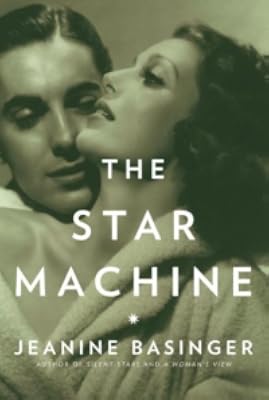
The Star Machine
by Jeanine Basinger
On This Page
Description
Film studies authority Basinger gives us an entertaining look into the "star machine," examining how, at the height of the studio system, from the 1930s to the 1950s, the studios manufactured star actors and actresses. She shows us how the machine worked when it worked, how it failed when it didn't, and how irrelevant it could sometimes be. She gives us the "human factor," case studies focusing on big stars groomed into the system: the "awesomely beautiful" (and disillusioned) Tyrone Power; show more the seductive, disobedient Lana Turner; and a dazzling cast of others--Loretta Young, Errol Flynn, Irene Dunne, Deanna Durbin. She anatomizes their careers, showing how their fame happened, and what happened to them as a result. (Both Turner and Flynn, for instance, were involved in notorious court cases.) In conclusion, she explains what has become of the star machine and why the studios' practice is no longer relevant.--From publisher description. show lessTags
Recommendations













Member Reviews
"The idea of a star being born is bushwah. A star is created, carefully and coldbloodedly, built up from nothing, from nobody...Age, beauty, talent - least of all talent - has nothing to do with it...We could make silk purses out of sow's ears every day in the week."
During the Golden Age of movies the studio system controlled and manufactured the lives of their actors, having final say over everything from haircuts to spouses and covering up the seedier side of Hollywood. Basinger brings to light the lives of lesser known actors and shows us from the inside out how they were created and kept in line. It's an intimate look at a way of life that has since disappeared, accompanied by a great set of archival photos.
My love of classic show more movies runs deep so this book was right up my alley. The great part about this book is it introduces the reader to actors they may not know as well. It doesn't cover the John Wayne's and Judy Garland's of the era. Instead it introduces readers to other amazing actors like Jean Arthur and William Powell, stars who were famous more than 50 years ago but have since been mostly forgotten. For me, it was nice to read more about a group of actors I'd watched on screen but knew little about. For example, Eleanor Powell was almost singlehandedly responsible for saving Warner Brothers Studios during the Depression. "Her powerful, low-to-the-ground tap dancing tended to blow any male partner out of the water. She was physically stronger than most of the men available to play opposite her, and she certainly could out-tap everyone."
The reader is told the old studio system is no longer in existence but in its hey day was extremely impressive. MGM could complete a film every nine days. 'In 1950 alone they completed 16 cartoons, 12 "Travelogues", 9 "Pete Smith specialties", 8 "People on Parades", 104 "News of the Day" and 41 feature films.' I tried not to let my jaw hit the floor. The amount of complex coordination it would have taken is mindboggling.
Basinger references a huge stack of movies and provides a variety of stock and candid photos that help put names to faces and also reveal the variety of talent at the studios. I only wish the book had included more actors or had been longer. It was nice to see how things worked but I almost wanted a more chronological approach to see how things started and follow through to when the system broke down. If you love classic movies then I would highly recommend this book. It's a great addition to any library and now has a home in mine. show less
During the Golden Age of movies the studio system controlled and manufactured the lives of their actors, having final say over everything from haircuts to spouses and covering up the seedier side of Hollywood. Basinger brings to light the lives of lesser known actors and shows us from the inside out how they were created and kept in line. It's an intimate look at a way of life that has since disappeared, accompanied by a great set of archival photos.
My love of classic show more movies runs deep so this book was right up my alley. The great part about this book is it introduces the reader to actors they may not know as well. It doesn't cover the John Wayne's and Judy Garland's of the era. Instead it introduces readers to other amazing actors like Jean Arthur and William Powell, stars who were famous more than 50 years ago but have since been mostly forgotten. For me, it was nice to read more about a group of actors I'd watched on screen but knew little about. For example, Eleanor Powell was almost singlehandedly responsible for saving Warner Brothers Studios during the Depression. "Her powerful, low-to-the-ground tap dancing tended to blow any male partner out of the water. She was physically stronger than most of the men available to play opposite her, and she certainly could out-tap everyone."
The reader is told the old studio system is no longer in existence but in its hey day was extremely impressive. MGM could complete a film every nine days. 'In 1950 alone they completed 16 cartoons, 12 "Travelogues", 9 "Pete Smith specialties", 8 "People on Parades", 104 "News of the Day" and 41 feature films.' I tried not to let my jaw hit the floor. The amount of complex coordination it would have taken is mindboggling.
Basinger references a huge stack of movies and provides a variety of stock and candid photos that help put names to faces and also reveal the variety of talent at the studios. I only wish the book had included more actors or had been longer. It was nice to see how things worked but I almost wanted a more chronological approach to see how things started and follow through to when the system broke down. If you love classic movies then I would highly recommend this book. It's a great addition to any library and now has a home in mine. show less
The title is misleading: the book is not about the star machine, but about the products of that machine: the movie stars. The book provides very little information about the star machine itself: you won't, for example, learn much about the studios or the people who operated the machines. Needlessly long, the book quickly devolves into a series of star biographies. The author writes about the stars with considerable insight, but the whole is far less than the sum of its parts, and the book feels way longer than it is (and it's over 500 pages long).
What a fascinating and informative book! After the excellent job the first chapter did at laying out the big picture of the workings of the "star machine" in Hollywood of the '30s and '40s, I felt like I did sometimes lose sight of the forest for the trees when the book switched into case study mode -- but what interesting trees! The problem now, of course, is that I can't stop watching all the movies Basinger described.
An interesting look into movie studies during the 1930s, 1940s, and 1950s. By focusing on various stars' careers, Basinger notes how the "star machine" worked, its successes, and its failures. She includes great discussions of the human aspects. She concludes with an insightful analysis of what became of the "star machine" and why it is no longer in practice today.
A terrific companion piece to Ms. Basinger's "A Woman's View". Ms Basinger explores the Hollywood star making machine from those who played along, those who fought the machine and those who defied the machine. From little remembered stars like Eleanor Powell and Deanna Durbin to Lana Turner and Errol Flynn. Some of the stars or almost stars are covered in greater detail then others (Errol Flynn vs Van Johnson, Lana Turner vs Irene Dunne). And the footnotes are amazing reading in themselves. A must have for the classic film reader.
Scholarly, but not too scholarly...looking forward to trying to find all of the good films mentioned in this book! The only weakness is at time the biographies of the actors, at times, diverged from the topic of the book.
Chock-full of details and in references. She knows her stuff.
Members
- Recently Added By
Lists

Books Read in 2013
1,630 works; 51 members

Best Books on Film
46 works; 12 members
Author Information

15+ Works 1,180 Members
Jeanine Basinger is Chair of the Film Studies Program and Corwin-Fuller Professor of Film Studies at Wesleyan University, and Curator of the Cinema Archives there. She lives with her husband in Middletown, Connecticut.
Awards and Honors
Awards
Common Knowledge
- Canonical title
- The Star Machine
- Original publication date
- 2007
- People/Characters
- Jean Arthur; Wallace Beery; Irene Dunne; Deanna Durbin; Errol Flynn; Van Johnson (show all 10); Tyrone Power; Lana Turner; Clifton Webb; Loretta Young
- Important places
- Hollywood, Los Angeles, California, USA
- Dedication
- For Savannah, my star
- First words
- The star-making process—like everything else during Hollywood's studio years—was contradictory, unpredictable, and ambivalent, but none of that slowed the system down.
- Last words
- (Click to show. Warning: May contain spoilers.)And they know one when they see one.
Classifications
- Genres
- Nonfiction, General Nonfiction, History, Biography & Memoir
- DDC/MDS
- 384.80979494 — Society, government, & culture Commerce, communications & transportation regulations Communications Motion pictures Standard subdivisions History, geographic treatment, biography North America
- LCC
- PN1993.5 .U65 .B327 — Language and Literature Literature (General) Literature (General) Drama Motion pictures
- BISAC
Statistics
- Members
- 274
- Popularity
- 118,311
- Reviews
- 9
- Rating
- (4.22)
- Languages
- English
- Media
- Paper, Ebook
- ISBNs
- 3
- UPCs
- 1
- ASINs
- 3