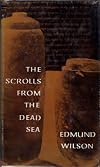
The scrolls from the Dead Sea
by Edmund Wilson
On This Page
Description
The Editors' Preface To the Reader Alphabetical listing of the Books of the Bible Abbreviations The Hebrew Bible --The Pentateuch --The Historical Books --The Poetical and Wisdom Books --The Prophetic Books The Apocryphal/Deuterocanonical Books Introduction --Books and Additions to Esther and Daniel that are in the Roman Catholic, Greek, and Slavonic Bibles --Books in the Greek and Slavonic Bibles; not in the Roman Catholic Canon --In the Slavonic Bible and in the Latin Vulgate Appendix --In show more the Appendix to the Greek Bible The New Testament --The Gospels --The Acts of the Apostles --Letters/Epistles in the New Testament --Revelation General Essays, Tables --The Canons of the Bible --Textual Criticism --Translation of the Bible into English Interpretation --The Hebrew Bible's Interpretation of Itself --The New Testament Interprets the Jewish Scriptures --Jewish Interpretation in the Premodern Era --Christian Interpretation in the Premodern Era --The Interpretation of the Bible: From the Nineteenth to the Mid-twentieth Centuries --Contemporary Methods of Biblical study --The Geography of the Bible Cultural Contexts --The Ancient Near East --The Persian and Hellenistic Periods --The Roman Period Tables --Timeline --Chronological Table of Rules --Weights and Measures --Calendar --Parallel Texts Translations of Ancient Texts Glossary Index to the Study Materials Concordance Color Maps show lessTags
Recommendations


















Member Reviews
The Scrolls from the Dead Sea and The Dead Sea Scrolls 1947-1969
By Edmund Wilson
This is a review of Edmund Wilson’s original book about the Dead Sea Scrolls, published in 1955, and his updated and expanded book, published in 1969. Much like Elaine Pagels’ books about the Gnostic Gospels, Wilson’s books are about the history and interpretation of the Dead Sea scrolls, rather than a translation of the original texts. Wilson’s books, more than Pagels’, are full of high adventure and intrigue, especially because they take place in Palestine, a land notorious for religious and political upheaval, and because of the time in which they take place, from 1947, at the end of the British mandate, to 1969, two years after the Six-Day War show more between the Arabs and the Israelis. The Dead Sea Scrolls were discovered by a Bedouin boy in a cave along the western shore of the Dead Sea in 1947, two years after the discovery of the Nag Hammadi scrolls (gnostic gospels) in Egypt. Unlike the Nag Hammadi texts, which are Christian (written in Coptic), the Dead Sea Scrolls are Jewish (written in Hebrew). They are of interest, however, to both Jewish and Christian biblical scholars, although for different reasons.
Wilson explains why the discovery of the scrolls was problematic and upsetting for scholars and why it took some time for them to be accepted as authentic. He reminds us that up until about 400 BCE, the Israeli religion was practiced and handed down through oral tradition. Our earliest written Judeo-Christian scriptures are:
- [ ] The Alexandrian Septuagint (a Greek translation of the Hebrew Bible that dates from the third century BCE)
- [ ] St. Jerome’s Latin Vulgate (a Latin translation of the Christian Bible that dates from the late fourth century CE)
- [ ] The Masoretic texts (a translation of the Hebrew Bible that dates from the ninth century CE)
It’s important to remember that almost all knowledge of the Bible, up until the 1947 discovery had come from a small set of texts that span from a period of about 1,300 years - 400 years before Christ with the Septuagint to 900 years after him with the Masoretic texts. As Wilson says, “It took some courage to face new materials where none had been imagined to exist.”
Wilson, one of America’s greatest literary critics, is a brilliant writer. He masterfully weaves a story that combines political intrigue, place-setting in a dry, dusty land where if only the fighting would stop so that archaeologists (several of whom are also clergy) can get on with it, and scholarly bickering and possessiveness of not only the scrolls but of their interpretation as well. His theory, or not so much his but the general consensus of what he believes are the more objective scholars, is that the Essenes, a Jewish communal society who lived from the second century BCE to the first CE, may have been the precedent for Christianity. At the start of his book, Wilson somewhat dryly describes the archaeology of the Essene monastery - the “cave” where the Bedouin boy unknowingly discovered the sect’s library. Much later, after he’s woven his fascinating tale, he connects the archaeological, religious, and historical dots with a beautiful sentence: “The monastery, this structure of stone that endures, between the bitter waters and precipitous cliffs, with its oven and its inkwells, its mill and its cesspool, its constellation of sacred fonts and the unadorned graves of its dead, is perhaps, more than Bethlehem or Nazareth, the cradle of Christianity.“
I enjoyed the original of Wilson’s book more than I did the expanded version. The original story was more compelling, and while the expanded version was certainly interesting, it didn’t capture the imagination quite so effectively. Additionally, Wilson weakened the aura of his story with an offputting appendix in the expanded version. The appendix was intended to demonstrate a point he had made consistently throughout both books - that scholars, many of whom have their own personal religious allegiances, often focus on minutia as a way to deflect from the big picture impact of the scrolls on collective Biblical knowledge. Knowledge that for some can be uncomfortable to absorb. Wilson simply could have left it at that because an astute reader understood exactly his point. However, in his appendix, he includes a series of point / counterpoint letters between himself and an anonymous scholarly reviewer of another author’s book about the scrolls. Rather than making himself look good, instead, through the esoteric and bitchy back and forth, both ended up looking like petty cat-fighters. They were both trying to make scholarly points, but to the lay reader, the points didn’t mean much. Instead, I found myself thinking, “Would you both just give it a drink!”
Regardless, I greatly enjoyed the original Scrolls from the Dead Sea. It was exciting to read after having read about the gnostic gospels because it showed the connection between Judaism and Christianity at a time when both were evolving from semi-mythology into written, codified religions. show less
By Edmund Wilson
This is a review of Edmund Wilson’s original book about the Dead Sea Scrolls, published in 1955, and his updated and expanded book, published in 1969. Much like Elaine Pagels’ books about the Gnostic Gospels, Wilson’s books are about the history and interpretation of the Dead Sea scrolls, rather than a translation of the original texts. Wilson’s books, more than Pagels’, are full of high adventure and intrigue, especially because they take place in Palestine, a land notorious for religious and political upheaval, and because of the time in which they take place, from 1947, at the end of the British mandate, to 1969, two years after the Six-Day War show more between the Arabs and the Israelis. The Dead Sea Scrolls were discovered by a Bedouin boy in a cave along the western shore of the Dead Sea in 1947, two years after the discovery of the Nag Hammadi scrolls (gnostic gospels) in Egypt. Unlike the Nag Hammadi texts, which are Christian (written in Coptic), the Dead Sea Scrolls are Jewish (written in Hebrew). They are of interest, however, to both Jewish and Christian biblical scholars, although for different reasons.
Wilson explains why the discovery of the scrolls was problematic and upsetting for scholars and why it took some time for them to be accepted as authentic. He reminds us that up until about 400 BCE, the Israeli religion was practiced and handed down through oral tradition. Our earliest written Judeo-Christian scriptures are:
- [ ] The Alexandrian Septuagint (a Greek translation of the Hebrew Bible that dates from the third century BCE)
- [ ] St. Jerome’s Latin Vulgate (a Latin translation of the Christian Bible that dates from the late fourth century CE)
- [ ] The Masoretic texts (a translation of the Hebrew Bible that dates from the ninth century CE)
It’s important to remember that almost all knowledge of the Bible, up until the 1947 discovery had come from a small set of texts that span from a period of about 1,300 years - 400 years before Christ with the Septuagint to 900 years after him with the Masoretic texts. As Wilson says, “It took some courage to face new materials where none had been imagined to exist.”
Wilson, one of America’s greatest literary critics, is a brilliant writer. He masterfully weaves a story that combines political intrigue, place-setting in a dry, dusty land where if only the fighting would stop so that archaeologists (several of whom are also clergy) can get on with it, and scholarly bickering and possessiveness of not only the scrolls but of their interpretation as well. His theory, or not so much his but the general consensus of what he believes are the more objective scholars, is that the Essenes, a Jewish communal society who lived from the second century BCE to the first CE, may have been the precedent for Christianity. At the start of his book, Wilson somewhat dryly describes the archaeology of the Essene monastery - the “cave” where the Bedouin boy unknowingly discovered the sect’s library. Much later, after he’s woven his fascinating tale, he connects the archaeological, religious, and historical dots with a beautiful sentence: “The monastery, this structure of stone that endures, between the bitter waters and precipitous cliffs, with its oven and its inkwells, its mill and its cesspool, its constellation of sacred fonts and the unadorned graves of its dead, is perhaps, more than Bethlehem or Nazareth, the cradle of Christianity.“
I enjoyed the original of Wilson’s book more than I did the expanded version. The original story was more compelling, and while the expanded version was certainly interesting, it didn’t capture the imagination quite so effectively. Additionally, Wilson weakened the aura of his story with an offputting appendix in the expanded version. The appendix was intended to demonstrate a point he had made consistently throughout both books - that scholars, many of whom have their own personal religious allegiances, often focus on minutia as a way to deflect from the big picture impact of the scrolls on collective Biblical knowledge. Knowledge that for some can be uncomfortable to absorb. Wilson simply could have left it at that because an astute reader understood exactly his point. However, in his appendix, he includes a series of point / counterpoint letters between himself and an anonymous scholarly reviewer of another author’s book about the scrolls. Rather than making himself look good, instead, through the esoteric and bitchy back and forth, both ended up looking like petty cat-fighters. They were both trying to make scholarly points, but to the lay reader, the points didn’t mean much. Instead, I found myself thinking, “Would you both just give it a drink!”
Regardless, I greatly enjoyed the original Scrolls from the Dead Sea. It was exciting to read after having read about the gnostic gospels because it showed the connection between Judaism and Christianity at a time when both were evolving from semi-mythology into written, codified religions. show less
The Scrolls from the Dead Sea and The Dead Sea Scrolls 1947-1969
By Edmund Wilson
This is a review of Edmund Wilson’s original book about the Dead Sea Scrolls, published in 1955, and his updated and expanded book, published in 1969. Much like Elaine Pagels’ books about the Gnostic Gospels, Wilson’s books are about the history and interpretation of the Dead Sea scrolls, rather than a translation of the original texts. Wilson’s books, more than Pagels’, are full of high adventure and intrigue, especially because they take place in Palestine, a land notorious for religious and political upheaval, and because of the time in which they take place, from 1947, at the end of the British mandate, to 1969, two years after the Six-Day War show more between the Arabs and the Israelis. The Dead Sea Scrolls were discovered by a Bedouin boy in a cave along the western shore of the Dead Sea in 1947, two years after the discovery of the Nag Hammadi scrolls (gnostic gospels) in Egypt. Unlike the Nag Hammadi texts, which are Christian (written in Coptic), the Dead Sea Scrolls are Jewish (written in Hebrew). They are of interest, however, to both Jewish and Christian biblical scholars, although for different reasons.
Wilson explains why the discovery of the scrolls was problematic and upsetting for scholars and why it took some time for them to be accepted as authentic. He reminds us that up until about 400 BCE, the Israeli religion was practiced and handed down through oral tradition. Our earliest written Judeo-Christian scriptures are:
- [ ] The Alexandrian Septuagint (a Greek translation of the Hebrew Bible that dates from the third century BCE)
- [ ] St. Jerome’s Latin Vulgate (a Latin translation of the Christian Bible that dates from the late fourth century CE)
- [ ] The Masoretic texts (a translation of the Hebrew Bible that dates from the ninth century CE)
It’s important to remember that almost all knowledge of the Bible, up until the 1947 discovery had come from a small set of texts that span from a period of about 1,300 years - 400 years before Christ with the Septuagint to 900 years after him with the Masoretic texts. As Wilson says, “It took some courage to face new materials where none had been imagined to exist.”
Wilson, one of America’s greatest literary critics, is a brilliant writer. He masterfully weaves a story that combines political intrigue, place-setting in a dry, dusty land where if only the fighting would stop so that archaeologists (several of whom are also clergy) can get on with it, and scholarly bickering and possessiveness of not only the scrolls but of their interpretation as well. His theory, or not so much his but the general consensus of what he believes are the more objective scholars, is that the Essenes, a Jewish communal society who lived from the second century BCE to the first CE, may have been the precedent for Christianity. At the start of his book, Wilson somewhat dryly describes the archaeology of the Essene monastery - the “cave” where the Bedouin boy unknowingly discovered the sect’s library. Much later, after he’s woven his fascinating tale, he connects the archaeological, religious, and historical dots with a beautiful sentence: “The monastery, this structure of stone that endures, between the bitter waters and precipitous cliffs, with its oven and its inkwells, its mill and its cesspool, its constellation of sacred fonts and the unadorned graves of its dead, is perhaps, more than Bethlehem or Nazareth, the cradle of Christianity.“
I enjoyed the original of Wilson’s book more than I did the expanded version. The original story was more compelling, and while the expanded version was certainly interesting, it didn’t capture the imagination quite so effectively. Additionally, Wilson weakened the aura of his story with an offputting appendix in the expanded version. The appendix was intended to demonstrate a point he had made consistently throughout both books - that scholars, many of whom have their own personal religious allegiances, often focus on minutia as a way to deflect from the big picture impact of the scrolls on collective Biblical knowledge. Knowledge that for some can be uncomfortable to absorb. Wilson simply could have left it at that because an astute reader understood exactly his point. However, in his appendix, he includes a series of point / counterpoint letters between himself and an anonymous scholarly reviewer of another author’s book about the scrolls. Rather than making himself look good, instead, through the esoteric and bitchy back and forth, both ended up looking like petty cat-fighters. They were both trying to make scholarly points, but to the lay reader, the points didn’t mean much. Instead, I found myself thinking, “Would you both just give it a drink!”
Regardless, I greatly enjoyed the original Scrolls from the Dead Sea. It was exciting to read after having read about the gnostic gospels because it showed the connection between Judaism and Christianity at a time when both were evolving from semi-mythology into written, codified religions. show less
By Edmund Wilson
This is a review of Edmund Wilson’s original book about the Dead Sea Scrolls, published in 1955, and his updated and expanded book, published in 1969. Much like Elaine Pagels’ books about the Gnostic Gospels, Wilson’s books are about the history and interpretation of the Dead Sea scrolls, rather than a translation of the original texts. Wilson’s books, more than Pagels’, are full of high adventure and intrigue, especially because they take place in Palestine, a land notorious for religious and political upheaval, and because of the time in which they take place, from 1947, at the end of the British mandate, to 1969, two years after the Six-Day War show more between the Arabs and the Israelis. The Dead Sea Scrolls were discovered by a Bedouin boy in a cave along the western shore of the Dead Sea in 1947, two years after the discovery of the Nag Hammadi scrolls (gnostic gospels) in Egypt. Unlike the Nag Hammadi texts, which are Christian (written in Coptic), the Dead Sea Scrolls are Jewish (written in Hebrew). They are of interest, however, to both Jewish and Christian biblical scholars, although for different reasons.
Wilson explains why the discovery of the scrolls was problematic and upsetting for scholars and why it took some time for them to be accepted as authentic. He reminds us that up until about 400 BCE, the Israeli religion was practiced and handed down through oral tradition. Our earliest written Judeo-Christian scriptures are:
- [ ] The Alexandrian Septuagint (a Greek translation of the Hebrew Bible that dates from the third century BCE)
- [ ] St. Jerome’s Latin Vulgate (a Latin translation of the Christian Bible that dates from the late fourth century CE)
- [ ] The Masoretic texts (a translation of the Hebrew Bible that dates from the ninth century CE)
It’s important to remember that almost all knowledge of the Bible, up until the 1947 discovery had come from a small set of texts that span from a period of about 1,300 years - 400 years before Christ with the Septuagint to 900 years after him with the Masoretic texts. As Wilson says, “It took some courage to face new materials where none had been imagined to exist.”
Wilson, one of America’s greatest literary critics, is a brilliant writer. He masterfully weaves a story that combines political intrigue, place-setting in a dry, dusty land where if only the fighting would stop so that archaeologists (several of whom are also clergy) can get on with it, and scholarly bickering and possessiveness of not only the scrolls but of their interpretation as well. His theory, or not so much his but the general consensus of what he believes are the more objective scholars, is that the Essenes, a Jewish communal society who lived from the second century BCE to the first CE, may have been the precedent for Christianity. At the start of his book, Wilson somewhat dryly describes the archaeology of the Essene monastery - the “cave” where the Bedouin boy unknowingly discovered the sect’s library. Much later, after he’s woven his fascinating tale, he connects the archaeological, religious, and historical dots with a beautiful sentence: “The monastery, this structure of stone that endures, between the bitter waters and precipitous cliffs, with its oven and its inkwells, its mill and its cesspool, its constellation of sacred fonts and the unadorned graves of its dead, is perhaps, more than Bethlehem or Nazareth, the cradle of Christianity.“
I enjoyed the original of Wilson’s book more than I did the expanded version. The original story was more compelling, and while the expanded version was certainly interesting, it didn’t capture the imagination quite so effectively. Additionally, Wilson weakened the aura of his story with an offputting appendix in the expanded version. The appendix was intended to demonstrate a point he had made consistently throughout both books - that scholars, many of whom have their own personal religious allegiances, often focus on minutia as a way to deflect from the big picture impact of the scrolls on collective Biblical knowledge. Knowledge that for some can be uncomfortable to absorb. Wilson simply could have left it at that because an astute reader understood exactly his point. However, in his appendix, he includes a series of point / counterpoint letters between himself and an anonymous scholarly reviewer of another author’s book about the scrolls. Rather than making himself look good, instead, through the esoteric and bitchy back and forth, both ended up looking like petty cat-fighters. They were both trying to make scholarly points, but to the lay reader, the points didn’t mean much. Instead, I found myself thinking, “Would you both just give it a drink!”
Regardless, I greatly enjoyed the original Scrolls from the Dead Sea. It was exciting to read after having read about the gnostic gospels because it showed the connection between Judaism and Christianity at a time when both were evolving from semi-mythology into written, codified religions. show less
two thirds of the book passes before any verse-length quotation from the scrolls is made. this is the story of the discovery, dissemination, and production of the scrolls more so than any exegesis of their content. From Mohammed the Wolf tossing stones into caves to a Metropolitan of the Syrian Jacobite Church frustrated in trying to gain financially from them, we get the story of how they came out. The Essenes get their own chapter as Wilson does a good job in a short work to place these texts and their implications in the inter-testament period and helping complete the story of a subjugated Judea with Messianic visions.
Very erudite book, chunks of which will go over the head of those who are not more deeply immersed in biblical studies. The wrangling and academic infighting sequences are more compelling and gripping, and more readily understandable. Wilson does make a game effort to try to place the contents of the Dead Sea Scrolls in context, but I'm not sure how much patience he has for the average reader. The appendix to this edition contains a series of letters that's essentially a "flame war" between a book reviewer and Wilson, and seems to be a pretty petty addition to the book.
Wilson focuses on the discovery and processing of the scrolls found in 1947 in caves near the Dead Sea. The content of the scrolls is given more cursory coverage, but the general thrust is conveyed. They were attributed to the Essene sect, whose presence in the region spanned from around the last third of 200 B.C. until at least 68 A.D. The theology evinced by the scrolls is similar to that of late apocryphal documents and also Persian theology, which, according to Wilson, "for a time gave Christianity some fairly severe competition." The principal elements of thought were: (1) the Two Ways (Darkness and Light); (2) Last Judgment at the end of time; (3) use of baptism; and (4) sacred repast in which bread and wine attain ritual show more significance. The scrolls also describe a "Teacher of Righteousness" who preaches sentiments later duplicated in the Gospels and who is persecuted and sentenced to die by an evil ruler.
Wilson notes that reaction to the translation of the scrolls was not favorable: Jews didn't like the idea that a powerful sect had "grown up inside Judaism but had nothing to do with Judaism." Christians were reluctant to recognize that the characteristic doctrines of Christianity as well as the outlines of [a Savior's] personal history were developed within a dissident branch of Judaism well before Jesus was even born.
Wilson's book was published in 1959. It will be interesting, when I go to the Dead Sea Scrolls exhibit later this month, to see how the response to the revelation of the scrolls has evolved over time.
ADDENDUM: Postscript after visiting the exhibit in San Diego:
What a surprise! There were some terrific photographs of Israel, and in particular the Dead Sea region. There were the scroll segments, there were the translations, and there were some pots and shards. What did they mean? Where was the controversy? If one hadn't previously absorbed the message that museums collaborate in the creation (or re-creation) of history and memory, the Dead Sea Scrolls exhibit brings it on home. A feast for postmodernist deconstructionists.
(JAF) show less
Wilson notes that reaction to the translation of the scrolls was not favorable: Jews didn't like the idea that a powerful sect had "grown up inside Judaism but had nothing to do with Judaism." Christians were reluctant to recognize that the characteristic doctrines of Christianity as well as the outlines of [a Savior's] personal history were developed within a dissident branch of Judaism well before Jesus was even born.
Wilson's book was published in 1959. It will be interesting, when I go to the Dead Sea Scrolls exhibit later this month, to see how the response to the revelation of the scrolls has evolved over time.
ADDENDUM: Postscript after visiting the exhibit in San Diego:
What a surprise! There were some terrific photographs of Israel, and in particular the Dead Sea region. There were the scroll segments, there were the translations, and there were some pots and shards. What did they mean? Where was the controversy? If one hadn't previously absorbed the message that museums collaborate in the creation (or re-creation) of history and memory, the Dead Sea Scrolls exhibit brings it on home. A feast for postmodernist deconstructionists.
(JAF) show less
NO OF PAGES: 121 SUB CAT I: Dead Sea Scrolls SUB CAT II: SUB CAT III: DESCRIPTION: Edmund Wilson, brilliant author and critic, describes the most exciting manuscript find of our time in a lucid account of the origin, discovery, and implications of the ancient Dead Sea scrolls, the first of which were found by Bedouin boys early in 1947. The significance of this dramatic discovery and its meaning to the history of Christianity and Judaism, and its relevance to modern Biblical research, is recounted in this absorbing narrative. The author visited the Dead Sea site and writes of scrolls and scholars with warmth and feeling, telling about the discovery of the scrolls, the environment, historical background, and the personalities involved. show more He traces the precarious journey of the scrolls from the hands of the Bedouin boys to the Syrian Metropolitan Samuel at the Monastery of St. Mark in Old Jerusalem. The Metropolitan purchased half the Hebrew manuscripts and brought them to the attention of interested scholars. The rest of the manuscripts were purchased by Professor Sukenik of the Hebrew University in New Jerusalem. It was a spectacular find - the oldest Biblical manuscripts yet known - which included a complete copy of the book of Isaiah. One of the scrolls contained a Manual of Discipline evidently used by the Essenes, a pre-Christian monastic order, whose monastery has recently been excavated near the cave where the scrolls were found. Other caves were explored, and there has come to light what is apparently a whole library of the literature of the religious movement to which the Essenes belonged - a literature which in some respects corresponds so closely with the Gospels and the Pauline Epistles that the latter are now thought to derive from it.NOTES: Donated by Gary and Angie Springer. SUBTITLE: show less
LOS ROYOS DEL MAR MUERTO
En la primavera de 1947 un pastorcillo beduino hizo un descubrimiento que iba a cambiar de raíz la visión que hasta entonces se había tenido de los escritos bíblicos: en la gruta de un acantilado, a las orillas del Mar Muerto, encontró los famosos rollos que habrían de llamar la atención mundial y obligar a un nuevo examen de los textos, a la luz de ese insólito material que parecía llegado de un mundo extinguido.
El escritor norteamericano Edmund Wilson hizo algunos viajes al lugar mismo de los hechos y registró, sintetizándolas magistralmente, las discusiones alrededor de los rollos del Mar Muerto. Wilson proporciona en este volumen un panorama completo de los estudios bíblicos: su proverbial show more erudición, la fluidez de su estilo y el sentido del humor están presentes aquí como en todos sus demás libros. Los rollos del Mar Muerto, sin embargo, destaca en el conjunto de su obra por la sagacidad apasionada con la que Wilson aborda desde el inicio su tema. Además de libro erudito, es una notable lección de periodismo; concebido originalmente como un reportaje que se publicó por entregas, fue tomando paulatinamente la forma de un tratado sobre los grandes temas bíblicos. show less
En la primavera de 1947 un pastorcillo beduino hizo un descubrimiento que iba a cambiar de raíz la visión que hasta entonces se había tenido de los escritos bíblicos: en la gruta de un acantilado, a las orillas del Mar Muerto, encontró los famosos rollos que habrían de llamar la atención mundial y obligar a un nuevo examen de los textos, a la luz de ese insólito material que parecía llegado de un mundo extinguido.
El escritor norteamericano Edmund Wilson hizo algunos viajes al lugar mismo de los hechos y registró, sintetizándolas magistralmente, las discusiones alrededor de los rollos del Mar Muerto. Wilson proporciona en este volumen un panorama completo de los estudios bíblicos: su proverbial show more erudición, la fluidez de su estilo y el sentido del humor están presentes aquí como en todos sus demás libros. Los rollos del Mar Muerto, sin embargo, destaca en el conjunto de su obra por la sagacidad apasionada con la que Wilson aborda desde el inicio su tema. Además de libro erudito, es una notable lección de periodismo; concebido originalmente como un reportaje que se publicó por entregas, fue tomando paulatinamente la forma de un tratado sobre los grandes temas bíblicos. show less
Feb 4, 2018Spanish
Members
- Recently Added By
Author Information

95+ Works 8,919 Members
Wilson roamed the world and read widely in many languages. He was a journalist for leading literary periodicals: Vanity Fair, where he was briefly managing editor; The New Republic, where he was associate editor for five years; and the New Yorker, where he was book reviewer in the 1940s. These varied experiences were typical of Wilson's range of show more interests and ability. Eternally productive and endlessly readable, he conquered American literature in countless essays. If he is idiosyncratic and lacks a rigid mold, that probably contributes to his success as a literary critic, since he was not committed to interpretation in the straitjacket of some popular approach or dogma. His critical position suits his cosmopolitan background---historical and sociological considerations prevail. He went through a brief Marxist period and experimented with Freudian criticism. Axel's Castle (1931), a penetrating analysis of the symbolist writer, has exerted a great influence on contemporary literary criticism. Its dedication, to Christian Gauss of Princeton, reads:"It was principally from you that I acquired.. .my idea of what literary criticism ought to be---a history of man's ideas and imaginings in the setting of the conditions which have shaped them."His volume of satiric short stories, Memoirs of Hecate County (1946), with its frankly erotic passages, was the subject of court cases in a less tolerant decade than the present one. It was Wilson's own favorite among his writings, but he complained that those individuals who like his other work tend to disregard it. (Bowker Author Biography) show less
Awards and Honors
Awards
Distinctions
Common Knowledge
- Canonical title*
- De boekrollen van de Dode Zee
*Some information comes from Common Knowledge in other languages. Click "Edit" for more information.
Classifications
Statistics
- Members
- 534
- Popularity
- 56,215
- Reviews
- 7
- Rating
- (3.16)
- Languages
- 6 — Dutch, English, Norwegian (Bokmål), Portuguese, Spanish, Swedish
- Media
- Paper
- ISBNs
- 8
- ASINs
- 29