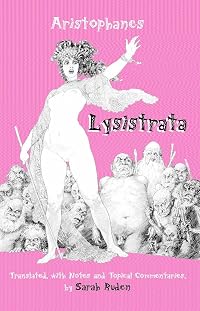
Lysistrata
by Aristophanes
On This Page
Description
One of the few plays that survived intact from the heyday of ancient Grecian drama, Lysistrata is an enormously influential work of satirical comedy. In order to bring an end to a destructive and never-ending war, the women of Greece take a temporary vow of chastity, pledging to remain abstinent until the conflict ends. As can be expected, mayhem—and hilarity—ensues..
Tags
Recommendations

























Member Recommendations

by chwiggy
Member Reviews
I love this! For the first time a modish modern translation works--for about two pages it's jarring for characters in Aristophanes to call each other "baby" and whatnot, and then you're like, oh yeah, this is the only way it could have been. The only way to get across the rollicking hilarity. I esteem a play that can treat love like war and put on a gay show for Athenians desperate for something to cheer about, and still raise spirits two thousand years later. And yeah, yeah, women and men, and women have to be the men because there are no real men that can end the war, and feminist readings and pacifism v. good and bad wars, I get all that. But I don't have anything profound to say about it really--just that I loved every moment and show more want to see it performed super bad. "It's not the heat, it's the tumidity." Good lord. show less
The popularity of this play, already in antiquity, naturally has everything to do with that provocative idea of a sex strike, through which women force their warmongering husbands to make peace. This lends itself to an avalanche of lewd, ambiguous, and—in Aristophanes’ case, obviously vulgar—puns and references, which are entertainment in themselves.
Moreover, this play is also formally more successful than the others I have read by him: the composition is quite homogeneous (the theme is sustained until the very end), and the opening scene, for example, feels very modern with a sharp dialogue in which the characters’ half-sentences tumble over one another.
A few relevant observations. Naturally, it is primarily the men who are show more ridiculed by Aristophanes, on the one hand with their drooling and on the other with their pathetic complaining about the behavior of the women. But the women are also put in their place, with their endless chatter and bickering, with their sometimes stupid reactions, and especially with their own sexual weakness (after a while, they too feel like having sex again).
Two. The sex strike seems to be the women's most effective weapon, but if you read the text closely, it turns out that the men's weak spot is not sex, but the fact that the women have confiscated the city's treasury (which is kept in the Acropolis). Aristophanes demonstrates a very modern insight here: it is money and economic power that are the deciding factors.
I am left with a reservation, however, that I expressed earlier: how on earth can you do justice to the many puns, implicit and explicit references, in a translation? Translators can be very creative, but it seems to me that a great deal is always lost regardless.
About the historical aspects of this piece, see my History account on Goodreads: https://www.goodreads.com/review/show/8646028157.
Disclaimer: I'm reading and reviewing classic ancient Greek plays, more or less in chronological order. But I'm not giving a rating. How could I, given their age? I'll make an exception only when a play is exceptional and still strikes an emotional and/or intellectual chord. show less
Moreover, this play is also formally more successful than the others I have read by him: the composition is quite homogeneous (the theme is sustained until the very end), and the opening scene, for example, feels very modern with a sharp dialogue in which the characters’ half-sentences tumble over one another.
A few relevant observations. Naturally, it is primarily the men who are show more ridiculed by Aristophanes, on the one hand with their drooling and on the other with their pathetic complaining about the behavior of the women. But the women are also put in their place, with their endless chatter and bickering, with their sometimes stupid reactions, and especially with their own sexual weakness (after a while, they too feel like having sex again).
Two. The sex strike seems to be the women's most effective weapon, but if you read the text closely, it turns out that the men's weak spot is not sex, but the fact that the women have confiscated the city's treasury (which is kept in the Acropolis). Aristophanes demonstrates a very modern insight here: it is money and economic power that are the deciding factors.
I am left with a reservation, however, that I expressed earlier: how on earth can you do justice to the many puns, implicit and explicit references, in a translation? Translators can be very creative, but it seems to me that a great deal is always lost regardless.
About the historical aspects of this piece, see my History account on Goodreads: https://www.goodreads.com/review/show/8646028157.
Disclaimer: I'm reading and reviewing classic ancient Greek plays, more or less in chronological order. But I'm not giving a rating. How could I, given their age? I'll make an exception only when a play is exceptional and still strikes an emotional and/or intellectual chord. show less
This comedy, originally written in 411 BC, was banned in 1967 in Greece because of its anti-war message. This modern translation by Douglass Parker breathes new life into the story and makes it accessible for all audiences.
The women in Greece decide that they are tired of their men always being away fighting the Peloponnesian War. One woman, Lysistrata, comes up with a brilliant idea and recruits the rest of the women to take part in her plan. They decide as a group to withhold sex from the men until they make peace. They lock themselves in the Acropolis and resist all temptation to give in to their husband’s demands. I loved the fact that the women don’t deny their own sexual desires and they have to fight both their urges and show more their husbands’ desires to make the plan work.
One of the funniest scenes includes a woman desperate to go back home to her husband. She announces she much leave and find a midwife because she’s about to deliver her baby… even though she wasn’t pregnant the day before. The women quickly call her on it and make her remove the metal helmet from under her dress where it was being smuggled to make her look pregnant.
BOTTOM LINE: The humor definitely plays better on the stage than the page, but I’ve found that to be true with all comedic plays. The premise is clever and fun and though it may be a bit silly, the message of encouraging peace is a good one. show less
The women in Greece decide that they are tired of their men always being away fighting the Peloponnesian War. One woman, Lysistrata, comes up with a brilliant idea and recruits the rest of the women to take part in her plan. They decide as a group to withhold sex from the men until they make peace. They lock themselves in the Acropolis and resist all temptation to give in to their husband’s demands. I loved the fact that the women don’t deny their own sexual desires and they have to fight both their urges and show more their husbands’ desires to make the plan work.
One of the funniest scenes includes a woman desperate to go back home to her husband. She announces she much leave and find a midwife because she’s about to deliver her baby… even though she wasn’t pregnant the day before. The women quickly call her on it and make her remove the metal helmet from under her dress where it was being smuggled to make her look pregnant.
BOTTOM LINE: The humor definitely plays better on the stage than the page, but I’ve found that to be true with all comedic plays. The premise is clever and fun and though it may be a bit silly, the message of encouraging peace is a good one. show less
Translation of comedy is always a challenge, particularly when the jokes are 25 centuries old. Last summer I was assigned, for a yearly symposium I attend at Notre Dame, the reading of Lysistrata, authored by the Greek playwright Aristophanes and first performed in 411 BCE.
As the play begins, the Peloponnesian War between Athens and Sparta (431–404 BC) has been going on interminably, with nearly all the young men away from home or otherwise engaged in the conflict. Seeing no likely prospect of an end to the war, Lysistrata, an Athenian woman, takes matters into her own hands and proposes desperate measures. She gathers representative women from all the city-states engaged in the war [how this could have been accomplished is not show more treated, nor is it important to the story] and persuades them to withhold sex from their husbands and lovers [when they actually saw them] until peace is concluded.
But for some minor scuffling for control of the Acropolis between the women and the men of Athens who are too old to be fighting the Spartans, very little action takes place. [The Acropolis of Athens was an ancient citadel located above the city of Athens and was home to several ancient buildings of great architectural and historic significance, the most famous being the Parthenon.]
The play consists primarily of dialog among the women in organizing their movement, and later discussions between choruses of women and men justifying their positions. Aristophanes introduces some bawdy levity in that the peace talks between the contestants are conducted by men who have constant erections.
Because the plot is so simple, the enjoyment of the play must come from the caliber of the dialog. I imagine part of the fun for ancient Greek audiences derived from the playwright’s mastery of different Greek dialects and accents. The translation I read, by Jack Lindsay, was too academic, archaic, and sterile. He attempted to create authenticity by having some of the interlocutors speak in what seemed like a Scottish accent. The effect is a bit off-putting because Lindsay’s pseudo-Scotsmen are barely understandable.
Although Aristophanes is known as a comic playwright and this play contains some comic scenes, the overall message is rather sad; i.e., there may be no rational or practical solution to the problems presented by war. In the case of the Peloponnesian War, he may have been quite correct: although the war had been going on for twenty years when the play was first staged, it still had another seven years to run. Moreover, Athens, the strongest city-state in Greece prior to the war's beginning, was reduced to a state of near-complete subjection, while Sparta became established as the leading power of Greece.
Evaluation: Scholars maintain that each era has a unique spirit that sets it apart from all other epochs. In German, such a spirit is known as “Zeitgeist,” from the German words Zeit, meaning “time,” and Geist, meaning “spirit” or “ghost.” But some works remain in the cultural Zeitgeist in successive eras, even if somewhat transmogrified. Lysistrata is one of those. Because the theme of Lysistrata has endured over centuries, I would recommend reading the original play, but trying a different translation if one is available.
(JAB) show less
As the play begins, the Peloponnesian War between Athens and Sparta (431–404 BC) has been going on interminably, with nearly all the young men away from home or otherwise engaged in the conflict. Seeing no likely prospect of an end to the war, Lysistrata, an Athenian woman, takes matters into her own hands and proposes desperate measures. She gathers representative women from all the city-states engaged in the war [how this could have been accomplished is not show more treated, nor is it important to the story] and persuades them to withhold sex from their husbands and lovers [when they actually saw them] until peace is concluded.
But for some minor scuffling for control of the Acropolis between the women and the men of Athens who are too old to be fighting the Spartans, very little action takes place. [The Acropolis of Athens was an ancient citadel located above the city of Athens and was home to several ancient buildings of great architectural and historic significance, the most famous being the Parthenon.]
The play consists primarily of dialog among the women in organizing their movement, and later discussions between choruses of women and men justifying their positions. Aristophanes introduces some bawdy levity in that the peace talks between the contestants are conducted by men who have constant erections.
Because the plot is so simple, the enjoyment of the play must come from the caliber of the dialog. I imagine part of the fun for ancient Greek audiences derived from the playwright’s mastery of different Greek dialects and accents. The translation I read, by Jack Lindsay, was too academic, archaic, and sterile. He attempted to create authenticity by having some of the interlocutors speak in what seemed like a Scottish accent. The effect is a bit off-putting because Lindsay’s pseudo-Scotsmen are barely understandable.
Although Aristophanes is known as a comic playwright and this play contains some comic scenes, the overall message is rather sad; i.e., there may be no rational or practical solution to the problems presented by war. In the case of the Peloponnesian War, he may have been quite correct: although the war had been going on for twenty years when the play was first staged, it still had another seven years to run. Moreover, Athens, the strongest city-state in Greece prior to the war's beginning, was reduced to a state of near-complete subjection, while Sparta became established as the leading power of Greece.
Evaluation: Scholars maintain that each era has a unique spirit that sets it apart from all other epochs. In German, such a spirit is known as “Zeitgeist,” from the German words Zeit, meaning “time,” and Geist, meaning “spirit” or “ghost.” But some works remain in the cultural Zeitgeist in successive eras, even if somewhat transmogrified. Lysistrata is one of those. Because the theme of Lysistrata has endured over centuries, I would recommend reading the original play, but trying a different translation if one is available.
(JAB) show less
NOTE: This book contains four plays, but this review only pertains to Lysistrata
Guys: if you ever want to be the life of the party (or maybe get yourself arrested), consider borrowing this 2500 year old bit from Aristophanes’ play Lysistrata:
KINESIAS: (entering the peace negotiation) ….I’ve come as a delegate to the Sexual Congress. (opens cloak to reveal massive, throbbing erection) Here are my credentials.
AHAHAHAHAHAHAHAHAHAHAHAHA! I’m just dying to use that one.
Now you might understand how Lysistrata got to be one of the five most frequently banned plays of all time, but that makes it all the more fun, doesn’t it? In it, the titular Lysistrata –a matron of Athens- laments at the needless destruction wrought by a twenty show more year long ongoing war between Athens and Sparta. She hits on a novel solution: organize a strike amongst all the women of Greece, refusing sex to their partners until the war is ended.
Beautiful in its simplicity, it not only delivers a serious anti-war message, but sets the stage for a LOT of great double entendres…
Here’s Koryphaios and Kinesias having a discussion about blueballs:
KORYPHAIOS: It’s a dreadful disease. When the crisis reaches its height, what do you take for it?
KINESIAS: Whatever comes to hand.
Here’s another one, which takes place right after the peace treaty is signed, and the women of Greece are again willing to fornicate:
ATHENIAN FARMER: (Hastily) Now that the war’s over, I wanna rush home and, uh, plow a few furrows.
SPARTAN FARMER: (Just as hasty) Yeah! I have to be going! Gotta work a few loads of fertilizer in, myself!
Those are some highlights, and there are a lot of other laughs too, but let’s get to the substance. The Athenian women are so sick of the war, they decide to abstain from sex. The obvious result, which the play spends a good deal of time exploring, is the affect this has on the men- who walk around with erections and complain about how horny and sex-starved they are. Ultimately the men break down and sign a peace treaty, to get back into their partners’ good graces (i.e. pants). So that’s like organized labor holding a strike, if you’re comfortable making that comparison, and that’s all good. But the more interesting angle is how the self-imposed strike affects the women: they miss the sex too, and amongst themselves grouse and complain, and consider abandoning the whole scheme.
LYSISTRATA: (to the lamenting women) If we can just hold out a little bit longer, we’ll come out on top.
SPARTAN WOMAN: Oh, how I love being on top!
And that’s good for some jokes, but it’s an interesting thought experiment too, isn’t it? If a nation is considering going to war, it might be useful to contemplate whether they would still declare war, if it meant that every adult had to abstain from sex until the fighting ends. I’m not just talking about the soldiers… if you think about it, that’s really the deal most of them get anyway. We have soldiers in the military who’ve been on 4, 5, even 6 deployments to Iraq and Afghanistan –each deployment generally being between 1 to 2 years. Obviously spouses (or partners otherwise) don’t accompany them, so these guys [I’m using the generic male, but let’s be clear: this applies to military women as well] are not only putting their lives on the line, they’re also going without sex for long stretches.
But what about the rest of the population? In World War II, the homefront made sacrifices for the war effort. There was rationing and shortages, and almost every family had loved ones drafted into service. Lately, we’ve kind of gotten away from that. Economics drive a lot of kids from impoverished areas to volunteer for military service, but there’s no draft, so more (but certainly not all) middle class and upper class families have avoided putting loved ones in harm’s way. Likewise, we haven’t had any rationing or shortages related to our wars since World War II. After 9/11, George W. Bush didn’t tell Americans to prepare for sacrifices; he essentially told them to go shopping. How times change!
But what if every adult man and woman in the country had to abstain from sex for the duration of our wars- as a sign of support and personal sacrifice? Would we still be in Afghanistan, ten years after the first boots hit the ground? Would we be beating the war drum against Iran, at every opportunity? I don’t think so.
The more I think about it, the more reasonable this yardstick sounds. It really forces an assessment of priorities, doesn’t it? To be sure, there still would be wars we choose to fight. World War II was a just war, and we fought it to protect our children from a life under fascism. Most of us would abstain from sex for four years, to prevent our kids from growing up under fascism, so The Lysistrata Test (as I’m going to start calling it) successfully identifies this as an appropriate war.
Now take The Spanish American War… a neocolonial adventure fought at the behest of yellow journalists, in response to a false flag operation. Give up sex for that? No way! Another point for The Lysistrata Test.
Then there are a whole slew of wars in that gray area… the Korean War? Well… you can make the humanitarian arguments, and you can make a case that our long-term security depended on preventing the famous “falling dominoes”, but on the other hand, our national security was not immediately threatened. Some people would forego the sex for that, and some people wouldn’t… But you know what? In every one of those gray area cases, you can bet that there would be vigorous debate in the public square about it. People would give a fuck. They would try to inform themselves about the issues, and they’d contact their elected representatives with their opinions. The war debate would be front page news, not celebrity gossip.
Another benefit of the Lysistrata Test is that it would keep us out of unnecessary alliances. Do we really want to sign an agreement with some other country, if it means we might have to go without sex for a few years? Let’s sit back and think about this some more… It’s genius! I really think Aristophanes was onto something.
Best line (in translation): It ain’t the heat; it’s the tumidity. show less
Guys: if you ever want to be the life of the party (or maybe get yourself arrested), consider borrowing this 2500 year old bit from Aristophanes’ play Lysistrata:
KINESIAS: (entering the peace negotiation) ….I’ve come as a delegate to the Sexual Congress. (opens cloak to reveal massive, throbbing erection) Here are my credentials.
AHAHAHAHAHAHAHAHAHAHAHAHA! I’m just dying to use that one.
Now you might understand how Lysistrata got to be one of the five most frequently banned plays of all time, but that makes it all the more fun, doesn’t it? In it, the titular Lysistrata –a matron of Athens- laments at the needless destruction wrought by a twenty show more year long ongoing war between Athens and Sparta. She hits on a novel solution: organize a strike amongst all the women of Greece, refusing sex to their partners until the war is ended.
Beautiful in its simplicity, it not only delivers a serious anti-war message, but sets the stage for a LOT of great double entendres…
Here’s Koryphaios and Kinesias having a discussion about blueballs:
KORYPHAIOS: It’s a dreadful disease. When the crisis reaches its height, what do you take for it?
KINESIAS: Whatever comes to hand.
Here’s another one, which takes place right after the peace treaty is signed, and the women of Greece are again willing to fornicate:
ATHENIAN FARMER: (Hastily) Now that the war’s over, I wanna rush home and, uh, plow a few furrows.
SPARTAN FARMER: (Just as hasty) Yeah! I have to be going! Gotta work a few loads of fertilizer in, myself!
Those are some highlights, and there are a lot of other laughs too, but let’s get to the substance. The Athenian women are so sick of the war, they decide to abstain from sex. The obvious result, which the play spends a good deal of time exploring, is the affect this has on the men- who walk around with erections and complain about how horny and sex-starved they are. Ultimately the men break down and sign a peace treaty, to get back into their partners’ good graces (i.e. pants). So that’s like organized labor holding a strike, if you’re comfortable making that comparison, and that’s all good. But the more interesting angle is how the self-imposed strike affects the women: they miss the sex too, and amongst themselves grouse and complain, and consider abandoning the whole scheme.
LYSISTRATA: (to the lamenting women) If we can just hold out a little bit longer, we’ll come out on top.
SPARTAN WOMAN: Oh, how I love being on top!
And that’s good for some jokes, but it’s an interesting thought experiment too, isn’t it? If a nation is considering going to war, it might be useful to contemplate whether they would still declare war, if it meant that every adult had to abstain from sex until the fighting ends. I’m not just talking about the soldiers… if you think about it, that’s really the deal most of them get anyway. We have soldiers in the military who’ve been on 4, 5, even 6 deployments to Iraq and Afghanistan –each deployment generally being between 1 to 2 years. Obviously spouses (or partners otherwise) don’t accompany them, so these guys [I’m using the generic male, but let’s be clear: this applies to military women as well] are not only putting their lives on the line, they’re also going without sex for long stretches.
But what about the rest of the population? In World War II, the homefront made sacrifices for the war effort. There was rationing and shortages, and almost every family had loved ones drafted into service. Lately, we’ve kind of gotten away from that. Economics drive a lot of kids from impoverished areas to volunteer for military service, but there’s no draft, so more (but certainly not all) middle class and upper class families have avoided putting loved ones in harm’s way. Likewise, we haven’t had any rationing or shortages related to our wars since World War II. After 9/11, George W. Bush didn’t tell Americans to prepare for sacrifices; he essentially told them to go shopping. How times change!
But what if every adult man and woman in the country had to abstain from sex for the duration of our wars- as a sign of support and personal sacrifice? Would we still be in Afghanistan, ten years after the first boots hit the ground? Would we be beating the war drum against Iran, at every opportunity? I don’t think so.
The more I think about it, the more reasonable this yardstick sounds. It really forces an assessment of priorities, doesn’t it? To be sure, there still would be wars we choose to fight. World War II was a just war, and we fought it to protect our children from a life under fascism. Most of us would abstain from sex for four years, to prevent our kids from growing up under fascism, so The Lysistrata Test (as I’m going to start calling it) successfully identifies this as an appropriate war.
Now take The Spanish American War… a neocolonial adventure fought at the behest of yellow journalists, in response to a false flag operation. Give up sex for that? No way! Another point for The Lysistrata Test.
Then there are a whole slew of wars in that gray area… the Korean War? Well… you can make the humanitarian arguments, and you can make a case that our long-term security depended on preventing the famous “falling dominoes”, but on the other hand, our national security was not immediately threatened. Some people would forego the sex for that, and some people wouldn’t… But you know what? In every one of those gray area cases, you can bet that there would be vigorous debate in the public square about it. People would give a fuck. They would try to inform themselves about the issues, and they’d contact their elected representatives with their opinions. The war debate would be front page news, not celebrity gossip.
Another benefit of the Lysistrata Test is that it would keep us out of unnecessary alliances. Do we really want to sign an agreement with some other country, if it means we might have to go without sex for a few years? Let’s sit back and think about this some more… It’s genius! I really think Aristophanes was onto something.
Best line (in translation): It ain’t the heat; it’s the tumidity. show less
Ladies! Ladies! Step right up and learn the mysterious lore of ancient Greece! Read Lysistrata and you, too, can learn to use the most fearsome Weapon ever devised to combat male Tyranny and lousy Government. By the time you finish this magnificent Book, you will know exactly how to wield the most powerful Secret Weapon in history! The best news of all: No purchase required. You're probably already carrying it with you!
P.S. The story of L is couched as a comedy, but I'm in a contant state of surprise that in the 2500 years since this play was penned, and after countless theatrical productions down through the years; after innumerable imitations and uncountable literary references, still nobody has learned the lesson. If you need proof show more of that, just look around you.
P.P.S. And if you need a nice dose of downer after finishing this one, try The Trojan Women. show less
P.S. The story of L is couched as a comedy, but I'm in a contant state of surprise that in the 2500 years since this play was penned, and after countless theatrical productions down through the years; after innumerable imitations and uncountable literary references, still nobody has learned the lesson. If you need proof show more of that, just look around you.
P.P.S. And if you need a nice dose of downer after finishing this one, try The Trojan Women. show less
It had been quite awhile since I contemplated over any books let alone penning a critical appraisal on Goodreads. It was tough trying to get words out of the overwhelming emotional vortex; an obstinate ketchup bottle ignoring the need of a fried potato for the tangy goodness. So, when Brian suggested a group reading of Lysistrata, I was a bit apprehensive. A Greek playwright crossing the dreaded course of fallen heroic tragedies; even more remorse to my cerebral coma; not a luxurious indulgence at the moment. Lysistrata is a woman’s name; yes it is and sex is the weapon used to hem the broken olive branch.
“To husband or lover, I’ll not open arms. Though love and denial may enlarge his charms. But still at home, ignoring him, show more I’ll stay. Bountiful, clad in saffron silk all day. If then he seizes me with by dint of force, I’ll give him reason for a long remorse. I’ll never lie and stare up at the ceiling. Nor like a lion on all four go kneeling. If I keep faith then bounteous cups be mine. Do you swear to this? Then I shall immolate the victim thus.”
Holding a pair of olive logs, a vine torch and a small pot of live embers; Lysistrata and her women folk thus embarked on an egalitarian journey within the locked Acropolis citadel; a long awaited unified cry of misplaced wisdom. Neither the pointless sexist blabber from unassailable old men who rather burn the protesters than give a patient ear nor the wailing of desperate husbands and lovers could shake the well rooted fortitude of this rebellious bunch. Peace is what they strive at the cost of their fornication. We pay taxes, manage finesse with domestic budgetary, and give birth to descendants who will render their youth to deathly absurdities in a unproductive war. Abandoned voices yearning to be heard outside the bedroom in the ubiquitous courtyards of masochism.
I’m a free woman; screams this slap-stick engaging play. Aristophanes delineated a cohesive front; an equalized gender dais debating the validity of aggressive hostilities. Wars not only annihilate countries but families too. Common sense is a rarity and idiocy the universal daily crow of a proud rooster. Underestimating the weak is the biggest blunder of an astute strategist. And, 'Groupthink' is not just a term coined by a confident Mr. Janis; harried egocentric faulty pronouncements can even corrupt sincerity. Remember the ‘Bay of Pigs’?? Nevertheless all is not lost and the inbred humor prances around like a spring rabbit. One cannot help but laugh when distressed over the abstinence issue Myrrhine’s husband Cinesias brings their child to convince to come back to a lovely home and a lonely husband. Even after pledging to bringpeace to the land, Myrrhine does not give in to the carnal needs bringing Cinesias to tear his hair out.
CINESIAS
A wicked thing, as I repeat.
O Zeus, O Zeus,
Canst Thou not suddenly let loose
Some twirling hurricane to tear
Her flapping up along the air
And drop her, when she's whirled around,
Here to the ground
Neatly impaled upon the stake
That's ready upright for her sake
Baudrillard was precise in inferring the power of seduction to be greater than the act itself.
"Master the kitchen, master the bedroom and so shall rule your husband". The evergreen thumb rule of triumph of one of my elderly aunt’s long-lasting marriage. In a world devoid of any sex toys or cinematic screenings, sex and food was the ultimate seduction of power. “Buy me the silver or no midnight climaxes!” You want me to clean after you; my closed legs will be your eternal marriage gift!”.... Can sex be really used as a weapon by ladies of all societal strata? Power seekers beware of the fairer sex for they have unfailing artillery!! Is the abstinence of sex capable of stopping mindless male aggression of power? Could Silvio Berlusconi minimize the impact of EU crisis if Ruby had protested the Bunga Bunga? Gaddafi would not have met with such a brutal death for being a scoundrel of a dictator. An excellent point put forth by Brian, about the Iraq War; wonders if the search of the indiscernible WMDs would have stopped if Mrs.Bush along with Mrs. Blair transpired Lysistrata proposal at the White House. The new democratic gesticulation could discipline the wildest of men, Napoleon would have been the best candidate; as the saying goes small men huge “ego”. Aristophanes is undoubtedly a visionary for banishing the discrepancies of gender biases bequeathing the ‘weaker’ sex with a new leash of power and control. No more will the patriarchal societies characterize gender roles and women no longer will be pretty bodies sitting on a vagina. Lysistrata’s protest was not designated to demoralize the validity of manhood, but an outright memo of the rarity of common sense and advocacy of peace over a senseless war fought for decades. The weak can be strong when they stand up for their rights and cannot be easily dismissed by mere ignorance. Not only wars, but numerous crimes against can be stopped with the ongoing strategy. The only fear looms is of how long it will be until the newly acquired democratic forum spits an authoritative fire. But, that is yet a farsighted destination and as of now, peace was ultimately restored and the Greeks merrily celebrated with abundance wine and sex. Wasn't that (sex) the ultimate catch after all?
LYSISTRATA
Earth is delighted now; peace is the voice of earth.
Spartans, sort out your wives: Athenians, yours.
Let each catch hands with his wife and dance his joy,
Dance out his thanks, be grateful in music,
And promise reformation with his heels.
show less
“To husband or lover, I’ll not open arms. Though love and denial may enlarge his charms. But still at home, ignoring him, show more I’ll stay. Bountiful, clad in saffron silk all day. If then he seizes me with by dint of force, I’ll give him reason for a long remorse. I’ll never lie and stare up at the ceiling. Nor like a lion on all four go kneeling. If I keep faith then bounteous cups be mine. Do you swear to this? Then I shall immolate the victim thus.”
Holding a pair of olive logs, a vine torch and a small pot of live embers; Lysistrata and her women folk thus embarked on an egalitarian journey within the locked Acropolis citadel; a long awaited unified cry of misplaced wisdom. Neither the pointless sexist blabber from unassailable old men who rather burn the protesters than give a patient ear nor the wailing of desperate husbands and lovers could shake the well rooted fortitude of this rebellious bunch. Peace is what they strive at the cost of their fornication. We pay taxes, manage finesse with domestic budgetary, and give birth to descendants who will render their youth to deathly absurdities in a unproductive war. Abandoned voices yearning to be heard outside the bedroom in the ubiquitous courtyards of masochism.
I’m a free woman; screams this slap-stick engaging play. Aristophanes delineated a cohesive front; an equalized gender dais debating the validity of aggressive hostilities. Wars not only annihilate countries but families too. Common sense is a rarity and idiocy the universal daily crow of a proud rooster. Underestimating the weak is the biggest blunder of an astute strategist. And, 'Groupthink' is not just a term coined by a confident Mr. Janis; harried egocentric faulty pronouncements can even corrupt sincerity. Remember the ‘Bay of Pigs’?? Nevertheless all is not lost and the inbred humor prances around like a spring rabbit. One cannot help but laugh when distressed over the abstinence issue Myrrhine’s husband Cinesias brings their child to convince to come back to a lovely home and a lonely husband. Even after pledging to bringpeace to the land, Myrrhine does not give in to the carnal needs bringing Cinesias to tear his hair out.
CINESIAS
A wicked thing, as I repeat.
O Zeus, O Zeus,
Canst Thou not suddenly let loose
Some twirling hurricane to tear
Her flapping up along the air
And drop her, when she's whirled around,
Here to the ground
Neatly impaled upon the stake
That's ready upright for her sake
Baudrillard was precise in inferring the power of seduction to be greater than the act itself.
"Master the kitchen, master the bedroom and so shall rule your husband". The evergreen thumb rule of triumph of one of my elderly aunt’s long-lasting marriage. In a world devoid of any sex toys or cinematic screenings, sex and food was the ultimate seduction of power. “Buy me the silver or no midnight climaxes!” You want me to clean after you; my closed legs will be your eternal marriage gift!”.... Can sex be really used as a weapon by ladies of all societal strata? Power seekers beware of the fairer sex for they have unfailing artillery!! Is the abstinence of sex capable of stopping mindless male aggression of power? Could Silvio Berlusconi minimize the impact of EU crisis if Ruby had protested the Bunga Bunga? Gaddafi would not have met with such a brutal death for being a scoundrel of a dictator. An excellent point put forth by Brian, about the Iraq War; wonders if the search of the indiscernible WMDs would have stopped if Mrs.Bush along with Mrs. Blair transpired Lysistrata proposal at the White House. The new democratic gesticulation could discipline the wildest of men, Napoleon would have been the best candidate; as the saying goes small men huge “ego”. Aristophanes is undoubtedly a visionary for banishing the discrepancies of gender biases bequeathing the ‘weaker’ sex with a new leash of power and control. No more will the patriarchal societies characterize gender roles and women no longer will be pretty bodies sitting on a vagina. Lysistrata’s protest was not designated to demoralize the validity of manhood, but an outright memo of the rarity of common sense and advocacy of peace over a senseless war fought for decades. The weak can be strong when they stand up for their rights and cannot be easily dismissed by mere ignorance. Not only wars, but numerous crimes against can be stopped with the ongoing strategy. The only fear looms is of how long it will be until the newly acquired democratic forum spits an authoritative fire. But, that is yet a farsighted destination and as of now, peace was ultimately restored and the Greeks merrily celebrated with abundance wine and sex. Wasn't that (sex) the ultimate catch after all?
LYSISTRATA
Earth is delighted now; peace is the voice of earth.
Spartans, sort out your wives: Athenians, yours.
Let each catch hands with his wife and dance his joy,
Dance out his thanks, be grateful in music,
And promise reformation with his heels.
show less
Members
- Recently Added By
Lists

Plays I Like
230 works; 31 members

Books With the Most Memorable Titles
478 works; 158 members

A Reading List
100 works; 3 members
1:28 p.m.'s 350 Stage Plays Challenge
94 works; 3 members

Funny Classics
20 works; 2 members

Greatest Books, allegedly
484 works; 9 members
Essential/Recognized Stage Plays
115 works; 4 members

New Lifetime Reading Plan by Fadiman and Major
225 works; 5 members

Our Favorite Banned Books
138 works; 122 members
Overdue Podcast
806 works; 9 members

Recommended Reading : 600 Classics Reviewed, Editors of Salem Press, 2015
634 works; 6 members
My Play Collection
769 works; 3 members
School Made Us Read It
380 works; 196 members

Books talked about in Pamela Dean's Tam Lin
74 works; 1 member

Abridged Western Canon
14 works; 1 member

In Our Time books
4,934 works; 2 members
r/acting on Reddit - Essential Plays
44 works; 2 members

Books Read in 2017
4,249 works; 129 members
Favourite Books
1,819 works; 316 members
Favourite Greek Books
97 works; 1 member

Banned or Challenged Books
400 works; 37 members

Best of World Literature
434 works; 51 members

Great Books Favorites
71 works; 6 members

Books You Read During High School (For School)
301 works; 52 members

100 Books to Read in a Lifetime (That Are Older Than 200 Years)
415 works; 173 members

University literature
145 works; 5 members
Banned Books Week 2014
268 works; 63 members

100 Most Recommended Works
100 works; 11 members

Women in War
148 works; 30 members
Blue Pyramid 1,276 Best Books of All Time
1,248 works; 32 members
Truly old classics
63 works; 6 members

Western World's Greatest Books - Project Gutenberg
295 works; 15 members
Harold Bloom - The Western Canon: A. The Theocratic Age
97 works; 13 members

The Books I Read in 2016
54 works; 1 member

Books Read in 2016
4,666 works; 197 members

bound
100 works; 1 member
Author Information

536 Works 20,758 Members
Aristophanes, 448 b.c. - 385 b.c. Aristophanes is considered to be one of the greatest comedic writers ever to have taken to the stage. He was born in Athens, Greece, in the town of Cydathenaeum. Aristophanes is believed to have been well educated, which would explain his propensity towards words. It is also believed that he owned land on the show more island of Aegina. Aristophanes was first a satirist, he was well known for attacking anything from politics to poets, mainly the war between Sparta and Athens and the poet Euripides. He wrote more than 40, eleven of which are still being acted today. "The Acharnians" was his first play, written in 425, B.C.. This was the first of his plays in reaction to the war, as well as the play "Peace." But perhaps Aristophanes most famous play, Lysistrata, made his true feelings of the war known. In this play, the women seek peace by claiming celibacy until the fighting is stopped. It is the play that he is most famous for, for capturing the feeling of the people in a way that was both lighthearted and poignant. Aristophanes died three years after the war ended, in 385, B.C.,but left behind a legacy that has lasted to the present day. (Bowker Author Biography) show less
Some Editions
Awards and Honors
Series
Belongs to Publisher Series
Work Relationships
Is contained in
Classic Comedies (Signet classics) Lysistrata, The comedy of Errors, The Inspector General, The Misanthrope,Candida by Maurice Charney
Aristophanis Comoediae. Tomus II: Lysistratam, Thesmophoriazusas, Ranas, Ecclesiazusae, Plutum, Fragmenta, Indicem Nominum continens (Oxford Classical Text) by Aristophanes
6 Plays: Birds / Lysistrata / Women at the Thesmophoria / Frogs / Assembly-Women / Wealth by Aristophanes
8 Plays: Assembly-Women / Birds / Clouds / Frogs / Lysistrata / Peace / Wasps / Women at the Thesmophoria by Aristophanes
A Treasury of the Theatre; an Anthology of Great Plays From Aeschylus to Hebbel by Philo M. Jr. Buck
Has the adaptation
Inspired
Has as a commentary on the text
Common Knowledge
- Canonical title
- Lysistrata
- Original title
- Λυσιστράτη
- Alternate titles
- Lysistrate
- Original publication date
- 411 BCE
- People/Characters
- Lysistrata; Cleonice; Myrrhine; Lampito; Cinesias
- Important places
- Athens, Greece; Athens Academy; Attica, Greece; Sparta, Greece; Greece; Miletus, Asia Minor (show all 7); The Acropolis, Athens, Greece
- Important events
- The Peloponnesian War; Classical Antiquity
- Related movies
- Lysistrata ou La grève des baisers (1910 | IMDb); Triumph der Liebe (1947 | IMDb); Destinées (1954 | IMDb); The Second Greatest Sex (1955 | IMDb); Die Sendung der Lysistrata (1961 | IMDb); Escuela de seductoras (1962 | IMDb) (show all 14); Lysistrate (1963 | IMDb); Festival:Lysistrata (1964 | s1e13 | IMDb); Flickorna (1968 | IMDb); Lysistrati (1972 | IMDb); Au théâtre ce soir:Lysistrata (1973 | IMDb); Lysistrate (1982 | IMDb); Komediya o Lisistrate (1989 | IMDb); Chi-Raq (2015 | IMDb)
- First words
- SCENE: In front of the entrance to the Athenian Acropolis.
- Last words
- (Click to show. Warning: May contain spoilers.)All hail, all hail, Protectress of us all!
[General dance]. - Original language
- Ancient Greek
- Disambiguation notice
- This volume contains Aristophanes' Lysistrata in translation only. Do not combine with editions including Greek text.
Classifications
- Genre
- Fiction and Literature
- DDC/MDS
- 882.01 — Literature & rhetoric Classical & modern Greek literatures Classical Greek dramatic poetry and drama standard subdivisions; collections; history, description, critical appraisal; Specific periods Ancient period to ca. 499
- LCC
- PA3877 .L8 — Language and Literature Greek language and literature. Latin language and literature Greek literature Individual authors
- BISAC
Statistics
- Members
- 3,221
- Popularity
- 5,342
- Reviews
- 48
- Rating
- (3.78)
- Languages
- 18 — Catalan, Chinese, Danish, Dutch, English, French, German, Galician, Greek (Ancient), Greek, Hungarian, Italian, Norwegian (Bokmål), Portuguese, Russian, Spanish, Swedish, Turkish
- Media
- Paper, Audiobook, Ebook
- ISBNs
- 168
- UPCs
- 2
- ASINs
- 81