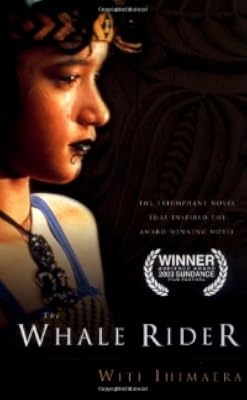
The Whale Rider
by Witi Ihimaera
On This Page
Description
As her beloved grandfather, chief of the Maori tribe of Whangara, New Zealand, struggles to lead in difficult times and to find a male successor, young Kahu is developing a mysterious relationship with whales, particularly the ancient bull whale whose legendary rider was their ancestor.Tags
Recommendations










Member Recommendations
Member Reviews
I found The Whale Rider by Witi Ihimaera an emotionally touching and inspired read. The book delves into the myth of how the Maori ancestors came to New Zealand, as well as other aspects of the Maori culture and mythology. Setting his story in modern times, he also wrote this book to appeal to his daughters who had complained that so many stories featured boys as the heroes.
As narrated by her uncle, we learn of Kahu, the first grandchild of her generation. She is cherished by everyone in the extended family except her grandfather, whom she greatly loves but who has no time for females. But after a traumatic episode of whales beaching themselves and dying, Kahu demonstrates that she has the gift to communicate with the giant creatures show more and she helps to restore one ancient giant to the ocean by using the revered tradition of riding the whale out to sea. As Kahu demonstrates her empowerment and overcomes the subtle resentment that her grandfather had directed at her, I was brought to tears.
Written in a poetic style and highlighted with Maori words (for which there is a glossary at the end of the book), I found The Whale Rider to be both a soothing and powerful read. Although marketed as a YA read, I think this book might appeal more to adults than to children. The Whale Rider is a magical book that I highly recommend. show less
As narrated by her uncle, we learn of Kahu, the first grandchild of her generation. She is cherished by everyone in the extended family except her grandfather, whom she greatly loves but who has no time for females. But after a traumatic episode of whales beaching themselves and dying, Kahu demonstrates that she has the gift to communicate with the giant creatures show more and she helps to restore one ancient giant to the ocean by using the revered tradition of riding the whale out to sea. As Kahu demonstrates her empowerment and overcomes the subtle resentment that her grandfather had directed at her, I was brought to tears.
Written in a poetic style and highlighted with Maori words (for which there is a glossary at the end of the book), I found The Whale Rider to be both a soothing and powerful read. Although marketed as a YA read, I think this book might appeal more to adults than to children. The Whale Rider is a magical book that I highly recommend. show less
This is a beautifully told, fable-like story that has moments of breathtaking loveliness and terrible pain. Little Kahu disappoints her great grandfather severely when she is born: as the first child of the oldest grandchild, she is supposed to be a boy to continue the sacred and traditional leadership of her Maori tribe. From the time that she is a baby, she exhibits preternatural wisdom, maturity, and kinship with whales, said to be primordially connected to the Maori. Kahu devotes her life to her grandfather, who pushes her gruffly to the side until her fateful 8th year, when her gifts emerge to save an ancient whale AND her people. The story weaves Maori history and mythology with more modern issues of racism, discrimination, and show more conflict between the old ways and the modern world.
Curriculum: this book would be a great addition to a secondary-level multi-cultural mythology class or unit. How are the myths of the world similar and different?
Ihimaera, W. (2003). The whale rider. Orlando: Harcourt. show less
Curriculum: this book would be a great addition to a secondary-level multi-cultural mythology class or unit. How are the myths of the world similar and different?
Ihimaera, W. (2003). The whale rider. Orlando: Harcourt. show less
Such a beautiful, challenging book. Witi Ihimaera weaves a lush story, combining land and sea, past and present. The tragic scenes were incredibly heartbreaking--between Kahu's one-sided relationship with Koro and when the whales beach themselves, I about started crying at my work desk. And the triumphs were equally brilliant--as fluid and swift as the feeling evoked as the whales sliced through the sea.
I would like to wonder out loud though as to the general designation of this book as children's literature. In the primary library in which I work, we shelve it as "J"...generally, chapter books for grade school and middle school readers. Ihimaera uses a reasonable amount of very erudite language that I imagine would be challenging even show more for some adult readers, and he addresses some rather adult issues of race and poaching through the novel's narrator, Kahu's Uncle Rawiri. I'm thinking specifically of two scenes: 1) The hit-and-run that occurs in Papua New Guinea when Rawiri's white friend, Jeff, hits and kills a native (and friend) on the side of the road with his family's car, and the family urges him to drive on because "It's only a native," and the tribe might seek retribution; and 2) The horrific and immensely sad scene when a herd of 200 whales beach themselves and poachers come to dismember the bodies before they've actually died.
I wonder sometimes what differentiates a children's book from an adult book. Just because Kahu is an 8-year-old doesn't mean necessarily that it should be a book for 8-year-olds (I wouldn't suggest a child read Bastard out of Carolina just because it has a young protagonist). I think this book has definite crossover appeal along the lines of To Kill a Mockingbird, and after viewing the movie after reading this book, I can see how they toned down a lot of the various conflict in the book to make it more kid-friendly. But that's the movie, which is great in its own right, and this is the book. Other libraries consider it a Young Adult book, but in a general sense of its audience, would a teen want to read a book in which its main character only reaches the age of 8? I haven't done any research yet into this question, but I wonder if Ihimaera intended for The Whale Rider to be a children's book or if this was the publisher's marketing idea? Hmmm...just some questions.
Despite all this(!), I really did truly enjoy the book, especially for its insight on Maori culture, the ecological concerns of a world very different from mine, and the bravery and persistence of Kahu. I would absolutely recommend it, focusing on more mature readers.
-----
Yay! The BBC World Book Club interviewed Witi Ihimaera and used one of my questions! Ihimaera provides a moving and eye-opening commentary about the book--you should check it out. show less
I would like to wonder out loud though as to the general designation of this book as children's literature. In the primary library in which I work, we shelve it as "J"...generally, chapter books for grade school and middle school readers. Ihimaera uses a reasonable amount of very erudite language that I imagine would be challenging even show more for some adult readers, and he addresses some rather adult issues of race and poaching through the novel's narrator, Kahu's Uncle Rawiri. I'm thinking specifically of two scenes: 1) The hit-and-run that occurs in Papua New Guinea when Rawiri's white friend, Jeff, hits and kills a native (and friend) on the side of the road with his family's car, and the family urges him to drive on because "It's only a native," and the tribe might seek retribution; and 2) The horrific and immensely sad scene when a herd of 200 whales beach themselves and poachers come to dismember the bodies before they've actually died.
I wonder sometimes what differentiates a children's book from an adult book. Just because Kahu is an 8-year-old doesn't mean necessarily that it should be a book for 8-year-olds (I wouldn't suggest a child read Bastard out of Carolina just because it has a young protagonist). I think this book has definite crossover appeal along the lines of To Kill a Mockingbird, and after viewing the movie after reading this book, I can see how they toned down a lot of the various conflict in the book to make it more kid-friendly. But that's the movie, which is great in its own right, and this is the book. Other libraries consider it a Young Adult book, but in a general sense of its audience, would a teen want to read a book in which its main character only reaches the age of 8? I haven't done any research yet into this question, but I wonder if Ihimaera intended for The Whale Rider to be a children's book or if this was the publisher's marketing idea? Hmmm...just some questions.
Despite all this(!), I really did truly enjoy the book, especially for its insight on Maori culture, the ecological concerns of a world very different from mine, and the bravery and persistence of Kahu. I would absolutely recommend it, focusing on more mature readers.
-----
Yay! The BBC World Book Club interviewed Witi Ihimaera and used one of my questions! Ihimaera provides a moving and eye-opening commentary about the book--you should check it out. show less
Maori chief Koro Apirana is an old man who feels his health and strength fading. He is desperate to have an heir of his own blood to pass on the things the next leader must know. But when his grandson produces the first child of the next generation, it is a disappointing girl. Koro vows to have nothing to do with her and to look outside his immediate family for the next heir.
The girl, Kahu, makes her great grandfather the center of her life and loves him like no other. She also has inherited some of the mystical Maori powers – apparently she can speak to the whales, echoing the Maori legend of Paikea who led his people to New Zealand on the back of a whale.
The story is told by Rawiri, Kahu’s uncle who is finding his own balance show more between the Maori traditions and the modern world. At one point he goes to work in Papua New Guinea, where, he finds that although the plantation owner’s son is his best friend, other dark-skinned people in the country are treated poorly.
The third set of characters are a pod of whales – we are inside the pod and hear their thoughts as they travel from the Antarctic northward to the fateful island of New Zealand.
This is much more than a children’s story, although it is often depicted as such. It’s a beautiful combination of the exquisitely sad and the beautiful with a strong element of humor thrown in (Go Nanny Flowers!) , which as the author says in an interview, is like “putting an arrow in the bum”(shooting someone with an arrow in the ass) to keep it from being too overwhelming to read.
5 stars with a few tears at the end. show less
The girl, Kahu, makes her great grandfather the center of her life and loves him like no other. She also has inherited some of the mystical Maori powers – apparently she can speak to the whales, echoing the Maori legend of Paikea who led his people to New Zealand on the back of a whale.
The story is told by Rawiri, Kahu’s uncle who is finding his own balance show more between the Maori traditions and the modern world. At one point he goes to work in Papua New Guinea, where, he finds that although the plantation owner’s son is his best friend, other dark-skinned people in the country are treated poorly.
The third set of characters are a pod of whales – we are inside the pod and hear their thoughts as they travel from the Antarctic northward to the fateful island of New Zealand.
This is much more than a children’s story, although it is often depicted as such. It’s a beautiful combination of the exquisitely sad and the beautiful with a strong element of humor thrown in (Go Nanny Flowers!) , which as the author says in an interview, is like “putting an arrow in the bum”(shooting someone with an arrow in the ass) to keep it from being too overwhelming to read.
5 stars with a few tears at the end. show less
Koro Apirana is disappointed to learn that his first great-grandchild is a girl, Kahu. But Kahu grows into a young child determined to get her great-grandfather to love her.
I read this book to fulfill one of Book Riot's "Read Harder" challenges for 2019; it was listed on their website as an example for a specific category. I thought it sounded interesting and was even more pleased to learn it's considered a children's book, since that could be helpful for my job (recommending books to kids is a big part of being a children's librarian!). In the introduction to the book, the author explains how he wrote this book in part for his young daughters who were sick of seeing only boys as the heroes in narratives. So this all seemed show more promising.
Unfortunately, it was pretty disappointing. Ihimaera's way of writing a strong female character fell precisely into the same trap that so many men fall into -- basically making the girl into a boy. Literally, there is a story given of the ancestor who prayed to the gods to become a man in order to overcome a perilous situation. This is referenced numerous times, including at this book's climax when Kahu's great-grandmother declares "If you think you need the help, well, I shall change myself into a man." Kahu herself is named after a male ancestor and is constantly trying to sneak herself into male-centric activities (e.g., listening outside the door of classes designed only for the men in the tribe). Further, the whole story isn't even told from Kahu's perspective; instead it's mainly told from the first-person point of view by her uncle Rawiri, a grown man.
Which brings me to my second point -- this doesn't really seem to be a children's book. Even though Kahu is the book's nominal hero, she isn't the narrator and we spend a lot of time with Rawiri when he isn't even around Kahu. This includes an interlude in which he travels first to Australia and then to Papua New Guinea, where he witnesses the casual murder of a "native." Other scenarios are also disturbing (including the gory cutting up of whales), and some of the language is suggestive and not exactly appropriate for young children. For instance, note this passage towards the end of the book: "The old mother whale began in a three-tone sequence drenched with love. 'My dear lord,' she continued, adding a string of harmonics. 'My man,' she breathed with slyness, threading her words with sensuous major arpeggios, 'the rider you carry isn't Paikea.' The other female whales edged away carefully, but they secretly admired the courage of the old mother whale in questioning the identity of the whale rider. ... The old mother whale cast her eyes downward, hoping that the bull whale would take this as a sign of feminine submission, but she knew, in fact, what she was up to. 'No, no, my lord,' she belled sweetly. The other female whales gasped at the old mother whale's stubbornness. The warrior whales waited for the word from their leader to teach her a lesson." And, yes, even the whales are in a strict patriarchy (with some rather disturbing implications)! The prose can in fact be quite beautiful at times, but the language seems to be above the vocabulary knowledge held by your average 8-year-old (the age of Kahu at the end of the book).
The story itself is layered with mythology, which could be interesting. However, it was so apparent from beginning to end what all would happen that it held no compelling reason to keep reading. I found myself putting it down a lot after only a few pages; even though it's a short book, it took me a while to finish it as a result. show less
I read this book to fulfill one of Book Riot's "Read Harder" challenges for 2019; it was listed on their website as an example for a specific category. I thought it sounded interesting and was even more pleased to learn it's considered a children's book, since that could be helpful for my job (recommending books to kids is a big part of being a children's librarian!). In the introduction to the book, the author explains how he wrote this book in part for his young daughters who were sick of seeing only boys as the heroes in narratives. So this all seemed show more promising.
Unfortunately, it was pretty disappointing. Ihimaera's way of writing a strong female character fell precisely into the same trap that so many men fall into -- basically making the girl into a boy. Literally, there is a story given of the ancestor who prayed to the gods to become a man in order to overcome a perilous situation. This is referenced numerous times, including at this book's climax when Kahu's great-grandmother declares "If you think you need the help, well, I shall change myself into a man." Kahu herself is named after a male ancestor and is constantly trying to sneak herself into male-centric activities (e.g., listening outside the door of classes designed only for the men in the tribe). Further, the whole story isn't even told from Kahu's perspective; instead it's mainly told from the first-person point of view by her uncle Rawiri, a grown man.
Which brings me to my second point -- this doesn't really seem to be a children's book. Even though Kahu is the book's nominal hero, she isn't the narrator and we spend a lot of time with Rawiri when he isn't even around Kahu. This includes an interlude in which he travels first to Australia and then to Papua New Guinea, where he witnesses the casual murder of a "native." Other scenarios are also disturbing (including the gory cutting up of whales), and some of the language is suggestive and not exactly appropriate for young children. For instance, note this passage towards the end of the book: "The old mother whale began in a three-tone sequence drenched with love. 'My dear lord,' she continued, adding a string of harmonics. 'My man,' she breathed with slyness, threading her words with sensuous major arpeggios, 'the rider you carry isn't Paikea.' The other female whales edged away carefully, but they secretly admired the courage of the old mother whale in questioning the identity of the whale rider. ... The old mother whale cast her eyes downward, hoping that the bull whale would take this as a sign of feminine submission, but she knew, in fact, what she was up to. 'No, no, my lord,' she belled sweetly. The other female whales gasped at the old mother whale's stubbornness. The warrior whales waited for the word from their leader to teach her a lesson." And, yes, even the whales are in a strict patriarchy (with some rather disturbing implications)! The prose can in fact be quite beautiful at times, but the language seems to be above the vocabulary knowledge held by your average 8-year-old (the age of Kahu at the end of the book).
The story itself is layered with mythology, which could be interesting. However, it was so apparent from beginning to end what all would happen that it held no compelling reason to keep reading. I found myself putting it down a lot after only a few pages; even though it's a short book, it took me a while to finish it as a result. show less
It’s very unusual for me to read a book that I’ve already seen the movie for. However, it’s been some time since I’ve seen The Whale Rider movie and this audio was a freebie from the YA Sync Summer Program so I decided to give it a try. I’m so glad I did. It was a whale of a tale!!! (Sorry couldn’t resist : P).
This audio was sheer perfection! The narration, the music, the story…the whole thing was just lovely and just as good (at times even better) than the movie. The narrator and music really gave the story that extra something special. It felt like I was sitting on the couch on a rainy day while my favorite uncle told me a story from his life. I loved it!
What made this story were the characters. They were all awesome show more even when they weren’t acting awesome (ahem, Koro). Their interaction and dialogue made them real. I know I’m not expressing this right, but I felt like they were my family members because I could identify their personalities with the people in my life. The stubborn grandfather reminded me of my dad. Nanny Flowers with her gentleness and spunkiness reminded me a bit of my mom.
I loved how the magic realism was integrated into the story. It was a slow integration until finally towards the end it became more of a modern day folktale. It was very simplistic in style, but still highly emotional. For example, the school scene… I was balling while driving listening to how Kahu had learned the Maori speech specifically for Koro, yet he didn’t show, and how her family stood up to support her. It still brings tears to my eyes at the years Koro wasted away.
I also loved the environmental lessons thrown in throughout the book. How humans have affected the environment by doings things like overfishing. How we have become careless of the world and have tipped the balance. These lessons are shown through the perspective of human eyes and whale eyes. I thought it made it all the more poignant and I hope that this book is featured in schools more. show less
This audio was sheer perfection! The narration, the music, the story…the whole thing was just lovely and just as good (at times even better) than the movie. The narrator and music really gave the story that extra something special. It felt like I was sitting on the couch on a rainy day while my favorite uncle told me a story from his life. I loved it!
What made this story were the characters. They were all awesome show more even when they weren’t acting awesome (ahem, Koro). Their interaction and dialogue made them real. I know I’m not expressing this right, but I felt like they were my family members because I could identify their personalities with the people in my life. The stubborn grandfather reminded me of my dad. Nanny Flowers with her gentleness and spunkiness reminded me a bit of my mom.
I loved how the magic realism was integrated into the story. It was a slow integration until finally towards the end it became more of a modern day folktale. It was very simplistic in style, but still highly emotional. For example, the school scene…
I also loved the environmental lessons thrown in throughout the book. How humans have affected the environment by doings things like overfishing. How we have become careless of the world and have tipped the balance. These lessons are shown through the perspective of human eyes and whale eyes. I thought it made it all the more poignant and I hope that this book is featured in schools more. show less
Beautifully written story about the Maori people of New Zealand and their struggle to be a part of and live in present-day New Zealand while maintaining their cultural identity. This story brings together a stubborn great Grandfather and his ignored great Granddaughter, a diverse group of people intent on saving a pod of beached whales and the Maori past with the Maori present. The history, myths, legends, and beliefs of the Maori peoples are brought to life through the story of Kahu and her people. Filled with the perfect touch of magical realism, this book is a magical read!
Members
- Recently Added By
Lists

Native American / Indigenous Literature
172 works; 100 members

Recommend the 20 best books you've read in the last five years
2,168 works; 608 members

Read the book and saw the movie
1,170 works; 195 members

1001 Children's Books You Must Read Before You Grow Up
774 works; 101 members

A Child's Book Tour of New Zealand
67 works; 4 members

Pacific Islander Literature
21 works; 1 member

Books We Love to Reread
695 works; 298 members

BBC World Book Club
267 works; 5 members

Big Jubilee List
70 works; 3 members

Magic Realism
371 works; 52 members

Books with Twins
175 works; 12 members

Childhood: Books for or about children in different cultures around the wor
345 works; 18 members

Twins, fantasy -- children's/young adult fiction
62 works; 6 members

Best of World Literature
437 works; 52 members

Books Read in 2016
4,666 works; 197 members

1980s
356 works; 23 members

Reading Globally
136 works; 16 members

Short and Sweet
246 works; 24 members

Australia, New Zealand and Oceania
88 works; 20 members

World Book Club (BBC World Service)
212 works; 1 member
Talk Discussions
Past Discussions
ANZAC Author Challenge June 2015- Kim Scott & Witi Ihimaera in 75 Books Challenge for 2015 (July 2015)
Author Information

74+ Works 2,830 Members
Witi Ihimaera was born in Gisborne, New Zealand on February 7, 1944 into a Maori family of Mormons. After completing a B.A. in English, he worked as a journalist in New Zealand and started writing fiction. His first collection of short stories, Pounamu Pounamu, was published in 1972 and his first novel, Tangi, was published in 1973. His other show more works include Whanau, The Matriarch, The Whale Rider, The Dream Swimmer, Sky Dancer, The Trowenna Sea, and The Parihaka Woman. In 1982 he coedited an anthology of Maori writing, Into the World of Light, and continues to be a champion of literature in English by Maoris. In 2015 his title's Maori Boy: A Memoir and White Lies made The New Zealand Best Seller List and in 2016 it won the New Zealand Award general nonfiction award. (Bowker Author Biography) show less
Some Editions
Awards and Honors
Awards
Distinctions
Series
Belongs to Publisher Series
Work Relationships
Is contained in
Has the adaptation
Is abridged in
Common Knowledge
- Canonical title*
- Valasratsastaja
- Original title
- The Whale Rider
- Original publication date
- 1987
- People/Characters
- Kahu; Koro Apirana; Nanny Flowers; Rawiri
- Important places
- North Island, New Zealand; New Zealand
- Related movies
- Whale Rider (2002 | IMDb)
- Epigraph
- Kia hora te marino
Kia whakapa pounamu te moana
Kia tere te karohirohi
I mua i tou huarahi
May the calm be widespread
May the ocean glisten as greenstone
May the shimmer of light
Ever dance acr... (show all)oss your pathway - Dedication
- For Jessica Kiri and Olivia Ata, the best girls in the whole wide world
He tohu aroha ki a Whangara me nga uri o Paikea.
Thanks also to Julia Keelan, Caroline Haapu and Hekia Parata for their advice and assistan... (show all)ce - First words
- In the old days, in the years that have gone before us, the land and sea felt a great emptiness, a yearning.
- Last words
- (Click to show. Warning: May contain spoilers.)Let it be done.
*Some information comes from Common Knowledge in other languages. Click "Edit" for more information.
Classifications
- Genres
- Fiction and Literature, Kids, Young Adult
- DDC/MDS
- 823.914 — Literature & rhetoric English & Old English literatures English fiction 1900- 1901-1999 1945-1999
- LCC
- PZ7 .I273 .W — Language and Literature Fiction and juvenile belles lettres Fiction and juvenile belles lettres Juvenile belles lettres
- BISAC
Statistics
- Members
- 1,590
- Popularity
- 14,379
- Reviews
- 49
- Rating
- (3.85)
- Languages
- 10 — Dutch, English, Finnish, French, German, Hungarian, Japanese, Lithuanian, Maori, Spanish
- Media
- Paper, Audiobook, Ebook
- ISBNs
- 64
- ASINs
- 11