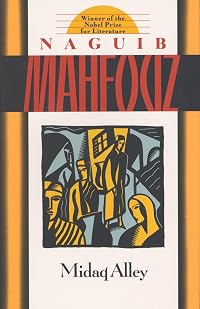
Midaq Alley
by Naguib Mahfouz
On This Page
Description
Never has Nobel Prize-winner Naguib Mahfouz's talent for rich and luxurious storytelling been more evident than in this outstanding novel, first published in Arabic in 1947. One of his most popular books (and considered by many to be one of his best), Midaq Alley centers around the residents of one of the teeming back alleys of Cairo.Tags
Recommendations












Member Recommendations
Member Reviews
A fine example of Middle Eastern storytelling. This story of life in Midaq Alley in Cairo, Egypt presents a microcosm of a small community of people who make up the community. Each person is described to us in a larger than life of soap opera style. This is the early forties, the world is engaged in the battles of WWII but other than that, the people of the alley really have little regard for the war except for how it can profit them, either as employees of the British or the black market. This book presents a people of Islamic faith but also as they are being influenced by Western ideas. This is a time before the rebellion against Western influence has progressed to where it is today. It was an easy read with humor but lots of truths show more that are timeless. show less
I love stories that feature an ensemble cast such as this. Midaq Alley is but one of many such small streets in Cairo. The residents form a microcosm of society – you have amoral profiteers and paragons of virtue, young and old, the beautiful and the deformed, hard workers and lazy ne’er-do-wells.
Over the course of the novel residents of the Alley fall in love, endure heartbreak, commit crimes, fall for promises, take chances at new adventures, become ill, and simply move on with their lives. The characters are frequently seduced by their hopes: If only I had … a husband, a title, nicer clothes, a better flat…etc.
The setting is 1940s Cairo, and the characters are definitely aware of Hitler and WW2. Still, the war is “out show more there” and what is most important to these characters is what is happening in Midaq Alley. Mahfouz’s writing is wonderfully atmospheric – I could smell the bread baking, or the hair oil used by the barber; hear the cacophony of sound in a busy public square; see the colors and movement of people gathering in a café. show less
Over the course of the novel residents of the Alley fall in love, endure heartbreak, commit crimes, fall for promises, take chances at new adventures, become ill, and simply move on with their lives. The characters are frequently seduced by their hopes: If only I had … a husband, a title, nicer clothes, a better flat…etc.
The setting is 1940s Cairo, and the characters are definitely aware of Hitler and WW2. Still, the war is “out show more there” and what is most important to these characters is what is happening in Midaq Alley. Mahfouz’s writing is wonderfully atmospheric – I could smell the bread baking, or the hair oil used by the barber; hear the cacophony of sound in a busy public square; see the colors and movement of people gathering in a café. show less
A soap opera set in 1940s Cairo.
This book made for an interesting book group discussion but I can't say I particularly enjoyed reading it. It seemed to lack flow and was more of a diary of events than a novel, in my opinion.
It's a bit of a cast of thousands, nineteen according to Wikipedia, and they were confusing to grasp at first. Thank goodness for the Kindle's ability to search back for key-words.
All the characters come from the same poverty stricken alley in Cairo in the 1940s. Everyone strives for something better but no-one really achieves their aim. Two characters go off to fight for the British Army and that brings them wealth initially, but it is curtailed by the end of WWII. The factory owner is doing well but his health show more lets him down...and so on...one tale of woe after another.
I was horrified by one character, Zaita, the cripple-maker. Who would choose to be blinded or crippled just to make them a more effective beggar? They were then obliged to pay Zaita a cut of their earnings in return for his services.
I think it was the extreme nature of the characters that resulted in my failure to connect with them. Each one was more of a cartoon character than someone from a book.
However, I'm sure I now have a better understanding of life in Cairo at that time and I don't regret the time spent reading the novel. show less
This book made for an interesting book group discussion but I can't say I particularly enjoyed reading it. It seemed to lack flow and was more of a diary of events than a novel, in my opinion.
It's a bit of a cast of thousands, nineteen according to Wikipedia, and they were confusing to grasp at first. Thank goodness for the Kindle's ability to search back for key-words.
All the characters come from the same poverty stricken alley in Cairo in the 1940s. Everyone strives for something better but no-one really achieves their aim. Two characters go off to fight for the British Army and that brings them wealth initially, but it is curtailed by the end of WWII. The factory owner is doing well but his health show more lets him down...and so on...one tale of woe after another.
I was horrified by one character, Zaita, the cripple-maker. Who would choose to be blinded or crippled just to make them a more effective beggar? They were then obliged to pay Zaita a cut of their earnings in return for his services.
I think it was the extreme nature of the characters that resulted in my failure to connect with them. Each one was more of a cartoon character than someone from a book.
However, I'm sure I now have a better understanding of life in Cairo at that time and I don't regret the time spent reading the novel. show less
This book was my introduction to Egyptian writers in general, and Nobel Prize winner Mahfouz in specific. In this book, I found him a gifted story-teller to whom I will definitely return.
This novel is told as a series of interlocking stories that portray the lives of a small group of individuals over a short period of time during the waning days of World War II. The stories are set in Midaq Alley, a poor backstreet in Cairo. As the book unfolds, you realize that the alley is a small village within the city; its inhabitants live, socialize, work and marry largely within its confines. Some embrace this sense of community; some feel confined and struggle to escape. The alley, itself, might almost be considered the major character of the show more book. Mahfouz fills it with a character of its own: shabby, cynical, vibrant, faintly corpulent. It seems to sit there, observing the individuals that run about within it, loving them in its own distant way. This sense of intimacy made me feel that I was watching the events through the alley's eyes in an odd sort of first person narrative.
There is a vibrance to the human characters who populate this story. Each individual, major or minor, is drawn with a keen eye for detail, with affection for their strengths, humor for their foibles and a lack of judgment for their flaws. I felt I knew each of these characters intimately: the inconstant Hamida, ruthless in her desire for wealth and luxury; responsible and kind Abbas, content with his life in the alley but willing to give it up for love; Kirsha, owner of the café, married but with a predilection for young men; Saniya, the miserly landlord obsessed with finding a younger husband; Zaita, the cripple maker who feels nothing but contempt for all but Husniya, the baker who beats her husband.
The social changes as Egypt struggles with a modern era, the side-effects with Western cultural imperialism, the role of religious faith in life, all of these provide an unobtrusive background as Mahfouz circulates among his creations, advancing each of their stories bit by bit as the novel progresses. The inherent inter-connectedness of their lives causes their stories to brush against each other until he draws them together in an ending that, though containing sadness, was never bleak or unsatisfying.
Highly recommended. show less
This novel is told as a series of interlocking stories that portray the lives of a small group of individuals over a short period of time during the waning days of World War II. The stories are set in Midaq Alley, a poor backstreet in Cairo. As the book unfolds, you realize that the alley is a small village within the city; its inhabitants live, socialize, work and marry largely within its confines. Some embrace this sense of community; some feel confined and struggle to escape. The alley, itself, might almost be considered the major character of the show more book. Mahfouz fills it with a character of its own: shabby, cynical, vibrant, faintly corpulent. It seems to sit there, observing the individuals that run about within it, loving them in its own distant way. This sense of intimacy made me feel that I was watching the events through the alley's eyes in an odd sort of first person narrative.
There is a vibrance to the human characters who populate this story. Each individual, major or minor, is drawn with a keen eye for detail, with affection for their strengths, humor for their foibles and a lack of judgment for their flaws. I felt I knew each of these characters intimately: the inconstant Hamida, ruthless in her desire for wealth and luxury; responsible and kind Abbas, content with his life in the alley but willing to give it up for love; Kirsha, owner of the café, married but with a predilection for young men; Saniya, the miserly landlord obsessed with finding a younger husband; Zaita, the cripple maker who feels nothing but contempt for all but Husniya, the baker who beats her husband.
The social changes as Egypt struggles with a modern era, the side-effects with Western cultural imperialism, the role of religious faith in life, all of these provide an unobtrusive background as Mahfouz circulates among his creations, advancing each of their stories bit by bit as the novel progresses. The inherent inter-connectedness of their lives causes their stories to brush against each other until he draws them together in an ending that, though containing sadness, was never bleak or unsatisfying.
Highly recommended. show less
The more I read of Mahfouz, the more confused I grow. I have read excellent works and I have read works that I considered a waste of time. I chose this work specifically as one I had somehow overlooked and which has a very good reputation. The plot revolves around a large cast of individuals who live or work in this tiny alley in Cairo during World War II. The book is no more or less than the story of these and a number of other lives. Mahfouz’s themes are numerous: religion, marriage, gender roles, and even Egyptian nationalism. But overriding them all, perhaps is the economics of wealth and poverty. Indeed, Mahfouz is said to have acknowledged that Hamida, whose desperation to leave the alley ends in tragedy, is a metaphor for Egypt show more itself. The characters are very well-drawn and complex but I found not one of them particularly sympathetic. Sadly, they often seemed more pitiful than unfortunate. Mahfouz doesn’t judge—a strength of his writing and his depictions—but ultimately I found this more depressing and disappointing than anything else. [Trivia: this was made into a Mexican film, El Callejón de los Milagros, starring Salma Hayek. It won a substantial number of awards in many Spanish-speaking countries.] show less
Mahfuz inserisce il romanzo in un’unita spaziale precisa, come se in realtà fosse il Vicolo stesso, anziché la folta schiera di personaggi, il vero protagonista del romanzo. E’ l’immobilità (del tempo, della società, delle persone), il punto cruciale del romanzo. Vite intere scorrono nel Vicolo, come in un’isola fuori dal tempo. Tutti i personaggi che orbitano intorno ad esso vivono il proprio dramma personale: i ricchi vivono il disagio familiare o il problema dell’identità sessuale, i poveri lottano per una posizione più elevata, cercando di conquistarla con mezzi ambigui. Chi attraverso la guerra, quella che si crede infinita, contro Hitler, fonte di fortuna inaspettata (saranno poi gli stessi personaggi ad show more autocriticarsi per il fatto di gioire di qualcosa di così orribile). E chi, come Hamida, la giovane opportunista, che cerca fortuna come prostituta, rompendo gli impegni d’amore presi, per lei veramente poco importanti. Tutto questo non può che portare al dramma finale, ma anche di questo il Vicolo si fa beffe e in pochi giorni tutto è passato e tutto resta immobile.
Lo stile di Mahfuz è immersivo e delicato, riuscendo a dipingere Il Cairo nei suoi colori e odori. La gestione dei molti personaggi è fluida e lo stacco tra uno e l’altro non comporta noia o disorientamento, come in altri autori. show less
Lo stile di Mahfuz è immersivo e delicato, riuscendo a dipingere Il Cairo nei suoi colori e odori. La gestione dei molti personaggi è fluida e lo stacco tra uno e l’altro non comporta noia o disorientamento, come in altri autori. show less
Mahfuz inserisce il romanzo in un’unita spaziale precisa, come se in realtà fosse il Vicolo stesso, anziché la folta schiera di personaggi, il vero protagonista del romanzo. E’ l’immobilità (del tempo, della società, delle persone), il punto cruciale del romanzo. Vite intere scorrono nel Vicolo, come in un’isola fuori dal tempo. Tutti i personaggi che orbitano intorno ad esso vivono il proprio dramma personale: i ricchi vivono il disagio familiare o il problema dell’identità sessuale, i poveri lottano per una posizione più elevata, cercando di conquistarla con mezzi ambigui. Chi attraverso la guerra, quella che si crede infinita, contro Hitler, fonte di fortuna inaspettata (saranno poi gli stessi personaggi ad show more autocriticarsi per il fatto di gioire di qualcosa di così orribile). E chi, come Hamida, la giovane opportunista, che cerca fortuna come prostituta, rompendo gli impegni d’amore presi, per lei veramente poco importanti. Tutto questo non può che portare al dramma finale, ma anche di questo il Vicolo si fa beffe e in pochi giorni tutto è passato e tutto resta immobile.
Lo stile di Mahfuz è immersivo e delicato, riuscendo a dipingere Il Cairo nei suoi colori e odori. La gestione dei molti personaggi è fluida e lo stacco tra uno e l’altro non comporta noia o disorientamento, come in altri autori. show less
Lo stile di Mahfuz è immersivo e delicato, riuscendo a dipingere Il Cairo nei suoi colori e odori. La gestione dei molti personaggi è fluida e lo stacco tra uno e l’altro non comporta noia o disorientamento, come in altri autori. show less
Members
- Recently Added By
Lists

1001 Books You Must Read Before You Die
1,448 works; 1,133 members

1940s
221 works; 25 members

Canon de la narrativa universal del siglo XX
254 works; 6 members

Middle East Fiction
179 works; 16 members

Harold Bloom - The Western Canon: D. The Chaotic Age
833 works; 24 members

Africa
109 works; 8 members

Books Read in 2020
4,379 works; 123 members

Books written in uncommon languages
97 works; 8 members

Arab and Arab Diaspora Literature We Recommend
112 works; 53 members
Talk Discussions
Past Discussions
Group Read, August 2015: Midaq Alley in 1001 Books to read before you die (August 2015)
Author Information

330+ Works 19,104 Members
Naguib Mahfouz was born in Cairo, Egypt on December 11, 1911. He received a degree in philosophy from the University of Cairo. He took on several civil service and government department jobs to supplement his income while writing, but retired from that career in 1971. During his lifetime, he wrote more than 30 novels including The Games of Fate, show more The Cairo Trilogy, Children of Gebelawi, The Thief and the Dogs, Autumn Quail, Small Talk on the Nile, and Miramar. He received numerous awards including the Egyptian State Prize, the Presidential Medal from the American University in Cairo, and the Nobel Prize for Literature in 1988. He died as a result of a head injury on August 30, 2006 at the age of 94. (Bowker Author Biography) show less
Some Editions
Awards and Honors
Awards
Series
Belongs to Publisher Series
Unionsverlag Taschenbuch (402)
L'eclèctica (140)
Work Relationships
Is contained in
Common Knowledge
- Canonical title
- Midaq Alley
- Original title
- زقاق المدق; Zuqaq al-Middaqq
- Original publication date
- 1947
- People/Characters*
- Hamida; Abbas al-Helwu; Kamil; Selim Alwan; Sayyid Ridwan al-Husseini; Kirsha (show all 13); Hussein Kirsha; Umm Hamida; Umm Hussein; Dottor Bushi; Zaita; Saniyya Afifi; Shaykh Darwish
- Important places
- Cairo, Egypt; Cairo
- Related movies
- El callejón de los milagros (1995 | IMDb)
- First words
- Many things combine to show that Midaq Alley is one of the gems of times gone by and that it once shone forth like a flashing star in the history of Cairo.
- Last words*
- (Click to show. Warning: May contain spoilers.)"Sì, ogni cosa ha fine, che in inglese si dice end e si scrive e.n.d.”.
- Original language
- Arabic
*Some information comes from Common Knowledge in other languages. Click "Edit" for more information.
Classifications
- Genres
- Fiction and Literature, General Fiction
- DDC/MDS
- 892.736 — Literature & rhetoric Literatures of other languages Afro-Asiatic literatures Arabic (Egypt, Lebanon, Palestine, Saudi Arabia, Sudan) Arabic fiction 1945–2000
- LCC
- PJ7846 .A46 .Z4813 — Language and Literature Oriental languages and literatures Oriental philology and literature Arabic Arabic literature Individual authors or works
- BISAC
Statistics
- Members
- 1,616
- Popularity
- 13,982
- Reviews
- 38
- Rating
- (3.81)
- Languages
- 18 — Arabic, Basque, Catalan, Danish, Dutch, English, Finnish, French, German, Indonesian, Italian, Malay, Norwegian (Bokmål), Norwegian, Portuguese, Spanish, Swedish, Turkish
- Media
- Paper, Audiobook, Ebook
- ISBNs
- 65
- ASINs
- 16