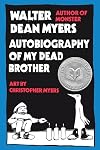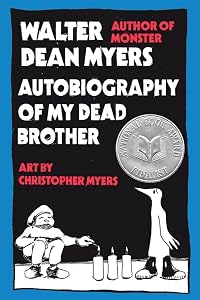
Autobiography of My Dead Brother
by Walter Dean Myers
On This Page
Description
Jesse pours his heart and soul into his sketchbook to make sense of life in his troubled Harlem neighborhood and the loss of a close friend.Tags
Recommendations






Member Reviews
Fifteen year old Jesse is struggling to navigate growing up in a violent neighborhood. A kid he grew up with, a boy he calls his “blood brother”, is taking a turn for the worse and starting to sell drugs. Jesse begins to write his autobiography as his blood brother, Rise, falls deeper into the pit of drug dealing and is eventually shot and killed. amily doesn’t have to be blood related to be family. Rise’s mother took care of Jesse since he was a baby and they’ve done a blood pact. In a sense, Jesse loses his brother before he even dies. Many kids have to face watching siblings get mixed up in the wrong crowds and get hurt.
I have read this with several groups of students and I prefer it to most of WDM's books. The addition of artwork/cartooning adds depth to the story and encourages critical reading among students. Myers sets his characters apart from those in other 'urban' tales through their sensitivity and artistry. I've often thought that if you've read one Myers novel, you've read them all. They certainly maintain a stock set of characteristics, but AOMDB was definitely above his typical par.
Colter Brantz
EDCI 4120/5120
Meyers, Walter Dean. (2005). Autobiography of My Dead Brother. New York: Harper Collins.
Grade Levels: 8-10
Category: Realistic Fiction
Read-Alouds: 15-28 (Rise, Jesse, & Mason) 57-63 (Mason in Iron City) 193-212 (Can boys cry?)
Summary: Jesse is a talented young artist growing up in an increasingly rough neighborhood in Harlem. His best friend/blood brother Rise seems to be mimicking the path of the neighborhood in which the two boys were raised—as it gets tougher so does Rise. The boys are involved in a social club called the “Counts,” which is rapidly turning from club to gang. One of the group’s members, Mason, was imprisoned for robbing a bodega, and even though his guilt or innocence is never really show more clear, Mason and the Counts are seen as social ills. As the book progresses we find that Rise is growing more and more distant from Jesse, and closer and closer to the violent and corruptive forces in Harlem. Throughout the book, Jesse illustrates a biography of Rise that clearly depicts his descent into evil. By the time that Rise recognizes the errors in his lifestyle it is too late and he is gunned down in front of Jesse and their mutual friends.
Themes: A primary theme in this book is the possible effect that environment can play on an individual, and also how the same environment has different effects on different people. Additionally, by way of multiple shootings and subsequent funerals, the nature of gang violence is clearly presented as senseless and ceaseless. Last, despite social forces, all people make of their lives, or biographies, whatever they themselves choose.
Discussion Questions:
What role does Sydney play in this story? Is it significant that the only law enforcement shown in the book is a black man?
What does the lack of clarity in Mason’s legal troubles suggest about the politics in Harlem?
What is the significance of the fact that Little Man was crying when the police found him after he shot Rise? Why is Jesse angry that the paper printed this detail?
Why is the book titled Autobiography of My Dead Brother instead of Biography…?
Reader Response: Overall, the book seemed to have a clear social and intellectual purpose that guided the story. I have a problem with this in that the story is forced to play a secondary role to authorial purpose, and I think that this is a mistake in priority. A great deal of the language in the text, and in the dialogue, felt forced and somewhat false. That said, I appreciate what it was that the story attempted to present, and I also appreciate the use of the title as a guidepost for finding the meaning of the book. Upon the reader’s recognition that the biography that Jesse writes about Rise is truly written by Rise’s actions, it becomes clear that Meyers wants the reader to understand that people write their own stories, and create their own endings. Rise wrote his ending by virtue of the choices that he made throughout the text. show less
EDCI 4120/5120
Meyers, Walter Dean. (2005). Autobiography of My Dead Brother. New York: Harper Collins.
Grade Levels: 8-10
Category: Realistic Fiction
Read-Alouds: 15-28 (Rise, Jesse, & Mason) 57-63 (Mason in Iron City) 193-212 (Can boys cry?)
Summary: Jesse is a talented young artist growing up in an increasingly rough neighborhood in Harlem. His best friend/blood brother Rise seems to be mimicking the path of the neighborhood in which the two boys were raised—as it gets tougher so does Rise. The boys are involved in a social club called the “Counts,” which is rapidly turning from club to gang. One of the group’s members, Mason, was imprisoned for robbing a bodega, and even though his guilt or innocence is never really show more clear, Mason and the Counts are seen as social ills. As the book progresses we find that Rise is growing more and more distant from Jesse, and closer and closer to the violent and corruptive forces in Harlem. Throughout the book, Jesse illustrates a biography of Rise that clearly depicts his descent into evil. By the time that Rise recognizes the errors in his lifestyle it is too late and he is gunned down in front of Jesse and their mutual friends.
Themes: A primary theme in this book is the possible effect that environment can play on an individual, and also how the same environment has different effects on different people. Additionally, by way of multiple shootings and subsequent funerals, the nature of gang violence is clearly presented as senseless and ceaseless. Last, despite social forces, all people make of their lives, or biographies, whatever they themselves choose.
Discussion Questions:
What role does Sydney play in this story? Is it significant that the only law enforcement shown in the book is a black man?
What does the lack of clarity in Mason’s legal troubles suggest about the politics in Harlem?
What is the significance of the fact that Little Man was crying when the police found him after he shot Rise? Why is Jesse angry that the paper printed this detail?
Why is the book titled Autobiography of My Dead Brother instead of Biography…?
Reader Response: Overall, the book seemed to have a clear social and intellectual purpose that guided the story. I have a problem with this in that the story is forced to play a secondary role to authorial purpose, and I think that this is a mistake in priority. A great deal of the language in the text, and in the dialogue, felt forced and somewhat false. That said, I appreciate what it was that the story attempted to present, and I also appreciate the use of the title as a guidepost for finding the meaning of the book. Upon the reader’s recognition that the biography that Jesse writes about Rise is truly written by Rise’s actions, it becomes clear that Meyers wants the reader to understand that people write their own stories, and create their own endings. Rise wrote his ending by virtue of the choices that he made throughout the text. show less
I really liked this book because it will speak to the reality that many of the students in my school live in and it is written in a way that even the most reluctant readers will take to. The story revolves around two childhood friends, now teenagers, in present day Harlem. Rise who is two years older than Jesse has started down the gang path and as the two friends take different paths, Jesse struggles to keep the memory of his “old” friend’s persona alive. Jesse is a talented illustrator and he uses drawing as a way to cope with the changes and challenges of his life. Walter Dean Myers paints a vivid, not always pretty picture of life in the inner city. The illustrations and comic strips in the book add depth to the reader’s show more understanding of the characters’ lives and an added plus for reluctant readers. show less
Jesse narrates the story of young men in his neighborhood and what it's like to get involved in gangs, drugs, and life on the street. Jesse and his friends are relatively easy to associate with, and it is interesting to watch their emotional growth as they watch events unfold in their neighborhood. It takes place in present day Harlem, which is crucial to the story. The theme is the general search for an independent identity, which Jesse gains from watching his friends' actions and learning from their mistakes. The writing style Myers uses expresses the lingo of the streets, and shows the double personalities of young people when they associate with their peers and their superiors. The illustrations that are included to demonstrate show more Jesse's drawings are essential to the story and show the emotion and thought he puts in to his art. It is a great representation of the roles gender and culture play in a teenager's life, and I would include it in my collection. show less
Walter Dean Myers has created a stark and sadly realistic novel of urban youth. Growing up is hard and changing blood brothers and best friends, Jesse and Rise, in different ways. Jesse has his “art thing” to focus on and keep him above the street, but what does Rise have? Rise has power and commands respect that’s why he wants Jesse to write his biography. Jesse puts it down on paper and Rise tells like it is. As Jesse writes his best friend’s biography he realizes how little he knows of the man his friend has become. When Rise starts getting on with drug dealers and hustlers Jesse tries to speak to him through his writing and drawings. This novel is an incredible, gut-wrenching and fast paced read recommended for high schoolers.
Amazing book that's an eye opener about the culture in Harlem or any poor neighborhood with high crime. Gritty realism, brilliant writing with compelling characters. For readers of all ages.
Members
- Recently Added By
Author Information

150+ Works 38,487 Members
Walter Dean Myers was born on August 12, 1937 in Martinsberg, West Virginia. When he was three years old, his mother died and his father sent him to live with Herbert and Florence Dean in Harlem, New York. He began writing stories while in his teens. He dropped out of high school and enlisted in the Army at the age of 17. After completing his army show more service, he took a construction job and continued to write. He entered and won a 1969 contest sponsored by the Council on Interracial Books for Children, which led to the publication of his first book, Where Does the Day Go? During his lifetime, he wrote more than 100 fiction and nonfiction books for children and young adults. His works include Fallen Angels, Bad Boy, Darius and Twig, Scorpions, Lockdown, Sunrise Over Fallujah, Invasion, Juba!, and On a Clear Day. He also collaborated with his son Christopher, an artist, on a number of picture books for young readers including We Are America: A Tribute from the Heart and Harlem, which received a Caldecott Honor Award, as well as the teen novel Autobiography of My Dead Brother. He was the winner of the first-ever Michael L. Printz Award for Monster, the first recipient of the Coretta Scott King-Virginia Hamilton Award for Lifetime Achievement, and a recipient of the Margaret A. Edwards Award for lifetime achievement in writing for young adults. He also won the Coretta Scott King Award for African American authors five times. He died on July 1, 2014, following a brief illness, at the age of 76. (Bowker Author Biography) show less
All Editions
Awards and Honors
Awards
Distinctions
Notable Lists
Work Relationships
Has as a student's study guide
Common Knowledge
- Important places
- Harlem, New York, New York, USA
Classifications
- Genres
- Teen, Fiction and Literature, Young Adult
- DDC/MDS
- 813.54 — Literature & rhetoric American literature in English American fiction in English 1900-1999 1945-1999
- LCC
- PZ7 .M992 .A — Language and Literature Fiction and juvenile belles lettres Fiction and juvenile belles lettres Juvenile belles lettres
- BISAC
Statistics
- Members
- 423
- Popularity
- 73,238
- Reviews
- 19
- Rating
- (3.94)
- Languages
- English
- Media
- Paper, Audiobook, Ebook
- ISBNs
- 11
- ASINs
- 4