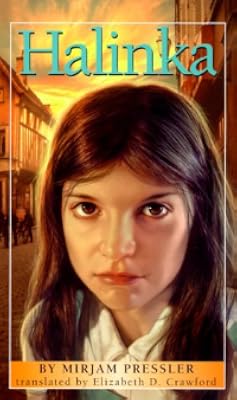
Halinka
by Mirjam Pressler
On This Page
Description
While living in a home for emotionally disturbed girls in Germany just after World War II, twelve-year-old Halinka carefully hides her thoughts, feelings, and even her hopes.Tags
Recommendations
















Member Recommendations
by meggyweg
Member Reviews
Halinka lives in a "home," an orphanage, of sorts, in post-WW2 Germany. Her mother was abusive, but she longs to live with her aunt, whom she describes as loving and wanting to take care of Halinka but can't until she finds a husband. Halinka hesitates to make friends in the home because she believes opening up to people will lead to pain, but she slowly learns that that's not always the case.
This is not exactly a happy story, but it does end on a hopeful upturn. It's well-written, despite Halinka being a little too observant and articulate for her age (a constant issue with middle grade books written in the first person), and the characters are very nicely drawn. I love that certain plot points are left unresolved when resolving them show more would have made the ending too pat and saccharine. As it stands, the story is perhaps a bit darker than it would have been, but much more realistic and satisfactory. Halinka is a complicated little girl, and I love her for it. show less
This is not exactly a happy story, but it does end on a hopeful upturn. It's well-written, despite Halinka being a little too observant and articulate for her age (a constant issue with middle grade books written in the first person), and the characters are very nicely drawn. I love that certain plot points are left unresolved when resolving them show more would have made the ending too pat and saccharine. As it stands, the story is perhaps a bit darker than it would have been, but much more realistic and satisfactory. Halinka is a complicated little girl, and I love her for it. show less
This was a perfect comfort read, especially for my 10-year-old self. I’m sure it would have been a favorite book of mine around that time.
I was immediately engaged. It was a very quick read and hard to put down.
I adore the narrator main character, with her strengths and flaws. I appreciate that she’s a reader, and thoughtful and introspective, and a survivor, and that she’s not always honest. In other words, she seems so real. I also like that the reader gets to know quite a bit about the other children in the home and things about some of the adults too. I also appreciated that a lot is left unknown and up to the readers’ imaginations and guesses. I think the way the story showed the girls and how they coped with their show more situations was very authentic. The characters are truly three-dimensional and have depth, the children and the adults too. The latter often isn’t the case in children’s books.
It reminded me a bit of The Secret Language though I thought this book was better than that one.
I felt emotionally touched, I was always interested, and I sometimes got hungry, typical of me when I’m reading books where food is described in great detail, especially when there are hungry characters and characters not getting quite enough food or not normally getting to choose what they eat.
The inside book cover mentions that the girls (in Halinka’s room) are 12 (well they’re in two grades so I’d guess different ages by at least a year) but they did seem a bit younger to me. Maybe 10? Maybe 11? Given their backgrounds and circumstances and given that this is historical fiction and not contemporary, I guess they could seem a bit younger to me than they are.
I’m not taking off any stars but there were things that bother me, such as the fat shaming, though in these girls’ cases, getting not quite enough food to be fully satisfied, it’s perfectly understandable.
I think this English language edition was translated with U.S. audiences in mind. The way they say the school grades is very American.
Anyway, I loved it and I’m so glad that I read it. This is the third book I’ve recently read that worked to get me out of a reading slump. Superb book!
Recommended for many readers, especially girls 9-12, and people who work with neglected and abused kids, institutionalized kids, and families in crisis.
ETA: I should think more before I write. I want to add that there is a lot of humor in this book despite its generally sad stories. show less
I was immediately engaged. It was a very quick read and hard to put down.
I adore the narrator main character, with her strengths and flaws. I appreciate that she’s a reader, and thoughtful and introspective, and a survivor, and that she’s not always honest. In other words, she seems so real. I also like that the reader gets to know quite a bit about the other children in the home and things about some of the adults too. I also appreciated that a lot is left unknown and up to the readers’ imaginations and guesses. I think the way the story showed the girls and how they coped with their show more situations was very authentic. The characters are truly three-dimensional and have depth, the children and the adults too. The latter often isn’t the case in children’s books.
It reminded me a bit of The Secret Language though I thought this book was better than that one.
I felt emotionally touched, I was always interested, and I sometimes got hungry, typical of me when I’m reading books where food is described in great detail, especially when there are hungry characters and characters not getting quite enough food or not normally getting to choose what they eat.
The inside book cover mentions that the girls (in Halinka’s room) are 12 (well they’re in two grades so I’d guess different ages by at least a year) but they did seem a bit younger to me. Maybe 10? Maybe 11? Given their backgrounds and circumstances and given that this is historical fiction and not contemporary, I guess they could seem a bit younger to me than they are.
I’m not taking off any stars but there were things that bother me, such as the fat shaming, though in these girls’ cases, getting not quite enough food to be fully satisfied, it’s perfectly understandable.
I think this English language edition was translated with U.S. audiences in mind. The way they say the school grades is very American.
Anyway, I loved it and I’m so glad that I read it. This is the third book I’ve recently read that worked to get me out of a reading slump. Superb book!
Recommended for many readers, especially girls 9-12, and people who work with neglected and abused kids, institutionalized kids, and families in crisis.
ETA: I should think more before I write. I want to add that there is a lot of humor in this book despite its generally sad stories. show less
A sad, sweet tale of a lonely girl (I don't remember them mentioning her age, but I'd guess eleven or so) in an orphanage. Although the story is set in Germany in the early 1950s, it could come from just about any time or place.
Halinka's attempts to stay strong and find some joy in her Spartan existence ring true. At first she stays aloof from everyone, keeping her thoughts and inside her head and sharing them only with her secret book and a beloved aunt whom she occasionally visits. Eventually, however, Halinka lets her guard down and confides in a few select people at the children's home.
I thought the characterization in particular was very well-done. With the novel being set in an institution, all the orphan girls might start to blur show more together, but Pressler was able to make each child, and each staff member, distinctive. Although the movement in the story is largely internal, the fundraising contest added some suspense. I would highly recommend this for 9-to-12 girls.
A few notes: contrary to some of the descriptions of this book, the orphanage is NOT a home for "troubled" girls. I also don't think Halinka is Jewish, though the book wasn't entirely clear on that point. In any case it didn't matter whether or not she was. show less
Halinka's attempts to stay strong and find some joy in her Spartan existence ring true. At first she stays aloof from everyone, keeping her thoughts and inside her head and sharing them only with her secret book and a beloved aunt whom she occasionally visits. Eventually, however, Halinka lets her guard down and confides in a few select people at the children's home.
I thought the characterization in particular was very well-done. With the novel being set in an institution, all the orphan girls might start to blur show more together, but Pressler was able to make each child, and each staff member, distinctive. Although the movement in the story is largely internal, the fundraising contest added some suspense. I would highly recommend this for 9-to-12 girls.
A few notes: contrary to some of the descriptions of this book, the orphanage is NOT a home for "troubled" girls. I also don't think Halinka is Jewish, though the book wasn't entirely clear on that point. In any case it didn't matter whether or not she was. show less
About a young orphan girl growing up in a children's home in Germany during the 1950s.
ISBN from different edition.
No valid German National Library records retrieved.
Ratings
Members
- Recently Added By
Author Information

88+ Works 1,648 Members
Mirjam Pressler was born on June 18, 1940 in Darmstadt, Germany. She is the author of several novels that have won awards in her native Germany and also received high praise from critics after being translated into English. In Malka and Halinka Pressler focuses on young Jewish protagonists who have been forced by fate to endure the Holocaust, show more while in Shylock's Daughter she returns readers to fifteenth-century Italy as she attempts to answer haunting questions surrounding the motivations of characters in a popular play by William Shakespeare. While receiving notice for her novels, Pressler is most well known for her work revising the diaries of Jewish Holocaust victim Anne Frank, and she is considered an expert on Franks's life and writings. She made the finalist for the Hans Christian Andersen Awards 2016 in the author category. (Bowker Author Biography) show less
Some Editions
Awards and Honors
Classifications
Statistics
- Members
- 113
- Popularity
- 288,451
- Reviews
- 6
- Rating
- (4.22)
- Languages
- 7 — Catalan, Chinese, Dutch, English, German, Italian, Spanish
- Media
- Paper, Audiobook, Ebook
- ISBNs
- 16