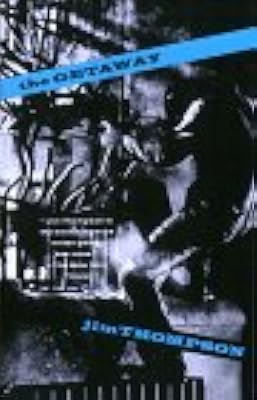
The Getaway
by Jim Thompson
On This Page
Description
"Doc McCoy is the most skilled criminal alive. But when for the first time in Doc's long criminal career, his shot doesn't hit the mark, everything begins to fall apart. And Doc begins to realize that the perfect bank robbery isn't complete without the perfect getaway to back it up. THE GETAWAY is the classic story of a bank robbery gone horribly wrong, where the smallest mistakes have catastrophic consequences, and shifting loyalties lead to betrayals and chaos. The basis for the classic show more Steve McQueen film of the same name, as well as a 1994 remake with Alec Baldwin, Thompson's novel set the bar for every heist story that followed--but as Thompson's proved time and again, nobody's ever done it better than the master"-- show lessTags
Recommendations






Member Reviews
I read this in an omnibus edition, but I want to review them singly.
I've never really cared for the Sam Peckinpah film of this, though I think that's just down to mostly not caring much for Sam Peckinpah films. In fact, I rather preferred the trashy 1994 remake, which was, if nothing else, a good deal pacier. It is interesting, though, that the film versions of Doc McCoy, seem to respectively reflect the then current notions of what made a good bad guy: Steve McQueen's cool icy glare and Alec Baldwin's brooding intensity. Neither of them fit with Thompson's original, a warm, attractive, personable charmer who's friendly and reassuring right up until the point where he shoots you in the mouth.
In the novel, Doc and his wife along with a show more damaged and unstable accomplice named Rudy stage a daring bank heist and get away more or less scott free. There's one other accomplice, but he doesn't make it out of the bank. There's a double cross, leaving Rudy supposedly dead and Doc and Carol go on the run. Rudy isn't dead, however, and the getaway isn't clean.
Doc and Carol's relationship is put to the test as her inexperience and his ruthlessness chip away at the genuine love they have for each other. They leave a trail of bodies in their wake, as does the loathsome Rudy. They are ruthless and pitiless criminals who do whatever needs to be done to protect themselves, ultimately damning themselves to a pretty, perfectly constructed little corner of hell.
It's a brilliant, perfectly-formed little novel. The characters are vivid, and it's a sign of the very best sort of writer can make the the reader become so involved in what happens to such terrible people. The book is full of acute psychological insights - translated to film as callow misogyny and macho cool - and there are many dark, memorable and wretched ordeals for them to endure and many innocent lives for them to destroy. The book was originally published as throwaway pulp in 1959. Time has transformed it into an enduring piece of savage, unsettling literature. show less
I've never really cared for the Sam Peckinpah film of this, though I think that's just down to mostly not caring much for Sam Peckinpah films. In fact, I rather preferred the trashy 1994 remake, which was, if nothing else, a good deal pacier. It is interesting, though, that the film versions of Doc McCoy, seem to respectively reflect the then current notions of what made a good bad guy: Steve McQueen's cool icy glare and Alec Baldwin's brooding intensity. Neither of them fit with Thompson's original, a warm, attractive, personable charmer who's friendly and reassuring right up until the point where he shoots you in the mouth.
In the novel, Doc and his wife along with a show more damaged and unstable accomplice named Rudy stage a daring bank heist and get away more or less scott free. There's one other accomplice, but he doesn't make it out of the bank. There's a double cross, leaving Rudy supposedly dead and Doc and Carol go on the run. Rudy isn't dead, however, and the getaway isn't clean.
Doc and Carol's relationship is put to the test as her inexperience and his ruthlessness chip away at the genuine love they have for each other. They leave a trail of bodies in their wake, as does the loathsome Rudy. They are ruthless and pitiless criminals who do whatever needs to be done to protect themselves, ultimately damning themselves to a pretty, perfectly constructed little corner of hell.
It's a brilliant, perfectly-formed little novel. The characters are vivid, and it's a sign of the very best sort of writer can make the the reader become so involved in what happens to such terrible people. The book is full of acute psychological insights - translated to film as callow misogyny and macho cool - and there are many dark, memorable and wretched ordeals for them to endure and many innocent lives for them to destroy. The book was originally published as throwaway pulp in 1959. Time has transformed it into an enduring piece of savage, unsettling literature. show less
Jim Thompson always gives you something extra. Here, for me anyway, it was the ending. I’ll have to dance around it to avoid spoilers.
The plot is good, hard noir stuff. Doc McCoy is a master thief, just off a prison sentence, and looking for the proverbial big score. Doc is the mastermind for a rural bank holdup, doing his part from a distance while two cohorts invade the bank.
One of the cohorts, Rudy Sorrento is a figure in his own right — a veteran criminal without moral scruples or squeamishness, like Doc. They are allies and antagonists from the get-go. You know what’s coming. There’s no honor among thieves here at all.
Doc is married to Carol. I’d like to say Carol is interesting because of her subtle intelligence, clever show more wit, and unflagging self-respect. I’ll have to save that for a different character in a different story.
What she is is in love with Doc. That’s it. She has no moral compass to call her own other than devotion to Doc, so she inherits Docs’ own erratic-at-best compass.
The robbery goes off, the getaway is a mess. If you don’t get shot or beat up in this story, you’ve been miscast.
Doc and Carol have planned to make out for the town of El Rey in Mexico, across the border to safety with the bank’s money. Enough to live well there, out of reach of the law.
The potentially fatal mistake is Carol’s. She falls for a simple con, losing the take in a railway station. You can guess what Doc does with the con man. That’s not a spoiler, that’s just Doc.
Her mistake starts dominoes falling, and they lead to an intense police hunt. Doc and Carol hide out with Ma Santis and enjoy the hospitality she offers — coffin-like caves to hide in with underwater entrances and sleeping pills to ward off the creeps and claustrophobia. Then a small hut made from cow dung. Ma Santis is great.
The goal is to reach El Rey. El Rey is the finish line, a goal, even a paradise of sorts for Doc and Carol.
And that’s where the “something extra” comes in.
When I read Pop. 1280, I was stunned at Thompson’s ability to bring something surreal and supernatural into the story. I couldn’t believe what I had read. I had the same reaction here.
What kind of paradise is fitting for a noir character like Doc, or Carol? This is where Thompson separates himself from other noir writers. He conjures an ending that transcends the genre. It's not just deserts or petard-hoisting, it's justice as if drawn from a higher realm. show less
The plot is good, hard noir stuff. Doc McCoy is a master thief, just off a prison sentence, and looking for the proverbial big score. Doc is the mastermind for a rural bank holdup, doing his part from a distance while two cohorts invade the bank.
One of the cohorts, Rudy Sorrento is a figure in his own right — a veteran criminal without moral scruples or squeamishness, like Doc. They are allies and antagonists from the get-go. You know what’s coming. There’s no honor among thieves here at all.
Doc is married to Carol. I’d like to say Carol is interesting because of her subtle intelligence, clever show more wit, and unflagging self-respect. I’ll have to save that for a different character in a different story.
What she is is in love with Doc. That’s it. She has no moral compass to call her own other than devotion to Doc, so she inherits Docs’ own erratic-at-best compass.
The robbery goes off, the getaway is a mess. If you don’t get shot or beat up in this story, you’ve been miscast.
Doc and Carol have planned to make out for the town of El Rey in Mexico, across the border to safety with the bank’s money. Enough to live well there, out of reach of the law.
The potentially fatal mistake is Carol’s. She falls for a simple con, losing the take in a railway station. You can guess what Doc does with the con man. That’s not a spoiler, that’s just Doc.
Her mistake starts dominoes falling, and they lead to an intense police hunt. Doc and Carol hide out with Ma Santis and enjoy the hospitality she offers — coffin-like caves to hide in with underwater entrances and sleeping pills to ward off the creeps and claustrophobia. Then a small hut made from cow dung. Ma Santis is great.
The goal is to reach El Rey. El Rey is the finish line, a goal, even a paradise of sorts for Doc and Carol.
And that’s where the “something extra” comes in.
When I read Pop. 1280, I was stunned at Thompson’s ability to bring something surreal and supernatural into the story. I couldn’t believe what I had read. I had the same reaction here.
What kind of paradise is fitting for a noir character like Doc, or Carol? This is where Thompson separates himself from other noir writers. He conjures an ending that transcends the genre. It's not just deserts or petard-hoisting, it's justice as if drawn from a higher realm. show less
A dark, unglamorous crime novel that doesn’t even attempt to portray crime as something that pays.
The falsely personable, but deeply nihilistic Doc McCoy, his wife Carol, and partner Rudy Torrento, “paranoid; incredibly sharp of instinct; filled with animal cunning” rob a bank and attempt a getaway to Mexico. The betrayals start immediately; no one is exempt. There are plenty of murders and close calls.
Thompson wrote a stunning thriller and morality tale rolled into one.
The falsely personable, but deeply nihilistic Doc McCoy, his wife Carol, and partner Rudy Torrento, “paranoid; incredibly sharp of instinct; filled with animal cunning” rob a bank and attempt a getaway to Mexico. The betrayals start immediately; no one is exempt. There are plenty of murders and close calls.
Thompson wrote a stunning thriller and morality tale rolled into one.
Both brilliant and weird. The “getaway” side of things is excellent, although Doc isn’t the master criminal he thinks he is given some questionable decisions. The ending is very strange though. I love it, but the allegorical, surreal setting is completely out of sync with the rest of the gritty realism of the story and feels a little jarring. A symbolic trip into “Hell” or just Thompson throwing a curveball? Who knows, but I thoroughly enjoyed the read regardless
I suppose I am like many others who came to this novel after seeing the film. The Steve McQueen version, I should emphasize. What is remarkable is that both film and novel are masterful in their own, separate and distinctly different ways. It is the last part of Thompson's book that is so different and so abstract as to divert the reader from the film completely. Its description of Doc and Carol on the run and their hideaway among Ma and Earl makes for one of the most harrowing and claustrophobic passages in contemporary literature. But then Thompson does himself one better with the final chapter, where Doc and Carol make their "getaway" to El Rey, which turns out to be the world's most sophisticated and luxurious charnel house. No show more other work in this genre turns on its protagonists so utterly and viciously. At novel's end, metaphor and reality merge in an indecipherable way. This book is a masterpiece. show less
Jim Thompson's The Getaway is, for the most part, a solid hard-boiled crime story. I was a big Steve McQueen fan as a teenager and enjoyed the 1972 Sam Peckinpah adaptation of this book, but when I finally got around to reading the source, I wondered if I was perhaps not being forced to rely on the memory of the film as a crutch. I saw Doc and Carol as Steve McQueen and Ali MacGraw, of course, but the book didn't have enough in the characterisation to separate itself from those shadows. My favourite scene from the film, one which has stayed with me vividly after all these years (where Doc buys a shotgun over-the-counter and lays waste to a police car) is not in the book at all.
None of this hindered my enjoyment of the book, which was show more heading to a respectable 3-star rating in my mind. But then the final act was just so weird. Some people have said that the progression from the dark caves to the manure pile and then on to El Rey is symbolic of a death and descent into Hell, and normally I am all about that sort of thing, but in Thompson's book it comes completely out of left-field. One moment you are reading a realistic, hard-boiled crime thriller and the next you have this strange, surrealistic world-building of a criminal dystopia. Thompson does nothing to facilitate this abrupt shift, and I closed the book feeling rather scrambled and dissatisfied. show less
None of this hindered my enjoyment of the book, which was show more heading to a respectable 3-star rating in my mind. But then the final act was just so weird. Some people have said that the progression from the dark caves to the manure pile and then on to El Rey is symbolic of a death and descent into Hell, and normally I am all about that sort of thing, but in Thompson's book it comes completely out of left-field. One moment you are reading a realistic, hard-boiled crime thriller and the next you have this strange, surrealistic world-building of a criminal dystopia. Thompson does nothing to facilitate this abrupt shift, and I closed the book feeling rather scrambled and dissatisfied. show less
Nice, quick read! I'm really becoming a fan of Jim Thompson! And I love that his good guys are often bad guys. And the bad guys are the even worse guys! Case in point - the main character of this story, Doc McCoy. I was rooting for him, and his wife, even though they rob banks and kill anyone who gets in their way! And they are being chased by the even worse guy, Rudy Torrento, with his broken up rib cage and his "mug like a piece of pie". I liked the chase, the scene at the lockers in the train station, and the time spent with Ma Santis and family. I didn't really like the ending at all, but am intrigued to know if the El Rey in this book inspired Quentin Tarintino's "El Rey" in his movies. Adios Doc, Carol, and Rudy - 'twas nice show more knowin' ya'! show less
Members
- Recently Added By
Lists

The Guardian's 1000 Novels Everyone Must Read
1,005 works; 548 members

Null
30 works; 1 member

Noirvember: Potential Reads
23 works; 1 member
Author Information

58+ Works 14,567 Members
American novelist and screenwriter Jim Thompson was born in Anadarko, Oklahoma on September 27, 1906. In Fort Worth, Texas during prohibition, he worked as a bellboy at the Hotel Texas for two years where he earned up to $300 a week by supplying hotel patrons with bootleg liquor, heroin, and marijuana. During the Depression, he worked with the show more Oklahoma Federal Writers Project and was a member of the Communist Party from 1935 to 1938. During World War II, he worked at an aircraft factory where he was investigated by the FBI for his Communist Party affiliation. His first novel, Now and on Earth, was published in 1942. He wrote more than thirty novels during his lifetime and most of them were paperback pulp crime novels. His best known works are The Killer Inside Me, Savage Night, A Hell of a Woman, and Pop. 1280. In 1955, he moved to Hollywood, California to write screenplays with Stanley Kubrick. Thompson helped write The Killing and Paths of Glory. He died after a series of strokes in Los Angeles, California on April 7, 1977. His long-time alcoholism and recent self-inflicted starvation contributed to his death. His death attracted little attention because none of his novels were in print in the U.S. at that time. (Bowker Author Biography) show less
Some Editions
Awards and Honors
Notable Lists
Series
Belongs to Publisher Series
Work Relationships
Is contained in
Common Knowledge
- Canonical title*
- La Fugida
- Original title
- The Getaway
- Original publication date
- 1959
- People/Characters
- Doc McCoy; Carol McCoy
- Related movies
- The Getaway (1972 | IMDb); The Getaway (1994 | IMDb)
*Some information comes from Common Knowledge in other languages. Click "Edit" for more information.
Classifications
Statistics
- Members
- 1,033
- Popularity
- 25,113
- Reviews
- 22
- Rating
- (3.79)
- Languages
- 11 — Catalan, Danish, Dutch, English, Finnish, French, German, Italian, Portuguese, Spanish, Swedish
- Media
- Paper, Audiobook, Ebook
- ISBNs
- 38
- ASINs
- 16