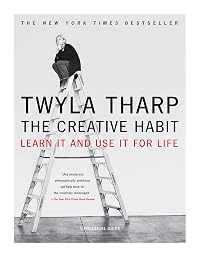
The Creative Habit: Learn It and Use It for Life
by Twyla Tharp
On This Page
Description
One of the world's leading creative artists, choreographers, and creator of the smash-hit Broadway show, Movin' Out, shares her secrets for developing and honing your creative talents--at once prescriptive and inspirational, a book to stand alongside The Artist's Way and Bird by Bird. All it takes to make creativity a part of your life is the willingness to make it a habit. It is the product of preparation and effort, and is within reach of everyone. Whether you are a painter, musician, show more businessperson, or simply an individual yearning to put your creativity to use, The Creative Habit provides you with thirty-two practical exercises based on the lessons Twyla Tharp has learned in her remarkable thirty-five-year career. In "Where's Your Pencil?" Tharp reminds you to observe the world -- and get it down on paper. In "Coins and Chaos," she gives you an easy way to restore order and peace. In "Do a Verb," she turns your mind and body into coworkers. In "Build a Bridge to the Next Day," she shows you how to clean the clutter from your mind overnight. Tharp leads you through the painful first steps of scratching for ideas, finding the spine of your work, and getting out of ruts and into productive grooves. The wide-open realm of possibilities can be energizing, and Twyla Tharp explains how to take a deep breath and begin... show lessTags
Recommendations
Member Reviews
I have to start with the fact that I disagree with what I see as the basic premise of this book. Twyla Tharp makes the case that, for a person to be creative, they must build a structured environment, develop a pattern of habits, and adhere to specific steps. It reminds me of a presentation on creativity I saw a number of years ago where the presenter stated, "To be successfully creative you must exactly follow these five steps."
Creativity does not lend itself to being put in a bucket, locked in a box, or sealed in an envelope. I agree that creativity must become a habit, but to build such strictures around the approach can limit the effectiveness of such creativity.
I say this realizing full well that Ms. Tharp's creativity cannot be show more questioned. She has not received her dance world accolades without an incredible amount of talent, skill, and...creativity. And that is why I have to temper all comments with the realization that no one approach to creativity works for every person. My disorder, disarray, dissonance, and disorganization will not work for everyone. Neither will Ms. Tharp's structured approaches.
And, I have to realize that, in spite of how I was put off by the beginning of this book, I came away with a number of good ideas on how to approach and drive creativity. Spoiler Alert! This review is going to end with the recommendation that you read this book.
But, to start, I was so put off by the beginning of the book that I almost didn't continue. What was the problem? Well, skipping the fact that the second chapter was titled "Rituals of Preparation" (based on my previous comments, you can see how I might be rankled by such a title), following are some of the off-putting quotes from the first chapter.
"I've learned that being creative is a full-time job with its own daily patterns. That's why...the most productive [writers] get started early in the morning , when the world is quiet..." I agree with the first sentence. The second is a gross generalization. I know many writers need a daily pattern. But some use mornings, some use afternoons, some use evenings, some use rum, and some waste time until the muse strikes – any moment, any time. Morning can be a good time to get work done. But that does not mean it is the best time to accomplish creativity.
"The routine is as much a part of the creative process as the lightning bolt of inspiration, maybe more." The habit of instilling creativity is a good thing. But "routine" – even a routine to develop creativity – does as much to inhibit creativity as drive it. The basic meaning of routine implies rote practices and repetitive processes. Here's a definition of routine taken from dictionary.com. "Regular, unvarying, habitual, unimaginative, or rote procedure." These are not the building blocks of creativity. I recognize that Ms. Tharp is trying to emphasize the habits of creativity, but an emphasis on routine may be more detrimental than beneficial.
"I will keep stressing the point about creativity being augmented by routine and habit...It is the perennial debate...between the beliefs that all creative acts are born of (a) some transcendent, inexplicable Dionysian act of inspiration...or (b) hard work. I come down on the side of hard work." I agree that creativity is augmented by routine and hard work. And it is definitely true that no one can succeed without training, learning, foot-pounds of energy spent at the typewriter/computer/canvas/instrument like Nemo blasting away at the Toccata and Fugue. But hard work and habits are not the answer. You can't sell me that particular piece of swamp land. Part of the process, yes; but not the answer.
Here is my problem with what I call "Structured Creativity". I am fine with developing patterns that help you reach your creative center. What I am not fine with is when someone believes that is the only way creativity will work. When you delve into how ideas are formed, some of the best arrive in situations away from normal work/thought/creative environments. It is about letting synapses connect when you least expect it. Serendipity, when allowed its head, strikes at the darnedest times.
But, in spite of all my ranting, my raving, my beating of breast, my cries into the wilderness, I think this is a book anyone interesting in creativity should read. [The crowd shies away, aghast at the inferred duplicity of the writer.] In fact, I recently gave a presentation on creativity and ended by including this book on the suggested reading list.
How, after all my castigations, can I suggest you read this book? Because within are some really good ideas about how creativity can be driven. And, while I don't agree with the formulaic approach Ms. Tharp promotes, I do believe people have to develop a certain "habit" of creativity which will help it occur without really thinking about it.
There are some good ideas in here – tools and techniques and suggestions that can invigorate creative processes. And that leads to my final recommendation – go for the tools and techniques and ideas, and ignore the overall structure. In other words, don't make her habits your habits, but wantonly steal her ideas. show less
Creativity does not lend itself to being put in a bucket, locked in a box, or sealed in an envelope. I agree that creativity must become a habit, but to build such strictures around the approach can limit the effectiveness of such creativity.
I say this realizing full well that Ms. Tharp's creativity cannot be show more questioned. She has not received her dance world accolades without an incredible amount of talent, skill, and...creativity. And that is why I have to temper all comments with the realization that no one approach to creativity works for every person. My disorder, disarray, dissonance, and disorganization will not work for everyone. Neither will Ms. Tharp's structured approaches.
And, I have to realize that, in spite of how I was put off by the beginning of this book, I came away with a number of good ideas on how to approach and drive creativity. Spoiler Alert! This review is going to end with the recommendation that you read this book.
But, to start, I was so put off by the beginning of the book that I almost didn't continue. What was the problem? Well, skipping the fact that the second chapter was titled "Rituals of Preparation" (based on my previous comments, you can see how I might be rankled by such a title), following are some of the off-putting quotes from the first chapter.
"I've learned that being creative is a full-time job with its own daily patterns. That's why...the most productive [writers] get started early in the morning , when the world is quiet..." I agree with the first sentence. The second is a gross generalization. I know many writers need a daily pattern. But some use mornings, some use afternoons, some use evenings, some use rum, and some waste time until the muse strikes – any moment, any time. Morning can be a good time to get work done. But that does not mean it is the best time to accomplish creativity.
"The routine is as much a part of the creative process as the lightning bolt of inspiration, maybe more." The habit of instilling creativity is a good thing. But "routine" – even a routine to develop creativity – does as much to inhibit creativity as drive it. The basic meaning of routine implies rote practices and repetitive processes. Here's a definition of routine taken from dictionary.com. "Regular, unvarying, habitual, unimaginative, or rote procedure." These are not the building blocks of creativity. I recognize that Ms. Tharp is trying to emphasize the habits of creativity, but an emphasis on routine may be more detrimental than beneficial.
"I will keep stressing the point about creativity being augmented by routine and habit...It is the perennial debate...between the beliefs that all creative acts are born of (a) some transcendent, inexplicable Dionysian act of inspiration...or (b) hard work. I come down on the side of hard work." I agree that creativity is augmented by routine and hard work. And it is definitely true that no one can succeed without training, learning, foot-pounds of energy spent at the typewriter/computer/canvas/instrument like Nemo blasting away at the Toccata and Fugue. But hard work and habits are not the answer. You can't sell me that particular piece of swamp land. Part of the process, yes; but not the answer.
Here is my problem with what I call "Structured Creativity". I am fine with developing patterns that help you reach your creative center. What I am not fine with is when someone believes that is the only way creativity will work. When you delve into how ideas are formed, some of the best arrive in situations away from normal work/thought/creative environments. It is about letting synapses connect when you least expect it. Serendipity, when allowed its head, strikes at the darnedest times.
But, in spite of all my ranting, my raving, my beating of breast, my cries into the wilderness, I think this is a book anyone interesting in creativity should read. [The crowd shies away, aghast at the inferred duplicity of the writer.] In fact, I recently gave a presentation on creativity and ended by including this book on the suggested reading list.
How, after all my castigations, can I suggest you read this book? Because within are some really good ideas about how creativity can be driven. And, while I don't agree with the formulaic approach Ms. Tharp promotes, I do believe people have to develop a certain "habit" of creativity which will help it occur without really thinking about it.
There are some good ideas in here – tools and techniques and suggestions that can invigorate creative processes. And that leads to my final recommendation – go for the tools and techniques and ideas, and ignore the overall structure. In other words, don't make her habits your habits, but wantonly steal her ideas. show less
I’ve read a LOT of books on creativity, and I’m always hoping for something fresh when I pick up a new one. I want something that feels like a conversation with someone who gets it. Twyla Tharp delivered on this in many ways, even if she took some detours that didn’t quite land for me.
Tharp is big on the idea that creativity isn’t some magical gift bestowed by the universe, and I couldn't agree more! Creativity -- and in particular, work in a creative field -- boils down to the skills you develop through discipline, preparation, and showing up consistently. She makes the case that rituals and routines are your best friends when it comes to building a creative habit, and that part made me want to stand up and cheer.
Now here's the show more thing: Tharp opens the book by saying it’s not about dance, but, well, it's most definitely about dance. A lot about dance. To be fair, dance is her life’s work, so of course, it’s the lens through which she views creativity. But for someone like me, who knows next to nothing about choreography, the constant dance analogies were often more confusing than enlightening. There were moments where I could see her trying to make the leap to other creative fields, but she didn't quite get there.
That said, the book wasn’t a miss for me. Far from it! I highlighted and annotated 63 distinct quotes as I went along, which speaks volumes about the quality of the ideas Tharp is sharing. What really worked for me were the universal truths buried in her personal anecdotes. The stuff about persistence, overcoming blocks, and finding inspiration. It’s just that some of those lessons take a little effort to untangle from the dance-heavy context.
Overall, The Creative Habit is a solid, practical guide to building discipline in your creative life. It’s not perfect, but it’s packed with useful ideas and plenty of inspiration. Just be prepared to wade through a lot of dance talk along the way. show less
Tharp is big on the idea that creativity isn’t some magical gift bestowed by the universe, and I couldn't agree more! Creativity -- and in particular, work in a creative field -- boils down to the skills you develop through discipline, preparation, and showing up consistently. She makes the case that rituals and routines are your best friends when it comes to building a creative habit, and that part made me want to stand up and cheer.
Now here's the show more thing: Tharp opens the book by saying it’s not about dance, but, well, it's most definitely about dance. A lot about dance. To be fair, dance is her life’s work, so of course, it’s the lens through which she views creativity. But for someone like me, who knows next to nothing about choreography, the constant dance analogies were often more confusing than enlightening. There were moments where I could see her trying to make the leap to other creative fields, but she didn't quite get there.
That said, the book wasn’t a miss for me. Far from it! I highlighted and annotated 63 distinct quotes as I went along, which speaks volumes about the quality of the ideas Tharp is sharing. What really worked for me were the universal truths buried in her personal anecdotes. The stuff about persistence, overcoming blocks, and finding inspiration. It’s just that some of those lessons take a little effort to untangle from the dance-heavy context.
Overall, The Creative Habit is a solid, practical guide to building discipline in your creative life. It’s not perfect, but it’s packed with useful ideas and plenty of inspiration. Just be prepared to wade through a lot of dance talk along the way. show less
What makes someone creative? How does someone face the empty page, the empty stage and making something where nothing existed before? Not just a dilemma for the artist, it is something everyone faces everyday. What will I cook that isn't boring? How can I make that memo persuasive? What sales pitch will increase the order, get me the job, lock in that bonus? These too, are creative acts, and they all share a common need: proper preparation. For Twyla Tharp, creativity is no mystery; it's the product of hard work and preparation, of knowing one's aims and one's subject, of learning from approaches taken in the past. It's a process undertaken every day. It's a habit. The Creative Habit is not merely a look inside the mind of a remarkable show more woman with remarkable skills, but a programmatic, inspiring, encouraging guide to help each of us achieve our fullest creative potential. show less
Twyla Tharp believes creativity is not something you are just born with. It shouldn't be considered a gift. Instead, it is a craft to be honed. It should be cultivated and tended to just like a garden. There is a deliberate effort to creativity. While I didn't participate in any of her exercises, her methods were clear.
Great book on art, work and learning. One of the most useful and practical points of view on creativity, told in a very demystifying way by a great dancer and dance director. There's much to think about here. Also, meny exercises.
I started this book some time ago after I received it as a gift. I didn't get very far as it didn’t grab my attention and other books elbowed their way to the front of the line. I, finally, decided to get serious and really start reading it. One of the best things about it so far is that [a:Twyla Tharp|148884|Twyla Tharp|http://photo.goodreads.com/authors/1237207227p2/148884.jpg] describes creativity as a habit. While that sounds much more boring that creativity being a flash of light from God, it is much more comforting for me. I can develop a habit; I can't really wait around for a flash from God.
I took the first test and had a hard time with some of the questions, but found that I got into it as I went on. I also gained some show more insight and was able to go back and fill in other answers I had skipped.
Not being a student, I don't sit with my books at a table and read and write notes or take tests. I like the tests and think they are useful, but the tests came up periodically, usually at times when I didn’t have a writing implement or the time to devote to the test. This was one of the reasons I got stalled.
Eventually, I just started to read the book, not do the tests and underline words and phrases that spoke to me. That was a much better plan and I got a lot out of it. I would recommend it even if you are just trying to improve your creative problem solving skills. show less
I took the first test and had a hard time with some of the questions, but found that I got into it as I went on. I also gained some show more insight and was able to go back and fill in other answers I had skipped.
Not being a student, I don't sit with my books at a table and read and write notes or take tests. I like the tests and think they are useful, but the tests came up periodically, usually at times when I didn’t have a writing implement or the time to devote to the test. This was one of the reasons I got stalled.
Eventually, I just started to read the book, not do the tests and underline words and phrases that spoke to me. That was a much better plan and I got a lot out of it. I would recommend it even if you are just trying to improve your creative problem solving skills. show less
This is a pretty good book. Not necessarily the best of its type, but to be candid, I can’t be objective with this one because I’ve been a lifelong Twyla Tharp fan, have seen her company perform several times, think she’s a genius, so naturally I’ll be biased in favor of most things she would produce. So, just being honest. Still, that said, I DO think it’s a quality work that might appeal to many people, so definitely recommended.
Members
- Recently Added By
Lists

Books Read in 2015
3,299 works; 129 members

Female Author
1,234 works; 67 members

Creativity and the Creative Process
20 works; 4 members

The Great Courses: Visual Literacy Skills
53 works; 1 member

Books recommended by Calgary Public Library staff
1,588 works; 4 members

Lighting Design
25 works; 1 member
Author Information

10+ Works 2,372 Members
Modern dancer and choreographer Twyla Tharp was born in Portland, Indiana. As a child, Tharp was an accomplished musician, dancer, and athlete. In the early 1960s, she went to New York City to study dance, and she performed with the Paul Taylor Dance Company from 1963 to 1965. Then, in 1965, she formed her own small company, focusing her efforts show more on choreographing severe modern-dance works. As both a dancer and a choreographer, Tharp is noted for her ability to create dance with a popular appeal without losing integrity or depth. Although her first works were rather somber and highly structured in style, her later works have often captured a more whimsical note. Eight Jelly Rolls (1971), for example, delighted audiences with its dancing set to the jazz piano music of "Jelly Roll" Morton. Other enormously popular works include Coupe (1973), a piece set to music by the Beach Boys, and Push Comes to Shove (1976), which was choreographed for the ballet star Mikhail Baryshnikov. In addition to creating works for her own company, Tharp has created commissioned pieces for a number of other dance companies, for films, and for nondancers in such other entertainment fields as ice-skating and sports. These works include Bach Partita (1984), created for American Ballet Theatre, When We Were Very Young (1980) and The Catherine Wheel (1983), created for Broadway, and dance numbers created for the films Hair (1979) and White Knights (1985). (Bowker Author Biography) show less
All Editions
Common Knowledge
- Original publication date
- 2003
- People/Characters
- Twyla Tharp
- Dedication
- To my mother Lecille Confer Tharp, for making sure I had all the tools I would need.
To my father, William Albert Tharp, for giving me the DNA to build things from scratch.
To my son, Jesse Alexander Huot, for h... (show all)elping me create each new day. - First words
- I walk into a large white room.
- Quotations
- In the end, there is no one ideal condition for creativity. What works for one person is useless for another. The only criterion is this: Make it easy on yourself.
Metaphor is the lifeblood of all art. - Last words
- (Click to show. Warning: May contain spoilers.)It permits me to walk into a white room...and to walk out dancing.
- Blurbers
- Cathleen McGuigan; C. Carr; Sid Smith; Linda Winer; Elizabeth Zimmer
Classifications
Statistics
- Members
- 1,985
- Popularity
- 10,638
- Reviews
- 34
- Rating
- (4.06)
- Languages
- English
- Media
- Paper, Audiobook, Ebook
- ISBNs
- 5
- UPCs
- 1
- ASINs
- 7