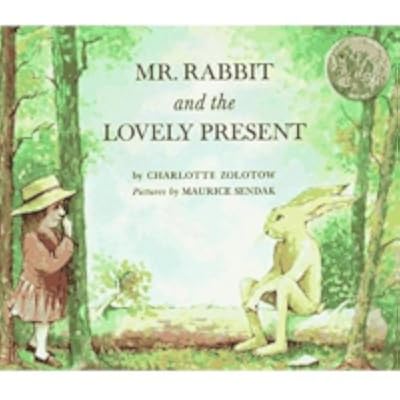
Mr. Rabbit and the Lovely Present
by Charlotte Zolotow
On This Page
Description
Mr. Rabbit helps a little girl find a colorful present for her mother's birthday.Tags
Recommendations







Member Reviews
How, you may ask, does a grown man justify reviewing so many picture books for children? Especially books that he encountered first as an adult, not a child. Especially when the adult had little or no experience with such picture books himself as a child. That’s a good question, an easy one to answer, but thought-provoking nevertheless.
The easy answer is that, honestly, there have been no more significant experiences with books in my lifetime than reading with our children. At least twice a day for many years, we gathered around a book that provided communal experience. In the afternoon, just before naptime or an afternoon quiet hour, their mother read to them. (I was usually away at work.) At bedtime, they gathered around our Lincoln show more rocker once again, and I read aloud. Or I sat on a small sofa (what’s usually called a loveseat) with two on my lap and the others by our side or peering over my shoulder. We began with picture books, reading many of them over and over again, so that now they are well-worn, some even in fragile condition. Eventually, we proceeded on to chapter books, especially volumes in a series; like Narnia, Lloyd Alexander’s Taran books, the Borrowers, Oz books, Eleanor Estes’ Moffatt family, the Little House books, books by Roald Dahl and Robert Lawson and Carol Kendall, the George MacDonald fantasies, E. Nesbit’s fantasies, and tales illustrated by Arthur Rackham.
“Reading with our children” was my deliberately chosen phrase, for we were never simply reading to the children. (Oh, maybe the thirteenth time through Go, Dog, Go may have induced slumber, but generally speaking we chose books with our children that we all would enjoy.) Because I had had such a spare reading background as a child, most of these titles were new to me. So we read and responded together. That was special.
But that’s the easy answer. I think there are other reasons these picture books make my list of significant reading experiences. Let me illustrate with the book I want to review now, one of the very well-worn ones. It’s Mr. Rabbit and the Lovely Present (Harper & Row, 1962) by Charlotte Zolotow with pictures by Maurice Sendak. Like most good picture books, it’s simply an example of a well-made book. The full-page illustrations are impressionistic paintings with subtle coloring and bold designs, featuring one of Sendak’s quizzical children. In the simple story, the little girl wants to find the right birthday present for her mother, and Mr. Rabbit is her mentor. Zolotow’s text proceeds by dialogue.
“What does she like?” said Mr. Rabbit.
“Well, she likes yellow,” said the little girl.
“Yellow,” said Mr. Rabbit. “You can’t give her yellow.”
“Something yellow, maybe,” said the little girl.
“Oh, something yellow,” said Mr. Rabbit.
“What is yellow?” said the little girl.
Mr. Rabbit and the little girl are walking through the woods, with the apples that they have just found for the something red. Of course, the child/reader focuses on them, but the adult sees an impressionistic painting of the trunks of trees stretching back toward infinity. One sees only hints of yellow in the grass, the foliage, the very air. Featured prominently in the foreground is a fallen log and a stone with the sprout of an evergreen springing up between them. There’s the end of what remains of a wooden fence, and the large tree just behind the two of them (it looks like the trunk of an oak) is leaning as if one day it, too, may come crashing down, but no time soon. That’s the joy of a good picture book: a story, a picture of a child and a rabbit taller than she with apples, lots of color; and for the adult, a text and a painting with “hints and guesses” that go well beyond the page.
On another page, the child is sitting beside a small pond or prong of a lake. Mr. Rabbit is pointing. But the blue lake, with sycamores reflected in the water, is almost lost in a field of daisies. Impressionism worthy of Monet, expressive of infinite beauty and serenity and grace. “She likes blue,” the little girl said.
The dialogue repeats itself with variations for each of four basic colors. In the repetition there is a rite that children relate to, learning to repeat the words themselves. In the variations there is parallelism, which is simply a subtler repetition, an exercise in finding likeness in unlikeness.
In the end, the child has a present for her mother—a basket of colors, but I’ll let you experience the book itself to see how she managed this and how Mr. Rabbit played a part. On the last page, at the end of the day with stars shining in the distance, Mr. Rabbit heads off into the darkness—as Mr. Rabbit should. For the child, it’s a story well told and it ends happily. For the adult, simple values have been reinforced: the beauty of simplicity, and the omnipresence of Something infinitely gracious.
And that leads me to the last answer your question provoked. Reading with one’s family is a ritual. A ritual that can be repeated but is never quite the same. It is the ritual as much as the text or the illustrations that will be remembered and cherished. The voice, the family circle, the togetherness, the repetitions, expectations fulfilled with just a bit of a surprise.
For one of her birthdays, our children presented their mother with the same basket of colors that Mr. Rabbit helped the little girl find. The ritual played itself out in our lives.
Maurice Sendak is one of the best known of USAmerican book illustrators. He was a favorite of our children: Where the Wild Things Are, In the Night Kitchen, the Nutshell Library, Higgledy-Piggledy-Pop, stories featuring Rosie, but to me his other texts are not quite as simply sophisticated as Charlotte Zolotow’s and his illustrations not quite as aesthetically pleasing and memorable as in Mr. Rabbit and the Lovely Present. Now that was a significant reading experience.
“Good-by, now,” said the little girl.
“Good-by,” said Mr. Rabbit.
And we all know what they mean: good-by for now. show less
The easy answer is that, honestly, there have been no more significant experiences with books in my lifetime than reading with our children. At least twice a day for many years, we gathered around a book that provided communal experience. In the afternoon, just before naptime or an afternoon quiet hour, their mother read to them. (I was usually away at work.) At bedtime, they gathered around our Lincoln show more rocker once again, and I read aloud. Or I sat on a small sofa (what’s usually called a loveseat) with two on my lap and the others by our side or peering over my shoulder. We began with picture books, reading many of them over and over again, so that now they are well-worn, some even in fragile condition. Eventually, we proceeded on to chapter books, especially volumes in a series; like Narnia, Lloyd Alexander’s Taran books, the Borrowers, Oz books, Eleanor Estes’ Moffatt family, the Little House books, books by Roald Dahl and Robert Lawson and Carol Kendall, the George MacDonald fantasies, E. Nesbit’s fantasies, and tales illustrated by Arthur Rackham.
“Reading with our children” was my deliberately chosen phrase, for we were never simply reading to the children. (Oh, maybe the thirteenth time through Go, Dog, Go may have induced slumber, but generally speaking we chose books with our children that we all would enjoy.) Because I had had such a spare reading background as a child, most of these titles were new to me. So we read and responded together. That was special.
But that’s the easy answer. I think there are other reasons these picture books make my list of significant reading experiences. Let me illustrate with the book I want to review now, one of the very well-worn ones. It’s Mr. Rabbit and the Lovely Present (Harper & Row, 1962) by Charlotte Zolotow with pictures by Maurice Sendak. Like most good picture books, it’s simply an example of a well-made book. The full-page illustrations are impressionistic paintings with subtle coloring and bold designs, featuring one of Sendak’s quizzical children. In the simple story, the little girl wants to find the right birthday present for her mother, and Mr. Rabbit is her mentor. Zolotow’s text proceeds by dialogue.
“What does she like?” said Mr. Rabbit.
“Well, she likes yellow,” said the little girl.
“Yellow,” said Mr. Rabbit. “You can’t give her yellow.”
“Something yellow, maybe,” said the little girl.
“Oh, something yellow,” said Mr. Rabbit.
“What is yellow?” said the little girl.
Mr. Rabbit and the little girl are walking through the woods, with the apples that they have just found for the something red. Of course, the child/reader focuses on them, but the adult sees an impressionistic painting of the trunks of trees stretching back toward infinity. One sees only hints of yellow in the grass, the foliage, the very air. Featured prominently in the foreground is a fallen log and a stone with the sprout of an evergreen springing up between them. There’s the end of what remains of a wooden fence, and the large tree just behind the two of them (it looks like the trunk of an oak) is leaning as if one day it, too, may come crashing down, but no time soon. That’s the joy of a good picture book: a story, a picture of a child and a rabbit taller than she with apples, lots of color; and for the adult, a text and a painting with “hints and guesses” that go well beyond the page.
On another page, the child is sitting beside a small pond or prong of a lake. Mr. Rabbit is pointing. But the blue lake, with sycamores reflected in the water, is almost lost in a field of daisies. Impressionism worthy of Monet, expressive of infinite beauty and serenity and grace. “She likes blue,” the little girl said.
The dialogue repeats itself with variations for each of four basic colors. In the repetition there is a rite that children relate to, learning to repeat the words themselves. In the variations there is parallelism, which is simply a subtler repetition, an exercise in finding likeness in unlikeness.
In the end, the child has a present for her mother—a basket of colors, but I’ll let you experience the book itself to see how she managed this and how Mr. Rabbit played a part. On the last page, at the end of the day with stars shining in the distance, Mr. Rabbit heads off into the darkness—as Mr. Rabbit should. For the child, it’s a story well told and it ends happily. For the adult, simple values have been reinforced: the beauty of simplicity, and the omnipresence of Something infinitely gracious.
And that leads me to the last answer your question provoked. Reading with one’s family is a ritual. A ritual that can be repeated but is never quite the same. It is the ritual as much as the text or the illustrations that will be remembered and cherished. The voice, the family circle, the togetherness, the repetitions, expectations fulfilled with just a bit of a surprise.
For one of her birthdays, our children presented their mother with the same basket of colors that Mr. Rabbit helped the little girl find. The ritual played itself out in our lives.
Maurice Sendak is one of the best known of USAmerican book illustrators. He was a favorite of our children: Where the Wild Things Are, In the Night Kitchen, the Nutshell Library, Higgledy-Piggledy-Pop, stories featuring Rosie, but to me his other texts are not quite as simply sophisticated as Charlotte Zolotow’s and his illustrations not quite as aesthetically pleasing and memorable as in Mr. Rabbit and the Lovely Present. Now that was a significant reading experience.
“Good-by, now,” said the little girl.
“Good-by,” said Mr. Rabbit.
And we all know what they mean: good-by for now. show less
Utterly charming! This book has so much charm, between the earnest, serious little girl looking for the perfect present for her mother and the helpful, comical, casual Mr. Rabbit. The pace of the book is entrancing, part suspenseful, part predictable, feels like sailing in a light summer breeze. I can see why children have loved this book for half a century.
"Something blue, maybe," said the little girl.
"Lakes are blue," said the rabbit.
"But I can't give her a lake, you know," said the little girl.
"Something blue, maybe," said the little girl.
"Lakes are blue," said the rabbit.
"But I can't give her a lake, you know," said the little girl.
A little girl asks Mr. Rabbit to help her find a gift for her mother’s birthday. Mr. Rabbit and the little girl find objects based on colors the mother likes. By the end of the story the present is a basket of fruit that they have gathered throughout their walk in the country.
This book had me reminiscing over the presents I use to come up with to give to my mother when I was a small child. I remember when I was six years old painting “Happy Mother’s Day” and flowers on the backside of a paper plate with finger nail polish. This may seem like an odd Mother’s Day gift but my mother proudly holds on to my creation to this day.
Extension Ideas
1. Discuss the difference between fruits and vegetables. Use the food mentioned in the show more book along with others in an activity where the children will put them into the correct column and explain why.
2. Sort objects based on similar characteristics. show less
This book had me reminiscing over the presents I use to come up with to give to my mother when I was a small child. I remember when I was six years old painting “Happy Mother’s Day” and flowers on the backside of a paper plate with finger nail polish. This may seem like an odd Mother’s Day gift but my mother proudly holds on to my creation to this day.
Extension Ideas
1. Discuss the difference between fruits and vegetables. Use the food mentioned in the show more book along with others in an activity where the children will put them into the correct column and explain why.
2. Sort objects based on similar characteristics. show less
Mr. Rabbit and the Lovely Present is simply a lovely little picture book. Sweet and gentle, it is a humorous journey into the ultimate gift giving dilemma—Mommy’s birthday! What child will not empathize with the heroine’s hunt for just the right present? This clever concept book surreptitiously slips in color identification and association, as well as a lesson in gift appropriateness. Great bedtime reading that lends itself to further discussion of colors, food, fruits and gifts, as well as if rabbits really can talk . . .
MR. RABBIT AND THE LOVELY PRESENT is a precious little story about a young girl who needs help finding just the right birthday present for her mother; to do so, she seeks the help of the thoughtful Mr. Rabbit. Together they take a walk through nature as the little girl thinks about what her mother likes - such as the colors red, yellow, green, and blue. But as Mr. Rabbit wisely points out, "you can't give her red" (or any other color). Mr. Rabbit names several things of each color until he mentions just the right thing. By the end of the book, the little girl has created quite a "lovely present" for her mother. I remember reading this book as a child and I still found it enjoyable when I reread it. I love the watercolor, show more impressionist/romantic style illustrations because they have a very calm feel to them and the pastel color pallet adds to the whimsical idea of the story. The text is rather simple and quite repetitive so it would be a great book for beginning readers as they would be able to catch on quite quickly. This book would also be a wonderful way to help young children learn colors. Besides reading the book with students, I could also have them brainstorm other things that are red, yellow, green, and blue that Mr. Rabbit doesn't mention and have them name other colors not represented in the story. show less
I love finding and reading old children's books. This one was okay. The illustrations were nice but the repetition throughout the story because stale after a few pages. I did like the ending with the fruits and the basket. I guess children could learn the colors from this book and the items associated with the colors.
This 1963 Caldecott Honor book is a thoughtful concept book about four colors (red, yellow, green and blue). The colors are introduced within a whole narrative story, written by Charlotte Zolotow, rather than like the common concept color book that simply shows the color or objects of a certain color accompanied by the word for the color. A rabbit suggests items of a certain preferred color as possible birthday gifts to a little girl asking what she should get her mother for a birthday gift. None of the suggestions suits her, until he names fruit (apple for red, banana for yellow, pear for green and grapes for blue). Maurice Sendak’s muted watercolor illustrations set the perfect, peaceful tone. Limited as a book teaching color, show more because even most preschoolers know those four colors, and the overall quality of the illustrations is very soft and subdued. It is successful depicting patterns (the story structure) and patience. Because the story includes humor and a clever pattern, this book would be suitable for children in preschool through second grade.
Zolotow, C., Sendak, M., & Harper & Row, Publishers. (1962). Mr. Rabbit and the lovely present. New York: Harper & Row, Publishers. show less
Zolotow, C., Sendak, M., & Harper & Row, Publishers. (1962). Mr. Rabbit and the lovely present. New York: Harper & Row, Publishers. show less
Members
- Recently Added By
Lists

Best children's picture books
377 works; 85 members

Caldecott Honor Books
296 works; 22 members

Favorite Animal Fiction
359 works; 156 members

Rabbit and Fox Story Books For Children
139 works; 7 members

Honey For a Child's Heart
1,152 works; 25 members

Books Read in 2016
4,666 works; 199 members

Early Picture Books
467 works; 9 members
Author Information

Charlotte Zolotow was born Charlotte Gertrude Shapiro on June 26, 1915 in Norfolk, Virginia. She studied at the University of Wisconsin, where she took classes in art, writing and child psychology. She began her publishing career in New York, in the adult trade-book division of what is now known as HarperCollins, but eventually took a job in the show more children's division. As an editor, she presided over her own imprint, Charlotte Zolotow Books. She was named publisher emerita at HarperCollins in 1991. Her first picture book, The Park Book, was published in 1944. During her lifetime, she wrote more than 90 children's books including Mr. Rabbit and the Lovely Present, My Grandson Lew, William's Doll, The Hating Book, and The Seashore Book. In 1998, the Cooperative Children's Book Center (CCBC) at the Univeristy of Wisconsin - Madison's School of Education established the Charlotte Zolotow Award, which is an American literary award presented annually for outstanding picture book writing published in the United States in the preceding year. Zolotow died on November 19, 2013 at the age of 98. show less
Some Editions
Awards and Honors
Awards
Work Relationships
Is contained in
Common Knowledge
- Original publication date
- 1962
- People/Characters
- Mr. Rabbit; The Little Girl
- Dedication
- for Buena Dapolonia
- First words
- "Mr. Rabbit," said the little girl, "I want help."
- Quotations
- "Nothing to give your mother on her birthday?" said Mr. Rabbit. "Little girl, you really do want help."
- Last words
- (Click to show. Warning: May contain spoilers.)"Good-by," said Mr. Rabbit, "amd a happy birthday and a happy basket of fruit to your mother."
- Original language
- English
Classifications
Statistics
- Members
- 1,840
- Popularity
- 11,831
- Reviews
- 32
- Rating
- (3.66)
- Languages
- 8 — Catalan, Danish, English, Finnish, French, German, Spanish, Swedish
- Media
- Paper, Audiobook, Ebook
- ISBNs
- 45
- ASINs
- 17