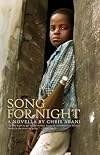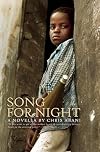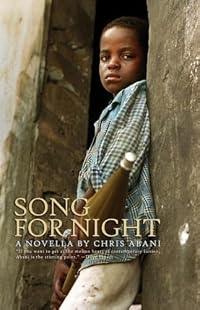
Song for Night: A Novella
by Chris Abani
On This Page
Description
Abani''s new novella furthers his tremendous success in becoming today''s most acclaimed young African
Tags
Recommendations








Member Reviews
I don't feel up to the task of reviewing this book. Maybe not 'up to the task' but rather 'worthy'. The subject matter alone (child soldiers in Africa) is enough to turn away many a seasoned reader, and I must admit that despite my having read a good number of dark and 'heavy' novels (the most immediate and relevant that comes to mind is Kozinski's "The Painted Bird which one of the review blurbs adroitly points out) I wasn't quite prepared for this.
Coming from a secular and very western cultural mindset, the back cover of this book broke the knees of my senses of comfort and security. And the opening lines and prefatory descriptions of protagonist 'My Luck' and his world similarly cut me down and bludgeoned me into something else, show more something ready to at least be told about the horrors of this setting.
And horrible it all is. Going into this book please bear in mind that very little in the way of taboo is left untouched or unmentioned. The atrocities of war, the ease of violating any and all inherent morality by way of 'just following orders' or simply abandoning oneself to the bacchanalian insanity of wartime savagery (rape, brutalizing, cannibalization) are put on full display in sparse un-ornamented prose that lays bare the true hell this all is.
Very much in keeping with the tradition of "The Painted Bird" the entirety of this novella is told from the perspective of a young child, the aforementioned 'My Luck'. But unlike that equally brilliant classic also about the horror of humanity and the incredible potential and ability to survive of that classic, here, the child protagonist is not only victim but perpetrator, literal killer the figuratively killed. An interesting continuation and even revising of something I've come to call 'trauma literature'.
But there's more to this story than just its base depictions of rank barbarism and inhumanity. There's a beauty that intertwines itself with all this madness. Some context: I read this book in one sitting (as part of the syllabus for a seminar in narrative I'm taking towards my masters) and while I read the book I listened, as I often do, to music. The specific music I listened to was Hans Zimmer's beautiful score for the Terrence Malick film 'The Thin Red Line'. With those gorgeously haunting notes, including the Melanasian choir voices towards the end, humming and rising me, crashing me down with each subsequent track, I felt less and less inured and comfortable as I read the story. Less and less I was in a comfortable den in Marina del Rey, California, reading a great book to great music while taking sips from a cool drink as a late fall breeze kicked up the star light dappled waters of the nearby waterway. I was stripped bare with each page, each line, each paragraph of this story, the layers of comfort and stability, of warmth, and hope, and assurance, all peeled back in rapid succession leaving behind a growing and desperately ravenous anxiety that quickened my breathing, softened the sharpness of my vision and made more and more difficult the act of reading.
However, though all this was happening, and the task of reading was difficult, the act of comprehending was not. I absorbed each word, devoured each word like a gift of water in an arid desert. 'My Luck's' journey to find his lost unit of land mine disarming, and eventual (spoiler) apparent crossing over into the realm of the dead, a realm different from the promised ones of the received wisdom of his imam father and catholic mother, and actually, as depicted, far more ancient, unnerved me in such a way that could only be described as a proxy version of beatification through suffering (if you'll forgive the borrowing of a Catholic term for this Secular Jew's review. There's a beauty in the small moments of humanity depicted that allow My Luck, and by extension we the readers, respite from the horrors around him. Small moments that show that beneath the horrific exteriors of most there might, just might, beat human hearts capable of love, morality, and sustaining life rather than ending it.
Read this book. It's a harrowing and destructive, but ultimately redemptive kind of necessary. This is fiction at its most diamond hard and cuttingly beautiful. show less
Coming from a secular and very western cultural mindset, the back cover of this book broke the knees of my senses of comfort and security. And the opening lines and prefatory descriptions of protagonist 'My Luck' and his world similarly cut me down and bludgeoned me into something else, show more something ready to at least be told about the horrors of this setting.
And horrible it all is. Going into this book please bear in mind that very little in the way of taboo is left untouched or unmentioned. The atrocities of war, the ease of violating any and all inherent morality by way of 'just following orders' or simply abandoning oneself to the bacchanalian insanity of wartime savagery (rape, brutalizing, cannibalization) are put on full display in sparse un-ornamented prose that lays bare the true hell this all is.
Very much in keeping with the tradition of "The Painted Bird" the entirety of this novella is told from the perspective of a young child, the aforementioned 'My Luck'. But unlike that equally brilliant classic also about the horror of humanity and the incredible potential and ability to survive of that classic, here, the child protagonist is not only victim but perpetrator, literal killer the figuratively killed. An interesting continuation and even revising of something I've come to call 'trauma literature'.
But there's more to this story than just its base depictions of rank barbarism and inhumanity. There's a beauty that intertwines itself with all this madness. Some context: I read this book in one sitting (as part of the syllabus for a seminar in narrative I'm taking towards my masters) and while I read the book I listened, as I often do, to music. The specific music I listened to was Hans Zimmer's beautiful score for the Terrence Malick film 'The Thin Red Line'. With those gorgeously haunting notes, including the Melanasian choir voices towards the end, humming and rising me, crashing me down with each subsequent track, I felt less and less inured and comfortable as I read the story. Less and less I was in a comfortable den in Marina del Rey, California, reading a great book to great music while taking sips from a cool drink as a late fall breeze kicked up the star light dappled waters of the nearby waterway. I was stripped bare with each page, each line, each paragraph of this story, the layers of comfort and stability, of warmth, and hope, and assurance, all peeled back in rapid succession leaving behind a growing and desperately ravenous anxiety that quickened my breathing, softened the sharpness of my vision and made more and more difficult the act of reading.
However, though all this was happening, and the task of reading was difficult, the act of comprehending was not. I absorbed each word, devoured each word like a gift of water in an arid desert. 'My Luck's' journey to find his lost unit of land mine disarming, and eventual (spoiler) apparent crossing over into the realm of the dead, a realm different from the promised ones of the received wisdom of his imam father and catholic mother, and actually, as depicted, far more ancient, unnerved me in such a way that could only be described as a proxy version of beatification through suffering (if you'll forgive the borrowing of a Catholic term for this Secular Jew's review. There's a beauty in the small moments of humanity depicted that allow My Luck, and by extension we the readers, respite from the horrors around him. Small moments that show that beneath the horrific exteriors of most there might, just might, beat human hearts capable of love, morality, and sustaining life rather than ending it.
Read this book. It's a harrowing and destructive, but ultimately redemptive kind of necessary. This is fiction at its most diamond hard and cuttingly beautiful. show less
I don't know why the book seems not credible as testimony . . .somehow it's not. Is it the seamlessness of the tableaux? not sure. But it is a Proustian reminiscence, that is, a brilliantly constructed one, where the sensuality of the construction is the point. It's weirdly reassuring that the need for aesthetic satisfaction is for some of us the dominant need. There's a selflessness that's necessary for such encompassing imagination of the world.
so it's a dazzling and strange small book. Somehow reminiscent too of another anomalous text, "Catherwood" by Marly Youmans.
so it's a dazzling and strange small book. Somehow reminiscent too of another anomalous text, "Catherwood" by Marly Youmans.
Song for Night follows the journey of Nigerian boy soldier My Luck as he endeavours to re-attach himself to his platoon, following the unexpected detonation of a mine. The platoon is a special one, one whose job is focused on reconnaissance and mine clearance, and My Luck’s particular role is in the diffusing of mines, a job for which his small stature is particularly suited. My Luck has also been ’adapted’ for mine clearance, having his voice cords severed so he is unable to scream should he be blown up and severely wounded.
Narrated in the first-person by My Luck himself, Song for Night follows the boy soldier as he navigates his way across a war-torn landscape full of danger and horror. Pausing at times to reminisce on his time show more as a boy soldier, My Luck reveals the abominable acts he's been involved in, and the sights which have scarred his soul forever.
Definitely not recommended for the faint of heat, Song for Night offers a vivid a powerful impression of what it may be like to wander a veritable ‘Hell on Earth’, in an African civil war that’s left little for salvation. There are threads of hope running through the story which keep the reader on the right side of abject despair, but overall a grim story which reveals the abhorrent consequences of war.
At times My Luck's ‘visionary interludes’ can make things slightly confusing at times, but putting this aside Abani presents a truly praiseworthy piece of literature. Read it and you’ll remember it for many years to come. Just be prepared for the shocks. show less
Narrated in the first-person by My Luck himself, Song for Night follows the boy soldier as he navigates his way across a war-torn landscape full of danger and horror. Pausing at times to reminisce on his time show more as a boy soldier, My Luck reveals the abominable acts he's been involved in, and the sights which have scarred his soul forever.
Definitely not recommended for the faint of heat, Song for Night offers a vivid a powerful impression of what it may be like to wander a veritable ‘Hell on Earth’, in an African civil war that’s left little for salvation. There are threads of hope running through the story which keep the reader on the right side of abject despair, but overall a grim story which reveals the abhorrent consequences of war.
At times My Luck's ‘visionary interludes’ can make things slightly confusing at times, but putting this aside Abani presents a truly praiseworthy piece of literature. Read it and you’ll remember it for many years to come. Just be prepared for the shocks. show less
Exquisitely, heartbreakingly written. A window on a world I hope never to know. Abani's prose sing and the story uncovers itself beautifully. One warning, this is not an easy read. It's brutal, but nicely done.
Brutal tale of teenager's experiences in West Africa after he becomes separated from his platoon. Not for the faint of heart.
Song for Night is a story of a child soldier in West Africa (possibly the author's native Nigeria?), who gets separated from his platoon. While on a mission to find them, he is chased by the memories of losing his family and girlfriend, the people that he has killed, and the possibility of his own death.
Ratings
Members
- Recently Added By
Author Information

31+ Works 1,649 Members
Chris Abani is an associate professor at the University of California, Riverside.
Awards and Honors
Common Knowledge
- Important places
- Nigeria; Africa
- Dedication
- Of course, for Sarah
And my nephews - Ikenna, Obinna, Chuks, Craig, Carl, Neven - First words
- What you hear is not my voice.
- Last words
- (Click to show. Warning: May contain spoilers.)"Mother," I say, and my voice has returned.
Classifications
Statistics
- Members
- 205
- Popularity
- 158,902
- Reviews
- 6
- Rating
- (3.94)
- Languages
- English, Italian, Swedish
- Media
- Paper, Ebook
- ISBNs
- 8
- ASINs
- 2