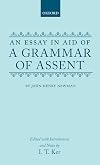
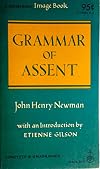
An Essay in Aid of a Grammar of Assent
by John Henry Newman
On This Page
Description
John Henry Newman (1801-1890) was a theologian and vicar at the university church in Oxford who became a leading thinker in the Oxford Movement, which sought to return Anglicanism to its Catholic roots. Newman converted to Catholicism in 1845 and became a cardinal in 1879. He published widely during his lifetime; his work included novels, poetry and the famous hymn 'Lead, Kindly Light', but he is most esteemed for his sermons and works of religious thought. This volume, first published in show more 1870, is an ambitious examination of the logical processes that underpin religious faith. Newman discusses how it is possible to believe what cannot be proven empirically, and postulates that the mind has the facility to bridge the logic gap to allow for humans to believe in things that they do not fully comprehend. A lucid and masterful work which remains relevant to contemporary discussions of faith. show lessTags
Recommendations







Member Reviews
Newman attempts to prove one can assent to truth of Christian doctrine without understanding it. But is that an adult, rational assent? A child may believe that Santa is real because Mom said so, but we do not regard that as an affirmation of the truth of Santa, only an affirmation of the child's trust in his parent. So is Newman basically confirming that his religion is based on the testimony of others whom he has chosen to trust? At what point do we say "Who has been to the North Pool and visited the workshop, petted the reindeer and seen the toys?" "Anyone?"
How is this different?
How is this different?
John Henry Newman's seminal book on the philosophy of faith. ... Newman's aim was to show that the scientific standards for evidence and assent are too narrow and inapplicable in concrete life.
One of the most technical of Newman's work is this volume in which he fills out the details of converting into the Roman Catholic faith.
Ratings
Members
- Recently Added By
Lists

Church Times 100 Best Christian Books
106 works; 26 members

Harold Bloom - The Western Canon: C. The Democratic Age
336 works; 15 members

Trinity College Booklist (1951): Class Three, Philosophy and Religion
80 works; 3 members
Author Information

582+ Works 10,665 Members
English clergyman John Henry Newman was born on February 21, 1801. He was educated at Trinity College, University of Oxford. He was the leader of the Oxford movement and cardinal after his conversion to the Roman Catholic Church. In 1822, he received an Oriel College fellowship, which was then the highest distinction of Oxford scholarship, and was show more appointed a tutor at Oriel. Two years later, he became vicar of St. Mary's, the Anglican church of the University of Oxford, and exerted influence on the religious thought through his sermons. When Newman resigned his tutorship in 1832, he made a tour of the Mediterranean region and wrote the hymn "Lead Kindly Light." He was also one of the chief contributors to "Tracts for the Times" (1833-1841), writing 29 papers including "Tract 90", which terminated the series. The final tract was met with opposition because of its claim that the Thirty-nine Articles of the Church of England are aimed primarily at the abuses of Roman Catholicism. Newman retired from Oxford in 1842 to the village of Littlemore. He spent three years in seclusion and resigned his post as vicar of St. Mary's on October 9, 1845. During this time, he wrote a retraction of his criticisms of the Roman Catholic Church and after writing his "Essay on the Development of Christian Doctrine," he became a Roman Catholic. The following year, he went to Rome and was ordained a priest and entered the Congregation of the Oratory. The remainder of Newman's life was spent in the house of the Oratory that he established near Birmingham. He also served as rector of a Roman Catholic university that the bishops of Ireland were trying to establish in Dublin from 1854-1858. While there, he delivered a series of lectures that were later published as "The Idea of a University Defined" (1873), which says the function of a university is the training of the mind instead of the giving of practical information. In 1864, Newman published "Apologia pro Vita Sua (Apology for His Life)" in response to the charge that Roman Catholicism was indifferent to the truth. It is an account of his spiritual development and regarded as both a religious autobiography and English prose. Newman also wrote "An Essay in Aid of a Grammar of Assent" (1870), and the novels "Loss and Gain" (1848), Callista" (1856) and "The Dream of Gerontius" (1865). Newman was elected an honorary fellow of Trinity College, Oxford, in 1877 and was made cardinal by Pope Leo XIII in 1879. He died on August 11, 1890. (Bowker Author Biography) show less
Series
Belongs to Publisher Series
Image Books (D19)
Work Relationships
Has as a reference guide/companion
Common Knowledge
- Canonical title
- An Essay in Aid of a Grammar of Assent
- Original title
- An essay in aid of grammar of assent
Classifications
Statistics
- Members
- 531
- Popularity
- 56,405
- Reviews
- 3
- Rating
- (4.23)
- Languages
- 8 — Dutch, English, French, German, Italian, Polish, Russian, Spanish
- Media
- Paper, Ebook
- ISBNs
- 36
- ASINs
- 26