On This Page
Tags
Recommendations























Member Reviews
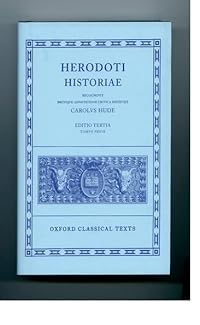
Edition: Reprinted Edition // Descr: xxx, 353 p. 17.5 cm. // Series: Pitt Press Series Call No. { 888 H43 6 } Edited by J.H. Sleeman Contains Geographical Index and Index to the Notes. // //
LIBROS I-IV: HISTORIAS (VOL. 1)
Primeros cuatro libros de las Historias del celebre historiador del siglo V a.C., considerado como el padre de la Historia. La Historia de Heródoto es sin duda una de las más atractivas que nos ha dejado la antigua Grecia. Planeada más para ser escuchada que para ser leída, guarda todo el encanto de las investigaciones personales del autor en la Helade y en oriente en una epoca que estaba pasando de la cultura arcaica a la etapa clásica. Contiene un esbozo de historia y costumbres de los pueblos orientales, Egipto, Persia, Lidia, etc., y una narración de las guerras medicas, que desembocaron en la deslumbrante Atenas de Pericles.
Primeros cuatro libros de las Historias del celebre historiador del siglo V a.C., considerado como el padre de la Historia. La Historia de Heródoto es sin duda una de las más atractivas que nos ha dejado la antigua Grecia. Planeada más para ser escuchada que para ser leída, guarda todo el encanto de las investigaciones personales del autor en la Helade y en oriente en una epoca que estaba pasando de la cultura arcaica a la etapa clásica. Contiene un esbozo de historia y costumbres de los pueblos orientales, Egipto, Persia, Lidia, etc., y una narración de las guerras medicas, que desembocaron en la deslumbrante Atenas de Pericles.
Feb 6, 2025Spanish
Ratings
Members
- Recently Added By
Author Information

716+ Works 19,667 Members
Herodotus was the inventor of universal history. Often called the Father of History, his histories are divided into nine books named after the nine muses. A native of Halicarnassus on the coast of Asia Minor (modern Bodrum, Turkey), he traveled extensively, writing lively descriptions of the lands he saw and the peoples he encountered. Herodotus show more set out to relate the story of the conflict of the Greeks of his own time against the "barbarian" Asiatic empire of Achaemenid Persia. His long narrative, titled by modern convention The Histories, begins with the earliest traditions he believed reliable. It ends with a highly colored account of the defeat of the Persian emperor Xerxes and his immense army of slaves by a much smaller number of Greeks fighting to preserve their freedom. Herodotus wrote history, but his methods and assumptions were not those of a modern historian, and his work was unjustly rejected by his successor Thucydides as factually highly unreliable and full of inappropriate romance. By his own admission, Herodotus retold the stories of other peoples without necessarily believing them all. This allowed him total artistic freedom and control to create a picture of the world that corresponded entirely to his own view of it. The result is a picture of Herodotus's world that is also a picture of his mind and, therefore, of many other Greek minds during the period known as "late Archaic." During this period, the Greek mind was dominated by reason, the domain of the first philosophers and the observant and thoughtful medical theorists of the Hippocratic school. Traditional beliefs in the gods of Homer and in their Oracles, especially the Oracle at Delphi, also dominated during this period. The literary genius of Herodotus consisted in the art of the storyteller. The stories he chose to tell, and the order in which he told them, provide his readers with a total view of his world and the way in which the will of the gods and the ambitions of humans interacted to produce what is known as history. For this reason the ancient critic Longinus justly called Herodotus "the most Homeric of all authors." Like Homer, Herodotus strove to understand the world theologically---a goal that makes his work difficult for the reader to understand at first. But, in place of Homer's divine inspiration, Herodotus used his eyes and ears and wrote not poetry but prose. Rejecting what is commonly known as myth, he accepted instead "oral tradition" about remembered events. For example, although he believed that the Trojan War had been fought, he could not investigate it beyond what the poets had said. In his view this "ancient history" of the Greeks and the peoples of Asia was not like contemporary history, because the heroes of old who had created it were beings of a different and superior order who had had a different, direct, and personal relationship with the gods. In recognizing this distinction, Herodotus defined for all time the limits of the historian's discipline. (Bowker Author Biography) show less
Series

Belongs to Publisher Series
Work Relationships
Is contained in
Common Knowledge
- Canonical title
- Historiae 1: Clio
- Alternate titles
- Le Storie. Libro I: La Lidia e la Persia
- People/Characters
- Croesus (of Lydia); Cyrus the Great (of Persia)
- Important places
- Mesopotamia; Lydia; Persia
- Disambiguation notice
- Ancient Greek edition of Herodotus, Book 1 of 9
Classifications
Statistics
- Members
- 133
- Popularity
- 244,620
- Reviews
- 2
- Rating
- (4.00)
- Languages
- 10 — Catalan, English, French, German, Greek (Ancient), Greek, Italian, Norwegian (Bokmål), Norwegian, Spanish
- Media
- Paper, Ebook
- ISBNs
- 13
- ASINs
- 3