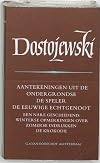
Verzamelde werken. Dl. IV: Een nare geschiedenis ; Winterse opmerkingen over zomerse indrukken ; Aantekeningen uit het ondergrondse ; De krokodil ; De speler ; De eeuwige echtgenoot
by F.M. Dostojewski
On This Page
Tags
Recommendations


















Member Reviews
'Wie naar een grootmeester onder de Russische romanschrijvers zoekt, denkt aan Dostojewski. Wie naar een meesterwerk onder het oeuvre van Dostojewski zoekt, denkt aan diens Aantekeningen uit het ondergrondse. Het staat in dit vierde deel van zijn Verzamelde werken en is volgens velen de sleutel tot zijn erop volgende monumentale romans.
De zes in dit deel opgenomen romans en verhalen dateren uit de jaren zestig van de negentiende eeuw, toen Dostojewski, na jaren van dwangarbeid in een Siberisch strafkamp als 'politieke misdadiger' en zijn daarop volgende verbanning 'gerehabiliteerd' was en hij zijn talent opnieuw tenvolle kon ontplooien.
En dit alles wordt de lezer aangeboden in een moderne, betrouwbare vertaling uit het Russisch die show more volledig recht doet aan de adembenemende zeggingskracht der originelen.' (Charles B. Timmer)
Voorts in dit deel de vermaarde korte romans De Speler, De krokodil, De eeuwige echtgenoot, Een nare geschiedenis en Winterse opmerkingen over zomerse indrukken show less
De zes in dit deel opgenomen romans en verhalen dateren uit de jaren zestig van de negentiende eeuw, toen Dostojewski, na jaren van dwangarbeid in een Siberisch strafkamp als 'politieke misdadiger' en zijn daarop volgende verbanning 'gerehabiliteerd' was en hij zijn talent opnieuw tenvolle kon ontplooien.
En dit alles wordt de lezer aangeboden in een moderne, betrouwbare vertaling uit het Russisch die show more volledig recht doet aan de adembenemende zeggingskracht der originelen.' (Charles B. Timmer)
Voorts in dit deel de vermaarde korte romans De Speler, De krokodil, De eeuwige echtgenoot, Een nare geschiedenis en Winterse opmerkingen over zomerse indrukken show less
Sep 11, 2015Dutch
Ratings
Members
- Recently Added By
Author Information

1,423+ Works 179,497 Members
One of the most powerful and significant authors in all modern fiction, Fyodor Dostoevsky was the son of a harsh and domineering army surgeon who was murdered by his own serfs (slaves), an event that was extremely important in shaping Dostoevsky's view of social and economic issues. He studied to be an engineer and began work as a draftsman. show more However, his first novel, Poor Folk (1846), was so well received that he abandoned engineering for writing. In 1849, Dostoevsky was arrested for being a part of a revolutionary group that owned an illegal printing press. He was sentenced to be executed, but the sentence was changed at the last minute, and he was sent to a prison camp in Siberia instead. By the time he was released in 1854, he had become a devout believer in both Christianity and Russia - although not in its ruler, the Czar. During the 1860's, Dostoevsky's personal life was in constant turmoil as the result of financial problems, a gambling addiction, and the deaths of his wife and brother. His second marriage in 1887 provided him with a stable home life and personal contentment, and during the years that followed he produced his great novels: Crime and Punishment (1886), the story of Rodya Raskolnikov, who kills two old women in the belief that he is beyond the bounds of good and evil; The Idiots (1868), the story of an epileptic who tragically affects the lives of those around him; The Possessed (1872), the story of the effect of revolutionary thought on the members of one Russian community; A Raw Youth (1875), which focuses on the disintegration and decay of family relationships and life; and The Brothers Karamazov (1880), which centers on the murder of Fyodor Karamazov and the effect the murder has on each of his four sons. These works have placed Dostoevsky in the front rank of the world's great novelists. Dostoevsky was an innovator, bringing new depth and meaning to the psychological novel and combining realism and philosophical speculation in his complex studies of the human condition. (Bowker Author Biography) show less

Fyodor Dostoyevsky has a Legacy Library. Legacy libraries are the personal libraries of famous readers, entered by LibraryThing members from the Legacy Libraries group.
Some Editions
Series
Belongs to Publisher Series
Classifications
Statistics
- Members
- 73
- Popularity
- 429,848
- Reviews
- 2
- Rating
- (4.38)
- Languages
- Dutch
- Media
- Paper
- ISBNs
- 4